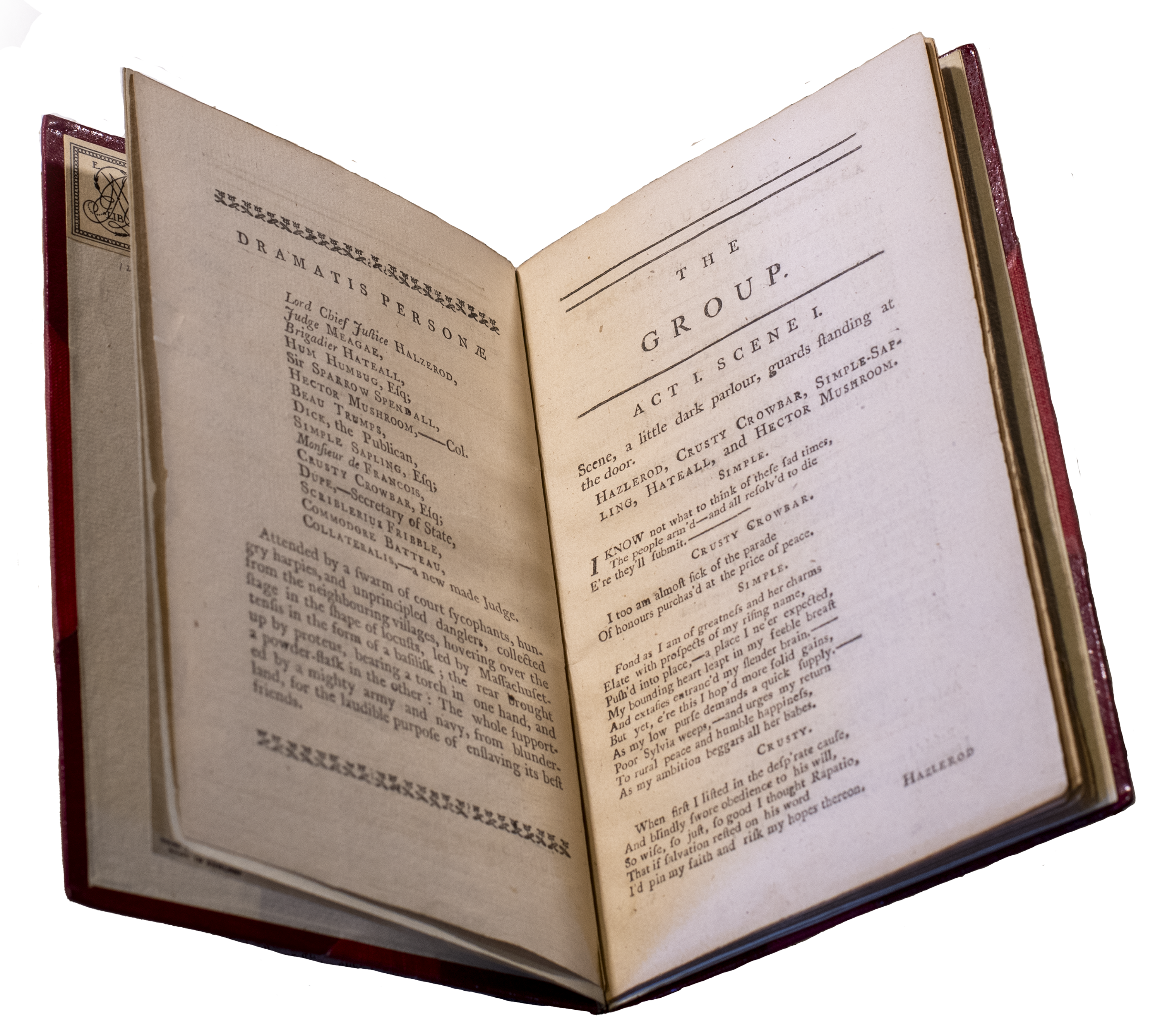
Bloody Work: Lexington and Concord 1775
Exhibit Introduction
In the afternoon of April 18, 1775, Major General Thomas Gage, Commander of the British Army in North America, ordered a detachment of over 800 grenadiers and light infantry soldiers—nobody knows exactly how many—to march out of Boston “with the utmost expedition and Secrecy.” Their mission was to travel seventeen miles northwest to Concord, Massachusetts, where they were to destroy arms, ammunition, provisions, and military supplies stockpiled there by American colonists. The recipient of the order was Lieutenant Colonel Francis Smith of the 10th Regiment of Foot, who was commanded to keep the instructions sealed until the time of march.
Lt. Col. Smith and Marine Major John Pitcairn assembled the men and, between 10:00 p.m. and midnight, boarded vessels to cross the water separating the rocky peninsula of Boston and the mainland, landing in East Cambridge. The activities of the Regular Army were scrutinized by Bostonians, including the Sons of Liberty. Intelligence and rumor about troop movements were funneled to Dr. Joseph Warren—the only member of the Massachusetts Committee of Safety remaining in Boston. Around the same time as the Regulars were making their way across the bay, he activated the American rebels’ communication network to notify the countryside of the imminent arrival of the soldiers and warn John Hancock and Samuel Adams, who were then at Lexington. Rider Paul Revere traveled north across the river and through Charlestown while William Dawes took the overland southerly route, raising the alarm as they went and reaching Lexington sometime before midnight.
The British Army units meanwhile gathered ashore at Phipps’ Farm across the water from Boston. In darkness, they trudged through the mud and marsh in a rising tide to the road toward Lexington. Despite their best efforts, the sound of hundreds of marching soldiers and wagons carried as they made their way northwest toward Concord. As sun broke around 5:00-5:30 in the morning, a contingent of around 238 soldiers under John Pitcairn arrived at Lexington, unexpectedly finding over 75 Massachusetts militiamen on the town green. Despite orders to the contrary, a Regular, a militiaman, or a bystander—again, nobody knows who—triggered their weapon, sparking the first gunfire of the American Revolution. Eight provincial fathers, brothers, and sons fell to the ground, dying or mortally wounded.
The march continued to Concord, where Lt. Col. Smith’s men secured the bridge routes in and out of the town, sought out the military stores that were still there, and seized or destroyed them. Over 400 militiamen arrived from surrounding towns and, at the sight of smoke and fire in Concord, engaged with the Regulars at the town’s narrow North Bridge at around 9:30 in the morning and then withdrew in the face of overwhelming odds. Five militiamen were killed, and more were wounded.
A couple of hours later, having finished their search of the town, Lt. Col. Smith led his troops out of Concord.
The return march to Boston was a long, bloody gauntlet for the redcoats, despite the arrival of over 1,000 reinforcements. Increasing numbers of Massachusetts militiamen arrived from distant towns and farms, giving near-constant fire from inside houses and barns, from behind trees and stone walls. By the time the expedition made it back to the safety of Boston, some 73 British Army soldiers were dead or dying, 174 were wounded, and dozens were missing. Meanwhile, the provincials counted 49 dead or dying men, 39 wounded, and five missing.
In the wake of the violence the belligerents engaged in a flurry of intelligence gathering. The Congress in Massachusetts secured depositions and disseminated them to other provincial governments. British Army officers, soldiers, and others gave reports and intelligence to Gen. Gage. Witnesses wrote letters and made notes in diaries. Newspapers published information as quickly as they could secure it. Propaganda in the form of dramatic printed fliers and broadsides decried the “Bloody Butchery” of the British Army and Royal Government, and shaped public opinion. Official and semi-official narratives did the same. And, as provincial combatants swarmed into positions around the garrisoned city of Boston, the Massachusetts Provincial Congress and the Royal Government tendered essentially irreconcilable resolutions. On May 5, 1775, the former disavowed any directives from Thomas Gage, and on June 12 the latter declared Martial Law.
Bloody Work: Lexington and Concord 1775 brings original historical letters and documents from the collections of the William L. Clements Library together with manuscripts from the collection of Dr. Gary Milan, loaned in memory of Joyce Kliger, to explore the early months of 1775 in Massachusetts, the bloodshed of April 19th, and its immediate aftermath. Ten items in the exhibition are drawn from the Thomas Gage Papers, one of the richest extant collections of primary sources for the study of American History between 1763 and 1775. The collection includes over 23,000 letters, documents, journals, and more. Within the collection are papers concerning Gage’s attempts to hold to the course prescribed by Parliament in his role as Massachusetts Colonial Governor from May 1774 through the outbreak of military violence. Gen. Gage’s papers are an almost unparalleled source of contemporary documentation of the events that ignited a nearly eight-year Revolutionary War between the British Empire and its North American colonies.
Libraries, museums, and historical societies across the United States are preparing relevant treasures in their collections for 250th Anniversary of the American Revolution displays and events. Thanks to diligent and careful acquisitions over generations of directors and curators, the William L. Clements Library has a wealth of original manuscripts, maps, printed works, and visual productions related to the Age of Revolutions in the late 18th and early 19th centuries. The six manuscripts on loan from the collection of Dr. Milan expand, support, and dovetail with the Clements Library’s selections, making “Bloody Work” a meaningful contribution to anniversary commemorations at fellow institutions and among private collectors.
Exhibit curated by Cheney J. Schopieray, Curator of Manuscripts.
Special thanks to U-M School of Music, Theatre & Dance students Sarah Hartmus and Lleyton Allen for recording the audio transcriptions of the exhibit captions and letter transcriptions.
Thanks to Clements Intern for Instruction and Fellowships James Watke-Stacy for providing audio recordings of the letter transcriptions.
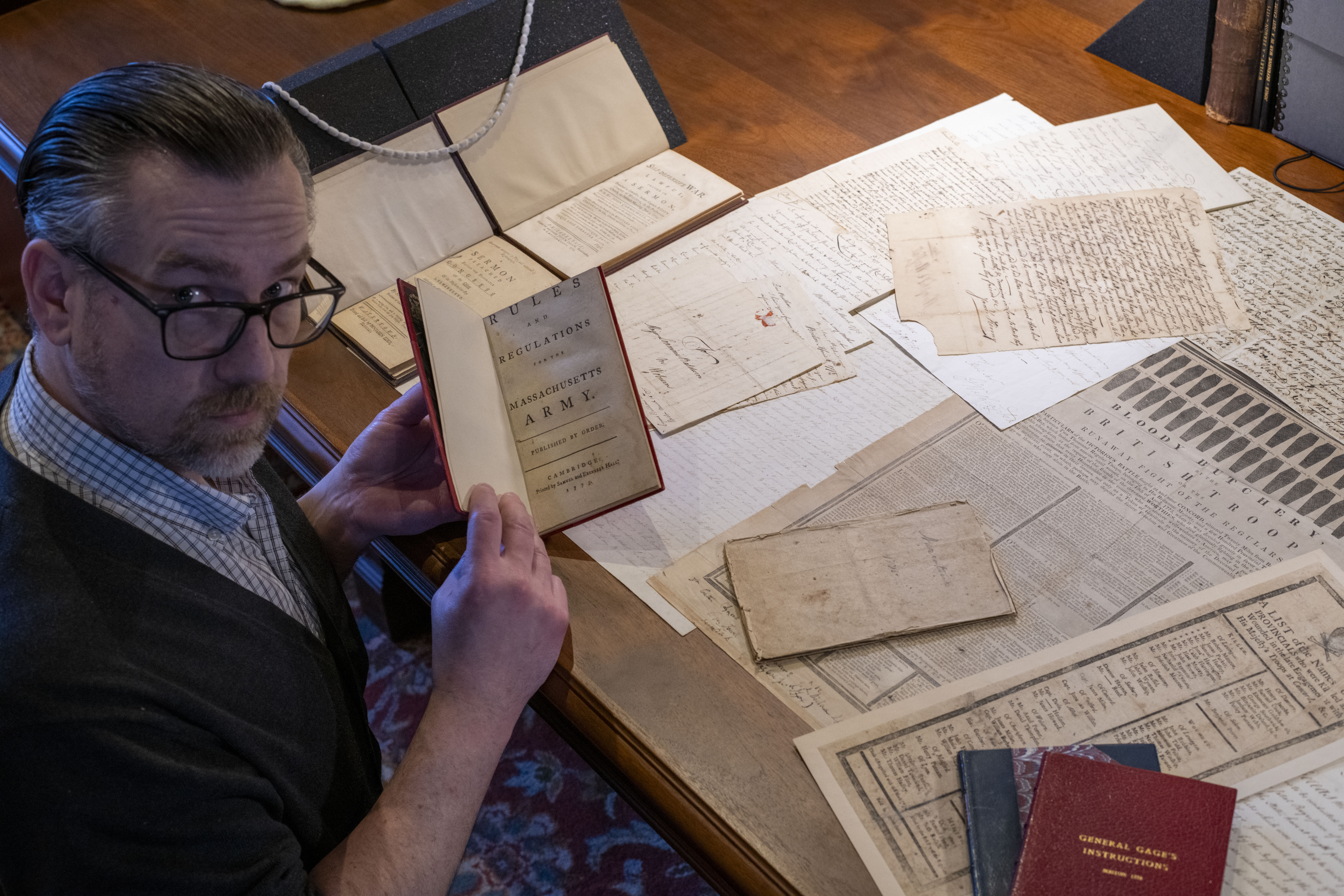
Curator Cheney J. Schopieray with materials considered for inclusion in this exhibit.