

No. 59 (Spring/Summer 2024)
One Nation Under a Grift
Paul J. Erickson
Randolph G. Adams Director
William L. Clements Library
“It is good to be shifty in a new country” was the advice offered by Captain Simon Suggs. Created by the Southwestern humor writer Johnson Jones Hooper in the 1840s, the fictional Captain Suggs personified a type that would become familiar in antebellum American writing: a confidence man. Suggs traversed the Alabama frontier in pursuit of a wide variety of schemes designed to separate his neighbors from their money.
Suggs’ motto reflected what was a constant reality for people living in the early United States. It was a new country, characterized by a vast geographic scale and extremely high levels of mobility compared to most countries in Europe. People often found themselves dealing with individuals they had never met, with no social context to determine whether shopkeepers or ministers or teachers were on the up and up. They bought plots of land they had never seen. They relied on strangers to manage their business affairs and keep track of their money. This lack of certainty regarding identity could serve as a ladder for the ambitious and unscrupulous. The person we know today as the General Baron von Steuben—the Prussian military officer credited with introducing training methods that turned the Continental Army into a professional fighting force during the Revolutionary War—was not a general, nor was he really a baron. But he was introduced as such to Benjamin Franklin in Paris, who wrote “General Baron” von Steuben a letter of introduction to George Washington, and that was that.
The pages of early American writing—both in manuscript and print—are filled with widespread unease about frauds, swindles, grifts, counterfeits, and outright theft. This anxiety was fully justified in an era when, to take one example, anywhere between ten and fifty percent of the paper currency in circulation was counterfeit. The proliferation of state banks in the antebellum decades flooded the market with thousands of banknotes in endless designs and denominations. People tried to verify whether their notes were worth anything, often with the help of regularly published counterfeit detectors. But at some level it didn’t matter. In an economy where actual gold and silver were extremely scarce, people needed paper money to make daily economic activity possible, whether that currency was real or fake.
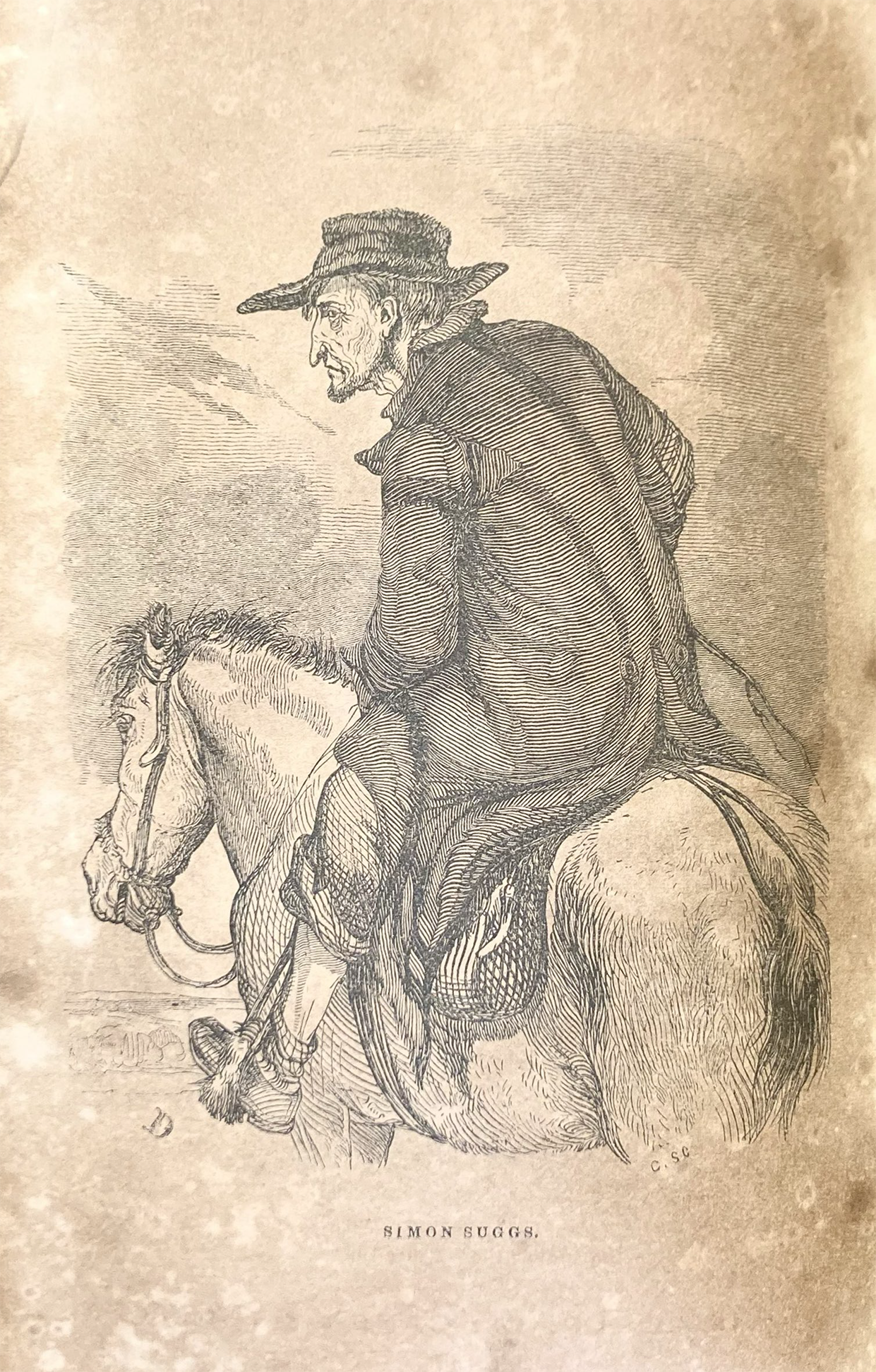
A teller of tall tales and an early exemplar of frontier humor, the shifty Captain Suggs was a lovable vagabond who cheated at cards, played (sometimes not so) harmless tricks on his circle of friends and acquaintances and was “a miracle of shrewdness.” His appeal was in “a quick, ready wit, which has extricated him from many an unpleasant predicament, and which makes him whenever he chooses to be so—and that is always—very companionable.” Major Jones’s Courtship and Travels; Some Adventures of Captain Simon Suggs, Late of the Tallapoosa Volunteers . . . (Philadelphia, 1846–7).
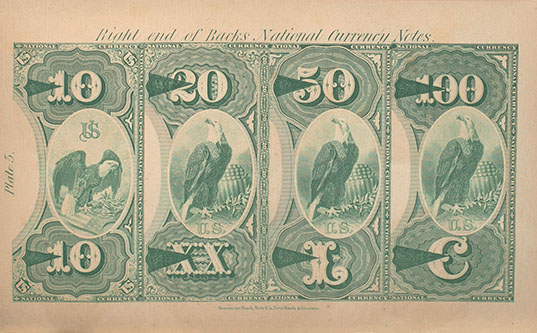
A sheet of bills from Heath’s Greatly Improved and Enlarged Infallible Government Counterfeit Detector by Laban Heath (Boston, [1866]) provided samples against which to compare one’s own bills for signs of illegitimacy.
Frauds of America (Chicago, 1896) touted the uses of physiognomy as a helpful guide to determining moral character: “it is the sensualist whose vice is read in his lips, the knave whose propensity is revealed in the shape of his mouth, the man of violence is surrendered by his eyes. An experienced detective, policeman, or a trained jailer seldom needs to ask the crime of which the prisoner was guilty. He can tell it by his face.”
Many authors of advice manuals, city directories, and novels shared a concern with helping the guileless avoid being duped. These writers were particularly attuned to the dangers that confidence men posed to young people who were moving to American cities to find work. Away from the familiar environments of home and church, these transplants were targets of seducers, gamblers, prostitutes, and more. The table of contents of an 1896 book titled The Frauds of America: How They Work and How to Foil Them by E.G. Redmond (Chicago, 1896) is a list of urban swindles for which Americans needed to be on the lookout: forgers and counterfeiters, pickpockets and shoplifters, mail thieves, Ponzi schemes, genealogical humbugs, sellers of counterfeit goods, blackmailers, mock auctioneers, and thimble riggers (the thimblerig was a form of shell game). As Karen Halttunen so brilliantly outlined in her book Confidence Men and Painted Women (New Haven, 1982), all of these anxieties stemmed from the fact that increasing numbers of Americans in the antebellum U.S. were in regular contact with strangers.
In the nation’s growing cities, signs of respectability, such as good manners and decorous dress, served as codes for trustworthiness. But respectable clothes and comportment could be easily faked, particularly with the help of the aforementioned advice guides. The same books that told people how to identify spurious banknotes or untrustworthy salesmen could also serve as instruction manuals for how to more effectively trick the unsuspecting. Indeed, the shelves of the Clements Library are not only rife with anxiety about being cheated, they are also filled with advice on how to do the cheating. Narratives of mercantile life told shop clerks how to include their thumb in the measurement of fabric, so as to short customers a thumb’s width. They advised grocers on exactly how much sand they could get away with adding to their sugar barrel without having customers complain.
Some items in the Clements Library’s collection are remarkably forthright in providing guidance for how to put one over on an unsuspecting public. One such recent acquisition is The Bordeaux Wine and Liquor Dealer’s Guide: A Treatise on the Manufacture and Adulteration of Liquors, (New York, 1857). The anonymous author frames his work as being primarily concerned with consumers’ safety, explaining that all the countries of Europe combined do not produce enough pure brandy “to supply the natural trade of New York City alone.” Therefore, the author wishes to “introduce an entirely new system of manufacturing and adulterating liquors, by which the use of poisons and poisonous compounds are avoided . . . .” Readers were intended to be comforted by the fact that while all the liquor they bought was fake, at least it wouldn’t kill them.
Visitors to the United States often remarked on the widespread public acceptance of deception. Charles Dickens, in his 1842 American Notes for General Circulation, expressed astonishment at how people who would elsewhere have been imprisoned as swindlers were instead praised for their “smart dealing.” Dickens wrote: “The following dialogue I have held a hundred times: ‘Is it not a very disgraceful circumstance that such a man as So-and-so should be acquiring a large property by the most infamous and odious means, and notwithstanding all the crimes of which he has been guilty, should be tolerated and abetted by your Citizens? He is a public nuisance, is he not?’ ‘Yes, sir.’ ‘A convicted liar?’ ‘Yes, sir.’ ‘He has been kicked, and cuffed, and caned?’ ‘Yes, sir.’ ‘And he is utterly dishonourable, debased, and profligate?’ ‘Yes, sir.’ ‘In the name of wonder, then, what is his merit?’ ‘Well, sir, he is a smart man.’”
![Cover of "Trial of the Notorious Ann Carson, and Her Accomplices" ([Philadelphia?], 1823).](https://clements.umich.edu/wp-content/uploads/2025/05/Ann-Carson-bg-removed-e1748015047784.png "Ann Carson bg removed")
Ann Carson perhaps epitomized the type of person whose appearance was no guarantee of social status. With her outward veneer of education, manners, and dress, she operated in higher society, managing at one point to gain admittance to an audience with Dolly Madison. However, once her means proved unequal to maintaining her upper-middle-class lifestyle, Carson turned to kidnapping, robbery, and finally, forgery. She died from typhoid in prison after being convicted in the trial described in this pamphlet, Trial of the Notorious Ann Carson, and Her Accomplices ([Philadelphia?], 1823).
The frequency with which anxiety about fraud and deception turns up in the Clements Library’s collections raises questions about what living under such conditions does to a people. Can we trust our institutions? Our government? Can we trust one another? Herman Melville’s 1857 novella The Confidence-Man (New York, 1857) serves in many respects as the core text for all of these questions. Set on the Mississippi steamboat Fidèle on April Fools’ Day, the novella shows the title character turning up in a multitude of guises to ask all of the ship’s passengers for their confidence. In the book’s final scene, an old man struggles in the dark to compare two banknotes he had gotten in St. Louis to the images in a newly acquired counterfeit detector. Unable to decide if the notes are genuine or not, he spoke for many of his compatriots in the antebellum U.S.: “I don’t know, I don’t know . . . there’s so many marks of all sorts to go by, it makes it a kind of uncertain.” Understanding how people in the past dealt with uncertainty is one of the greatest challenges that contemporary historians face, and it’s why the Clements collections remain such a tremendous resource.
The Original Snake Oil Salesman
Emiko Hastings
Curator of Books
“Snake oil,” the notorious quack medical cure-all, has become a common metaphor for frauds and swindles of all kinds. It evokes an image of a late-19th-century traveling medicine show, complete with a fast-talking salesman peddling a dubious product said to heal everything from headaches to paralysis. Whatever the supposed “snake oil” contained, you could be sure no actual snakes were involved.
The origin of that myth is often traced back to a single historical figure. Clark Stanley, the self-proclaimed “Rattle Snake King,” developed his Snake Oil Liniment in the 1880s and continued to sell it for several decades until it was finally debunked. Much of the surviving information about Stanley comes from his self-published pamphlet, The Life and Adventures of the American Cow-Boy ([Providence], 1897), which is half a how-to guide for aspiring cowboys and half an advertisement for his snake oil liniment. Stanley claimed to have lived with the “Moki” or Hopi Indians for two years, during which time he learned their language and dances, including the famous Snake Dance. Supposedly, a medicine man he befriended gave him the secret of making their snake oil medicine, which they used for rheumatism and other ailments. Stanley maintained that he took this recipe and made an improvement on the original formula for his own Snake Oil Liniment, which he began selling in Texas.
![Cover of Clark Stanley's autobiography, "The Life and Adventures of the American Cow-Boy: Life in the Far West" ([Providence], 1897). Includes an image of Stanley.](https://clements.umich.edu/wp-content/uploads/2025/05/Q59-Images-1.png "Clark Stanley")
Clark Stanley’s fabulations possibly began with his own autobiography, when he claimed to be born in Abilene, Texas, in 1854. The town was founded in 1881. The Life and Adventures of the American Cow-boy: Life in the Far West ([Providence], 1897).
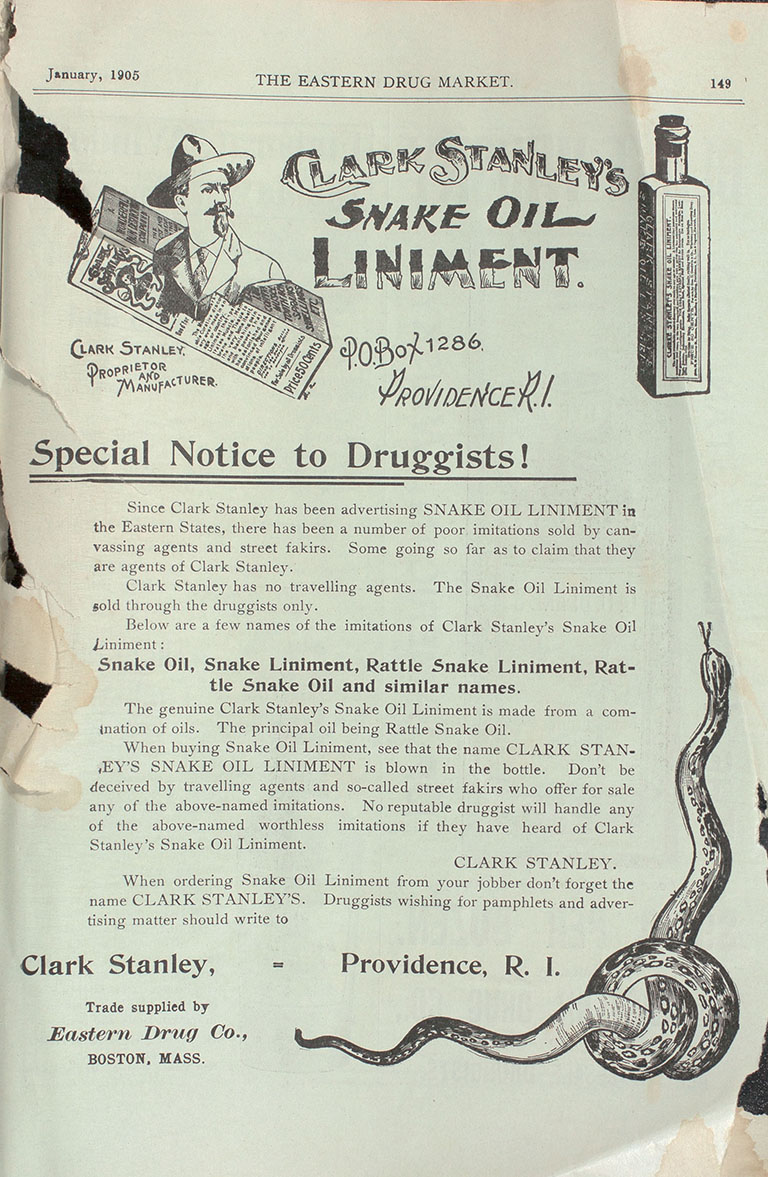
Given the eventual fate of Stanley’s product, this circular seems particularly audacious, warning users to be on the lookout for fakes and frauds, and to be wary of “poor imitations” peddled by those who would attempt to hoodwink the gullible buyer. Advertisement in The Eastern Drug Market, January 1905.
In 1893, Stanley said he attended the World’s Columbian Exposition in Chicago and made his snake oil liniment in a live demonstration, killing hundreds of snakes in front of his audience. If indeed this event took place as he described, it must have been an unofficial part of the fair, as Stanley does not appear among any official lists of exhibitors. After this publicity stunt, Stanley expanded his sales to the eastern United States and set up a factory in Providence, Rhode Island.
Stanley was apparently quite the showman, at least according to his own recounting. He was said to keep tame rattlesnakes as pets to be used in his shows, and claimed to have been bitten hundreds of times by venomous snakes, surviving only because he had the perfect cure for snake-bite. While several purported snake-bite antidotes were mentioned in his pamphlet, including a poultice of indigo and salt, applying a fresh-cut onion to the bite, and drinking generous amounts of whiskey, he did not specify which one he himself used. He raised thousands of rattlesnakes on his snake farms in Texas and Rhode Island in order to render their fat into oil for his liniment. The snake skins were tanned and made into slippers, belts, and neckties. Stanley’s Snake Oil Liniment claimed to cure rheumatism, gout, headache, toothache, sore throat, indigestion, frostbite, partial paralysis, lumbago, neuralgia, and insect and reptile bites. Ironically, Stanley also warned would-be customers against false imitations of his snake oil that were sold by traveling salespeople. He assured buyers that Clark Stanley’s Snake Oil Liniment was sold only by druggists.
The reputation of Stanley’s snake oil rested on its source as a traditional Indian remedy. However, his tale of living with the Hopi Indians and learning their secrets sounds like just the sort of false origin story that a scammer would invent. Other products of the time with similarly fictional backstories included Dr. Morse’s Indian Root Pills and Kickapoo Indian medicines. Both were created by white Americans but marketed as based upon Native American traditions. Stanley may indeed have witnessed a Hopi Snake Dance as he claimed, as white tourists were sometimes permitted to view this event. However, there does not appear to be any direct evidence tying Hopi traditions to the use of snake oil as medicine, and it seems unlikely that he alone would have learned this secret. Nevertheless, appropriating and commodifying Indigenous practices was a way for conmen like Stanley to give their fraudulent medicines an air of cultural authenticity.
Searching for the origin of snake oil, a popular alternate story has arisen that credits Chinese laborers on the transcontinental railroad with introducing it to the United States in the 1840s. According to this version, Chinese immigrants brought with them oil made from Chinese water snakes, a centuries-old remedy for muscle aches. Americans like Stanley saw its efficacy and marketing potential, but having no access to Chinese water snakes, began making oil with the locally-available American rattlesnake instead. It is true that Chinese water snakes are three times higher than rattlesnakes in omega-3 fatty acids, which can help to reduce inflammation when applied topically. American-made snake oil would be an inferior substitute.
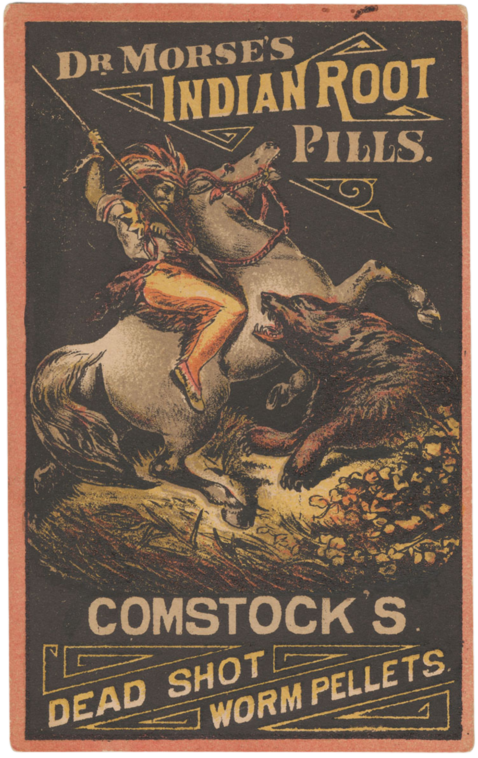
Dr. Morse’s Indian Root Pills traded on the romance of Native American traditions, and implied the ability to impart to its customers the strength and stamina of a bareback hunter. The pills were still being sold as late as the 1960s. Maxson Collection of Ephemera.

The Kickapoo Indian Remedies trade card at left borrows heavily from the image in George Catlin’s North American Indian Portfolio (London, 1844), capitalizing on the allure of the American West. At right is Buffalo Hunt, Chase No. 7.
While this theory has a charming simplicity to it, contrasting a real Chinese medicine with a shoddy American knock-off, there is little beyond circumstantial evidence to support it. Indeed, the use of rattlesnake oil in America long predates the arrival of Chinese immigrants. French captain Jean Bernard Bossu (1720– 1792), who explored the Mississippi River in the 1750s, reported that the Choctaw used snake oil for medicinal purposes. In the English translation of Bossu’s account (Travels Through That Part of North America, London, 1771), the Choctaw’s method is described: “The fat of the rattle-snake makes an excellent unguent for the rheumatic pains; this unguent penetrates into the body, to the very bones.” White American settlers appear to have copied the practice, listing snake oil among other household remedies in books such as Daniel J. Cobb’s The Family Adviser, Calculated to Teach the Principles of Botany (Rochester, N.Y., 1828). Cobb included rattlesnake oil among several oils made from animals, including bear, goose, hen, squirrel, mud-turtle, skunk, and wild-cat. He reported that “rattle-snake oil . . . will soften a callus, and will thereby many times limber a stiff joint.” In The Physician’s Assistant, Consisting of a Short and Comprehensive Materia Medica (S.l., 1833), Dr. Brooks recommends “rattle snake’s flesh, gall and grease” as a “great restorative.” A teaspoon of flesh could be powdered and mixed with wine, the gall preserved in chalk and given to treat fevers, and the grease taken internally or applied externally.
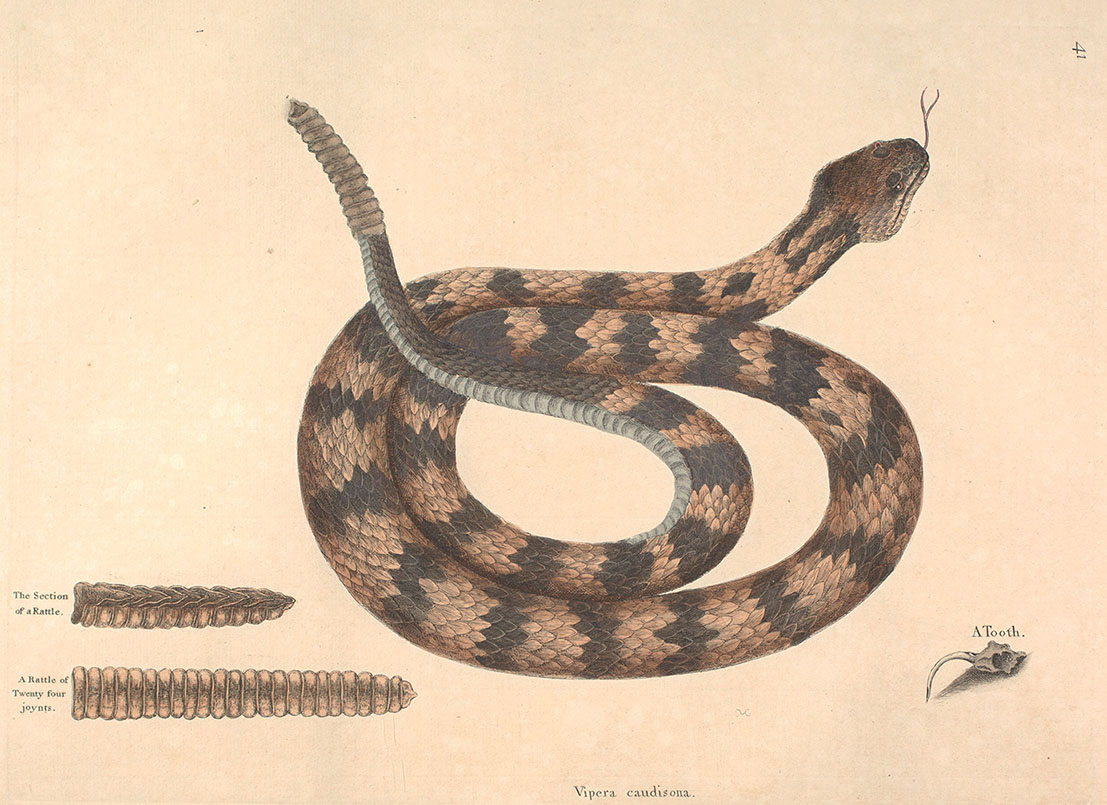
As opposed to the process of extracting venom, which requires ‘milking ‘ the fangs with no ill effects to the snake, rendering snake oil entails boiling down snake tissues, a process unavoidably fatal to the snake. This image of the American rattlesnake is a hand-colored copper plate engraving by Mark Catesby from The Natural History of Carolina, Florida and the Bahama Islands (London, 1731–43), vol. 2, plate 41.
Stanley wasn’t even the only person of his day to mass-produce snake oil as a medicine. Others across the country were manufacturing snake oil from rattlesnakes, crafting liniments containing the oil as an ingredient, or selling products called “snake oil” that did not actually contain any snake products. A number of these also traded on a supposed link to Native traditions, including Blackhawk’s Liniment, Rub-in-Oil sold by “Chief White Horse” of Madison, and White Eagle’s Indian Oil Liniment.
There does not seem to be a clear answer as to why snake oil had a surge in popularity while other animal oils remained in limited use. The reported ease and profitability of snake farming may have had something to do with it, compared to the difficulty of commercially producing bear or wildcat oil. As a venomous creature, the snake is naturally more dangerous and exciting than the common goose, squirrel, or skunk. Snake oil may also have caught the popular imagination because of its strong association with cowboys and the imagery of the American West.
By the time Clark Stanley’s Snake Oil Liniment was finally discredited, the term “snake oil” was already being used disparagingly to refer to any worthless cure-all medicine. Over a decade before Stanley claimed to have made his debut at the World’s Columbian Exposition, a May 15, 1882, issue of the Chicago Medical Review discussed snake oil as a fraud: “There are persons who still have great faith in the virtues of rattlesnake oil, and believe it a specific for rheumatism. A traveling quack who announced that his cure-all was compounded of rattlesnake oil, reaped a silver harvest from crowds on the square of a large city, not long ago.”
The final blow for Stanley came in 1916, when he was charged with violating the Food and Drugs Act. His snake oil liniment had been tested and found to contain nothing but “a light mineral oil (petroleum product) mixed with about 1 per cent of fatty oil (probably beef fat), capsicum, and possibly a trace of camphor and turpentine.” Having falsely represented his liniment as a remedy for numerous ailments, he was fined $20. The era of snake oil as medicine was finally over, but it continues to live on in the popular imagination as the quintessential American fraud.
The Mysterious Mrs. Ross
Cheney J. Schopieray
Curator of Manuscripts
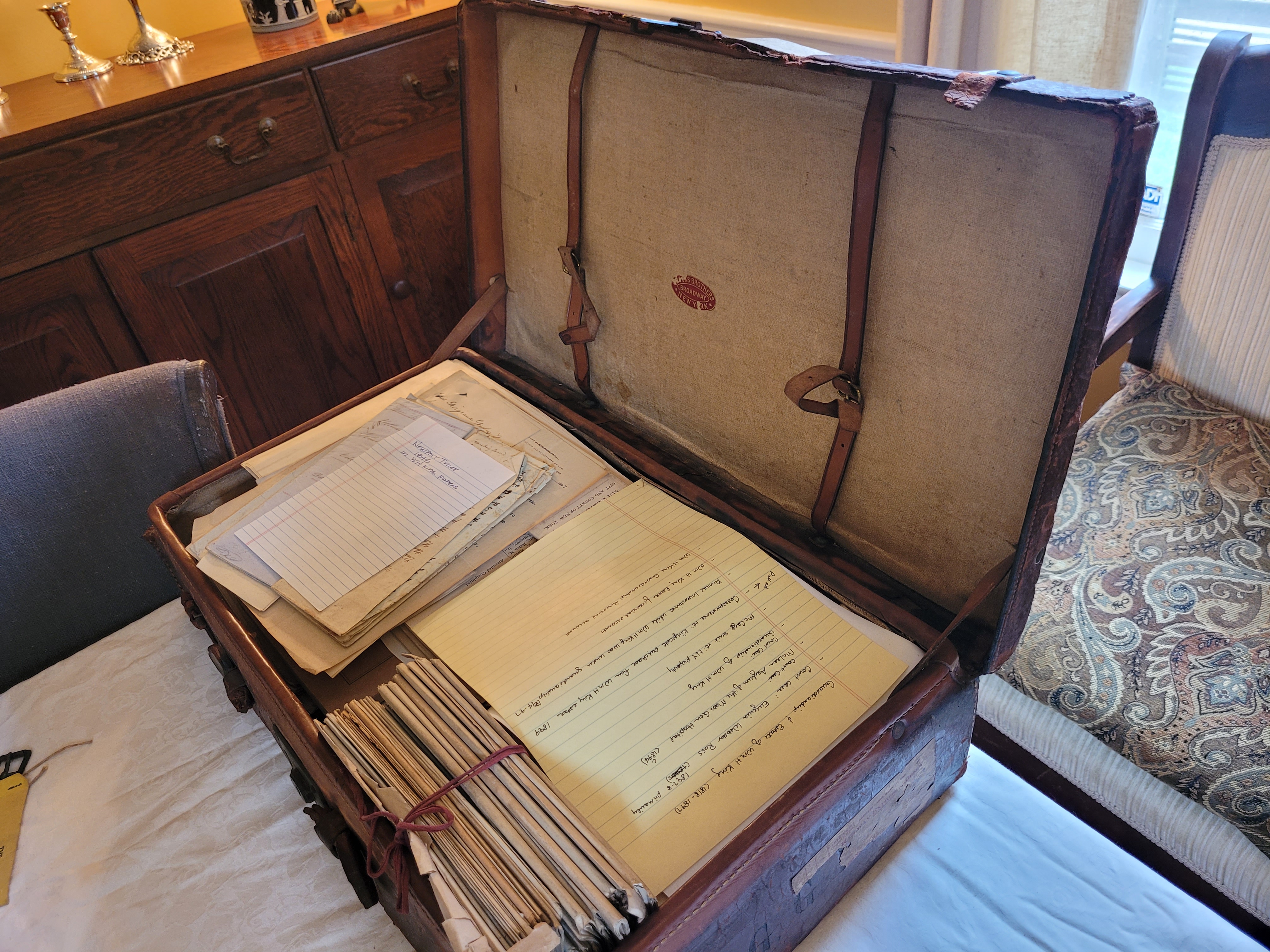
The William L. Clements Library acquired a group of King Family Papers in 1996. They focus heavily on the Kings’ mercantile activities at Macau and Canton, China, family property, and William H. King’s institutionalization. In 2020, the King Family Papers were digitized to support Fellow Lauren Davis’ research for “Beyond Institutions: Mental Disorders and the Family in New York, 1830–1900.” More recently, the library was contacted by Fran Wescott, a relative of a King family guardian, who thoughtfully and generously donated a large collection of 19th-century King family papers in the fall of 2023. This addition offers a wealth of new source material on a compelling family—and also Mrs. Ross.
“Mrs. Ross has always been a wandering character, her relatives don’t know where she lives or how. Her history, if written, might be as romantic as that of Rob Roy, Jesse James or Belle Star.”
Mrs. Ross is “a woman of uncommon intelligence and great will power, but as having obtuse moral perceptions, unscrupulousness as to the means, by which she attained her desires.”
(E. S. & J. T. Drake letters, October 16 and November 10, 1893; Port Gibson, Mississippi; King Family Papers).
In late 1888, a woman named Mrs. Ross arrived at the McLean Asylum for the Insane at Somerville, Massachusetts, to visit patient William H. King. Though she had never met him, she rejoiced in the belief that she had found her long lost uncle who had been presumed dead decades before. She was taken by his “patience, gentleness and beautiful humility” and began to work toward bettering his living conditions and comfort. She sent him papers and gifts. When Mr. King had a sore red spot on the bridge of his nose, she bought and sent him a pair of new gold spectacles with fine French crown lenses. Fearing for his discomfort she recommended elegant coverings for his leather armchair. Believing him in need of attention, she pleaded for increased social calls by herself and by prominent men and women who had known him. She encouraged frequent visits by asylum personnel to give him smiles and cheering words to lift his “poor broken spirit.” Nothing should be spared to provide for his comfort and happiness.
The institutionalized William H. King had been a prominent Newport, Rhode Island, merchant who made his fortune as a trader in China in the 1840s and 1850s. William King never married or had children, and by the early 1860s showed increasing signs of mental distress, characterized by heavy alcohol consumption, paranoia, hallucinations, and violent outbursts. His brother Edward King worked with Dr. Benjamin D. Silliman and others to assess William’s condition. On July 31, 1866, the King family had William involuntarily committed to the McLean Asylum under the care of superintendent Dr. Edward Cowles. There he remained for the 22 years before his unexpected visit from Mrs. Ross.
Dr. Cowles was suspicious of Mrs. Ross from their first interview. Between 1888 and 1893, Mrs. Ross sent a string of letters to the superintendent, making claims that she had inherited her uncle’s southern estate in the 1860s because he’d been thought dead—and could now impart it to her uncle. She believed that he was illegally imprisoned and was not insane. She besmirched William King’s brothers as men who had kidnapped him and confined him at the asylum for their own purposes. Though the brothers were now dead, their children—King’s nieces and nephews—were living off his wealth while keeping him from the luxuries he could afford. She praised Dr. Cowles for his care and protection of her uncle from the “evil” people living off the riches stolen by their fathers. As King’s niece, Mrs. Ross wrote, “No living mortal has any right to him but me—no living mortal has any right to his belongings but himself.”
Altercations with attendants and doctors resulted in the temporary banning of Mrs. Ross from asylum visits. During her exile, Mrs. Ross blew kisses from the street when William King was taken on his regular carriage rides. She continued to send papers and gifts, though some or all of them were intercepted and withheld. She eventually apologized to the asylum personnel, insisting that her behavior was on account of her desire to support Mr. King and noting that she would help build the finest sanitarium in the world with suitable accommodations for wealthy clientele and protection against the greed of “selfish and wicked” people.
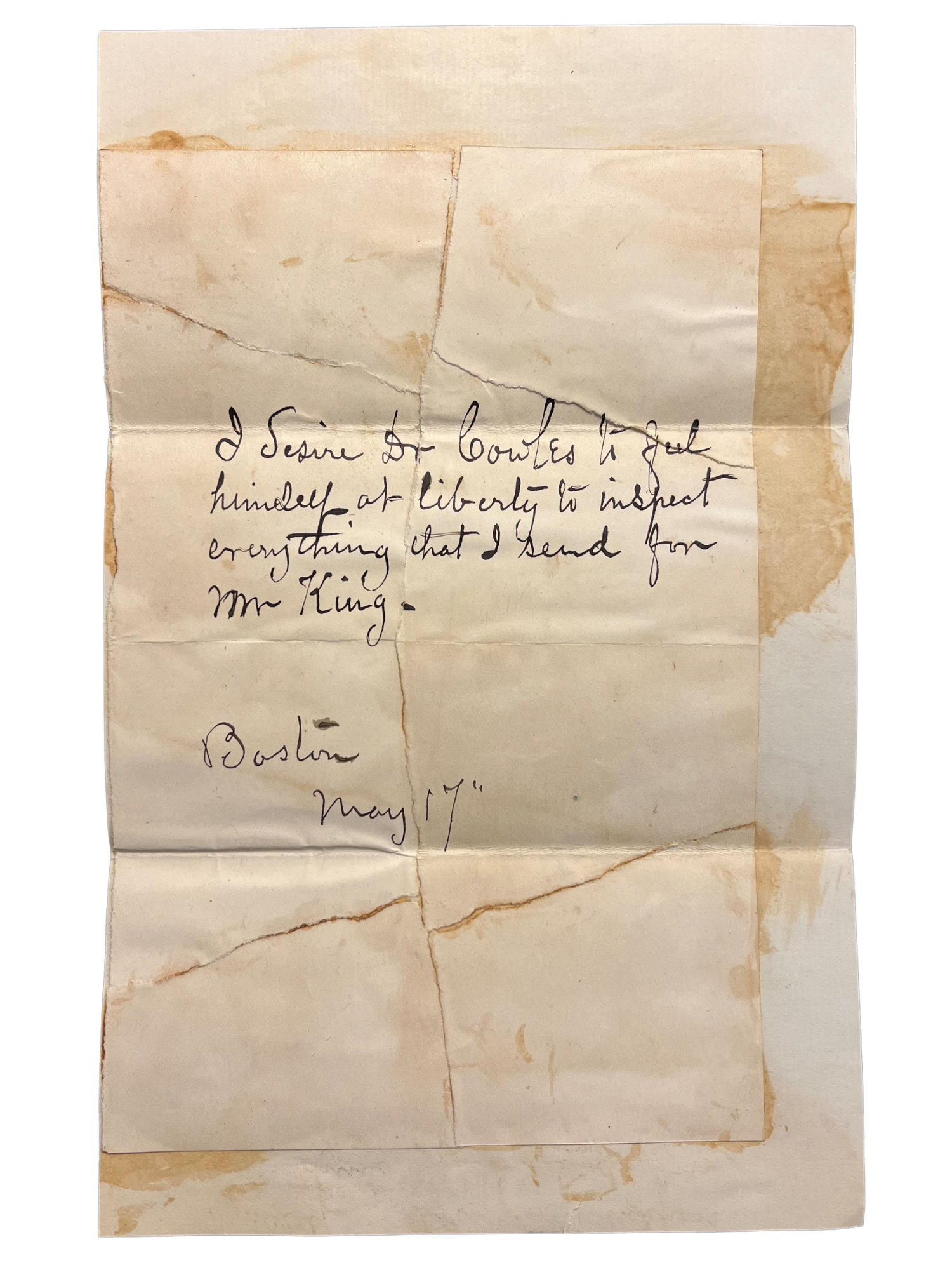
When Mrs. Ross believed her packages were not making it to William King, she presented this note encouraging Dr. Cowles to inspect them. It was torn in six, but then someone—probably the superintendent—had it pasted back together for retention.
“Who is Mrs. Ross,” read newspaper headlines in New York, Rhode Island, and Massachusetts in 1893. Mrs. Ross had filed a petition for habeas corpus with the Supreme Judicial Court in Suffolk County, Massachusetts, for the illegal institutionalization of William King and his unlawful detention at the asylum. She argued that he was sane and should gain his freedom. Immediately after the 1893 petition, W. H. King was removed from the asylum to a hotel, evaluated by a guardian ad litem, found to be insane and in need of medical care for seizures, and re-committed by the judge’s decree. Mrs. Ross appealed and asked for a jury trial to determine in/sanity. The appeal was rejected and dismissed on December 6, 1893. And thus began a string of lawsuits and appeals that would wend their way from Massachusetts to Rhode Island, to New York, and to the United States Supreme Court over the next six years.
Another legal battle between Mrs. Ross and the King family arose several months later upon the death of David King, Jr., William King’s nephew and guardian. The flurry of claims and counterclaims in the courts fed curiosity about Mrs. Ross, and newspapers scrambled for information about her. Who was this woman and how was she related to William H. King? The Providence Journal published regular updates and shared the common refrain, “No Explanation of the Identity of the Mysterious Mrs. Ross Who is Fighting the King Heirs.” Lawyers for Mrs. Ross refused to disclose her background so as not to prejudice the case.
Mrs. Ross’ opening affidavit of December 1894 carefully narrated the abduction of William King by his brothers at Troy, New York, in 1866, his forced institutionalization, the sketchy and missing paperwork surrounding it, and called into question the dismissal of her habeas corpus case the preceding year. She claimed that William H. King was not actually William H. King, but instead was her uncle Peletiah W. Gordon. Few other facts were provided and the bits and pieces about Mrs. Ross were only revealed through depositions of people who knew her through family. They shared that Eugenia A. Webster Ross was born at Port Gibson, Mississippi, to parents James and Christiana Calhoun. Her mother had died when she was young, and Eugenia was raised by her grandmother, Aletheia Gordon. According to an aunt-in-law, “Mrs. Alethea [sic] Gordon, the grandmother of Mrs. Ross, was very penurious and exceedingly eccentric. I believe that tendency thus inherited by Mrs. Ross had developed into insanity upon questions of property and the inheritance of great estates.” Eugenia Calhoun married Captain Isaac A. Ross. After her husband’s death in the 1870s, she did not inform the captain’s mother, who only learned of it months afterward from another source. Acquaintances claimed she had a “roving” disposition with no fixed address, unknown sources of money, and no estate through her deceased husband. She assumed different names in her travels and was boarding sporadically in Salem, Massachusetts between 1888 and 1891 as “Mrs. Black.”
At length, on July 1, 1895, a final decree from the Supreme Court Appellate Division at Providence, decided on William H. King’s relative, George Gordon King, as guardian.
The King family heard nothing more from Eugenia Ross until the death of William H. King on March 6, 1897, at the psychiatric Butler Hospital in Providence where he had been transferred. The King family deliberated on the most appropriate executors for William’s massive estate. George Gordon King and Sarah Birckhead, representing the two branches of family, were granted letters of administration. Eugenia A. Webster Ross filed an appeal to the Supreme Court of Rhode Island at Newport after the probate court upheld the appointment. She argued that George and Sarah were not next of kin, that Eugenia was next of kin, and that the Newport probate court granted the appointments before a legally required 30-day window passed. Over the spring and summer of 1897, Eugenia led her lawyers on an expedition to find evidence proving that the William H. King that traded in China was not the man who died in Butler Hospital and that Peletiah W. Gordon was the deceased. They called at the homes of King family members, demanding that they turn over or reproduce family photographs, private and business papers, family histories, and a sculpted bust. The goal was to secure depositions of persons who could visually identify which man was which.
On July 22, 1897, the Chief Justice ordered a deposition by Mrs. Ross, but she could not be found. The King’s lawyers hired the Pinkerton Agency to find her and deliver the summons. When the agent discovered her, he attempted to serve the document in the street. Mrs. Ross “caused a disturbance,” refused to accept the paper, and failed to appear before the judge. She was held in contempt. The case was decided in favor of the Kings for Mrs. Ross’ contempt and failure to submit the ordered bill of particulars in the Fall Term 1897. Mrs. Ross was terrifically frustrated and believed that she had been denied justice on account of a legal technicality. The case rose to the United States Supreme Court, which decided against her on November 7, 1898. And then as the Kings, the courts, creditors, and unpaid assistants began to press in on Mrs. Ross for financial obligations associated with the previous six years of litigation, she vanished.
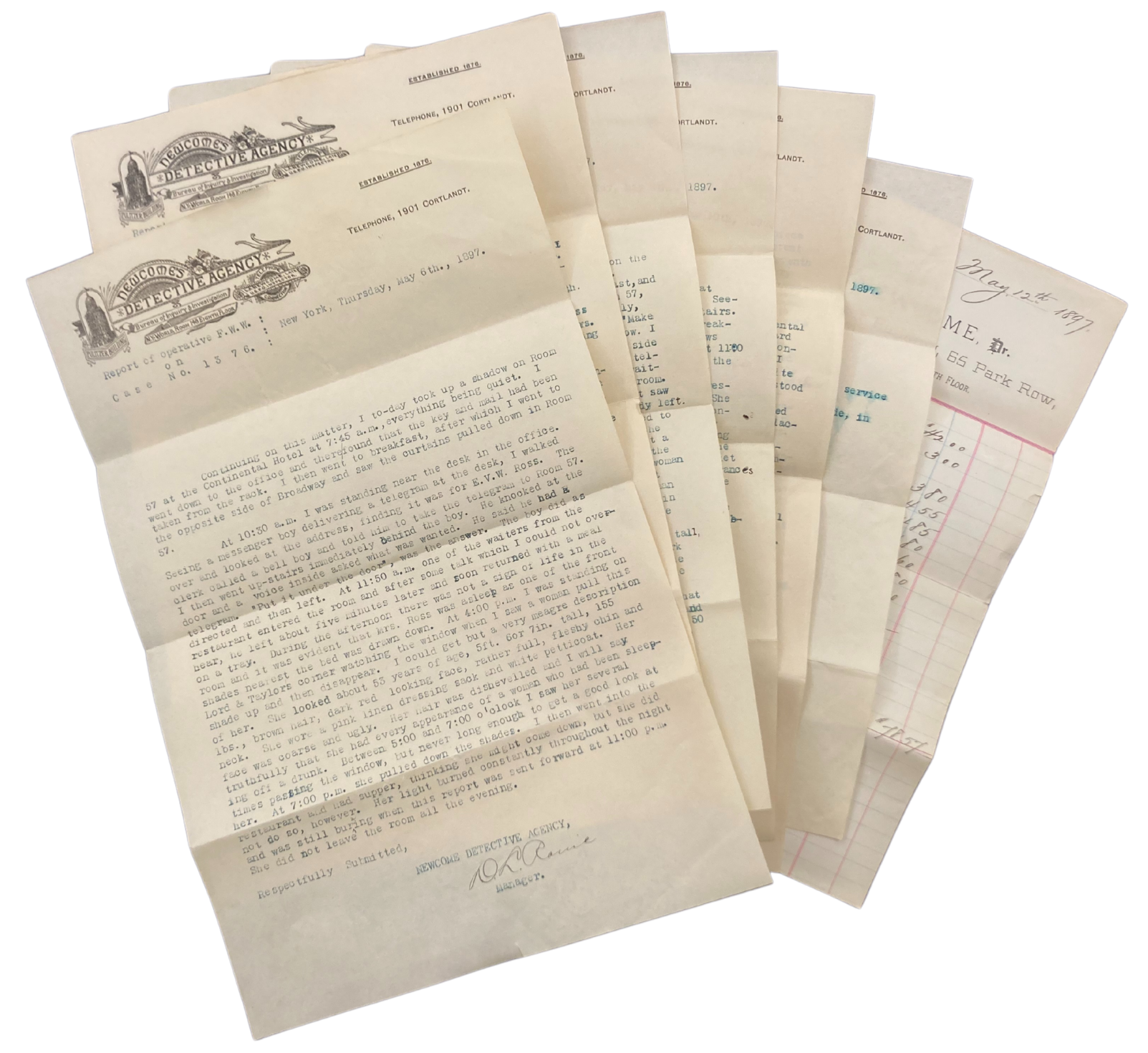
The 2023 addition to the King Family Papers included daily reports on the surveillance of Mrs. Ross. King family lawyers hired detectives on more than one occasion to find, identify, and serve papers to Mrs. Ross. In May 1897, Newcome’s Detective Agency operative F. W. Warde tracked her down at Room 57 of the Continental Hotel in New York. Questioning the bellboy about Room 57’s occupant elicited the response, “. . . she ain’t no Princess, but she’d like to be.” When finally confronting her in the hallway outside her room, she refused to take the papers, insulted his intelligence, and demanded information about who sent him. Stating that the papers only needed to touch her, he placed them on her shoulder and departed.
Eugenia Aletheia Calhoun Webster Ross was mysterious, but the lawyers, newspapers, in-laws, and detectives were simplistic in reducing her to an “adventuress” perpetually clamoring after wealthy men’s estates. Born in 1836, Eugenia was raised brought up by her father and grandmother in a tumultuous environment. Her father James was a manipulative and cruel man, who engaged in duplicitous real and personal property schemes. He relied on a combination of threats, genealogy and inheritance arguments, and questionable legal transactions to secure for himself the property of his in-laws, the Gordons. After the death of Eugenia’s mother in 1838, James installed himself on his mother-in-law’s cotton plantation at Port Gibson. He threatened that if she did not grant permission for him to live there, he would take Eugenia away to Texas where he would disallow any contact between them. Aletheia gave in and James, Eugenia, and Eugenia’s brother Adam settled on the plantation. An agreement was signed, stipulating that they could live on the plantation beginning June 28, 1837, so long as James kept the plantation profitable. James began calling the plantation “Calhoun Place.”
This arrangement lasted six years, until Aletheia’s husband died. His will stipulated that Aletheia would receive $1,000 annual allowance plus four enslaved domestic workers; considerable property would go to their children Christiana and Peletiah W. Gordon; and an investment was allotted to grandson Adam Calhoun for his education. To frustrate these terms, James refused to give Aletheia any accounting of plantation costs or profits. He also intervened and prevented her annual allowance, providing instead erratic small amounts of cash and groceries. Without regular funds, she was unable to pay debts, at least one of which went to court. She believed that James was intending to lead the courts into forcing her to sell the plantation property, which James would then buy for himself. Aletheia’s fears were justified. At an earlier date, she had sent James to Kanawha, Virginia, to pay taxes on 6,000 acres of Gordon lands. He instead sold the land to pay the taxes, and bought the property under his own name. To make matters worse, James’ barbarity prompted 10 of the 21 enslaved men, women, and children at “Calhoun Place” to flee to Aletheia’s home for protection. James gathered together several men and attacked her house, breaking into her kitchen, shouting, threatening, and pursuing the terrified enslaved laborers.
Eugenia Calhoun’s grandmother died in 1844, and she was left alone with her father. In a horrific irony, James became Aletheia’s executor. He took over the property, remarried, and parceled and sold parts of the land. Eugenia observed these actions. She saw court proceedings and women’s secondary legal status repeatedly favor her father’s unjust efforts to steal property and monies that rightly belonged to her mother and to her uncle—and to Eugenia as next of kin. What she didn’t witness herself, she learned through papers and court records later. Her father’s preoccupation with avarice revealed itself when Eugenia’s fiancée Isaac A. Ross asked James for permission to marry. Her father refused on grounds that Ross was only interested in Eugenia for her property. Nevertheless, Eugenia and Isaac married in 1858, and shortly thereafter “Isaac A. Ross & wife” sued James E. Calhoun for the inheritance he’d stolen from Aletheia, Christiana, and Eugenia. The Civil War caused delays, but on March 15, 1866, a portion of the claims were validated, and the courts awarded Eugenia Ross $17,641.86.
Eugenia Ross spent her 30s handling various aspects of her husband’s mercantile business, while simultaneously pursuing two avenues of legal inquiry. She attempted to track down her uncle Peletiah W. Gordon, who may or may not have been dead, and to secure her just inheritance from the Gordon property spuriously sold or re-arranged by her father. In the latter case, she engaged in multiple Mississippi lawsuits that finally concluded in 1895. In the former case, Eugenia’s path became murky. The Pinkertons later suggested that Eugenia became a Spiritualist during the Civil War period and that a medium working out of the Gayoso Hotel in Memphis, Tennessee, told her that her uncle Peletiah W. Gordon was still alive. Her investigations discovered that as a youth, Peletiah ran away multiple times, from home and from his school at Lawrenceville. After a final argument with his mother Aletheia, he left the family for good in his late teens. The last piece of information Eugenia learned was that her uncle was arrested in Boston for pickpocketing $27 and afterward absconded.
It is not clear how Eugenia came to the conclusion that her uncle changed his identity. In the 1870s, she came to believe Archibald W. Gordon (A.W.G.) of Mobile, Alabama, was in truth Peletiah W. Gordon (P.W.G.). She claimed that P.W.G. ran away and became director of the U.S. Bank at Mobile as A.W.G. Though the theory was far fetched, her strong advocacy, intelligence, and persuasiveness convinced lawyers to take it to court. They worked for her on promises of percentage returns, while she in turn borrowed money from individuals on similar assurances. Isaac B. Rich, Spiritualist editor of the newspaper Banner of Light (Boston, 1857–1907), offered to put up over $20,000 on loan and percentage returns for the effort. The Alabama cases were not decided in her favor. Eugenia Ross followed other genealogical trails, looking for P.W.G. and other ancestors’ estates, from Texas and New Hampshire to England, eventually leading to William H. King in the asylum at Somerville, Massachusetts, in 1888.
In the latter half of 1888, the same year Mrs. Ross arrived at the McLean Asylum in Massachusetts, she also arrived unannounced on the doorstep of septuagenarian schoolteacher Phoebe Dowdle at Stonewall, Mississippi. Mrs. Ross talked about the special place in her heart for Phoebe’s brother Edward, who had been so kind during Eugenia’s brother’s death. Mrs. Dowdle remembered Eugenia as a child and listened to stories of Mrs. Ross’ wealth, connections in Port Gibson, Philadelphia, Baltimore, and elsewhere. Two years later, Eugenia returned to convince Phoebe to join her in a month-long trip to New York. After pressure and convincing, the two women left Mississippi in October 1890. At Mrs. Ross’ insistence, Mrs. Dowdle brought only a trunk of her grandfather’s papers and his picture—no additional clothing or other baggage. One week later, Phoebe sent a note to her daughter Isabella with no return address, stating “If I had only known what I know now, I would never have been here.” And then silence.
The Dowdle children tried to speak with Mrs. Ross’ connections in Port Gibson—most were dead. Neither family, friends, nor detectives knew where Eugenia went with their mother. In the latter half of 1892, Salem, Massachusetts, mayor Robert Rantoul received a letter from Salem resident Mary F. Huse. Mary and her clairvoyant husband Asa had taken in a female boarder of unknown background two years earlier. She had been left there by a Mrs. Black, who offered to pay a large weekly sum for board because the woman was of “unsound mind,” confused, and needed additional care. Mrs. Black came and went, sometimes staying away for many months at a time, repeatedly insisting that the boarder needed to be ready at a moment’s notice for her return. The Huses could not convince their boarder to tell them anything about her family or where she came from. Over time, Mary Huse felt something was wrong.
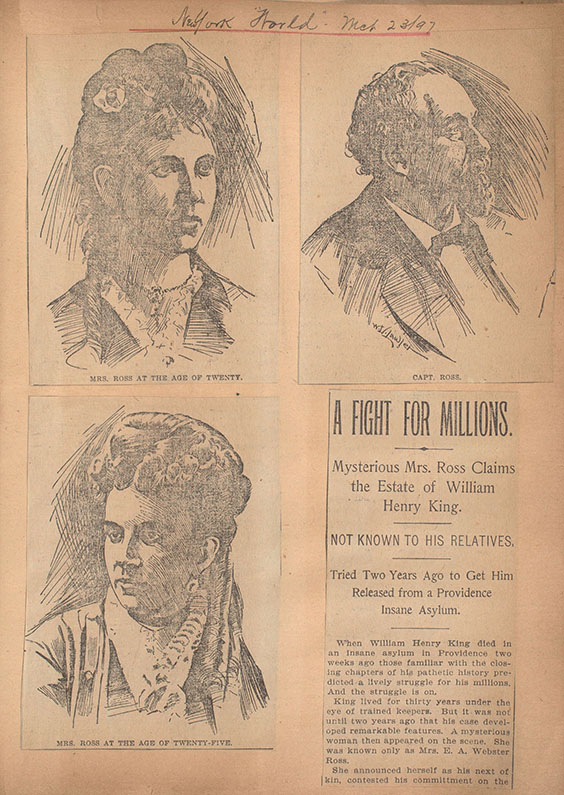
The King family compiled a newspaper scrapbook containing clippings related to the various cases by Mrs. Ross, including this page with reports of the March 1897 legal proceedings and a rare portrait of Eugenia Calhoun Ross. The volume of material kept by the family relating to the Ross cases speaks to its impact on the lives of those involved.
In February 1893, after mayor Rantoul began an investigation, Mrs. Dowdle revealed her identity. Mrs. Ross/ Black had convinced Phoebe Dowdle that she would be placed in an insane asylum if she shared even the tiniest detail about her identity with the Huses or anyone else. Mrs. Dowdle was so terrified that she remained in the Huses’ home, fearing they wouldn’t believe her true circumstances and that at any moment, Mrs. Black/Ross would show up and have her committed. Mayor Rantoul arranged for Mrs. Dowdle to travel home to Mississippi, met with Mrs. Ross and her lawyer to turn over unpaid board for the Huses, and the affair ended. Or, nearly so. Unbelievably, in December 1893, Mrs. Ross sent a letter to Phoebe Dowdle, stating that she was coming to visit in a few weeks.
The Clements Library’s collections are filled with complicated people, who seem to plead simultaneously for empathy and opprobrium. Mrs. Ross shrewdly built legal cases with a paucity of evidence, manipulated and deceived lawyers and people who loaned or gave her money, caused emotional pain to bereaved family members, inserted herself into the life of a mentally ill man on false pretenses, kidnapped and psychologically tortured an older woman for multiple years, crafted two or more identities for deceptive reasons, and much else. At the same time, she grew up watching her father ruthlessly manipulate her grandmother for advantage, experienced his threats and violence, and saw her own property stolen by him. She developed a strong character and a sense that she had to fight for her inheritance and her rights in the male-dominated spheres of the court system and daily life. The tale of Mrs. Ross has important ties to the history of mental health care, women and the law, property, slavery, Spiritualism, journalism, and more in the 19th century United States. Her full story has yet to be written, but when it is, it might just be as romantic as that of Rob Roy, Jesse James, or Belle Starr.
A Quartet of Cons from the Collections
Cheney J. Schopieray
Curator of Manuscripts
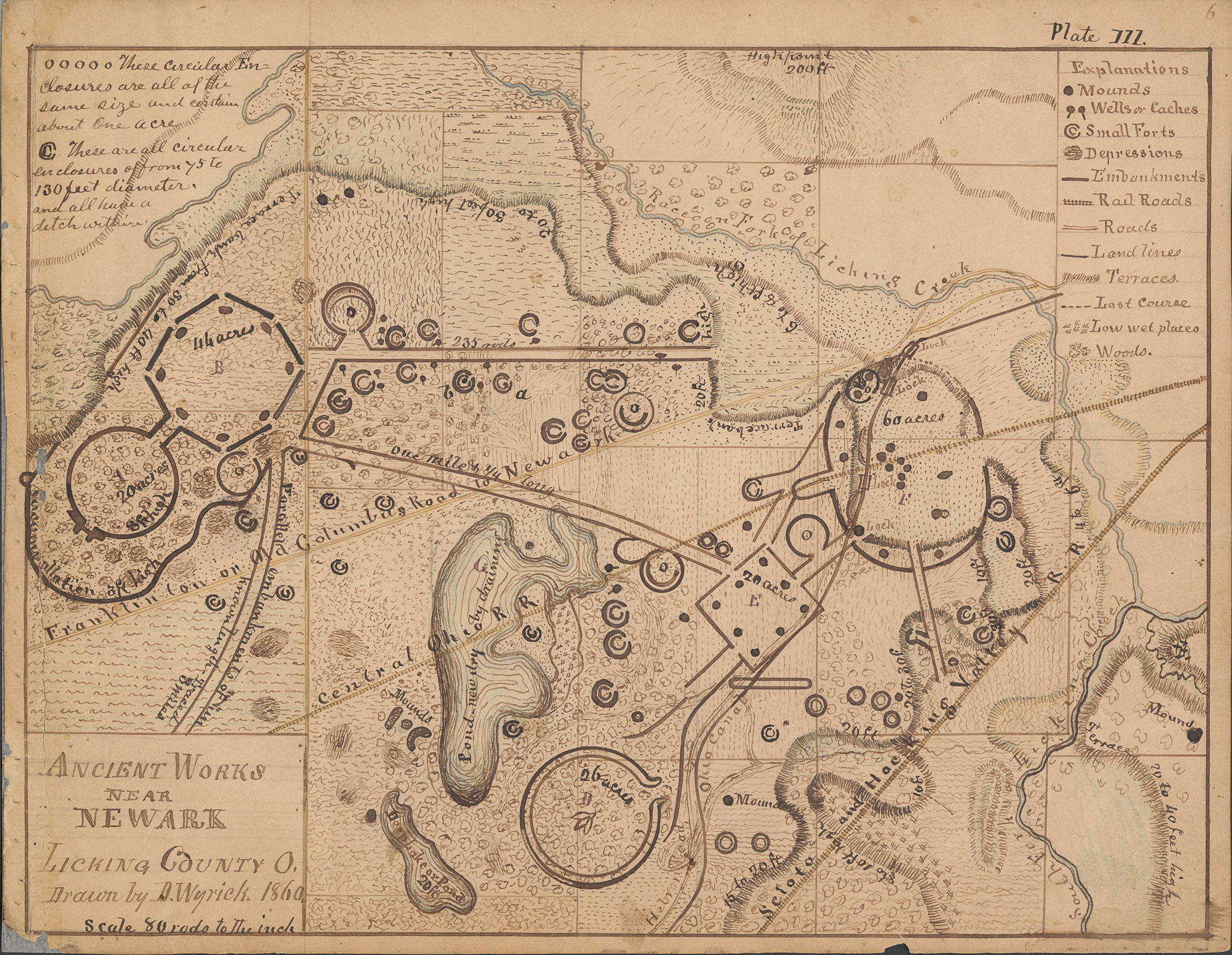
David Wyrick’s 1860 map of “Ancient Works Near Newark, Licking County O.” clearly shows the mind for organization and detail required in archeaological work by including measurements, details of topography, roads, and railroads. Wyrick depicts The Newark Earthworks, remnants of a 2,000-year-old complex that is the largest set of earthworks known. It is believed that groups of Native Americans from all over North America gathered at the Newark Earthworks to practice spiritual traditions, celebrate, and connect with one another and the world around them.
Deceiver or Deceived?
In the summer of 1860, Newark, Ohio, surveyor David Wyrick made an astounding discovery. While digging in a cluster of pre-Columbian indigenous burial mounds he uncovered a stone inscribed with what appeared to be an ancient Hebrew text. Wyrick and the so-called “Keystone” became instant sensations and topics of controversy. Beginning in the 17th century, theories circulated that Native Americans were descended from Lost Tribes of Israel. Wyrick’s Keystone supported this argument, and he postulated in a letter to antiquarian William Brockie, “This may have been a lost relic of the children of Israel—or a lost ornament by some other race who obtained it of them . . .” (September 1860). In November of the same year, Wyrick uncovered another stone, this one carved with an abridged version of the Ten Commandments and an image of Moses. This stone was aptly named “Decalogue” and, together with the Keystone, became known as the Newark Holy Stones.
His finds were lauded by some and pronounced fabrications by others, but the latter voices were proven to be correct. David Wyrick died in 1864 by an overdose of laudanum taken to treat his severe rheumatoid arthritis, and in the following decades he was denounced in archaeological journals as a forger and denigrated for being an amateur. It is true that Wyrick was largely self-educated, but he was a serious student of archaeology and natural science, and he realized the importance of careful documentation as evidenced by the hand drawn maps and diagrams in the Clements Library’s David Wyrick collection. Dr. Peter Dunham of Cleveland State University described Wyrick as a man with “a sublime mix of naïveté and incisive wit and intelligence,” and believed Wyrick was not the forger, but rather the victim of an elaborate scam conducted by a local individual who particularly disliked Wyrick. The Newark Holy Stones are in the permanent collections of the Johnson-Humrickhouse Museum in Coshocton, Ohio.

Wyrick’s drawing of the Keystone with Hebrew lettering. The stone was made of novaculite, a very hard fine-grained siliceous rock used for whetstones.
The Shame of Victimization
The variations of confidence schemes and con games are many, and they often require ingenuity, creativity, organization, skill, and at the very least brazenness in the face of potential consequences. The perpetrators often inspire curiosity, and their exploits invoke a sort of glamor. But tarnish comes when remembering the serious psychological, social, and economic harm suffered by their victims. Even the sharpest among us can be drawn into their schemes. The monetary losses and self-directed doubt and anger can be devastating. How could I let this happen? How could I be so stupid? It seems so obvious—what was I thinking? What will people think of me if they find out?
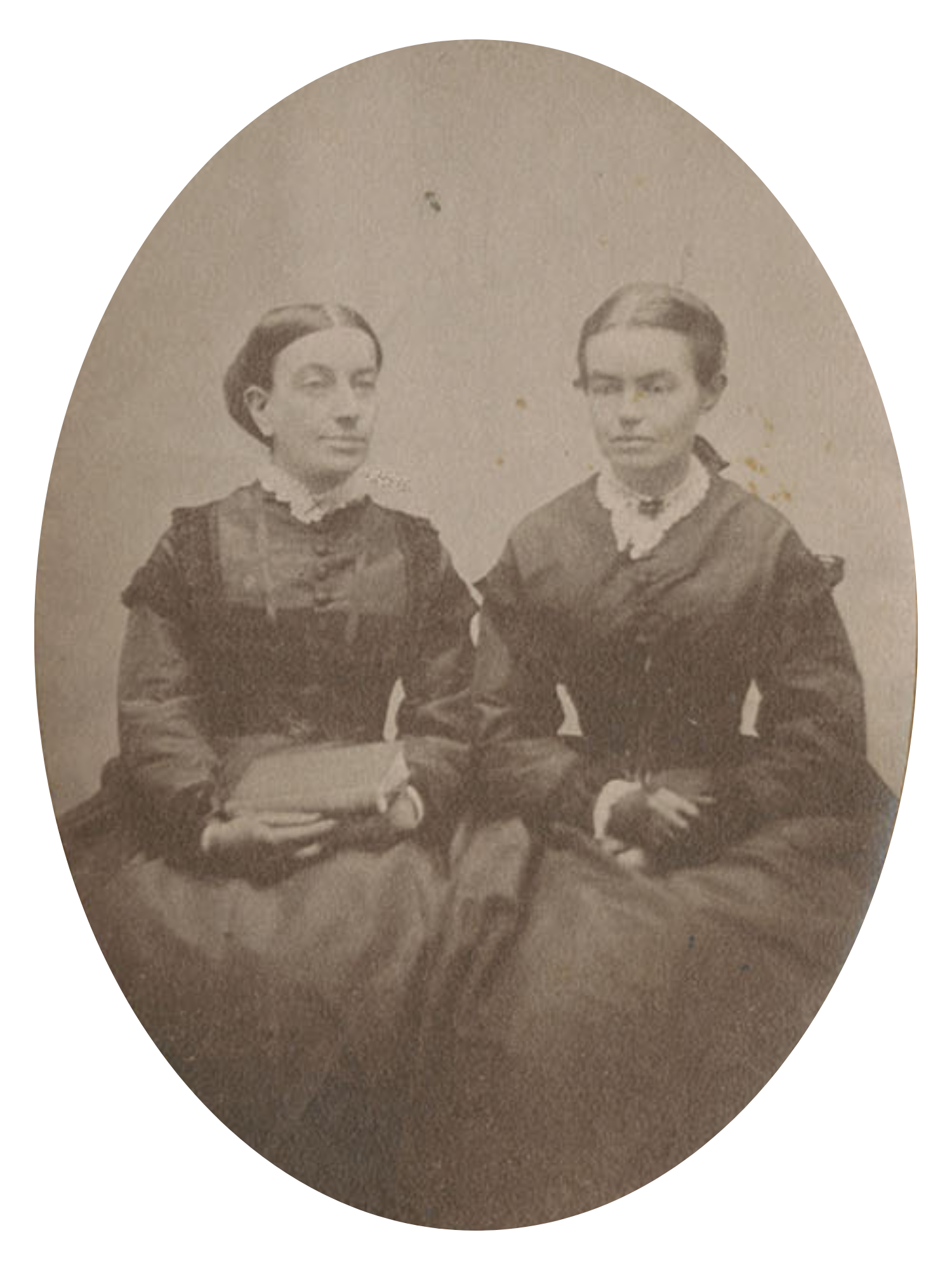
Emily Howland (at right) lived a life of activism on behalf of African Americans, with deep compassion for wrongs committed against them. Her public advocacy no doubt led to her being targeted in a scam which used a fabricated but all-too-believable tale of suffering for monetary gain.
Emily Howland (1827–1929) of Sherwood, New York, was a reformer active in abolitionism, Black education, and women’s rights and suffrage movements. She was a brilliant and steadfast woman acting on some of the most challenging and progressive efforts of her day. And yet she, too, found herself on the receiving end of deception. On October 14, 1905, Emily Howland was interrupted at supper by an unexpected visitor. It was an African American man who told her that he was fleeing to Canada from North Carolina. He had seen his sister murdered, he defended her, and was targeted for lynching on reward of $500. He had difficulty walking because he had been shot twice in the back. He told her that he met with Harriet Tubman (1822–1913) at her home in Auburn, who directed him to Howland. He needed $135, so Emily accumulated the funds. He departed but then returned the next Monday and said that men seized him en route but he escaped. He did find someone who could get him out of the country for $450 (since the railways were being watched). Against her better judgment, Emily wrote a bank check for that amount. She recalled being disturbed at his “most excited & harrowing” manner after taking the check.
Emily Howland had been close friends with Harriet Tubman for many years, so she decided to go to Auburn, ask Tubman about the case, and request that no more similar cases be sent to her. As Emily relates in a letter dated October 21, 1905, Harriet told her that “about 2 months ago a colored man brought this fellow to her house with this same story & wanted shelter for him which of course was promptly granted. He had a revolver . . . slept in her barn some more nights, wanted money. She begged some for him not enough to satisfy him. . . . Harriet said she had never mentioned my name to him. He had got it in some way. The whole affair seems like a horrid nightmare.” Emily Howland reproached herself for not listening to her own apprehensions when giving in to the second request for money. She was embarrassed about the amount of money lost, could not pay the next bill she received, and grieved over the good works for humanity that that money could no longer support. Her goal was to avoid dwelling on the events and remembering that “this too will pass.”
Spanish Prisoners and Nigerian Princes
In March 1908, L. F. Liscombe of New Hampshire received an urgent letter from Luis Rubio. Rubio wrote from prison at Valencia, Spain, and explained that he was related to Liscombe through his in-laws. He had been secretary treasurer under Gen. Martínez Campos during the Cuban Revolution, but he defected and joined the revolutionaries. He was forced to flee to England, taking £36,000 of his assets. There, he received news that his wife died, leaving his 15-year-old daughter Emily a prisoner in Santa Elena, Spain. Rubio rushed to Spain but was detained on arrival and imprisoned. Before he left England, however, he deposited the £36,000 in a London bank “on a special private contract” such that only the bearer of a particular security document could access it. The document was in a hidden compartment in his portmanteau, which was confiscated and would not be released without payment of his sentencing costs. Since he was sick and dying, Rubio pled that Liscombe pay the costs to release the embargo, which would allow Emily to be supported, and also provide an ample reward to Liscombe for his help. Since he could not receive letters at the prison, he needed Liscombe to airmail Pedro Romero at Calle del Mar, Provincia de Valencia, for more information and details on how to send the payment.

The “Mexican prisoner” letter sent to Randolph G. Adams in 1940. No response has been located.
Thirty-two years later, Clements Director Randolph Adams (1892–1951) received an urgent letter. A prisoner in Mexico City needed help, for the sake of his “dear daughter as well as [his] very existence.” Confined for bankruptcy, he beseeched Dr. Adams to pay for the embargo placed on his suitcases, one of which contained a baggage check that could be used to release his trunk, which was held at a customs house in the United States. That trunk had a secret compartment which held $285,000 and if Adams would advance the embargo release funds, he would receive $9,500 of the hidden monies. “Due to serious reasons of which [he] will know later,” Adams should airmail or wire the prisoner (signed “A”) via his contact Julio Rios at R. de Bolivia 22- Dept. 1, Mexico City.
These occurrences may sound familiar to modern readers. The “Spanish Prisoner” letters are an example of international crime and a precursor to the modern and widely experienced “Nigerian Prince” emails, which follow the structure of an advance fee scam. The con artist tries to establish connection to the recipient, provides a story with appeals for humanitarian help, and requests some amount of money needed to access a large amount of hidden capital. They appeal to potential victims’ emotional desires to help those in need as well as their own greed or monetary needs. Of course, the prisoner and the Nigerian royalty are fabricated, there are no funds to release, and there is no daughter to save; there is only that advance fee—and the subsequent silence or requests for additional funds.
If you fell for one of these advance fee scams, not to worry. Cheney J. Schopieray (b. 1980) received an email on July 24, 2011, from Gary Smith, who was duped by a Nigerian Prince scam after paying upwards of $20,000. Smith received confirmation of the fraud from FBI agent Williams D. Chase. Thanks to his [Chase’s] help, Smith was “the happiest man on earth” because he received promise of restitution of $1M U.S. currency. All Cheney needed to do was send $190 for Special Agent Chase to run the paperwork, via his contact at [email protected]. He is pretty sure his portion of the $1M will arrive any day now.
He Seen His Opportunities and He Took ‘Em
Tammany Hall philosopher George W. Plunkitt (1842–1924) famously justified political corruption by distinguishing between Honest Graft and Dishonest Graft. The former being personal and political party financial gains secured through use of insider information or bestowing salary benefits on cohorts, while simultaneously benefiting State projects. As he said, “The books are always all right. The money in the city treasury is all right. Everything is all right.” Dishonest graft, he said, is the use of political position to engage in illegal activity such as accepting bribes and kickbacks, engaging in theft, blackmailing criminals, or collaborating with gamblers and other lawbreakers.
President Thomas Jefferson appointed Philadelphian Levett Harris (ca. 1784–1839?) as U.S. Consul to Russia at St. Petersburg in 1803. Harris held the position until 1817, with a period as chargé d’affaires while Ambassador John Quincy Adams (1767–1848) was in Ghent negotiating the treaty to end the War of 1812. In 1817, Harris returned to the United States to seek appointment as Ambassador to Russia. His prospects were high, given the Czar’s favor and his length of service as consul. These hopes were dashed when a series of revelations about consular corruption came to light through other U.S. government personnel and American merchants in Russia. The accusations primarily related to Harris profiting by the certification of nonneutral ships as American at the port of St. Petersburg under false papers, and by using monetary incentive to encourage his appointees to do the same. His nomination was quietly squelched, and Harris sued William D. Lewis, whose printed pamphlet against him did much to null his potential ambassadorship. The Supreme Court of the Eastern District of Pennsylvania handled the case Harris v. Lewis, which lasted around seven years and ended in Harris’ favor after a 16-day trial with a minimal monetary award.
The Clements Library’s Levett Harris Letterbook includes one communication that reflects careful calculations undertaken to move goods surreptitiously through the customs process at St. Petersburg—in this case exporting a collection of paintings for Harris’ own benefit. Harris wrote to John Vaughan (1756–1841), Philadelphia merchant and arts patron, to inform him of a forthcoming shipment of paintings which he hoped to sell for around $8,000. Harris hoped that Vaughan would buy them and if not, that he would hang onto them until Harris returned from Russia. “As these pictures will necessarily be entered as a part of my household effects & moveables there can be no duty charged upon them. I have not mentioned this circumstance to my Bankers . . . and as moreover the Neptune is a public Ship & the things on board belonging to the public mission there will necessarily be no custom house interference.” (September 16/28, 1814).
Levett Harris used his position to claim that a collection of pictures he intended to sell were his own household goods to avoid tariffs, and loaded these paintings on a public ship to avoid customs scrutiny. If hairs were split as Plunkitt splits them, Harris would serve as an example of dishonest graft, whose corruption benefited himself without also supporting party and public. The most generous epitaph we could offer might be “Levett Harris: He Seen His Opportunities and He Took ’Em.”
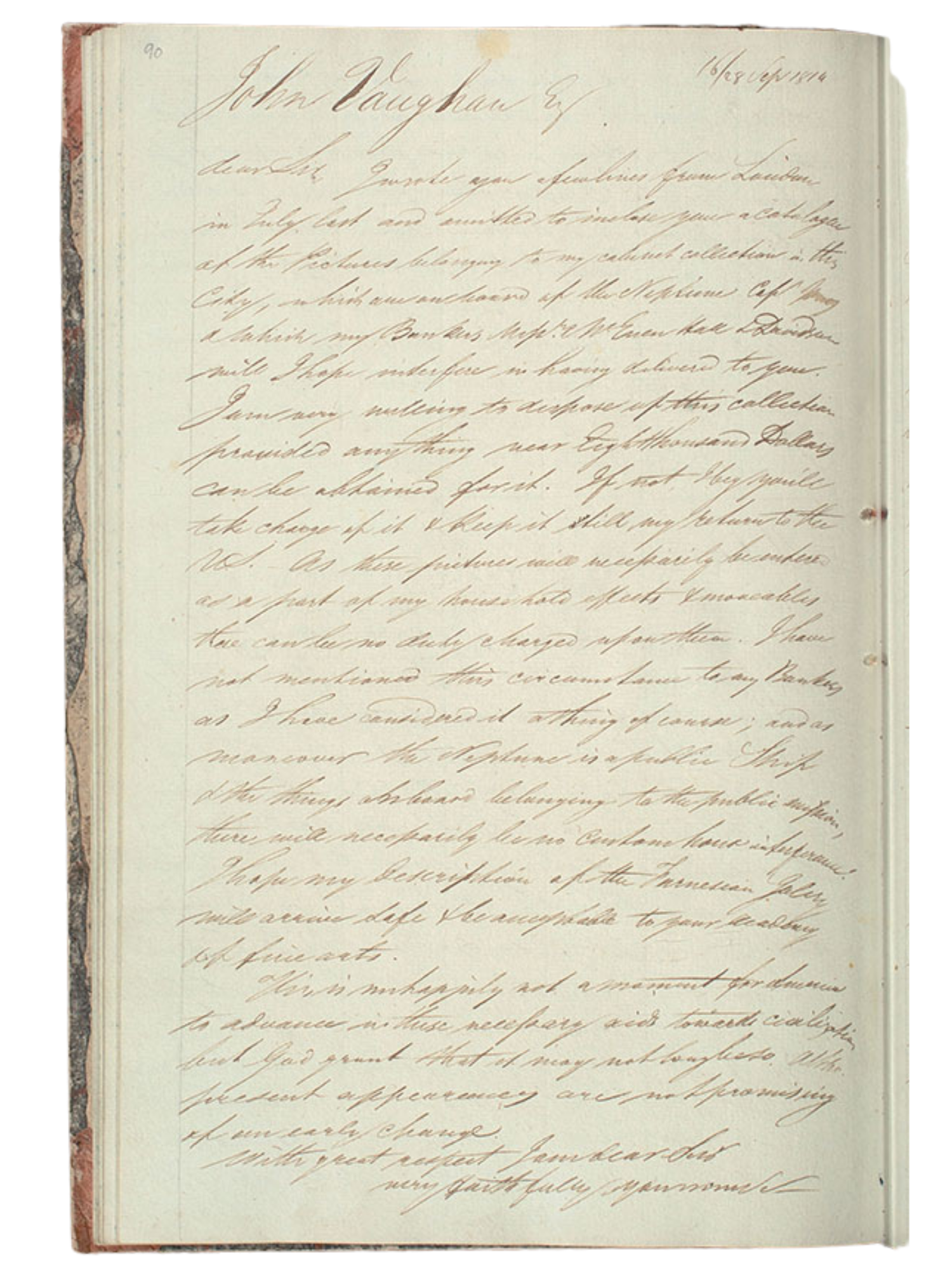
Levett Harris’ letterbook contains copies of his outgoing correspondence in the hand of his secretary, Joachim Schmidt, including this letter regarding the shipment of paintings. In addition to accusations of Harris making a personal profit, William Lewis’ allegations included the fact that Harris’ appointees were hired on the terms that they pay an annual sum to Harris, because of the pecuniary benefits that accrued to them as a result of their position.
Getting Away With It
Clayton Lewis
Curator of Graphic Materials, retired
Rowland Stephenson (1782– 1856), Member of Parliament for Leominster, was descended from generations of wealth and accomplishment and was well known to the social elite as a respected partner of the Lombard Street bank, Remington, Stephenson & Co. Although described as dapper, Stephenson was deeply in debt and had committed his bank to financing schemes that were hemorrhaging money, including the enormous, unfinished London Coliseum (an amazing story in itself) promoted by surveyor/artist Thomas Horner (1785–1844). In November of 1828, rumors spread of Remington, Stephenson & Co.’s insolvency.
It all caught up with Stephenson on December 26, 1828, when he was confronted by his banking partners. A hasty internal audit had revealed that Stephenson and his personal clerk, James Harman Lloyd, had secretly been using negotiable securities placed on deposit at his bank as collateral for personal loans. Remington, Stephenson & Co.’s liabilities now exceeded its assets by nearly £200,000, forcing a panicked closure, and triggering a run on London banks. The year ended with the financial ruin of many depositors. Senior partner Joseph Toulmine, age 64, suffered a stroke and died after having been declared completely bankrupt.
Before dawn the following morning, December 27, Stephenson ordered up his luxurious yellow coach and two gray mares and fled, accompanied by James Lloyd. By 6:00 that same morning, the remaining partners of Stephenson’s bank knocked at the door of his London residence to find it empty. Rewards were posted for both Stephenson and Lloyd. The hunt was wide-ranging. Dispatches went out to European seaports requesting cooperation in their apprehension, and reported sightings of the fugitives came in from every direction.
Stephenson’s hairsbreadth escape from London was followed by a dogged chase across the West Country, with Bow Street magistrate court officers on his heels. Two Bow Street officers were themselves arrested in St. Ives on suspicion that they were the notorious Stephenson and Lloyd.
Hiding for several nights of severe weather in the isolated seaside village of Clovelly on the Devon coast, Stephenson hired a small boat to cruise the Bristol channel to intercept a ship bound for America. On January 4, 1828, Stephenson and Lloyd boarded the heavily laden and slow sailing Kingston, bound for Savannah, Georgia, with a load of salt. Agents with arrest warrants representing London bankruptcy court just missed Stephenson and Lloyd at Clovelly but were quickly onboard a vessel for New York. The Royal Navy sent a cutter to the Azores in the hope of intercepting the Kingston as she replenished there, to no avail.
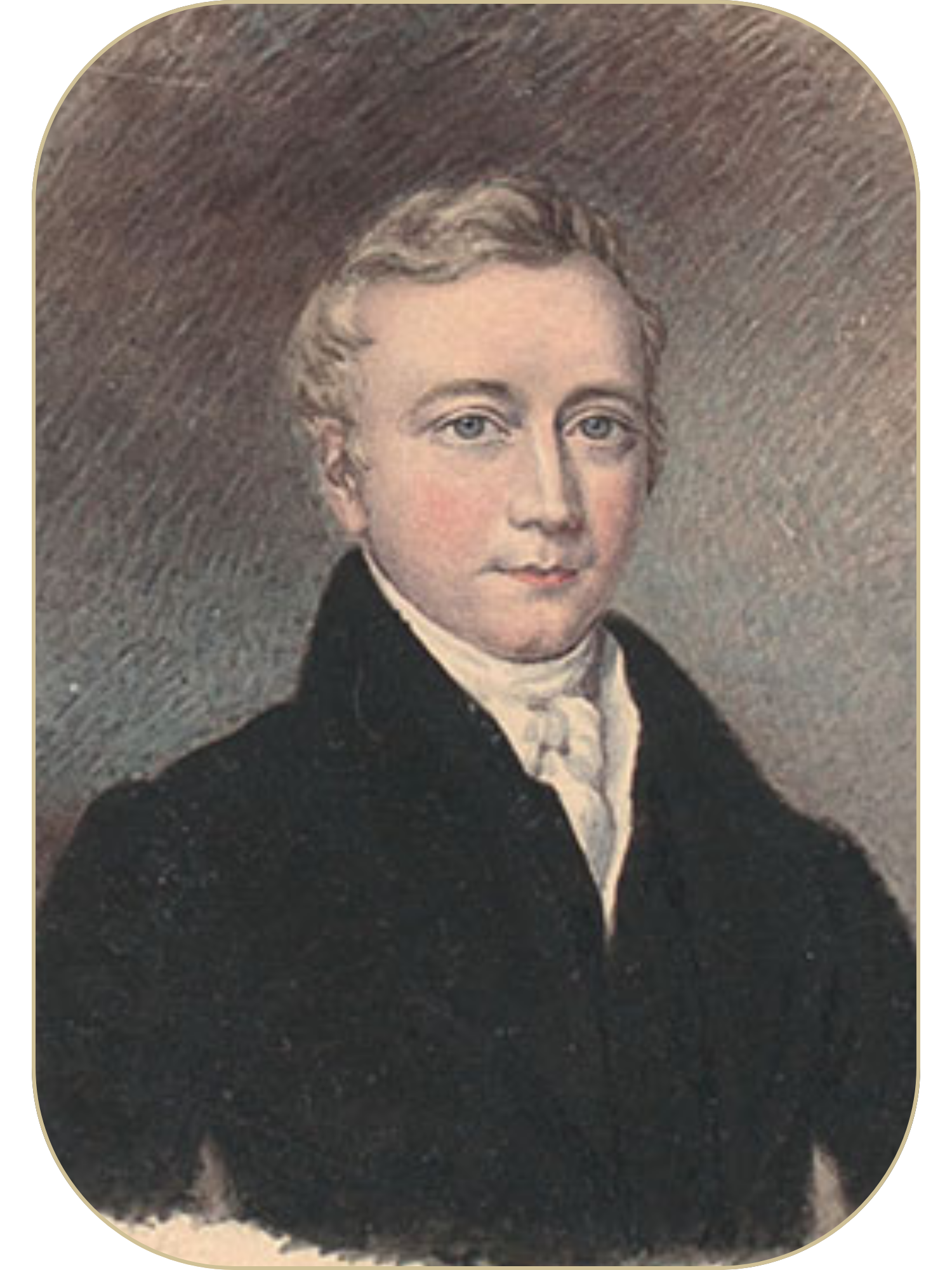
An anonymous miniature watercolor portrait of Rowland Stephenson, “a man who was accustomed to shuffle thousands before breakfast,” according to author and descendent Paul Bangay.
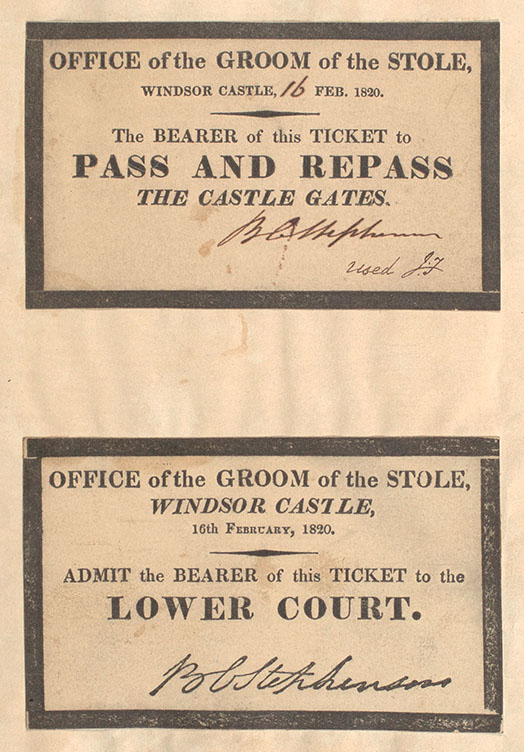
Stephenson’s passes for entry to Windsor Castle for the burial of the remains of King George III in the Royal Vault, February 16, 1820, signified his membership in the upper echelons of British society.
When Stephenson and Lloyd landed in Georgia on February 28, they were dismayed to find their story in the American papers, including their descriptions, details of their expected arrival in Savannah, and the posting of an additional reward by a retired sheriff of London turned bounty hunter, Joseph Parkins. Parkins, a notorious hothead, already had a history with Stephenson over past political confrontations. Parkins also was a significant depositor at the failed Remington, Stephenson & Co. He happened to be in the United States and was more than eager to pursue the case on behalf of the bank as well as for himself. It was personal.
Alerted to Stephenson’s presence by these same news reports, William Oates, Deputy Jailer of Savannah quickly apprehended Stephenson, bound him, locked him in the cabin of a fast pilot boat, and sailed up the coast to New York City, intending to hand him over to the British Consul and collect the rewards. Acting on word that Stephenson was being held against his will in New York Harbor, the chief constable of New York located and took charge of Stephenson. A battered but much relieved Stephenson stayed comfortably in a room in the constable’s house, even dining with British Consul James Buchanan. The news that the now notorious embezzler Rowland Stephenson was in New York spread like wildfire, along with public outrage that “foreign agents” were operating inside the country to apprehend him, in violation of the sovereignty of the United States.
A hearing in front of a New York judge went badly for the many parties interested in prosecuting Stephenson. The various warrants from Britain were ruled to be invalid, British Consul Buchanan refused to testify on William Oates’ behalf, and a writ was issued to apprehend Oates and his gang from Savannah for kidnapping. The judge was particularly unimpressed with the quarrelsome Parkins, who could not demonstrate any authority on American soil. The court recorder announced that Stephenson was at liberty and free to leave as cheers rang out.
Having fled New York, Parkins’ Savannah gang were arrested and prosecuted in Georgia. Strapped for cash, Parkins himself eventually landed in the same debtors’ prison that had previously held Stephenson. Deeply embittered, in 1938 he published a pamphlet, An Abridged Correspondence Between J. W. Parkins And His Late Bankers. Messrs. Remington, Stephenson & Co. London (S.l., [1829?]), complaining about the gross injustice of his situation and that “the reader … will be ready to acknowledge that Mr. Parkins is the most victimized man he ever read of.” James Lloyd is recorded as having married in 1833 in Georgia but disappeared after that.
With assistance from his eldest son, Stephenson acquired an estate in Bucks County, Pennsylvania. In 1848 he became a naturalized citizen. Rowland Stephenson passed away in Bristol, Pennsylvania, in 1856 at the age of 74. His last will reveals a life of comfort, short of extravagance. Scrapbooks were listed among his final possessions.
At the Clements Library in 2005, a worn and fragile scrapbook with pasteboard and leather binding landed on my desk. It was acquired on one of Director John C. Dann’s expeditions into the depths of John King Books in Detroit. I recall him telling me, “It’s British, not much American content. Seems to be a fine early example, worth having. Have a look and let me know what you think.” I have been thinking about it ever since.
In format, it is typical. In content, exceptional and mysterious. Spanning roughly 1820–1850, it includes carefully handwritten charts outlining the costs of a royal coronation, the debts of the Prince Regent George IV, tables of tax revenues, brief written histories of The Bank of England, and a willow sprig from the grave of Napoleon Bonaparte at St. Helena. With these are mixed popular prints from magazines, clippings regarding remarkable lives and deaths, lottery tickets, forged bank notes from the Bank of England (forgery being a capital crime at the time), humorous poems and sayings, over 100 clipped autographs of Members of Parliament and other British notables, and invitations to royal events at Windsor Castle and Buckingham Palace, including the funeral of George IV and the coronation of Victoria. Also tipped in are a few amusing manuscript letters, related to parliamentary affairs, and one fine miniature watercolor portrait of a gentleman.

The mysterious compiler of the Rowland Stephenson scrapbook was fascinated by all things financial, including the lottery. Sometimes decried as a form of government supported fraud and beset by forgeries and dodgy ticket-sellers, the lottery became the subject of review by a committee appointed by the British government. The committee reported that “under no system of regulations which can be devised will it be possible for Parliament to adopt it as an efficient source of Revenue, and at the same time divest it of all the evils and calamities of which it has hitherto proved so baneful a source.” The British lottery was suspended in 1826, and was reinstated in its current form in 1994.
Upon further study, a common thread began to emerge, having something to do with banking, personal debt, the costs of royalty, and financial crimes. A name, not known to me at the time, Rowland Stephenson, MP, appeared frequently as the addressee of the manuscript letters, the guest of royal event invitations, and the subject of the watercolor portrait. His name also appeared in a newspaper clipping announcing the reward for information leading to his arrest. A quick look into his entry in the Dictionary of National Biography found this: “Stephenson’s parliamentary career was distinguished solely by his manner of leaving it.” I was certainly intrigued and began to gather as much information as I could find on this absconder to America.
There is a distinctive handwriting throughout the scrapbook, however, it does not resemble Stephenson’s. Some of the material, of British origin, dates from after his 1828 escape to America, so it is very unlikely that this scrapbook was compiled by Stephenson. However, the personal nature of much of the contents—invitations, letters, etc.—are undoubtedly material that passed through his hands. Whose scrapbook was this and how did it get to America? Was it compiled by someone close to Stephenson (his sister-in-law, who lived at his estate?), or possibly a contemporary “true crime” memorabilia collector who attended the bankruptcy auctions of Stephenson’s personal property in England? In any case, the contents indicate it was probably assembled in Britain, well after Stephenson and Lloyd departed.

Forged Bank of England note, 1818. A chilling artifact given that forgery was a capital crime punishable by hanging. The severity of the punishment indicated both the era’s deep reliance on paper currency and credit, and the relative ease of producing credible looking fakes, such as this example. Rowland Stephenson was accused of other capital crimes, but not forgery.
In 2021 I was in touch with Dr. Paul Bangay, a descendant of the Stephenson family and the author of a carefully researched and detailed account of his relative in The Dapper Little Banker (Lancaster, England, 2011). Bangay was not aware of the scrapbook. I was excited to share images from it, and he enjoyed seeing them. He did not recognize the handwriting, nor offer a theory on how and why it could have landed in America. Much of the information in this article was drawn from Paul Bangay’s book, which is a captivating read.
Stephenson’s story is a complicated one which elicits a complicated response. Americans have a history of sympathizing with the fugitive and the outlaw. Nationalist pride and indignation also drove America’s defense of this financial scoundrel and protected him from prosecution. However, as we have re-learned of late, the collapse of financial institutions and the crime of embezzlement are not victimless. One wonders how a similar dramatic tale chronicling the experience of one of Stephenson’s victims would alter our perceptions.
Supreme Nonsense: The Ancient Band of the Anderson
Jakob Dopp
Graphics Division Cataloger
Whether or not people can truly interact with spirits of the deceased has long been a subject of controversy and fascination. Skeptics of 19th-century spiritualism often leveled accusations of financially-motivated fraud against the likes of William H. Mumler, Madame Diss Debar, and Tennessee Claflin, to name a few. Indeed, even the most enthusiastic proponents of spiritualist practices found themselves at times questioning the credibility and intentions of others within their ranks. The Clements Library holds a particularly wonderful example related to what this author considers to be an instance of fraudulent spiritualism, the Wella and Pet Anderson spirit drawings photograph album.
A total of 26 cabinet cards compiled by a Chicago-based spiritualist named John C. Bundy comprise the album, all of which photographically reproduce hand-drawn portraits of spirits created by married spiritualist duo Wella and Lizzie “Pet” Anderson. Originally from Maine, the Andersons became established in Brooklyn, New York, in the 1860s. Pet’s role was that of the trance medium who facilitated contact with the dead, while Wella served as a conduit through whom spirits could execute portraits of themselves. An Anderson spirit drawing could be completed in two to three hours, with Wella working in 10 to 12 minute bursts, often while in a darkened room and at times even blindfolded. Wella claimed to have had no previous artistic training or experience.
While the Andersons initially rendered spirit drawings on demand for people looking to connect with deceased relatives, they embarked on a different venture in the 1870s. Collaborating with fellow spiritualists Dr. James Cooper of Ohio and “General” Jonas Winchester (1810–1887) of California (a mining executive and first state printer of California), the Andersons relocated to San Francisco in November of 1870 in order to further explore a blossoming relationship with what can only be described as an allstar team of extraordinary spirits. This 28-member assemblage was dubbed The Ancient Band, and they supposedly had long been secretly guiding the progress of humanity from the spirit realm where they resided. Dr. Cooper claimed to have independently made first contact with The Ancient Band in 1857, while the Andersons only became aware of their existence during a séance with Winchester in 1869. The Ancient Band soon began to impress themselves so deeply upon the Andersons that even when they attempted to produce portraits of deceased relatives for customers, all they could conjure were portraits of members of the group. In 1874, the Andersons and Jonas Winchester put on an exhibition of portraits of Ancient Band members and published a descriptive catalog, The Biographical and Descriptive Catalogue of “The Ancient Band” (New York, 1874), that provided background details for each member of the group. Photographs of the exhibited portraits were copyrighted by the Pacific Art Union, a corporate entity controlled by Winchester.
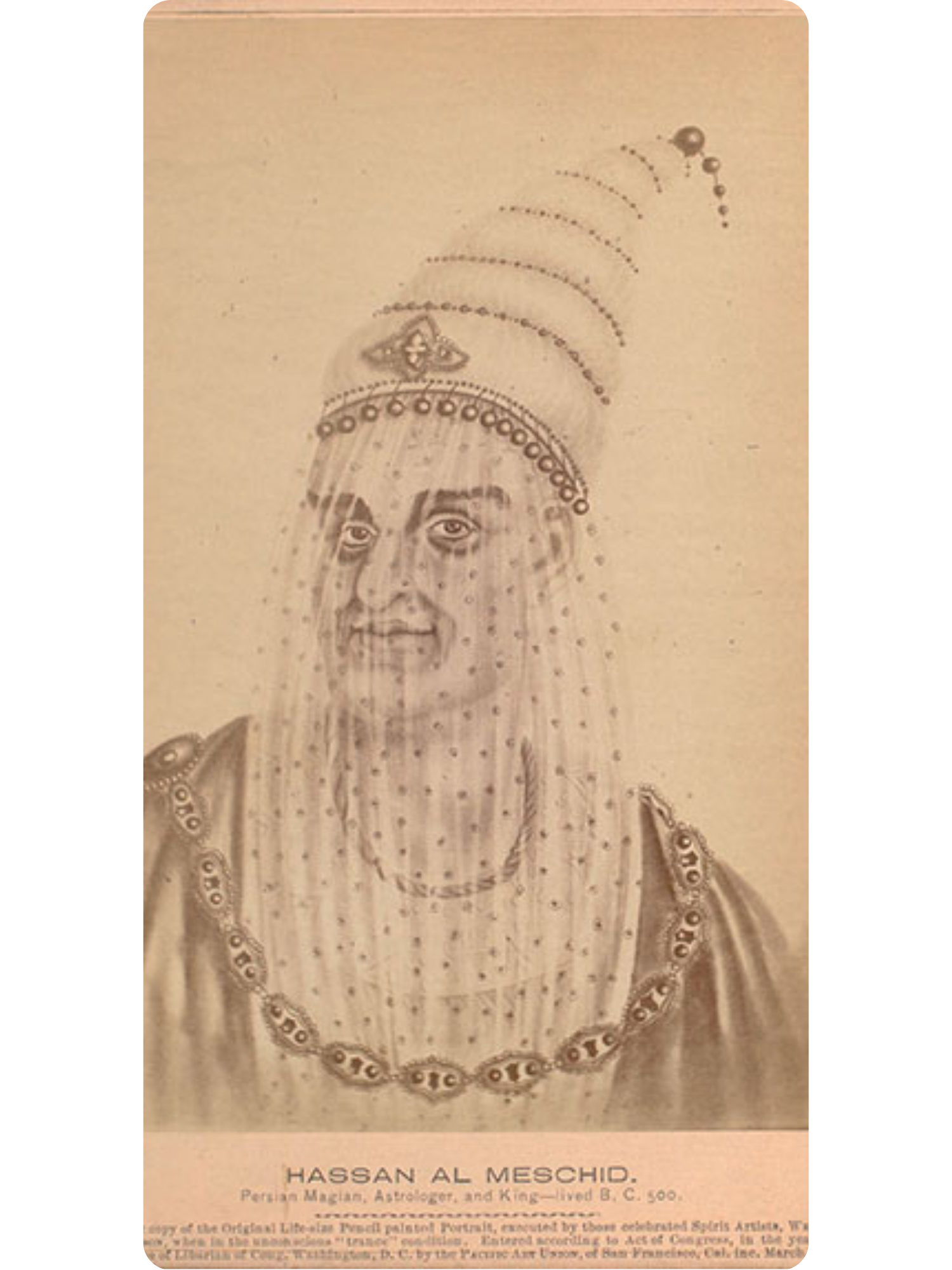
Hassan al Meschid was perhaps intended to inspire awe and mystery with the cryptic symbols on his headwear and his veil (“a most beautiful illusion which few painters can equal”). According to the Andersons, al Meschid was a wise philosopher and astrologer in Persia in the early 600s B.C., killed when he attempted to depose a cruel ruler.

The problematic portrait of “Confucius, The Great Chinese Reformer and Sage” that raised suspicions with San Francisco’s Chinese community and armed skeptics of the Andersons with ammunition to support claims of fraud.
Numerous members of The Ancient Band were in fact real historical figures including Anthony van Dyck, Omar ibn Al Kattab, Abelard and Heloise, Plutarch, Pindar, Alfred the Great, and Gautama Buddha. However, more than a few were complete fabrications cleverly constructed with a veneer of plausibility. For instance, there was “Henri de Brianville,” an English knight and alchemist who lived during the reign of Charles I; “Adehl,” an ancient necromancer from India who lived to the ripe old age of 180 after inventing an Elixir of Life; and “Dawn,” a young woman born in Massachusetts in the 1770s who perished just one hour into the dawning of her existence (hence the name).
Even aspects of some of the real historical figures don’t quite add up. In the descriptive catalog, the Andersons showcased their portrait of a ponytailed Confucius to the “learned and wealthy Chinese merchants” of San Francisco’s Chinatown. The response of the Chinese critics was to enlighten the Andersons that during the lifetime of Confucius (ca. 551–479 BCE) the queue (braided hairstyle) was not worn, the custom having been established only a few hundred years ago by edict, as a badge of loyalty to the present reigning [Manchurian] dynasty.” Apparently, this anachronism was used as proof that the Andersons’ spirit drawings were in fact fraudulent, “thereby discrediting the correctness of the Spirit Artist.” However, the Andersons attempted to explain away this gaffe by claiming that, much like Samson of the Old Testament, Confucius “believed in the idea that there was a power in the hair, which added to physical health and mentality” and that he “wore it braided, to keep it out of his way.” The fact that the Andersons felt compelled to defend themselves against the charges of fakery speaks volumes about the perceived threat to their reputations it must have posed at the time.
The most peculiar (and dubious) of all the Ancient Band depictions in this album are two portraits of individuals named Orondo and Atyarrah, both of whom were supposedly high-ranking members of a civilization occupying the lost continent of Atlantis. It was claimed in the descriptive catalog that they had both been alive during the time of their homeland’s sudden destruction. Atyarrah was said to be a military official leading an expedition in North America at the time of Atlantis’s fall, while Orondo (an eight foot tall engineer with a supreme talent for mining) was described as being intimately involved with salvaging the remnants of Atlantean civilization by brokering a network of strategic intermarriages with indigenous tribes of North America. For this reason, Orondo was billed as “Father of the Mound Builders.” The catalog claimed that integration of Atlantean genius was the reason certain Native American civilizations (such as the Mayans, Aztecs, Incas, Mound Builders, etc.) reached such astounding heights of sophistication and cultural complexity. The Atlanteans were even said to have undertaken “formidable invasions of Europe and Africa” while also populating the Indian subcontinent, where they introduced the caste system of social hierarchy. Such ideas are of course not only false, they are also offensive to the civilizations they misrepresented.
Ultimately, The Ancient Band project turned out to be a commercial flop, perhaps unsurprising given Jonas Winchester’s well-documented reputation as an incorrigible spendthrift. In the aftermath of the exhibition’s failure, Pet filed for divorce from her husband, and her petition was granted in 1877. While Wella appears to have returned to the East Coast and continued the practice of spirit drawing, Pet stayed out West for a time and even took out newspaper ads in San Francisco and Denver advertising services as a stock tip medium, trance medium, and psychic locator of undiscovered mines.
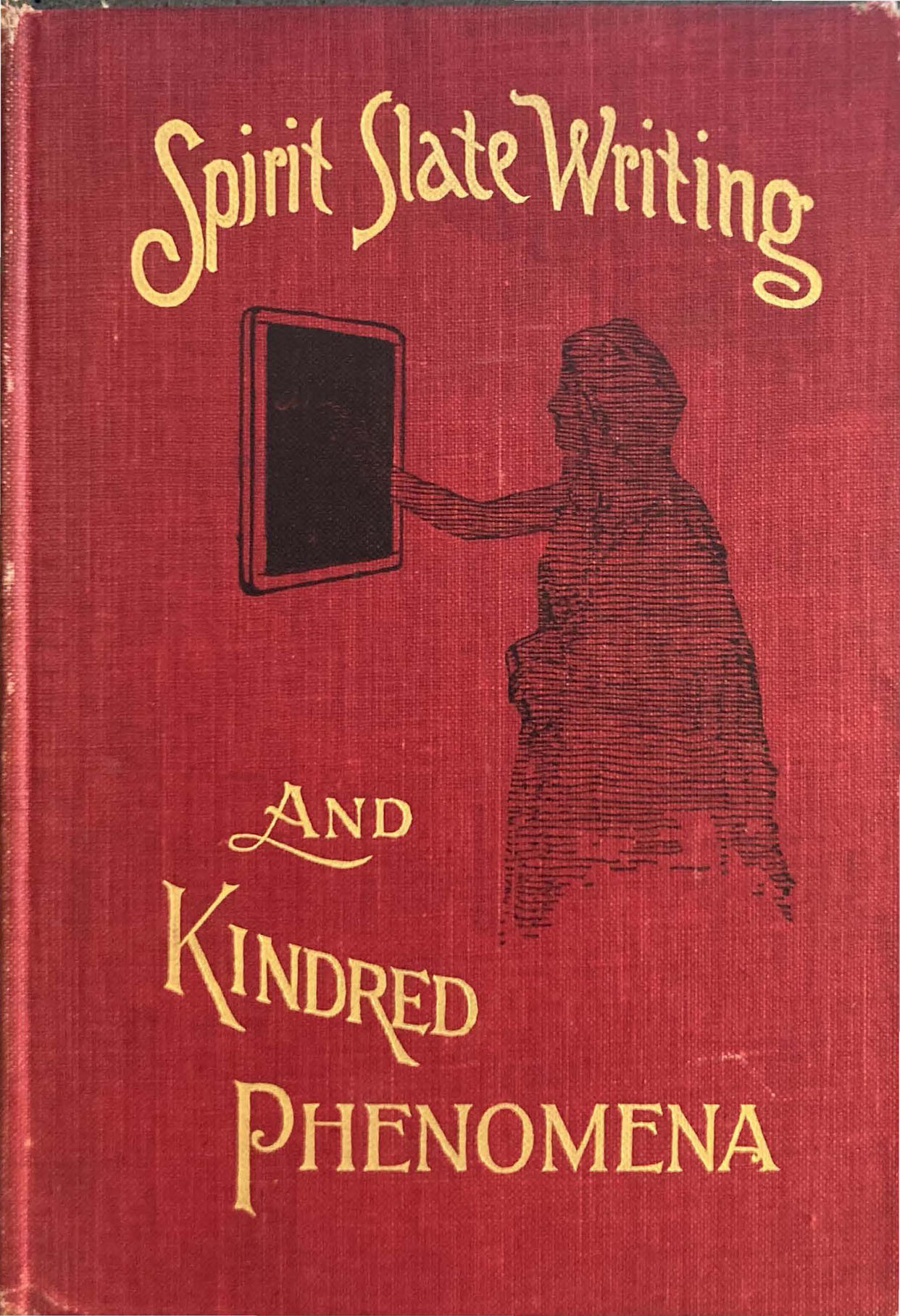
In the late 19th century when the Anderson’s were practicing their craft, others were attempting to warn spiritual seekers to be on the lookout for frauds. William Robinson (1861–1918), assistant to noted magician Alexander Herrmann (1844–1896) and author of Spirit Slate Writing and Kindred Phenomena (New York, 1898), walked a fine line. “The author of the present volume is not an opponent of spiritualism— on the contrary, he was brought up from childhood in this belief”; rather he attempted “to explain the methods of those who, under the mask of mediumship . . . victimize those seeking knowledge of their loved ones who have passed away.” Robinson’s book provided detailed descriptions and engravings to illustrate methods of deception used by charlatans in the field.

The deceased had many means of communicating with spiritual seekers. This stereograph, published by H. P. Moore in 1869, shows two women with their hands on a planchette, which would either be equipped with a pencil to convey a written message, or used on a Ouija board to select letters and numbers. The ghostly presence at rear no doubt directed the action.
Finally, Eunice White Beecher (1813–1897) (widow of clergyman Henry Ward Beecher and sister-in-law to author Harriet Beecher Stowe) had much to say about Pet Anderson and numerous other spiritualist mediums who began contacting her shortly after her husband’s death. In an interview included in the February 19, 1893, issue of the St. Louis Globe, Mrs. Beecher stated that shortly following the passing of her husband, “Spiritualists seemed to look upon me as their legitimate prey or object of conversion. . . . A clergyman in Chicago gave me a great deal of annoyance by sending letters in which he said Mr. Beecher had been heard from in the other world and that he said for twenty years he had been preaching error.” Another letter claimed that “Mr. Beecher had sent word from spirit land through ‘Pet’ Anderson, a female medium, that he had been in error for fifty-five years. Then the man wrote me begging me to let ‘Pet’ Anderson come here and stay with me for two or three days . . . Then he sent me what he called a sermon of Mr. Beecher’s, which he said had been communicated from spirit land.” When asked by the reporter if she thought the sermon was true to her husband’s style, Mrs. Beecher responded, “I hope none of his friends ever accused him of preaching anything like that. It was the most preposterous, childish nonsense that was ever penned. I could not imagine how such supreme nonsense could be conceived.” Nonsense or not, the human impulse to connect with the deceased and confirm the existence of an afterlife can be powerful. People like the Andersons skillfully manipulated these desires into opportunities for profit.
Collection Encounters: Confessions of a Curator
Jayne Ptolemy
Associate Curator of Manuscripts
I have a confession. I hated early American history for much of my pre-adult life. The Jamestown colony, Federalists, the Missouri Compromise, robber barons. I hated all of it. It just felt so stuffy, so distant, and so boring. It wasn’t until I went to college and got to really study and wonder about the details of everyday life and the strange qualities of the human condition that I got hooked. In the spirit of what allowed me to fall in love with the past, I want to offer a selection of items that flag those lighthearted, quirky moments that provide openings to rejoice in the people we encounter in the collections.
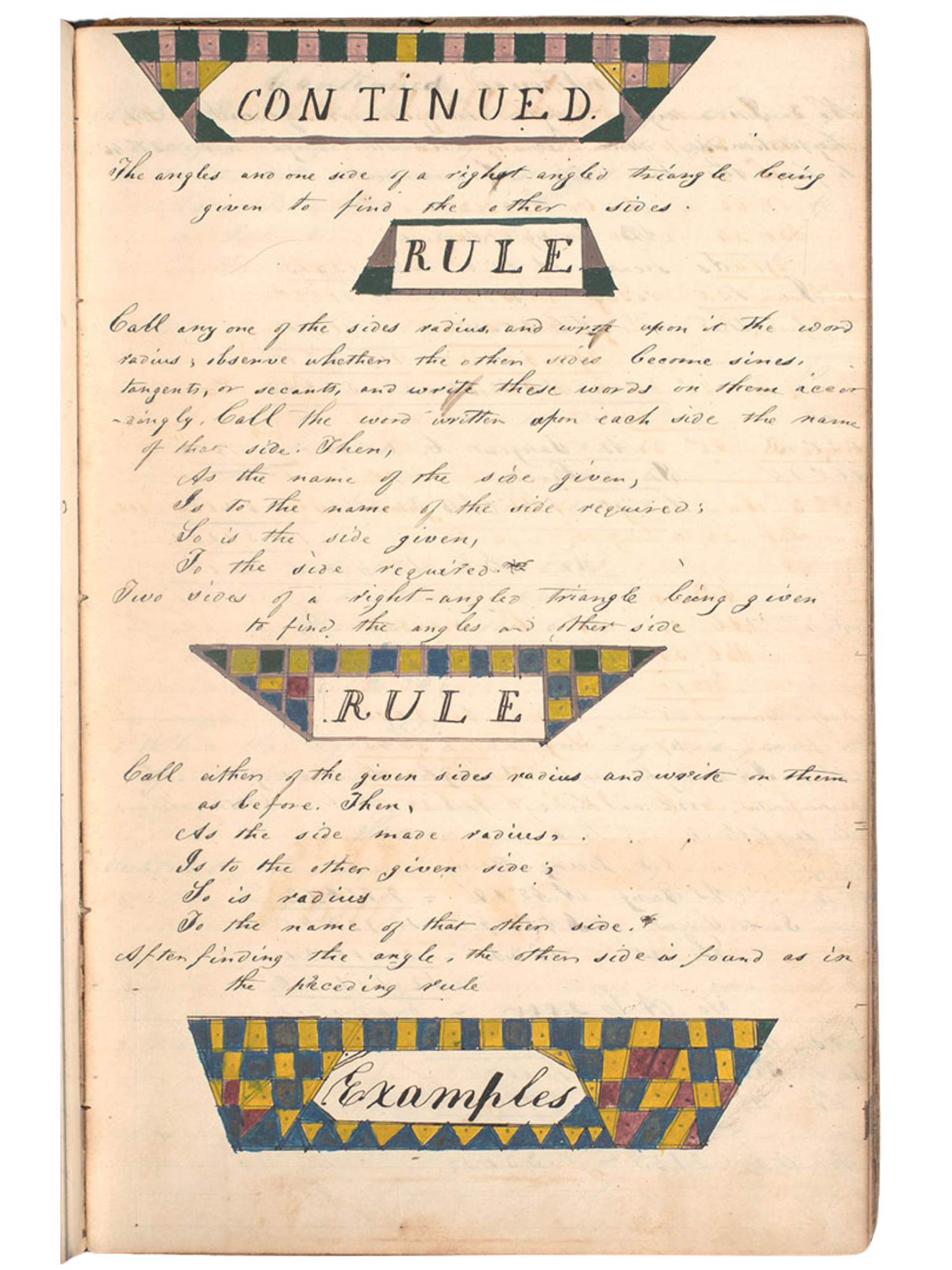
Perhaps few things seem less joyful to most of us than trigonometry. But recently, while processing new purchases, I had the delight of reviewing a young Leo Engleman’s cypher book. Mixed in with examples and problems and scratch marks made by protractors, are exquisitely colorful geometric designs doodled by a bored thirteen-year-old. They serve to remind us that math and art are not so far apart, and that even focused school work has its whimsical wanderings that help us better imagine the boy behind the problem sets.
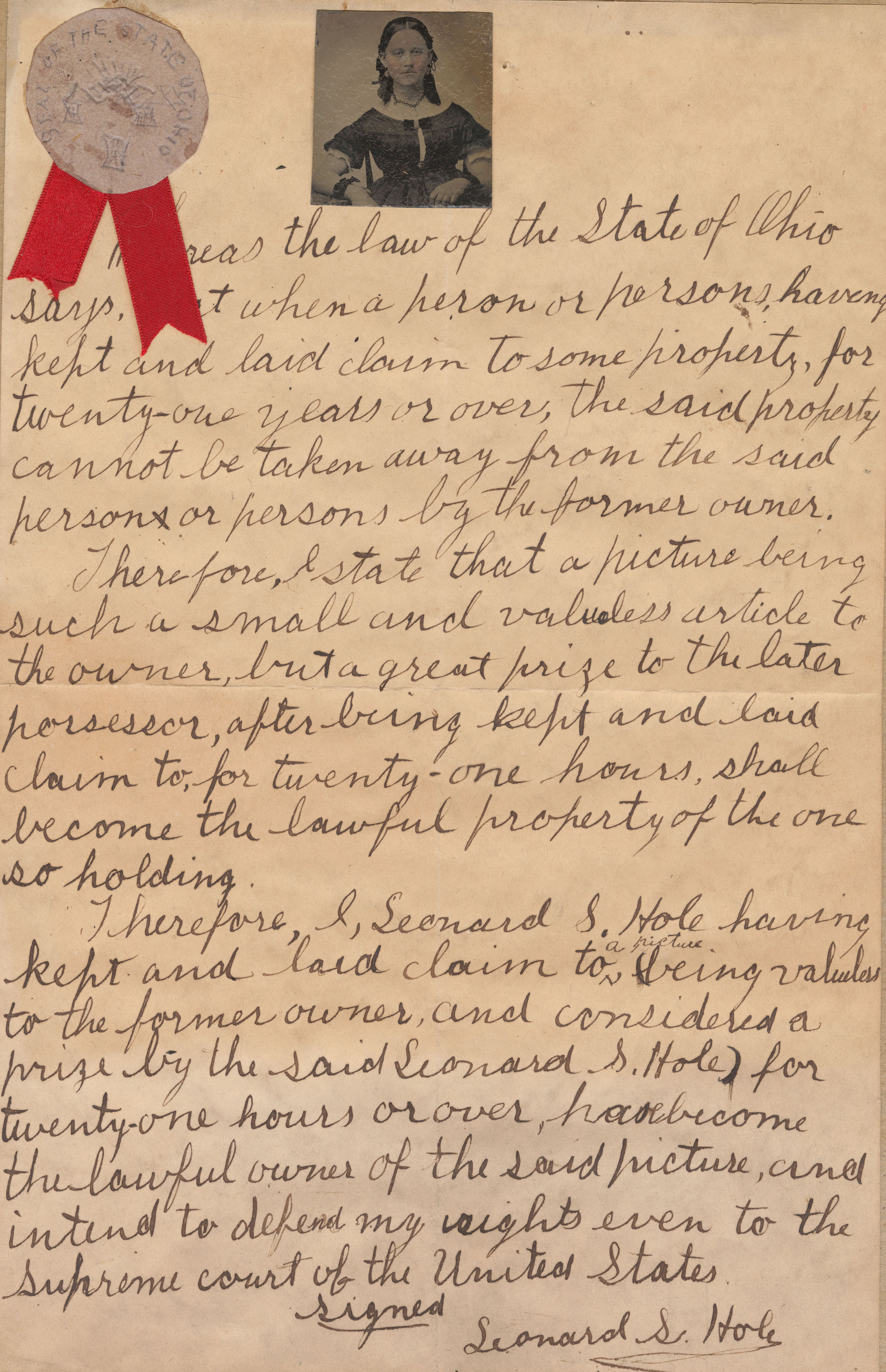
Threats of facing legal proceedings are also, generally, not much fun! It’s the subversion of those weighty expectations of confrontation and boredom that make this piece we are integrating into our Law, Crime, and Punishment Collection so stunning. Here, Leonard S. Hole created a mock legal form laying claim to a small tintype of a girl, citing Ohio law of possession to justify his holding onto the treasure. Now it is part of the Clements holdings, pointing us to the surprisingly playful ways property law can help us better understand social (and perhaps burgeoning romantic?) relationships.
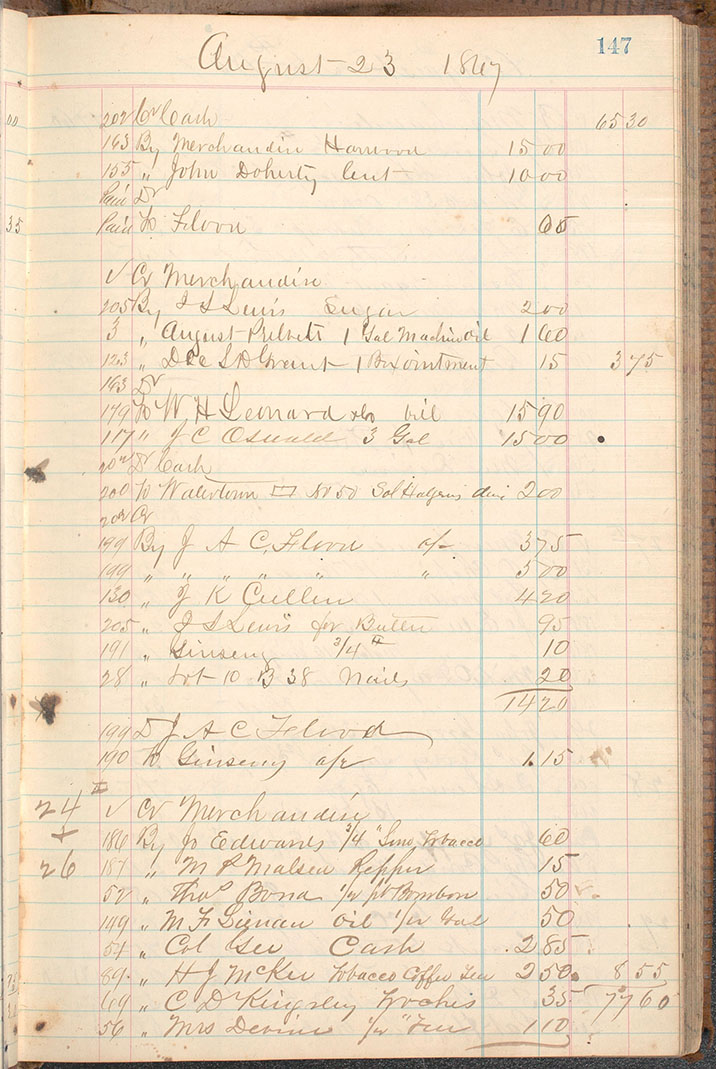
Few things can make your eyes cross faster than a 300-page financial ledger, but every once in a while you stumble across something that just makes you burst into laughter, like these two unfortunate flies splatted on the page of Georgiana Lewis’s daybook on August 23, 1867. You can just imagine her standing sweaty in the store, tending to sales of foodstuffs and general merchandise on a sweltering summer day, plagued by buzzing flies. Can’t you viscerally feel that rush of joy she might have felt when she slammed the book and got two of them! It was those two flies that rocked me out of skimming the numbers and just moving through the volume and allowed me to slow down and remember to focus on Georgiana.
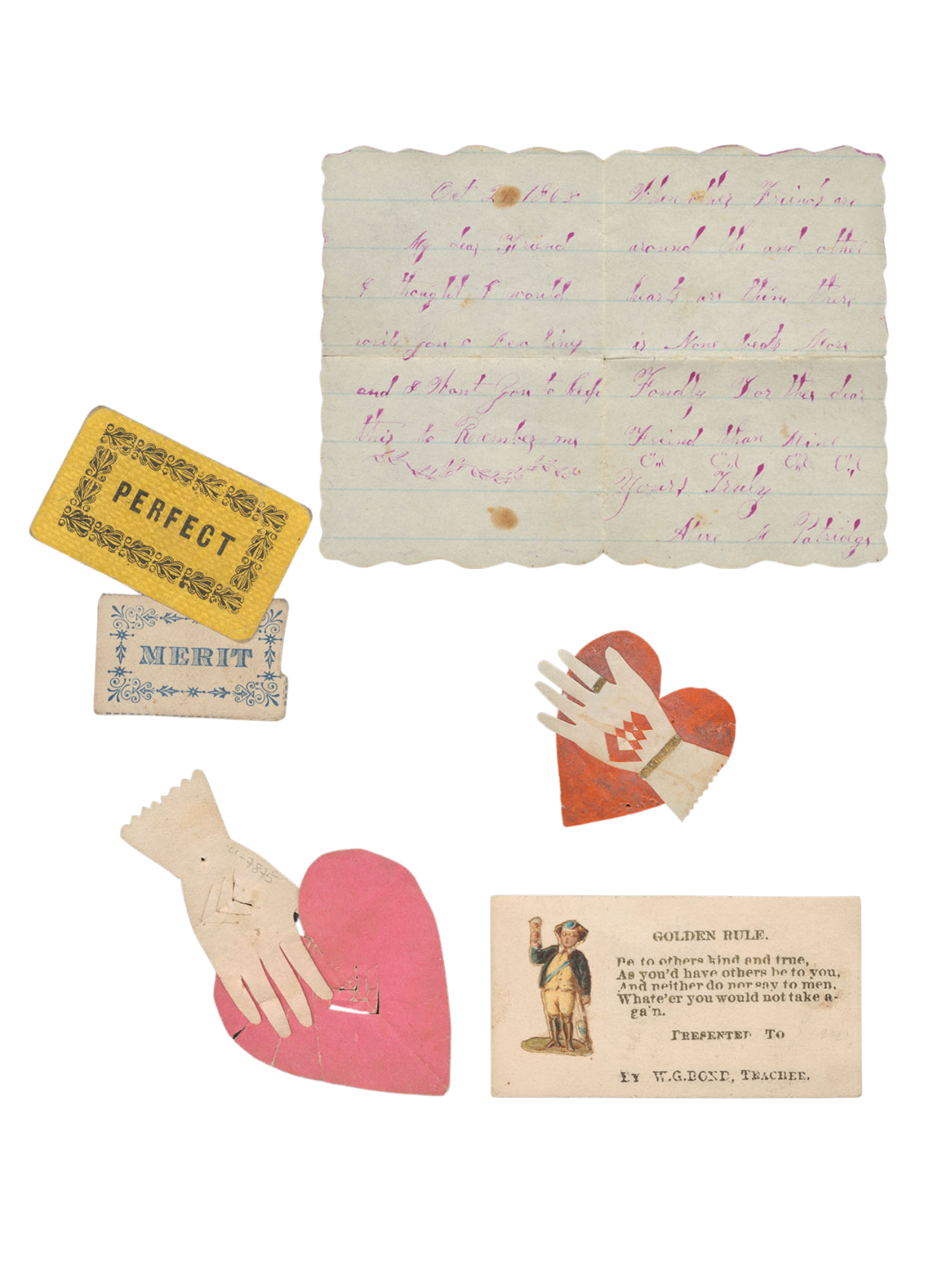
These small moments bring the people back to the forefront of our minds and enliven their histories. A small diary kept by Nannie N. Linscott reminded me powerfully of this lesson. Thumbing through it the first time, I admit to feeling a little irritated. She wrote barely anything, and when she did her entries for the day mostly read like the following: “Had a music lesson.” Well. How do I write a finding aid for that? But then, tucked quietly into the back pocket of the diary, were a handful of treasured things: hand-cut valentines, rewards of merit, a poem penned on miniature, scalloped paper. And there she was! Now I could see and connect to Nannie, be excited by her story, even if it was mostly just quiet days peppered by the occasional music lesson, because there’s personality and personhood behind it all that brings that spark to our eyes. Perfect, indeed.
Developments & Staff News
Developments: Philanthropists, Heroes, and Helpers
Angela Oonk
Director of Development
Luckily, the stories I have to tell are the antithesis to the title of this publication. The donors to the Clements Library form the community that we call the Clements Library Associates. I am delighted to interact with philanthropists, heroes, and helpers every day.
Mrs. Ross’ false claims of kinship brought to mind true family connections. Ben Upton serves on the Clements Library Associates Board of Governors in the footsteps of his mother Harriet Skinner Upton who was the first woman to Chair the Board from 1979-1985. Ben and his siblings, Betsy Stover and Margy Trumbull, were delighted to realize that their mother would have also celebrated her 100th birthday during the centennial year of the Clements Library. To honor her memory, they provided matching funds for a Giving Tuesday crowdfunding project in support of conservation. The Upton family sees the importance of preserving the Clements collections for present and future use. Support for the Clements permeates throughout the Upton family with many grants awarded through the Frederick S. Upton Foundation. The most recent grant helps fund a 2-year graduate assistantship created in partnership with the School of Information.

Clements Associate Curator of Manuscripts Jayne Ptolemy (center) discusses items on display at the Adopt a Piece of History Fest with attendees Laura Craig and Dekyi Sonam. (U-M Photo Services, Eric Bronson).
“Adopt a Piece of History” donors are recognized on virtual bookplates on the Clements Library webpage.
We closed out our Centennial Year with an Adopt a Piece of History Fest which brought us full circle. William Clements created the library through his own philanthropy, and encouraged funding for future additions to the collection. This event celebrated new acquisitions, and provided the opportunity for attendees to see items first hand, and sponsor the purchase of historical materials, their conservation, and their use in instruction. Over twenty-five items were adopted in one evening. Donors are listed in a virtual bookplate gallery on the Clements webpage. The celebratory tea-party atmosphere provided ample opportunity for everyone to mingle and to meet Clements staff members.
The Clements Library has always been as much about the people as the collections. On June 15, 1923, at the luncheon preceding the dedication of the Clements, George Winship had this to say, “The William L. Clements Library places the University of Michigan in a distinguished position for the teaching of our country’s history, and for training scholars.” As we enter our second century, we give our gratitude to everyone who participates in and believes in the work of the library.
Joanna and James Davis pose with their adopted item, a menu from the 1891 meeting of the “Prisoners of War” in Attleboro, MA (U-M Photo Services, Eric Bronson)

Staff News
Sierra Laddusaw joins the Clements Library as the Curator of Maps and Graphics. Sierra obtained a B.A. from Ouachita Baptist University in 2008, an M.L.S. from Texas Woman’s University in 2015, and is currently working towards a M.S. in Geographic Information Science from Northwest Missouri State University. Sierra comes to us from her role as the Curator of Maps and Co-Curator of the Chapman Texas Collection at Cushing Memorial Library, Texas A&M University, and the Scholarly Communication Librarian at the University of Arkansas–Fort Smith. She has written on the role of maps and spatial data in information literacy, popular culture in libraries, and bibliometrics. As curator, Sierra manages the operations of the Maps Division and the Graphics Division, including collection development, providing research assistance, and participating in instruction with the library’s primary source materials.


The Development team welcomes Tiffani Irhke as the new Marketing Coordinator. Tiffani graduated from the University of Michigan in 2023 with a dual bachelor’s degree in Psychology and Communication, and Media Studies. Tiffani is passionate about creating visibility and awareness for the library, and giving a platform to underrepresented voices and communities. Tiffani manages all digital marketing through social media, content creation, blog content, email newsletters, and website development. She also handles press releases, event publicity, and creates print materials and merchandise.
Digitization technician Meghan Ahrends joins the Clements Library to work on scanning and creating metadata for library materials, with a focus on the Henry Clinton Papers. Meghan earned a B.S. in History from Grand Valley State University, and an M.A. in History and Graduate Certificate in Archives from the University of Massachusetts Boston. Previously, Meghan worked as an Archives Assistant for the UMass Boston Archives & Special Collections and completed internships with the National Park Service and UConn’s Archives & Special Collections.


Randolph G. Adams Director of the Clements Library
Paul J. Erickson
Committee of Management
Santa J. Ono, Chairman
Gregory E. Dowd, Derek J. Finley, James L. Hilton, David B. Walters.
Paul J. Erickson, Secretary
Clements Library Associates Board of Governors
Bradley L. Thompson II, Chairman
John R. Axe, John L. Booth II, Kristin A. Cabral, Candace Dufek, Charles R. Eisendrath, Derek J. Finley, Eliza Finkenstaedt Hillhouse, Troy E. Hollar, Martha S. Jones, Sally Kennedy, Joan Knoertzer, James E. Laramy, Thomas C. Liebman, Ole Lyngklip, Richard C. Marsh, Janet Mueller, Drew Peslar, Richard Pohrt, Catharine Dann Roeber, Estrella Salgado, Anne Marie Schoonhoven, Arlene P. Shy, James P. Spica, Edward D. Surovell, Irina Thompson, Benjamin Upton, Leonard A. Walle, David B. Walters, Clarence Wolf.
Paul J. Erickson, Secretary
Clements Library Associates Honorary Board of Governors
Peter N. Heydon, Chair Emeritus
Joanna Schoff, Harold T. Shapiro
Clements Library Associates share an interest in American history and a desire to ensure the continued growth of the Library’s collections. All donors to the Clements Library are welcomed to this group. The contributions collected through the Associates fund are used to purchase historical materials. You can make a gift online at leadersandbest.umich.edu or by calling 734-647-0864.
Published by the Clements Library
University of Michigan
909 S. University Ave. • Ann Arbor, Michigan 48109
phone: (734) 764-2347 • fax: (734) 647-0716
Website: https://clements.umich.edu
Terese M. Austin, Editor, [email protected]
Savitski Design, Ann Arbor
Regents of the University
Jordan B. Acker, Huntington Woods; Michael J. Behm, Grand Blanc; Mark J. Bernstein, Ann Arbor; Paul W. Brown, Ann Arbor; Sarah Hubbard, Okemos; Denise Ilitch, Bingham Farms; Ron Weiser, Ann Arbor; Katherine E. White, Ann Arbor.
Santa J. Ono, ex officio
Nondiscrimination Policy Statement
The University of Michigan, as an equal opportunity/affirmative action employer, complies with all applicable federal and state laws regarding nondiscrimination and affirmative action. The University of Michigan is committed to a policy of equal opportunity for all persons and does not discriminate on the basis of race, color, national origin, age, marital status, sex, sexual orientation, gender identity, gender expression, disability, religion, height, weight, or veteran status in employment, educational programs and activities, and admissions. Inquiries or complaints may be addressed to the Senior Director for Institutional Equity, and Title IX/Section 504/ADA Coordinator, Office of Institutional Equity, 2072 Administrative Services Building, Ann Arbor, Michigan 48109-1432, 734-763-0235, TTY 734-647-1388, [email protected]. For other University of Michigan information call 734-764-1817.