

No. 61 (Spring/Summer 2025)
Love and Rockets
Paul J. Erickson
Randolph G. Adams Director
William L. Clements Library

The Cincinnati Observatory, opened in March 1845, was the first public observatory in the Western Hemisphere. Shown here is its second building—the original 11-inch telescope was moved in 1873 to a new observatory farther from downtown.
On January 29, 1859, Professor Ormsby Mitchel (1810–1862) delivered a lecture at the Academy of Music in New York titled “The Great Unfinished Problems of the Universe,” as the conclusion of his well-attended “Course of Five Popular Lectures on Astronomy.” Before the lecture, the gathered worthies passed a series of resolutions related to the construction of an “Astronomical Observatory” in Central Park, which had only partially opened the previous year. Mitchel was an appropriate guest for this honor, as he was at the time the best-known American popularizer of astronomical knowledge. A college professor and engineer based in Cincinnati, Mitchel took the lead in raising funds to build the Cincinnati Observatory and to purchase a suitable telescope. When it opened to the public in March 1845, the observatory housed the second-largest refracting telescope in the world.
Through his writing, lecturing, and fundraising, Mitchel was instrumental in spreading awareness of the new science of astronomy in the antebellum United States. In the first issue of The Sidereal Messenger (Cincinnati, 1846–1848), a periodical Mitchel launched in 1846, he wrote that the new wave of interest in the heavens called for the creation of more knowledge for general readers on “a subject which for the first time they are permitted to investigate by sight, and not by faith only.”
American writers and readers had of course long been interested in the notion of ascent, but mostly out of an interest in the perspective that a view from the heights would afford. That is to say, they were interested in looking down instead of up. The Clements Library’s large collection of bird’s-eye view prints are an example of this impulse, but it also took other forms. Several writers in the 19th-century United States imagined voyages to outer space, or encounters with extraterrestrial beings. A short interlude in Washington Irving’s A History of New York (New York, 1809) muses on the views that European settlers had of the Americas when they first crossed the Atlantic, and for comparison imagines a conquest of the Earth by “Lunatics,” little green men with tails who carried their heads under their arms and arrived from the moon on ships that slid down moonbeams. They transported the rulers of all the nations of Earth back to the moon, where the Man in the Moon, shocked by the barbarity of the earthlings, declared the entire planet to be a lunar possession.
In 1813, George Fowler published A Flight to the Moon, or, the Vision of Randalthus, a narrative in which the titular character is conveyed to the moon in an ethereal cloud. The narrator spends 175 pages explaining the science, politics, religion, and society of Earth to the Lunarians, a gentle race of blonde, blue-eyed moon people who were technologically far behind their terrestrial neighbors. Having nearly bored the Lunarians to death, Randalthus ensured that we had nothing to fear from a lunar invasion. At the end of the narrative, he also made a brief visit to the sun, which turned out to be hollow. Its interior was inhabited by a darkhaired, quick-tempered people who were somehow spared Randalthus’ lectures on the Ways of Earth.
An 1827 work of science fiction by George Tucker is unfortunately not held anywhere on the University of Michigan campus. A Voyage to the Moon: With Some Account of the Manners and Customs, Science and Philosophy, of the People of Morosofia differed from earlier speculative narratives in being more interested in describing the structure and habits of Lunarian society than in telling the people of the moon about life on Earth. Joseph Atterley, the narrator, was born on Long Island in 1786, the son of a sea captain in the China trade. On a voyage to Canton in 1822, his ship was wrecked in a typhoon, and the crew was washed ashore on the Burmese coast. Atterley was carried into the interior. In the Burmese mountains, he became friends with a Brahmin hermit who told him a secret: not only had he been to the moon, he knew how to get back. Having discovered a previously unknown metal in the local mines that repelled gravity, the hermit and Atterley decided to build a spacecraft out of this metal. With the assistance of a local coppersmith, they crafted an anti-gravitational cube that lifted them to the moon in the space of three days.

What looks like a rocket on the cover of this newly arrived U.S. edition of Jules Verne’s From the Earth to the Moon (New York, 1874) was actually a capsule fired from a gigantic gun designed by the novel’s Baltimore Gun Club.

The numerous series of dime novels and boys’ weeklies that flooded newsstands in the late 19th century were endlessly fascinated with travel to the skies and beyond, always enabled by the engineering prowess of American boyhood. (The Five Cent Wide Awake Library, Baldwin, NY, 1884)
The detailed description of the creation of this craft, combined with the technological advances heralded by Mitchel’s great telescope in Cincinnati, sparked a new focus in American speculative writing of the 19th century. No longer content with simply talking to the people of the moon, many writers became preoccupied with the technical challenge of actually getting to outer space. And this interest was most pronounced in the post-bellum outpouring of fiction intended specifically for boys.
Tucker’s spacecraft relied on a combination of mystical Eastern knowledge and esoteric craftsmanship. His narrative clearly influenced Edgar Allan Poe, whose 1835 short story “The Unparalleled Adventure of One Hans Pfaall” described a trip to the moon in a balloon-like contraption inspired by Tucker’s device. (Tucker was a professor at the University of Virginia when Poe was a student there.) What the ability to actually see into outer space inspired in many writers was a more practical approach to the questions of science fiction. What would flying machines look like? And how could they be built?
Jules Verne’s From the Earth to the Moon Direct in Ninety-seven Hours and Twenty Minutes was first published in Paris in 1867; a translated American edition appeared two years later. Although written in France, the novel’s focus was American. It concerned the efforts of the Baltimore Gun Club after the Civil War to steer the prowess of American artillerists in less destructive directions. Impey Barbicane, the club’s president, fixed on the goal of constructing a giant gun — eventually called “The Columbiad” — large enough to launch a manned capsule all the way to the moon. The novel was filled with discussions of the required size and caliber of such a gun, all amidst a welter of scientific calculations that were only made possible by the advances in astronomical observation that Mitchel so avidly promoted.
The fascination with the construction of contraptions that would bring American boys to the skies and beyond reached its height in the proliferation of dime novel series that focused on the exploits of young inventors.
Popular fiction for boys from the last three decades of the century was filled with descriptions of increasingly elaborate airships of all kinds. To take one example, Harry Collingwood’s The Log of the Flying-Fish (originally published in London) went through numerous American editions. Young readers were clearly enthralled with the technological sublime of its descriptions of the Flying-Fish, a vessel that could fly around the world without stopping and could also explore the depths of the ocean (all thanks to its construction out of “aethereum,” a newly discovered lightweight metal).
The fascination with the construction of contraptions that would bring American boys to the skies and beyond reached its height in the proliferation of dime novel series that focused on the exploits of young inventors. One recent arrival at the Clements is a bound volume of issues of the Five Cent Wide Awake Library, a weekly fiction series published by Frank Tousey in the 1880s and 1890s that recounted the engineering achievements of Frank Reade and his son, Frank Reade, Jr. Issues in this volume regaled young readers with stories of the construction of steampowered robots, electric horses, submarines, and — above all — airships. By that point in the 19th century, many Americans would have been aware that there was a world above the attic of a typical house (the 10-story Home Life Building in Chicago, generally considered the nation’s first skyscraper, was built in 1885). But the dream of being aloft, untethered to the earth, was more exhilarating than simply being in a tall building. The dissemination of knowledge about the heavens in the 19th century in the pages of popular fiction guaranteed that the American imagination would remain directed upwards.

Harry Collingwood’s The Log of the Flying Fish (New York, 1887) was originally published in London. This first U.S. edition featured the book’s silvery marvel—a combination airship and submarine that took readers to previously unexplored heights.
Life on the Moon in Two Acts
Sierra Laddusaw
Curator of Maps & Graphics
Modern believers of a moon hoax argue that the United States did not put astronauts on the moon in 1969 and base this conviction on the images captured during the moon landing; the positions of shadows, lack of stars, and an apparently “waving” American flag are used to argue that the moon landing was faked. But almost 140 years before the moon landing, there was another moon hoax. Known now as “The Great Moon Hoax,” the sensational story of discovering life on the moon was serialized in the New York-based penny newspaper The Sun.
The first story in a series of six appeared on the front page of The Sun on August 25, 1835, and laid the groundwork for the hoax. The story described John Herschel’s newly built telescope, reported to be much larger than other telescopes in use at the time and incorporating a new lens that could magnify and project the image of distant objects onto a canvas screen. In this first entry, readers also learned of the author, Dr. Andrew Grant, who was supposedly traveling and researching alongside Herschel. To lend an additional air of legitimacy, the article claimed that a more scientific account of the discoveries had been submitted to the British Royal Society and appeared in the Edinburgh Journal of Science.
Wednesday, August 26, brought the second story in the series and included an account of the discovery of life on the moon. The astronomers saw rock formations covered in dark red flowers, vast forests, and vegetation-covered plains. Herschel’s special magnifying lens spotted brown quadrupeds likened to bison, blue goat-sized creatures with a single horn, grey pelicans, black cranes, and amphibious animals. The third story brought more reports of animal and plant life: thirty-eight species of trees, more than seventy different plants, nine mammal species, and five kinds of birds. Some life forms displayed signs of significant advancements — a type of beaver was observed walking upright and making homes in huts that were heated by fire.

Richard Adams Locke, the man behind the “Great Moon Hoax” of 1835, was born and educated in England before relocating to New York City. Reactions to Locke’s ruse ranged from amusement by Horace Greeley, who encouraged readers to purchase the pamphlet, to outrage by Edgar Allen Poe, who was briefly convinced that Locke had plagiarized from his short story, “The Unparalleled Adventure of One Hans Pfaall.”
The astronomers saw rock formations covered in dark red flowers, vast forests, and vegetation-covered plains. Herschel’s special magnifying lens spotted brown quadrupeds likened to bison, blue goat-sized creatures with a single horn, grey pelicans, black cranes, and amphibious animals.
On day four, August 28, The Sun broke the news of a humanoid species living on the moon. Named Vespertilio-homo (bat-men) by the astronomers, these human-like creatures reportedly walked erect when on the ground but could also fly through the air using large bat-like wings. The report described them as standing four feet tall on average, with yellow-toned faces and prominent mouths, and covered in copper hair. The fourth article also included editorial commentary noting that certain facts concerning the bat-men were left out of the newspaper’s story; the editor claimed they would be included in a forthcoming publication from Herschel himself that would be supported by commentary from authoritative figures in government, science, and religion vouching for the credibility of the discovery.
The final stories shared the discovery of a large temple built of blue stone and additional details of Vespertilio-homo. The series came to an end with a report of tragedy striking Herschel’s observatory. Due to improper storage, the telescope’s lens had refracted the light of the sun and started a fire! The fire destroyed a wall of the observatory, but luckily the special magnifying lens survived. However, after repairs to the observatory were completed, the moon was no longer in position to be viewed, ending Herschel and his team’s lunar observations.
The Sun’s reporting of Herschel’s lunar discoveries was a sensation. Other newspapers reprinted the story and The Sun claimed an increase in circulation. It wasn’t until September 16, 1835, that the story was revealed to be untrue. Later a reporter for The Sun, Richard Adams Locke (1800–1871), claimed authorship, stating that he wrote the series as satire and never thought the public would believe it to be real. In 1859, Locke republished the six newspaper articles in a single volume, The Moon Hoax, or, The Discovery that the Moon has a Vast Population of Human Beings (New York, 1859). The added introduction expounded on the power of human imagination and placed Locke’s moon hoax in the same category as Thomas More’s Utopia, Jonathan Swift’s Gulliver’s Travels, and Daniel Defoe’s Robinson Crusoe. “It appears to be as natural for the human mind to be craving after the wonderful, the mysterious, the marvellous, and the new discoveries, as it is for the physical appetite to desire food, drink, and sleep, and thereby as it were constantly attempting to lift up the veil that hides incomprehensibilities from our vision.”
Both Herschel and his wife, Margaret, had opinions on the false story purporting to describe discoveries by him. In 1836, Margaret commented on the hoax in a letter to Herschel’s aunt: “Have you seen a very clever piece of imagination in an American Newspaper, giving an account of Herschel’s voyage to the Cape with an instrument [omitted] feet in length, & of his wonderful lunar discoveries. Birds, beasts & fishes of strange shape, landscapes of every colouring, extraordinary scenes of lunar vegetation, & groupes of the reasonable inhabitants of the Moon with wings at the backs, all pass in review before his & his companion’s astonished gaze — The whole description is so well clenched with minute details of workmanship & names of individuals boldly referred to, that the New Yorkists were not to be blamed for actually believing it as they did for forty eight hours — It is only a great pity that it is not true.” Herschel complained of the hoax in the postscript of an 1837 letter to his aunt: “I have been pestered from all quarters with that ridiculous hoax about the moon — in English French Italian and German!” (Herschel at the Cape, by D.S. Evans, et al. Austin, 1969).
While the stories in The Sun were indeed a hoax, at the Clements Library you can read evidence of the actual 1969 moon landing. The Manuscripts Division holds a copy of the transcription of the commentary among Buzz Aldrin, Neil Armstrong, Michael Collins, and NASA Mission Control that was provided to reporters shortly after the moon landing. An attentive reader of the transcript will note the Clements Library copy lacks the addition of the letter “a” to Armstrong’s famous quote — “That’s one small step for [a] man, one giant leap for mankind.” The addition of the letter “a” was requested by Armstrong himself, appears in later copies of the transcript, and is considered by NASA to be the official version of the quote. Armstrong stated that even though “a man” can’t be heard in the recording, it is what he said or at least was what he intended to say. Also lacking in the transcription are any reports of bat-men or other life forms on the moon.
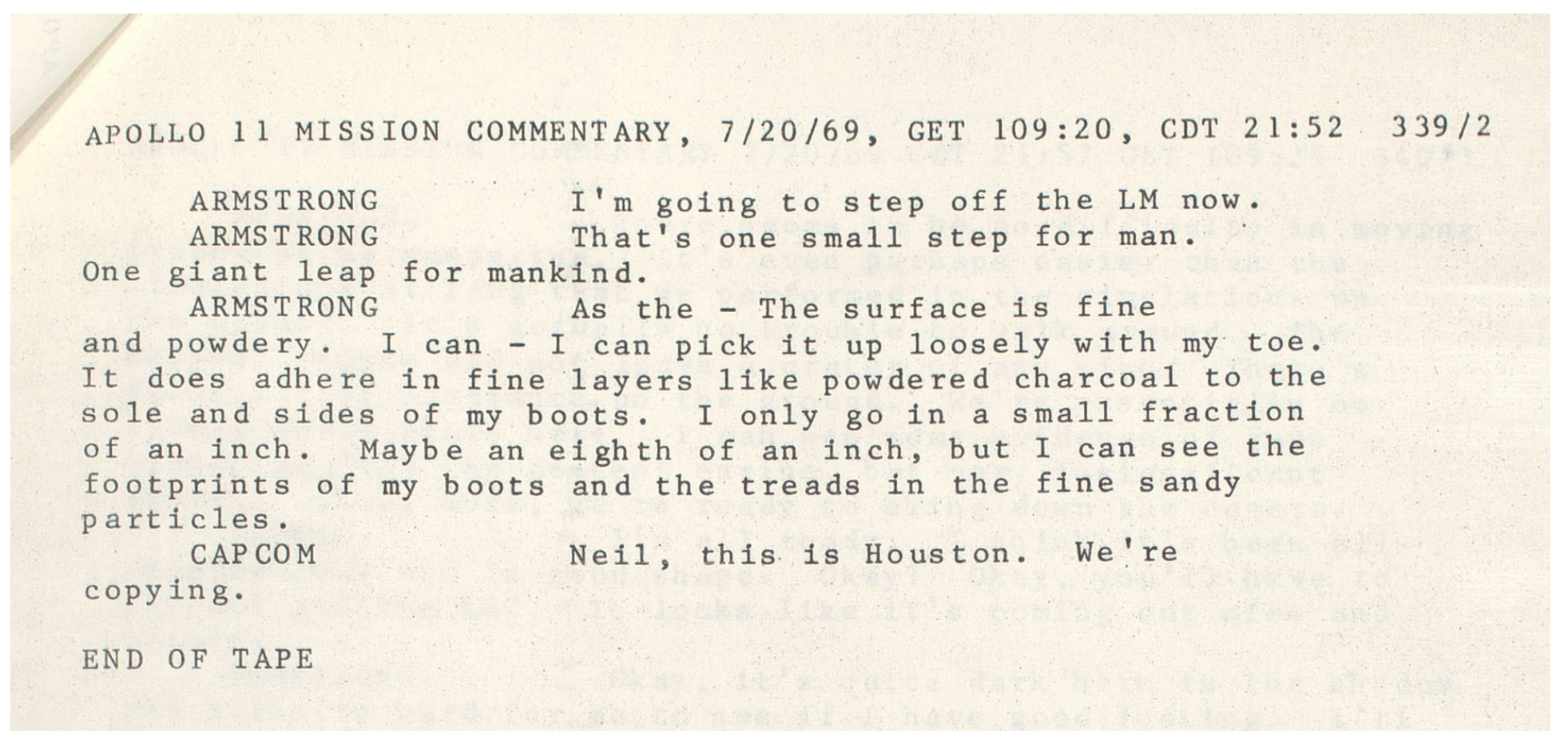
Although unlikely to persuade any of the moon hoax adherents, reading the typescript evokes a powerful and exceptional moment in human history.
Empire of Spirits
Jayne Ptolemy
Associate Curator of Manuscripts
Mid-19th-century America was a confusing time to contemplate life after death. Through their well-publicized communication with spirits who rapped on the walls of their home in western New York, Margaret and Catherine Fox had popularized the idea of spiritualism and the ability of gifted individuals to serve as mediums between the living and the dead. At the same time, however, scientific inquiry and technological advances made it easier than ever for skeptics to try to debunk any such encounters. The widely distributed periodical Scientific American ran numerous articles explaining just how spirit photographs were captured, how slates were manipulated to create spirit writings, and how mechanical devices might produce spirit rappings. “We live in a profoundly civilized age,” one article from September 1854 begins, “knowledge is increased, and the lights of science and philosophy are shed around the footsteps of high and low in all places. Yet with all our claims to superior enlightenment, that faculty of man and woman, curiosity, is made the subject of as gross deception now, as it was when kings kept astrologers and soothsayers to direct them when to go up to battle, to make new laws, and to read their dreams.” The stars, the heavens, the great realm of the unknown had long inspired both wonder and innovative ways to try and interpret life’s meaning. The combination of deeply held spiritual beliefs, expanding scientific knowledge, and genuine curiosity and hope made for a charged environment for Americans to grapple with questions of the heavens and afterlife.

Americans’ interest in angels and the heavens was widespread, even in musical culture like this illustrated sheet music for The Love Star Schottisch (Boston, 1853).
Henry Murfey, a bank clerk from Cleveland, Ohio, knew this all too well. He was only three years old when his baby sister Mary died in 1831. In an era when infant and child mortality was high, the loss of a young family member may have been common enough but it was still a devastating trauma that people carried throughout their lives. While Henry likely held no active memories of his sister, in 1856 he received messages from her through a medium, 25 years after her death. He recorded them in a letterbook now held at the Clements Library. Mary’s spirit recounted her final moments, being welcomed into the afterlife by an angel, and watching her family mourn her. “[I]t pained me to see those dear ones shed tears — But I was comforted by my kind guardian who told me I should some day speak to those friends.” The belief in a continued existence and the potential of future contact with loved ones was surely a consolation to those left grieving.
The combination of deeply held spiritual beliefs, expanding scientific knowledge, and genuine curiosity and hope made for a charged environment for Americans to grapple with questions of the heavens and afterlife.
But Mary’s messages went beyond merely affirming that the human spirit continued after death, also touching on where they continued. Her messages described a vibrant community of spirits with cities, temples, and places of learning. “I found that home was not in a house like yours but the heavens themselves were a vast tabernacle where we could enjoy each others society, and join in the blessings given us by our good Father.” Not only did the spirits dwell in the heavens, but they hailed from various heavenly bodies. Mary’s guide explained that “spirits from every planet sought that place being called the studio of developed minds” and invited her to visit them. “O, how pleased was I when I saw that he was so kind and that I could visit those planets that I admired looking at when on earth.” She and her guide went on a trip to Saturn, where instead of the “green grass and flowers & trees & s[h]rubs like Earth,” the flora was “all transparent and can be looked through.” The inhabitants were “very small and beautifull. Wearing no raiment but as nature made them perfectly pure and without stain they converse with each other panterminically, or by signs and their food is the transparent fruit that grows on dwarfish trees very small and so perfect that scarcely a bend or knot can be formed on any limb.” Mary’s message depicted a beautiful life in the heavens that spirits could move through freely.

19th-century Americans confronted the devastating losses of infant mortality in many ways, including with artistic reimaginings as in Birdie in Heaven (Philadelphia, 1868).
While these fantastical descriptions are attention-grabbing, it is notable that they included scientific concepts. “We can travel at a rapid rate,” she asserted, “all most as fast as thought. We have not eyes like thine for our spirits are visions of themselves[.] our good is the attraction that we have towards all those particles that compose our spiritual bod[ies].” The visit to Saturn was not just a narrative flourish — it also referenced ideas of how interplanetary travel and existence could be physically possible. Mary’s spirit relayed the challenges of trying to pass through the “density of the outer Stratas of atmospheric air” surrounding Saturn, indicating this trip was happening in actual space and that her audience would have questions about how the spirits confronted practical environmental issues. The unfathomable spiritual elements combined with scientific ones, both of which would have appealed deeply to 19th-century Americans steeped in a culture that valued both. The heavens, after all, were both a spiritual destination and a site of scientific inquiry. Henry Murfey’s recording of the messages from his “Angel Sister” show us how the two could come together.
Published accounts of spiritual interplanetary travel echoed this meshing of world views. Journeys into the Moon, Several Planets and the Sun (Philadelphia, 1837) provided a translated account of the German medium Pauline Dorathea Beuerly, whose spirit while in a “periodical state of Somnambulism” was able to rise “from the Earth into higher regions, and was enabled to see things, which remain concealed to the terrestrial eye . . . from the hitherto unknown empire of spirits in those worlds, that glisten on the firmament.” Beuerly recounted voyages to the moon, Mercury, Venus, Jupiter, dwarf planet Ceres, Saturn, Uranus, and the Sun. In addition to describing the climate, built environment, and spiritual residents of these places, Beuerly at times also referenced elements of the astronomical understandings of the day. Of the moon, she noted it was “the nearest body to our Earth” and affirmed it was “nearly forty times smaller than the Earth we inhabit.” The sun she described as an “uncommonly large body,” and that “We inhabitants of the earth believe the sun to be a real ball of fire, which he by no means is. The sun does not move, and beyond the sun are still millions, nay an uncountable number of stars, which are always visible; in one of them is the city of God, but this is also a sun.” Accounts of interplanetary spiritual travel reverberated with both religious and scientific belief, entwining and reinforcing each other.
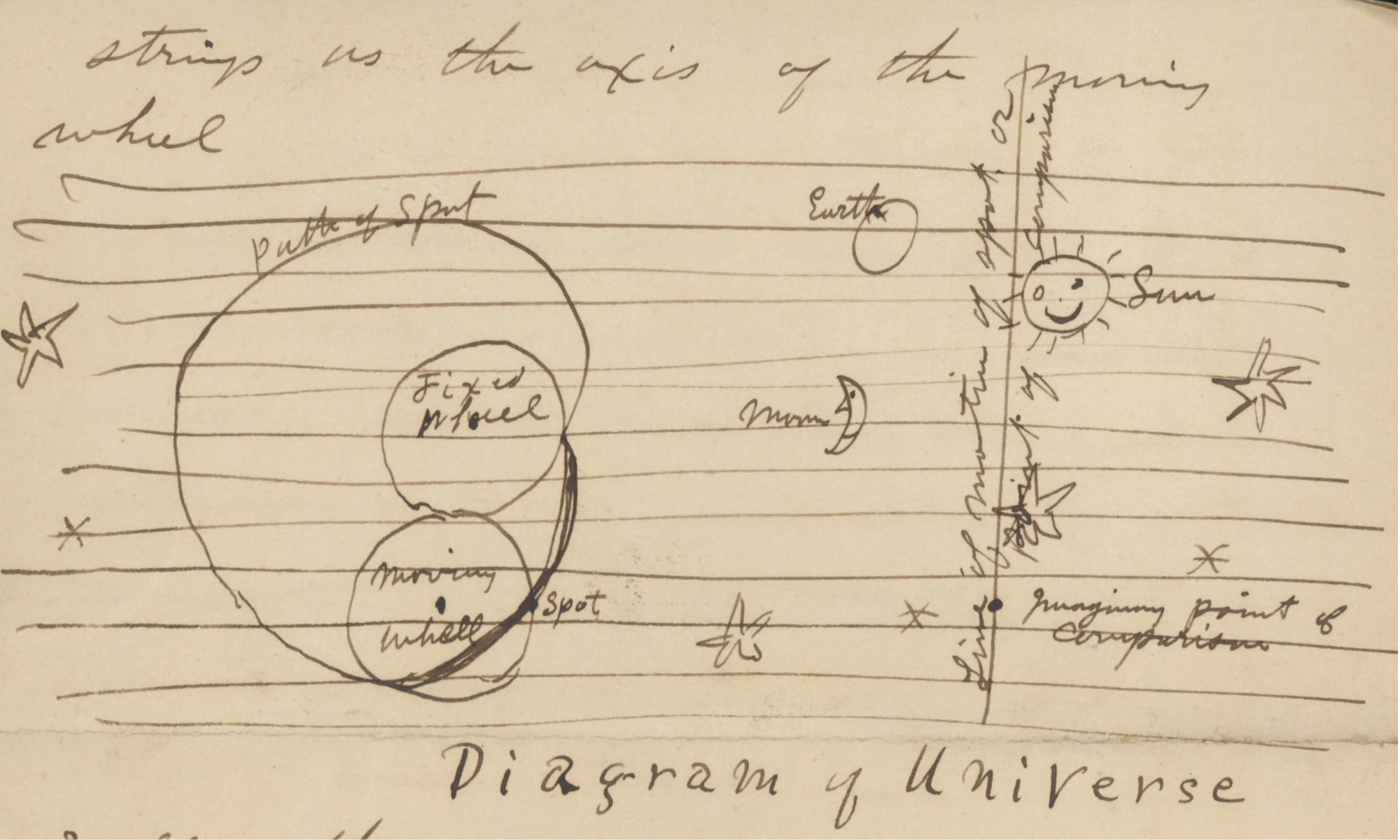
This “Diagram of [the] Universe” in the Brownell Family Papers was likely drawn by Ned Brownell in the 1850s, showing how Americans engaged with astronomical science in their daily lives.
In the messages relayed from Mary’s spirit to her brother, she provided several pieces of advice, including a suggestion of how he might respond to people inquiring “who are your associates or what is your belief.” “Tell them that Angels can and that they do communicate with Earth’s Inhabitants, and that all can hold intercourse with heaven. These interesting messages are not given to excite the marvellous or to clash with man’s inner feelings — They are given to enable the doub[t]ing mind to look forward with joy to the happy time of laying down on the bed of Death.”
Henry did not record his reactions to these messages, but we know he felt compelled to communicate with his sister even 25 years after her death. Wondering over the unknown possibilities of the heavens was reason enough.
Cosmography
Mary Pedley
Assistant Curator of Maps
The cosmos, from the Greek word κοσμοσ, incorporates the universe of earth and the heavens. The study of the cosmos is cosmology; the depiction of the cosmos is cosmography. Illustrating the cosmos has been a human pursuit since the advent of writing. A graphic depiction aids understanding of the movement of stars and what were later understood as planets across the sky, and helps trace the path of the sun’s rise and fall each day, as well as the appearance of the moon in all its phases. The heavenly bodies were more than celestial phenomena. Their movements were timekeepers and season markers, augurs of good fortune, heralds of ill. Cosmological maps show the relationship of earth and sky. They attempt to answer the big question: Where are we in the universe? To depict the answer, much depends on the description of the universe.
It is perhaps surprising that the Clements Library has any cosmographies at all, since they bear little ostensible relationship to the history of North America or the history of the United States. But since “discovery and exploration” provided the impetus for the encounter between the Europeans and the inhabitants of North America, it was also a theme that William Clements pursued. The basic notions of cosmology informed a sense of time and an understanding of place for both Europeans and Native Americans. Some of the rarest and most important books of the European Renaissance and the first century of printing were cosmographies, especially the work of the German scholar and professor of mathematics Peter Apian (1495–1552), whose Cosmographicus Liber (Landshut, Germany, 1524) was an influential guide to making maps and locating places, using the grid of latitude and longitude.
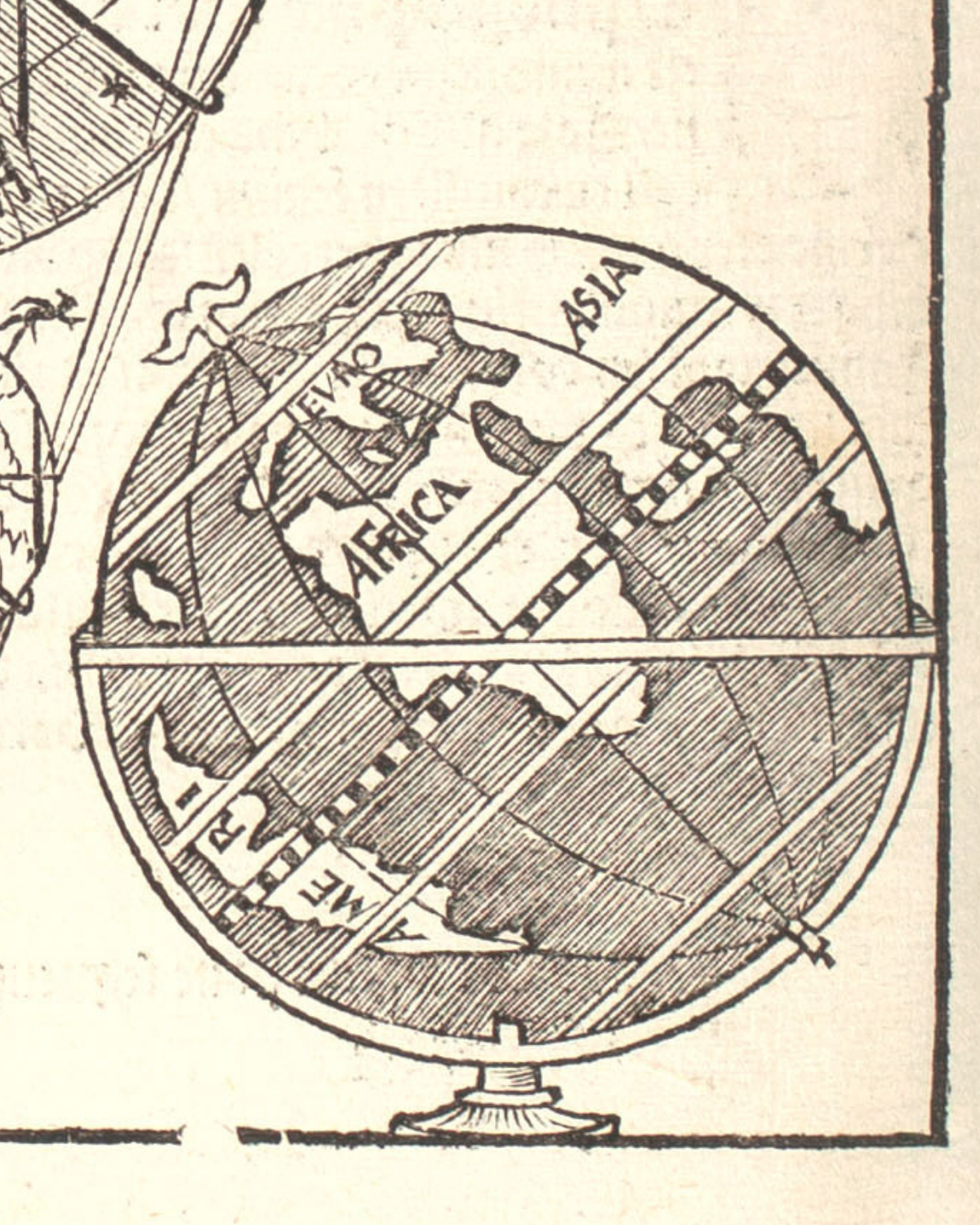
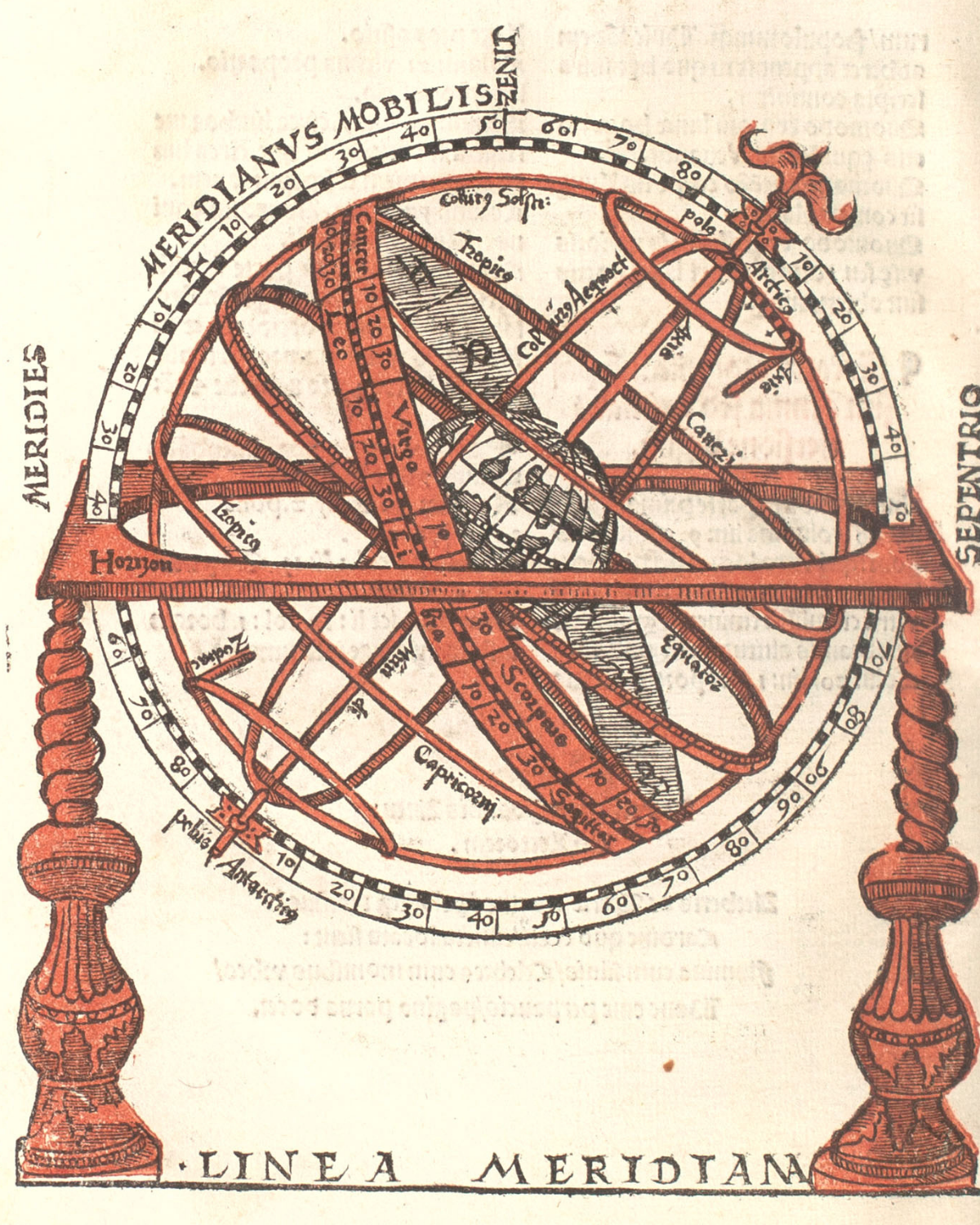
Globes and armillary spheres show the relationship between earth and sky. The appearance and naming of the continent “America” on the globe on the left [detail] made this work important for Mr. Clements to acquire. From Peter Apian, Cosmographicus Liber [Cosmographical Book], (Landshut, Germany, 1524).
Almost all cosmography understands the earth to be a sphere; the heavens too are often understood as a sphere or a domed shape surrounding the earth. Thus many cosmological maps are circular or represented by a globe or a globe within a globe, combined into one instrument known as an armillary sphere. The two previous images from Peter Apian’s work illustrate the concept.
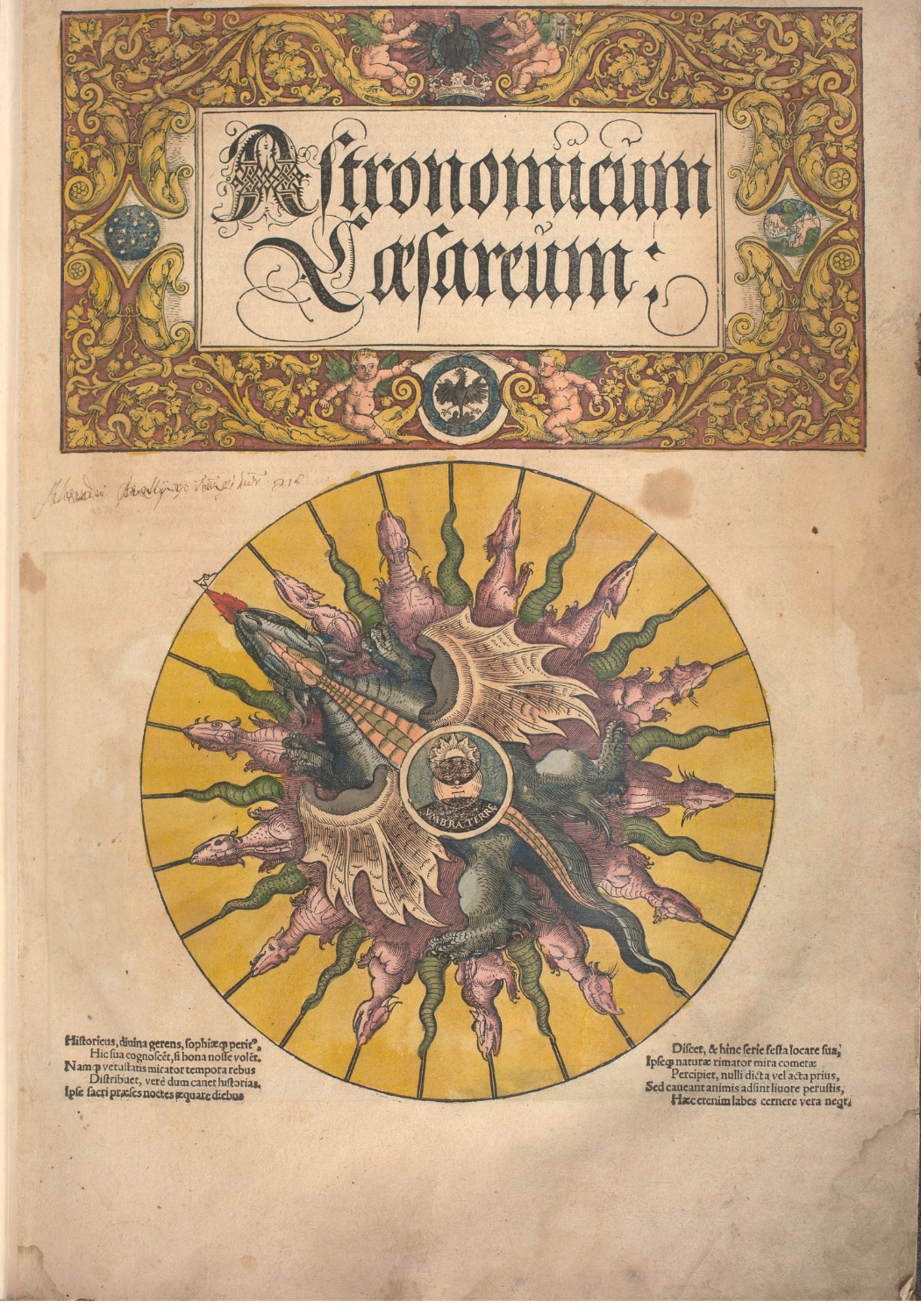
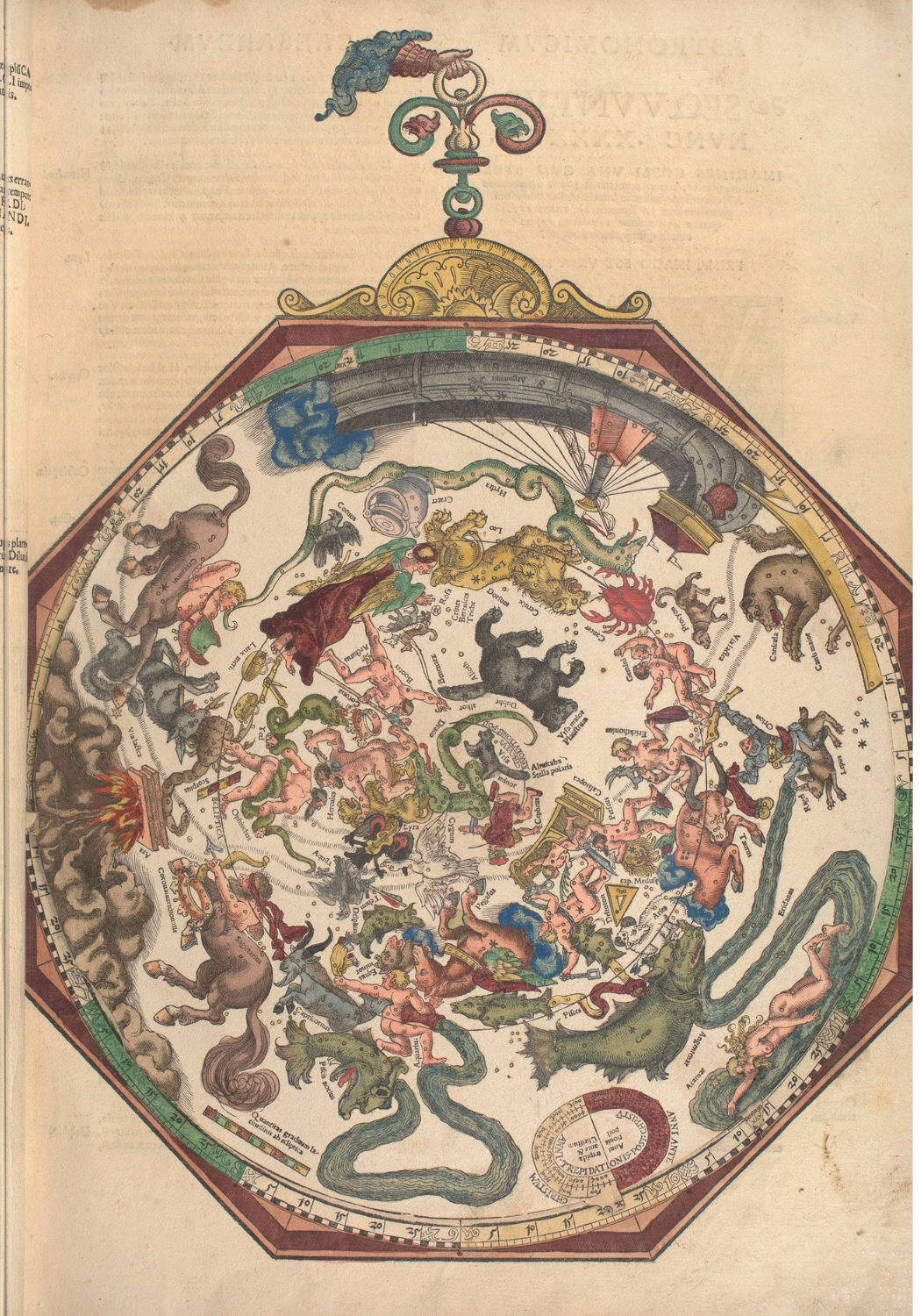
Peter Apian, Astronomicum Caesareum, 1540, title page and one of the star charts inside. The dragon pointer on the circular schema of the title page represents the motus capitis draconis (movement of the head of the dragon), that is, the astronomical arc on the ecliptic that reflects the ascending and descending nodes of the lunar cycle.
Cosmography not only needed to illustrate the basic concepts but also name the parts of the heavens whose movements were most important — the sun and the moon and their eclipses — followed by stars whose relationships with each other remained fixed while their arrangement, or constellation, seemed to move in a predictable pattern across the night sky. These groups are the constellations of the zodiac. The individual stars and the stellar arrangements acquired their own names, in the European West taken from Greco-Roman mythology and/or from the Arabic-speaking scholars and observers of the Mediterranean East.
Apian made the study of stars and other celestial objects the subject of his sumptuous work, the Astronomicum Caesareum of 1540, dedicated to the Holy Roman Emperor Charles V and to his brother Ferdinand I of Spain.
Included in this work were various volvelles, round mobile instruments that could be manipulated to predict lunar and solar eclipses, the rotation of the zodiac throughout the year, the movement of the planets across the heavens, and the precise location of various heavenly bodies on particular days. This helped meet a need for prediction, regularity, and constancy, and ensured some stability in the national and religious calendars. Uniformity and agreement were required for the measurement of time, the determination of specific liturgical and administrative dates, special events in calendars, and even the time of day (something we continue to debate in our views on daylight saving time). Several good YouTube videos demonstrate the use of these volvelles if the reader searches for “Astronomicum Caesareum.”
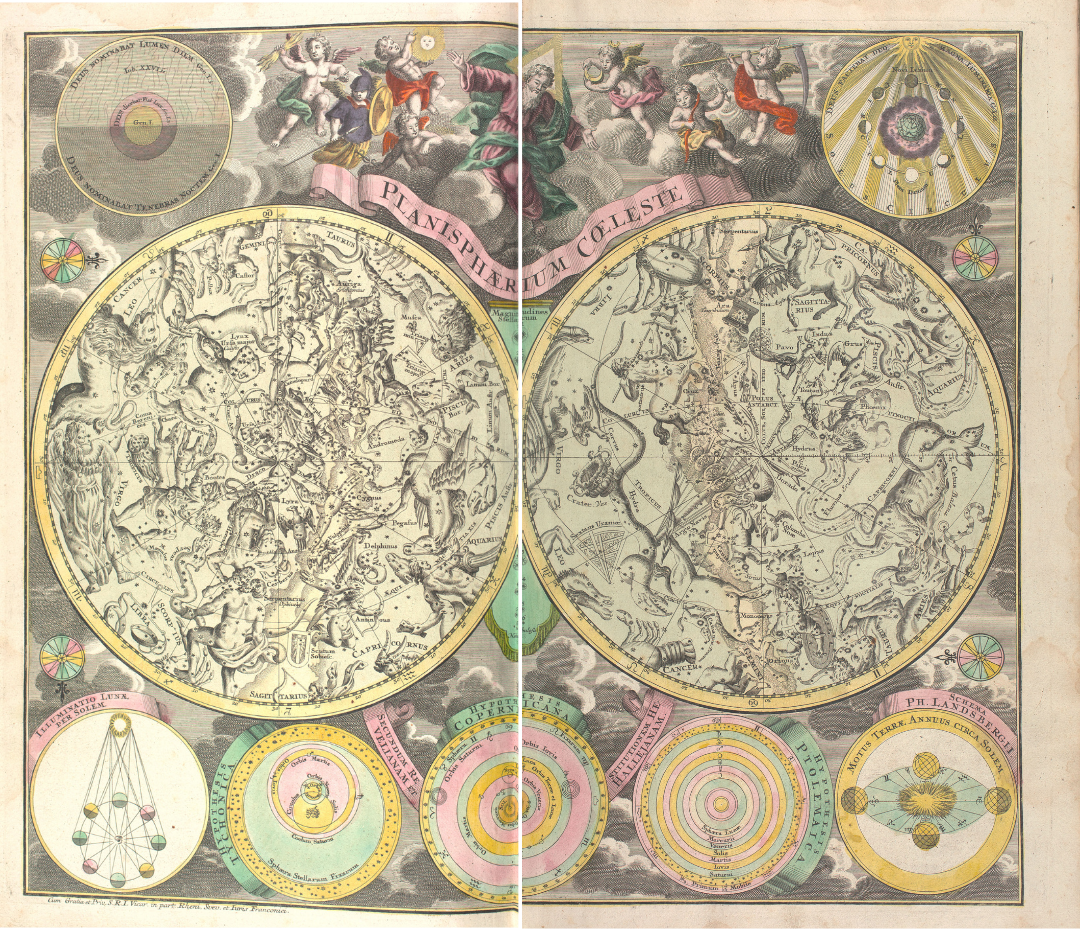
In “Planisphaerium Coeleste,” night and day occupy the upper left and right corners, mythological putti adorned with the attributes of particular gods hold the upper center, and comparative systems of the universe align along the bottom. The two hemispheres show the night sky in the northern (left) and the southern (right) hemispheres. From Atlas Novus Terrarum Orbis . . . by Johann Baptist Homann (Noribergae, [1702–1750]).
The second way the Clements Library collects cosmography is through atlases. These gatherings of maps into one volume are so named because Atlas, the Titan of Greek mythology, was supposed to hold up the heavens on his shoulders. His image often graces the frontispiece or title page of an atlas, as with the following title page for a composite atlas of German maps from the early 18th century. Inside the atlas, particularly in the productions of the 17th and 18th centuries, often a world map titled a Planisphere appeared, surrounded by cosmographical elements such as star charts, depictions of the sun and moon, and various models of the universe, as yet unsettled. An earth-centered solar system, as postulated by the Greek astronomer and geographer Claudius Ptolemy, was gradually being eclipsed (no pun intended) by the Copernican system with the sun at the center. Other theories had some traction too, such as the complex geo-heliocentric system of the Danish astronomer Tycho Brahe, which incorporated rotating spheres circulating around both the sun and Earth.
Cosmography and cosmology covered most of the subjects that developed by the 19th century into the disciplines of physics and astronomy. The invention and expanded use of the telescope and the increased number of observatories added to the number of planets that could be observed and recorded, and the codification of star names and constellations continued. Nonetheless, certain patterns continued unchanged from the Renaissance, including the depiction of the constellations, as shown on this issue’s cover from an atlas of astronomy by Elijah Burritt.
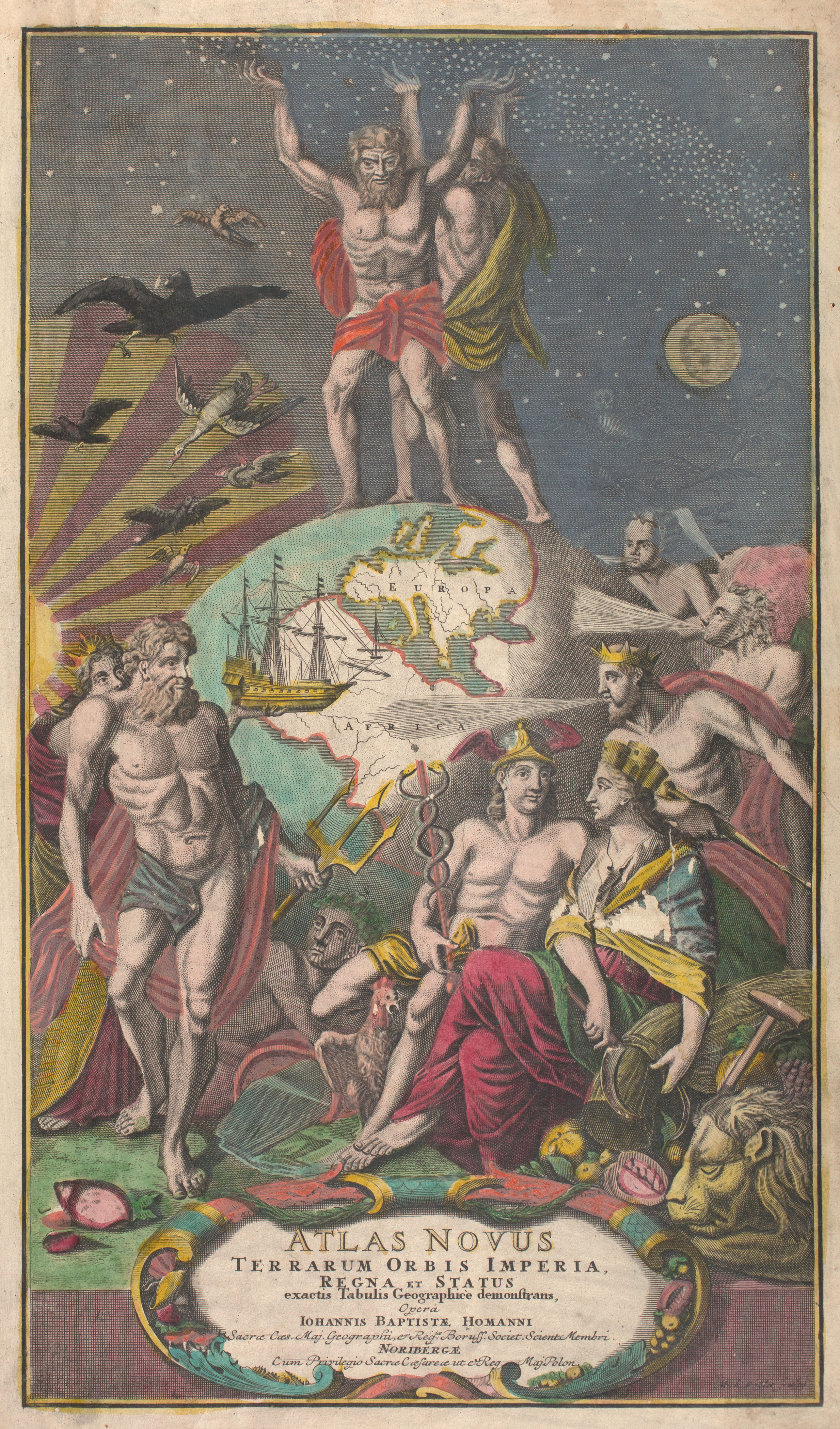
Atlas holding up the heavens, with night and the moon to the right, daylight to the left, and a host of gods: Neptune with his trident, Mercury with caduceus and winged helmet, crowned Jupiter with scepter, the wind gods, and Ceres seated with the bounty of her harvest. Title page, Atlas Novus Terrarum Orbis . . . by Johann Baptist Homann (Noribergae, [1702–1750]).
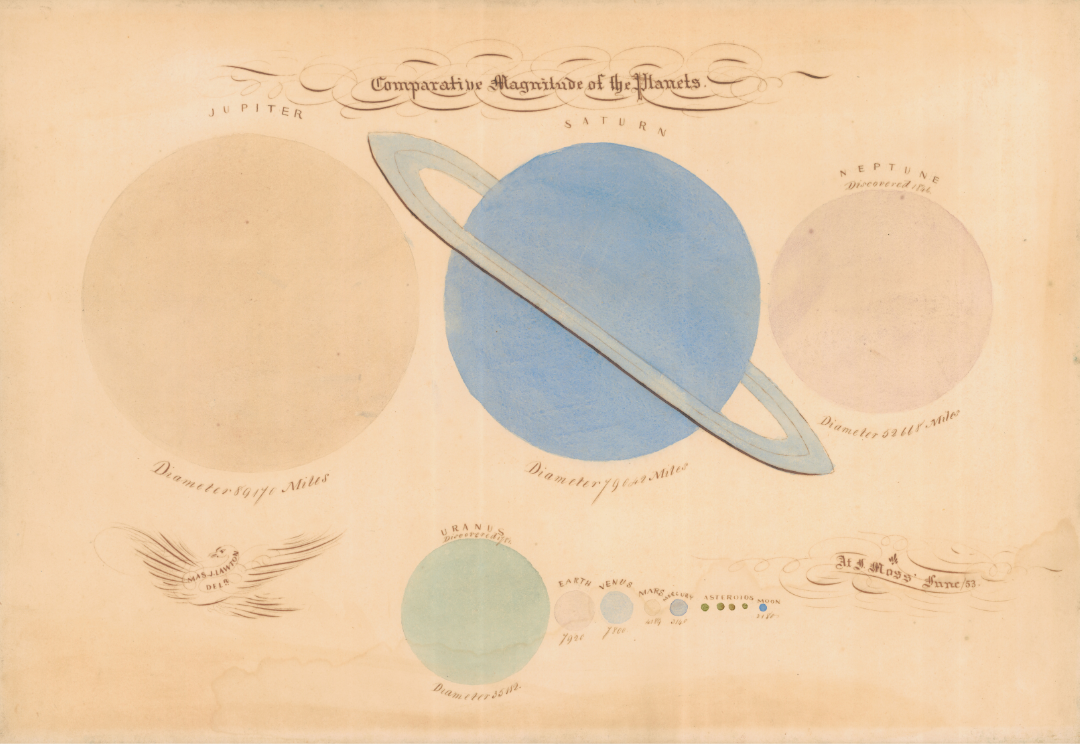
Lawton, “Comparative Magnitude of the Planets,” June 1853. Pen and ink and watercolor on heavy card stock. Probably copied from James Reynolds’ 1846 map of the same name.
With new technologies aiding observation, and with closer examination of the heavens by amateurs and professionals alike, new questions had arisen about the study of the planets, their movements, their sizes, their composition. A recent acquisition demonstrates the fascination of such comparisons for the young student J. Lawton, whose “Comparative Magnitudes of the Planets,” drawn in June 1853, includes the recently discovered Neptune, even larger than Uranus.
A Miscellany: Signs of the Zodiac and the Planets
Cheney J. Schopieray
Curator of Manuscripts
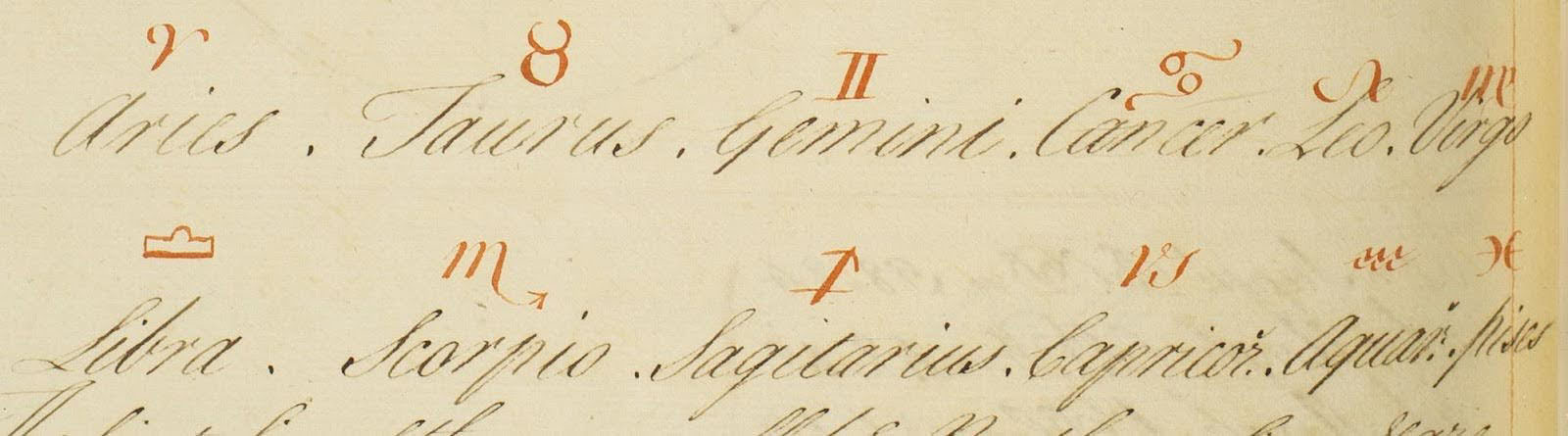
The anonymous author of “Practical Mathematics” included a list of the signs of the zodiac along with their Greek symbols as part of extensive definitions and problem sets relating to algebra, geometry, trigonometry, navigation, and surveying.
The University of Michigan’s collecting units, taken together, cover a broad sweep of human history, from ancient Babylonia and Greece to contemporary art and politics. There are few constants that persist across such a span of time and space, but there is at least one: a continuing belief in the influence of heavenly bodies on earthly matters. For millennia, people have recorded what they observed in the sky in order to lend meaning to what they experienced on the ground. A constant tension throughout this body of writing is between the accumulation of specialized knowledge and the desire to apply that expertise in accessible ways.
To take one example: “The Ecliptic, is a great Circle intersecting ye: Equator in two opposite points & making an Angle with it equal to ye: Suns greater Declination, (which is 23°..29°) & is that circle which ye: Sun is supposed to describe by his Annual Motion round the Earth, this Circle is usually divided into 12 equal parts call’d Signs, each Sign containing 30°..00°; begining from the intersection of the Equinoctial, & number’d as follows . . . .”
The above definition of “the ecliptic” is taken from a mid18th-century manuscript titled “Practical Mathematics” in the Duane Norman Diedrich Collection at the Clements Library. Does it seem opaque to the casual reader? Be not afraid! It merely offers a concise description of a set of celestial “signs” (i.e. constellations marking a portion of the sky) that travel along the path of the sun and seem to rise and fall over the course of a 12-month year. The sections of the ecliptic where each of these signs appear are what English speakers call the zodiac (from the ancient Greek ὁ τῶν ζῳδίων κύκλος, literally “circle of little animals”).
To help visualize the ecliptic, try to imagine a line beginning at the sun, passing through the Earth, and extending indefinitely out into space. As the Earth travels 360° around the sun, that line creates an imaginary flat plane. The swath of sky 8–9° above and below that plane is the ecliptic, where particular constellations appear. On the surface of the Earth, we look up at the seemingly fixed stars overhead, and the constellations of the ecliptic slowly change over the course of the year. From the 2nd century BCE, Babylonian astronomers interpreted the night sky by dividing the ecliptic into a yearly cycle of twelve parts (each covering 30° of Earth’s trip around the sun).
Claudius Ptolemy documented ancient Greek use of the same system in his Almagest (mid-2nd century CE), which established the names of the Zodiac signs that are still in daily use by horoscope-watchers nearly 1,900 years later: Aries (Ram, ♈︎), Taurus (Bull, ♉︎), Gemini (Twins, ♊︎), Cancer (Crab, ♋︎), Leo (Lion, ♌︎), Virgo (Maiden, ♍︎), Libra (Scales, ♎︎), Scorpio (Scorpion, ♏︎), Sagittarius (Archer or Centaur, ♐︎), Capricorn (Goat-Fish or Sea Goat, ♑︎), Aquarius (Water Bearer, ♒︎), and Pisces (Fish, ♓︎).
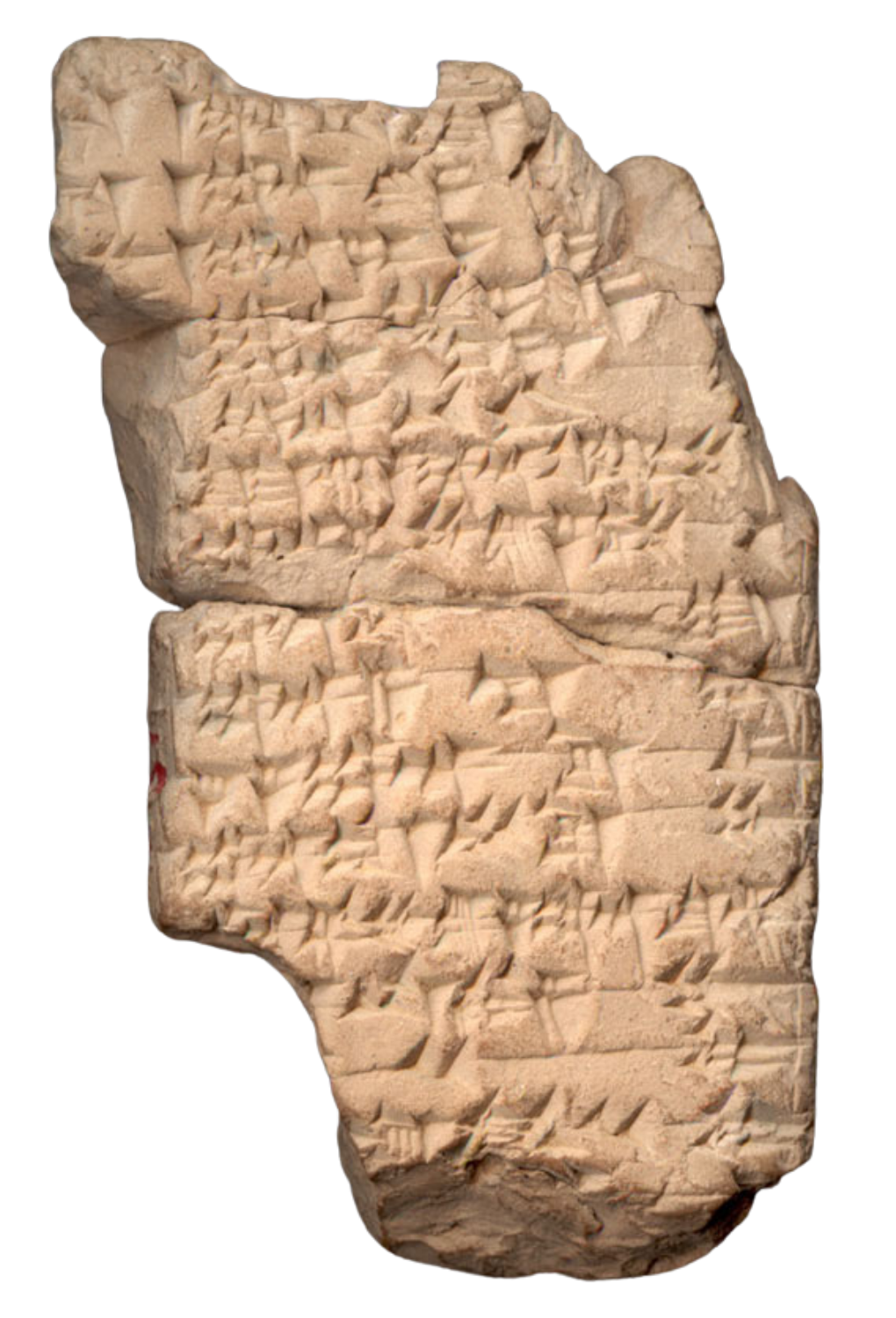
This surviving portion of a Cuneiform Tablet with Ziqpu Star List offers descriptions of stars from constellations not found in the ecliptic, including Lady of Life, the Demon with the Open Mouth, the Stag, the Old Man, and the Crook. The tablet, likely produced in Babylon and dating from the final three quarters of the first millennium BCE, is held by the Kelsey Museum of Archaeology: Kelsey Museum 89551, University of Michigan.
One of the reasons for observing and understanding the movements of the planets and the fixed stars was the persistent belief that different signs of the zodiac had particular relationships to various parts of the human body. The richly symbolic frontispiece of Ars Magna Lucis et Umbræ (Rome, 1646) by the German Jesuit priest and scientist Athanasius Kircher (1602–1680) showed a man holding a caduceus with its snakes intertwined around signs of the planets. Printed on his skin were signs of the zodiac — Gemini (twins) on his arms, Capricorn (goatfish) on his knees, and so on — to indicate correspondences between bodily ailments and the times of the year, as well as the correct times for medical treatments for those parts of the body. The Homo Signorum or Man of Signs appeared in numerous types of early American publications, notably in farmers’ almanacs of the 18th and 19th centuries. The one shown on the previous page is from Benjamin Banneker’s Almanack, accompanied by a rhyme intended to help remember the order of the signs and which body part they were believed to influence.
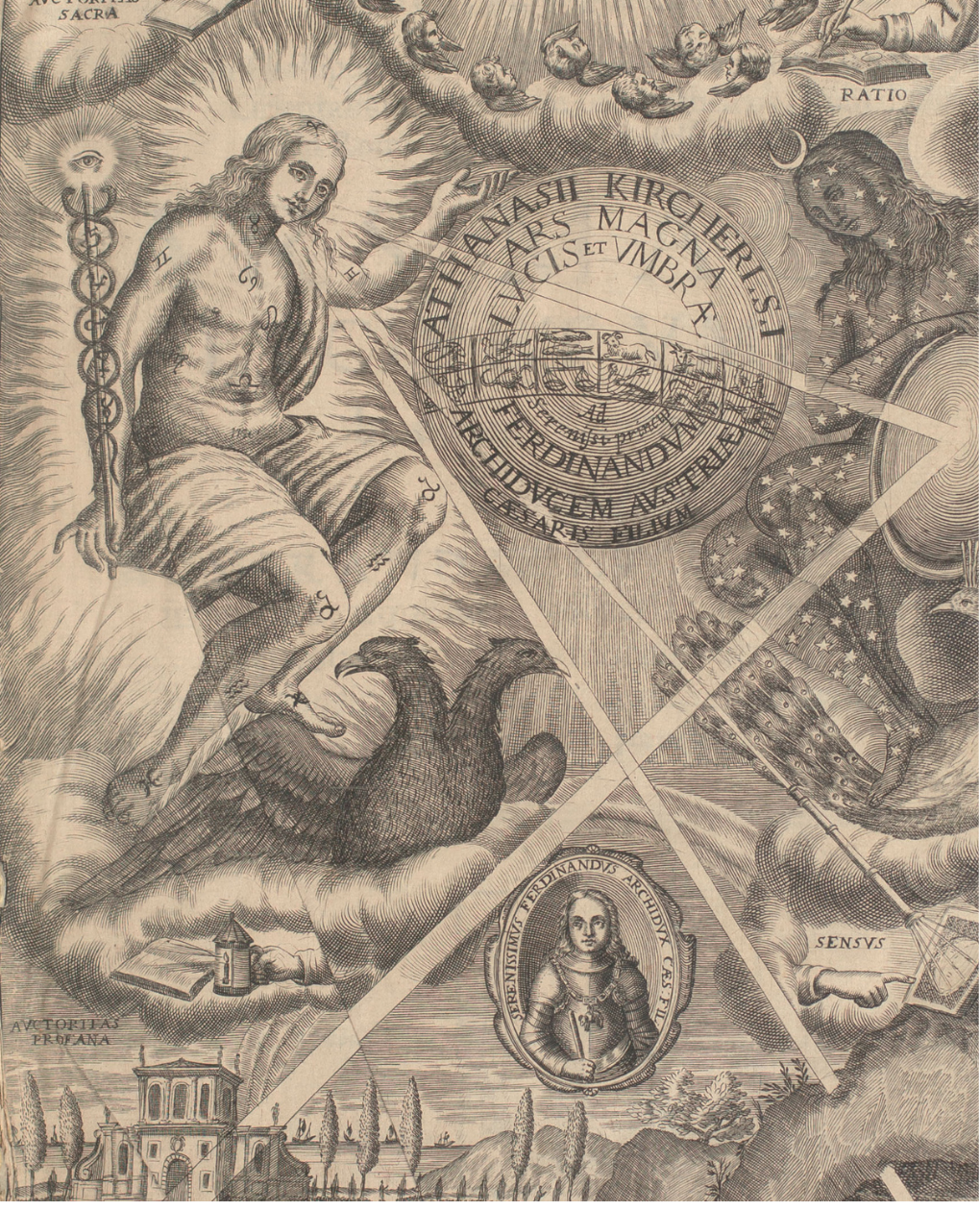
Detail from the frontispiece of Athenasius Kircher, Ars Magna Lvcis et Vmbræ (Romae: Sumptibus H. Scheus, 1646). Courtesy Special Collections Research Center (SCRC), University of Michigan.
Almanacs were among the most widely printed and consumed books of the period, and their astrological elements were part of everyday popular natural philosophy. People in early America looked to signs in the sky for literally down-to-earth reasons, seeking guidance from the stars on when to plant and harvest crops, as well as how to navigate the open sea. Celestial bodies were understood to guide the weather, which helped farmers and sailors anticipate floods and storms. Thus, a sound knowledge of how to interpret the zodiac could quite literally be the difference between feast and famine in the fields, or between life and death at sea.
By the early 18th century, clerical debates over astrological subjects had largely settled on a picture of a God who created the celestial bodies, as well as their practical uses and what influences they had on terrestrial matters. Astrology was considered a recognition of the creator’s marvelous design and not a subversive or unorthodox element in popular culture. This was, however, clearly understood to be “natural astrology,” focused on natural phenomena, and not a “judicial astrology,” which predicted social or political outcomes in human society. Judicial astronomy was uncommon enough that Protestant clergy were more often upset over the nude depiction of Men/Women of signs than the astrological content itself.
Human explorations of the causes, effects, and influences of celestial bodies on earthly affairs were also incorporated into different threads of religio-philosophical-mysticaltechnical traditions described together as Hermeticism. Hermetic beliefs were remarkably widespread in early America, appearing in sources created even in the northeastern backwoods.
The Clements Library holds a tattered volume with a shrunken, limp leather binding that was created and used by an itinerant schoolteacher in New Hampshire and the District of Maine between 1789 and 1811. Along with the expected assortment of instructional materials for students (mathematical exercises, basic legal and financial forms for students to copy, readings, penmanship practice statements) is a section on “Occult Philosophy or Magic,” where the schoolteacher copied selections from Heinrich Cornelius Agrippa von Nettesheim’s Three Books of Occult Philosophy (London, 1651). The table shown here connected the divine origins of the stars of the zodiac, planets, and spirits with the signs and sounds of their names. Left to right are the astrological names and symbols, Hebrew characters, chiromatic signs, Greek letters, and Latin letters.
The Enlightenment of the 18th century, with its elevation of reason and scientific inquiry, permitted a clearer understanding of the boundaries between knowable reality and speculation. This combined with technological advances in the creation of glass lenses made it possible for astronomers to observe the motions of heavenly bodies with a new level of precision. This precise observation did not supplant traditional beliefs in the influence of the stars and planets on human life, but refined it. This period saw divergence in the use and meaning of the terms astronomy and astrology, with the former referring specifically to observational science and the latter a blend of formerly held beliefs with new scientific discoveries.

In the prefatory illustration “The Anatomy of Man’s Body, as governed by the Twelve Constellations” from Banneker’s Almanack and Ephemeris (Baltimore, 1796).
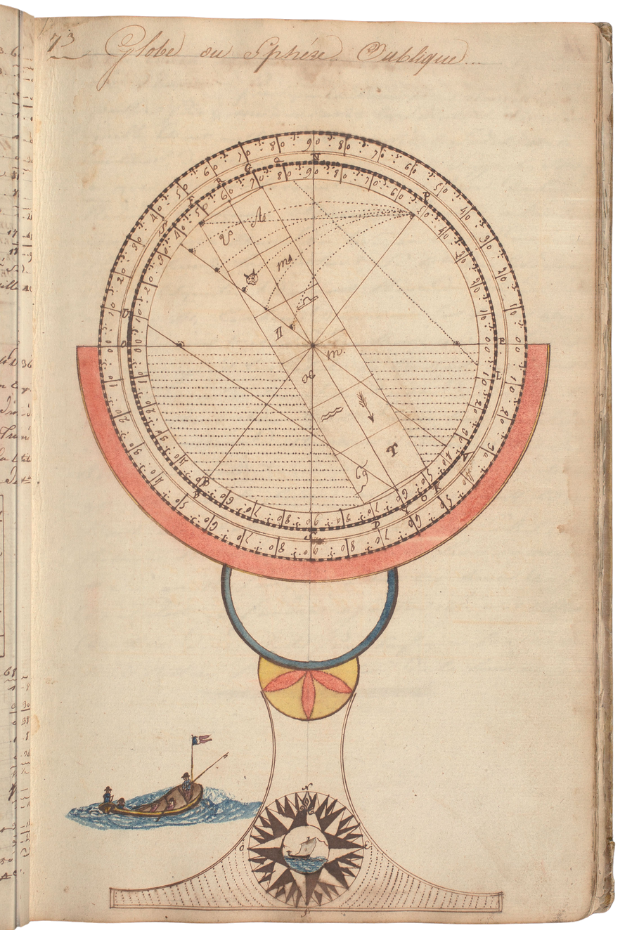
French sea captain Francis Naghel (1779-1843) carefully drew and colored this “Globe ou Sphére Oublique” in his book of navigational exercises around 1798. The globe is viewed from an angle such that the curved ecliptic appears straight. Naghel Exercise Book.
Perhaps the most extraordinary discovery of the 18th century was made by Hanover-born William Herschel (1738–1822), a musician and astronomer. Herschel ground and polished large and fine lenses for systematic observation of subtleties not easily seen by inferior telescopes, such as the relative movements of groupings of stars that appeared nearly as one. In March 1781, he observed the movement of an object thought to be a fixed star. After further observation and corroboration — as well as the calculation of its orbit by astronomer Anders Johan Lexell (1740–1784) — it was found to be a planet.
The discovery was literally and figuratively astronomical. Mercury, Venus, Mars, Jupiter, and Saturn are visible to unassisted eyes from Earth. They were known to ancient peoples and incorporated into cultures over the course of thousands of years. This new planet expanded the solar system to nearly twice the size once believed.
The known planets had names and generally adopted signs that were Romanized and Christianized variants of Greek and alchemical symbols: Mercury (☿), Venus (♀), Mars (♂), Jupiter (♃), and Saturn (♄). What to call the new planet? In celebration and recognition of William Herschel for his 1781 observations, the name “Herschel” spread as a contender. Herschel himself rejected his own name in favor of “Georgium Sidus” (George’s Star) after King George III. Without a naming process that transcended geo-political boundaries, French publications tended toward the name “Herschel,” as did the fledgling United States.
The name Uranus was suggested as early as 1782 and regularly adopted by the mid-19th century. It was suitable for a variety of reasons, not least of which was that in the Greco-Roman pantheon, Uranus was father of Saturn, who was father of Jupiter. As for a sign (notably absent from the 1798 Catechism’s table of planets earlier in this article), differing parties used either the first letter of Herschel’s name seated atop a globe (♅) or the character also adopted for platinum (⛢).
Taken as a whole, then, the body of materials on the University of Michigan campus that deal with the influence of heavenly bodies on earthly matters reflect the consistent belief in such influence, the flexibility to incorporate new scientific discoveries into long-standing belief systems , and the separation of deserving scientific study from astrological prediction. Newly discovered planets and stars challenged and demanded revision of some previous belief systems, while at the same time slid seamlessly into frameworks that offered readers in the past knowledge that was both meaningful and useful.
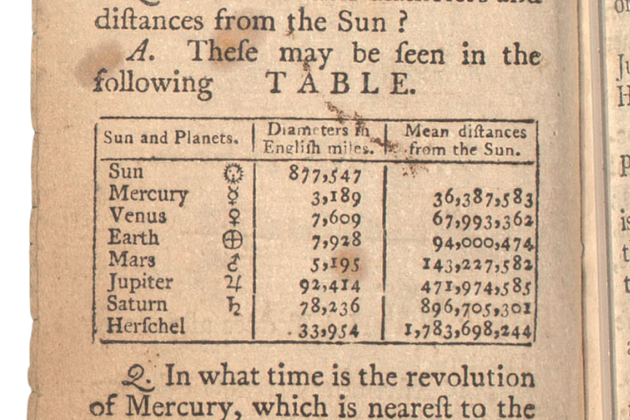
An aptly titled question-and-answer textbook for children, An Astronomical and Geographical Catechism (Boston, 1798) by Caleb Bingham (1757–1817) includes a table of the planets, their signs, their diameters, and their mean distances from the sun (in English miles). The distance of planet “Herschel” from the sun is here noted as just over 1.78 billion miles, compared to the next closest, Saturn, at less than 897 million miles.
The discovery was literally and figuratively astronomical. Mercury, Venus, Mars, Jupiter, and Saturn are visible to unassisted eyes from Earth. This new planet expanded the solar system to nearly twice the size once believed.
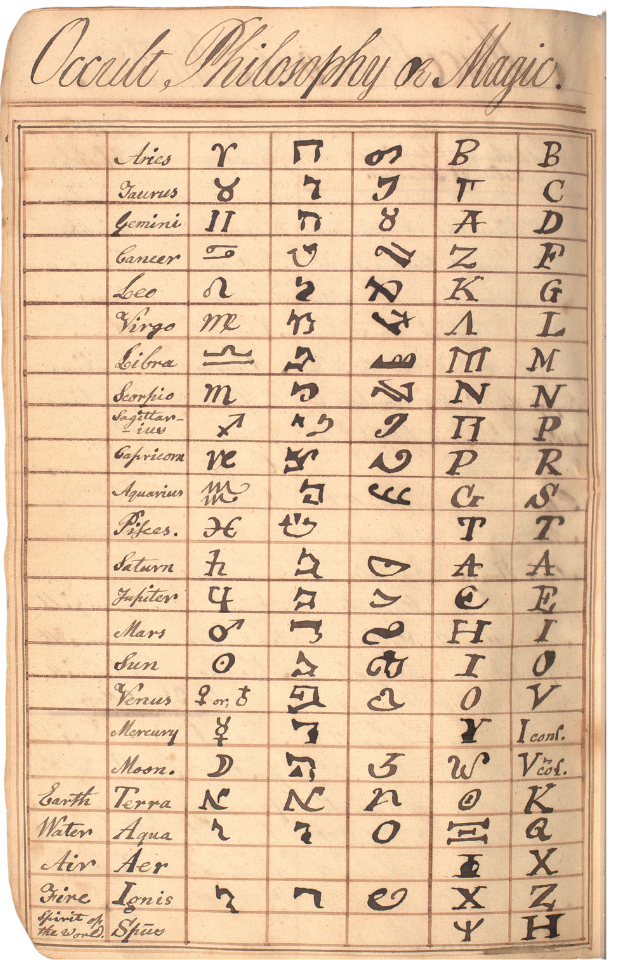
(left)
New England Schoolmaster’s Teaching Book, Duane Norman Diedrich Collection.
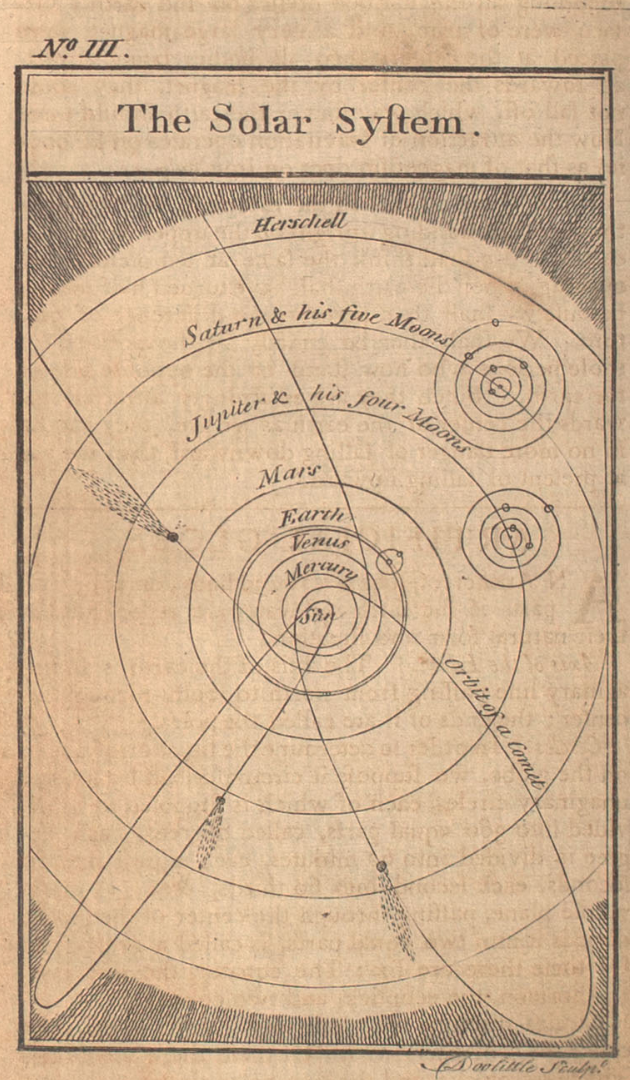
(right)
With the discovery of this new planet, printers of educational books and almanacs had to revise their texts, and decide what to call the new planet. Above: Amos Doolittle’s engraving of the solar system in Jedidiah Morse’s Geography Made Easy (Boston, 1790) shows the outer planet “Herschell”; John Payne opted for “Georgium Sidus” in his A New and Complete System of Universal Geography (New York, 1798). Curiously, William North abandoned both in The Mirror, or, Carolina and Georgia Almanac (Charleston, 1804) for the rather unusual “Herschelium Sidus”!
Capturing Clouds
Jakob Dopp
Graphics Cataloger
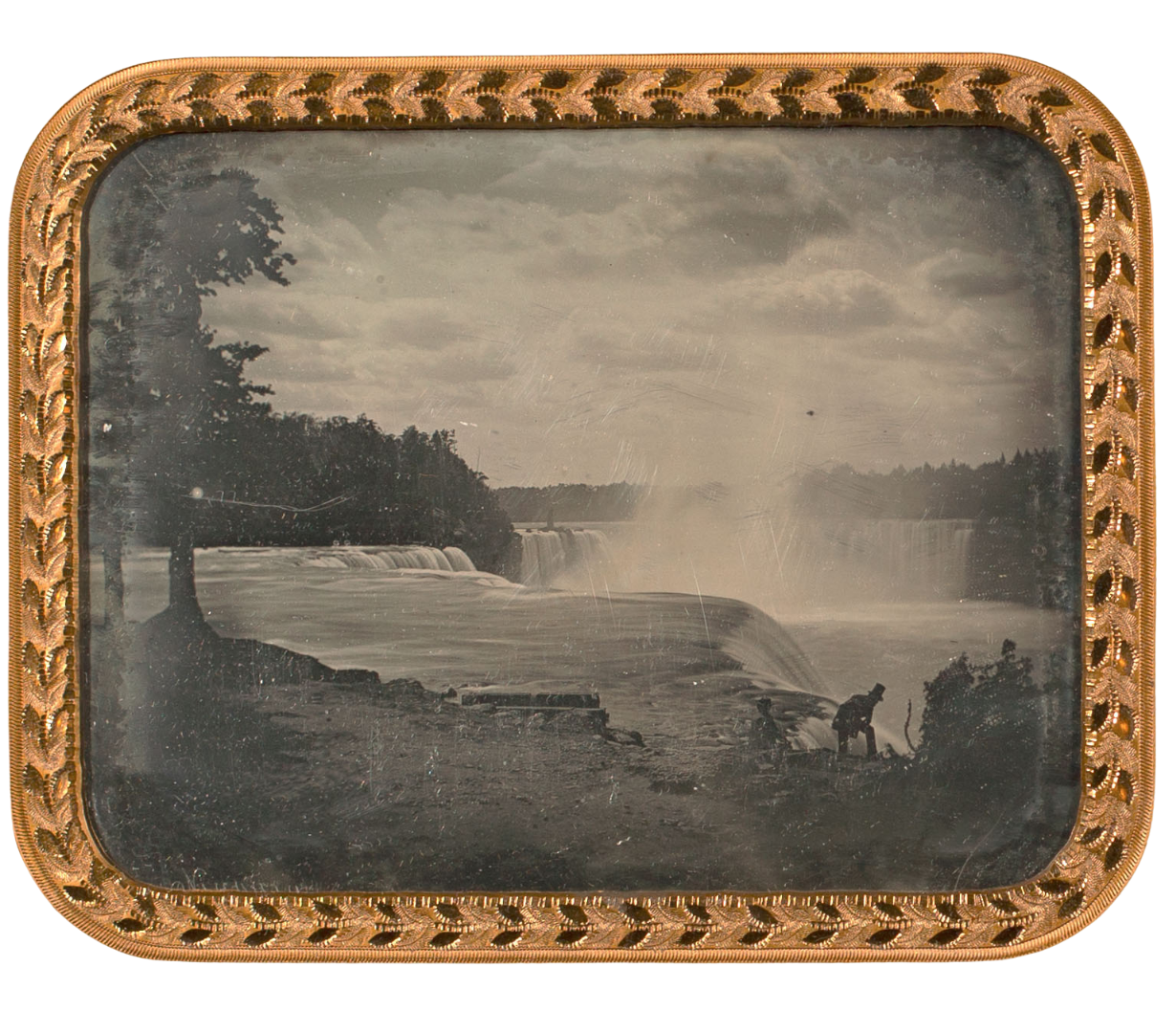
In this daguerreotype view, famed photographer Thomas Martin Easterly (1809–1882) somehow captured the clouds above Niagara Falls in 1853. It remains unclear how he managed to expose the plates for the perfect amount of time with the perfect amount of daylight to achieve this—his was a remarkable talent far outside the norm.
Photographers using the two earliest photographic processes, the daguerreotype and the salt paper print, found the cloud conundrum particularly problematic. Exposure times required for rendering features in the sky were shorter than those needed to render the landscape, as the photosensitive emulsions were more sensitive to the ultraviolet end of the light spectrum. This often resulted in daytime skies becoming overexposed in the final product. For salt prints, lengthy exposure times meant that, for the most part, skies appeared as blank spaces, with borders between cloud and sky indistinguishable. For daguerreotypes, an effect called “solarization” would often manifest, in which the sky appeared to have a blue tint as a result of the daguerreotype’s relative sensitivity to ultraviolet light. Unless the photographer possessed remarkable skill, any hint of white cloud formations would typically be subsumed by the larger sky.

The daguerreotype of the John D. Appleton house (unknown photographer, [1850-1859]), is a classic example of solarization caused by an overexposed plate. Bright conditions and a long exposure resulted in the blue tones visible in the final image.
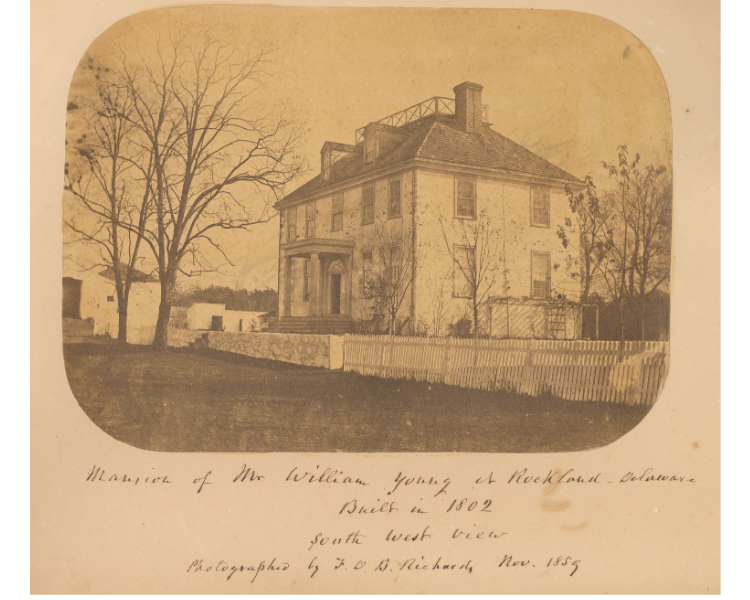
This architectural profile of the mansion of William Young (1755-1829) is a good example of a salt print lacking all cloud features.
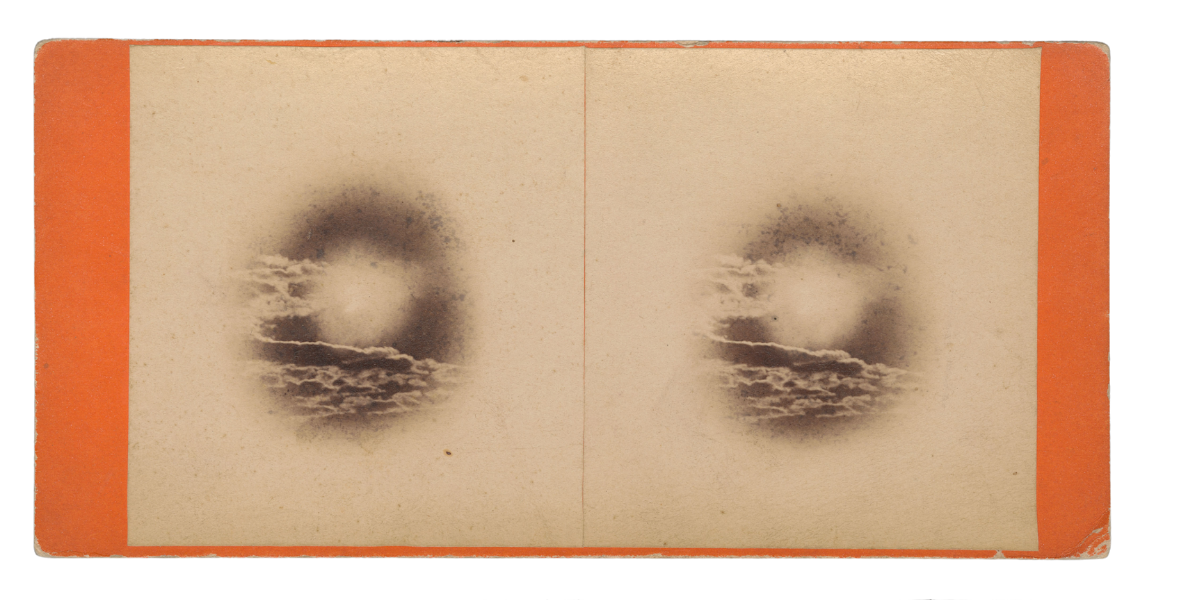
Focusing skyward could more easily yield cloud forms, eliminating the need to juggle the gap in exposure time required for near landscape and distant heavens. A.K.P. Trask (1831–1900) produced these images of the 1869 solar eclipse, which show signs of heavy retouching but also seemingly authentic cloud forms.
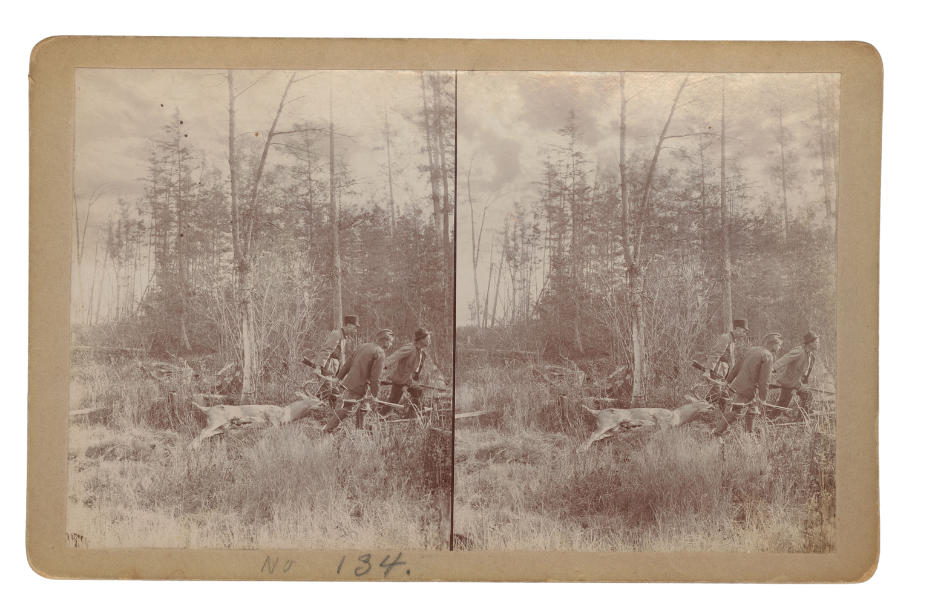
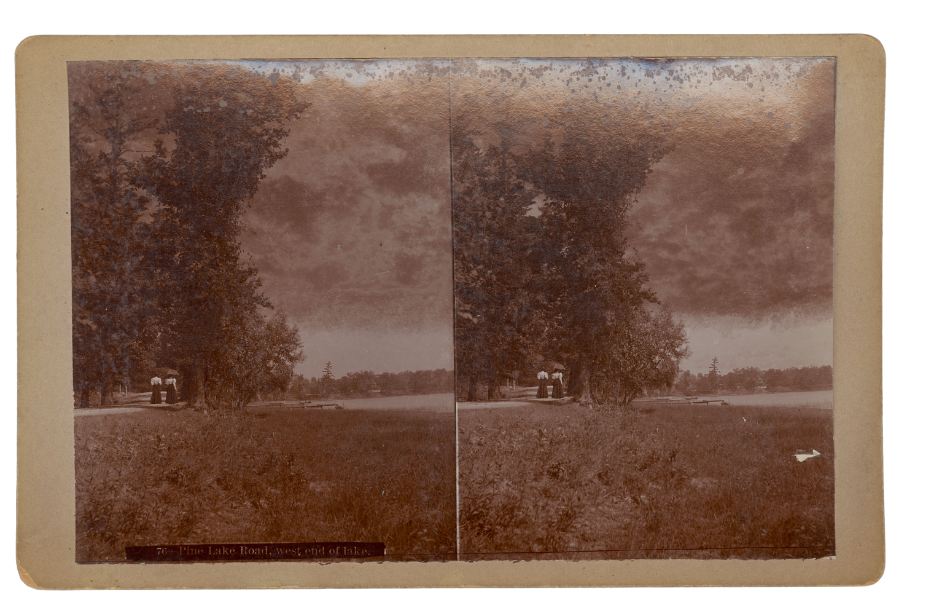
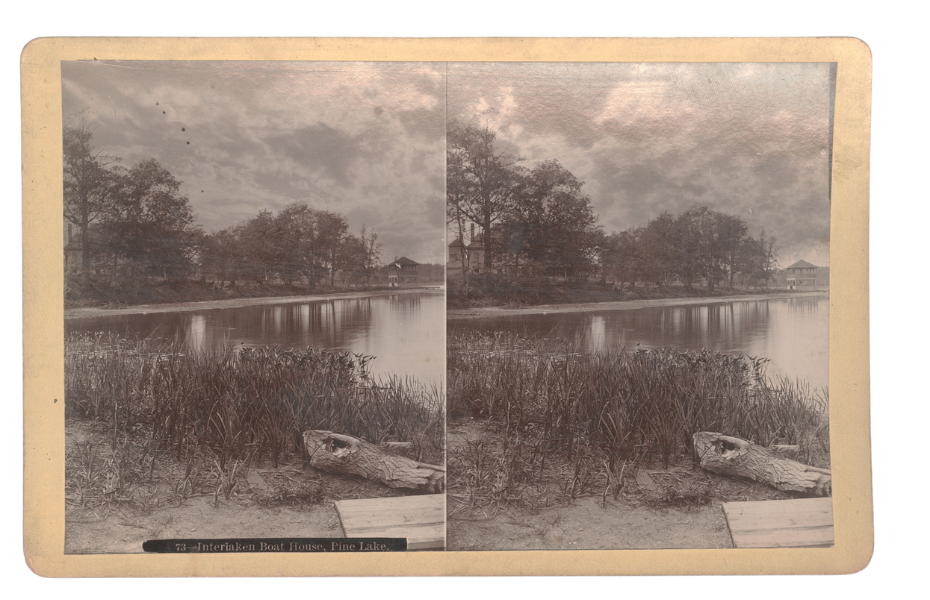
Look closely at this series of stereographs by Michigan photographer Ephraim P. Harris and you will notice vibrant clouds filling the sky. However, if you look even more closely, you will soon realize that the same cloud formations appear across every one of these images. There is no question that the photographer concocted these scenes using the popular technique of combination printing. Because the sky template appears to have been overlaid directly across both the left- and right-hand stereo frames, it produces a headache-inducing dissonance when these images are viewed through a stereoscope, as the cloud forms are different in each frame.
Collection Encounters: Making Sense of the Skies
Maggie Vanderford
Librarian for Instruction and Engagement

MacNamara

Bramen

McLaughlin
Trent: I’m an associate professor of history at Texas A&M University. I received my Ph.D. in history from Columbia University in 2015. I spent a month at the Clements in summer 2022 as a Mary G. Stange Short-Term Fellow.
Trent: I’m writing a history of ordinary Americans’ ideas about the cosmos. My basic questions are: How have non-intellectuals understood the content and meaning of the heavens? How have their understandings changed since circa 1800? How have big spaces shaped big ideas? I think we often hear casual observations about our impersonal, mechanical, ultra-vast universe. We also encounter the view, very common in the story of the Scientific Revolution, that in earlier centuries people assumed a more personal, moral, human-scaled cosmos. I see that narrative as basically correct. But it’s very abstract. It’s told in a sweeping, grand-gesture type of way. I like giving it specific life in time and space. So I write about loggers’ camps in Vermont, or spectrocopes, or funeral sermons about where specifically we go when we die. I like the connection between the looming sky, a plainly visible object, and existential questions. I think the physics enriches the metaphysics and vice versa.
For most of the 19th century, the emphasis was on planetary relations or aspects, combined with timing techniques. By the late 19th century, there was the “psychological turn” and the rise of what we refer to as modern astrology. Sun Sign astrology appears in the early 20th century, led in part by American women such as Katherine Brown. This type of astrology is the most popular form, epitomized in the question: What’s your sign? The answer is based on the placement of the sun at the time of your birth, and it paved the way for horoscope columns in newspapers by the 1930s.
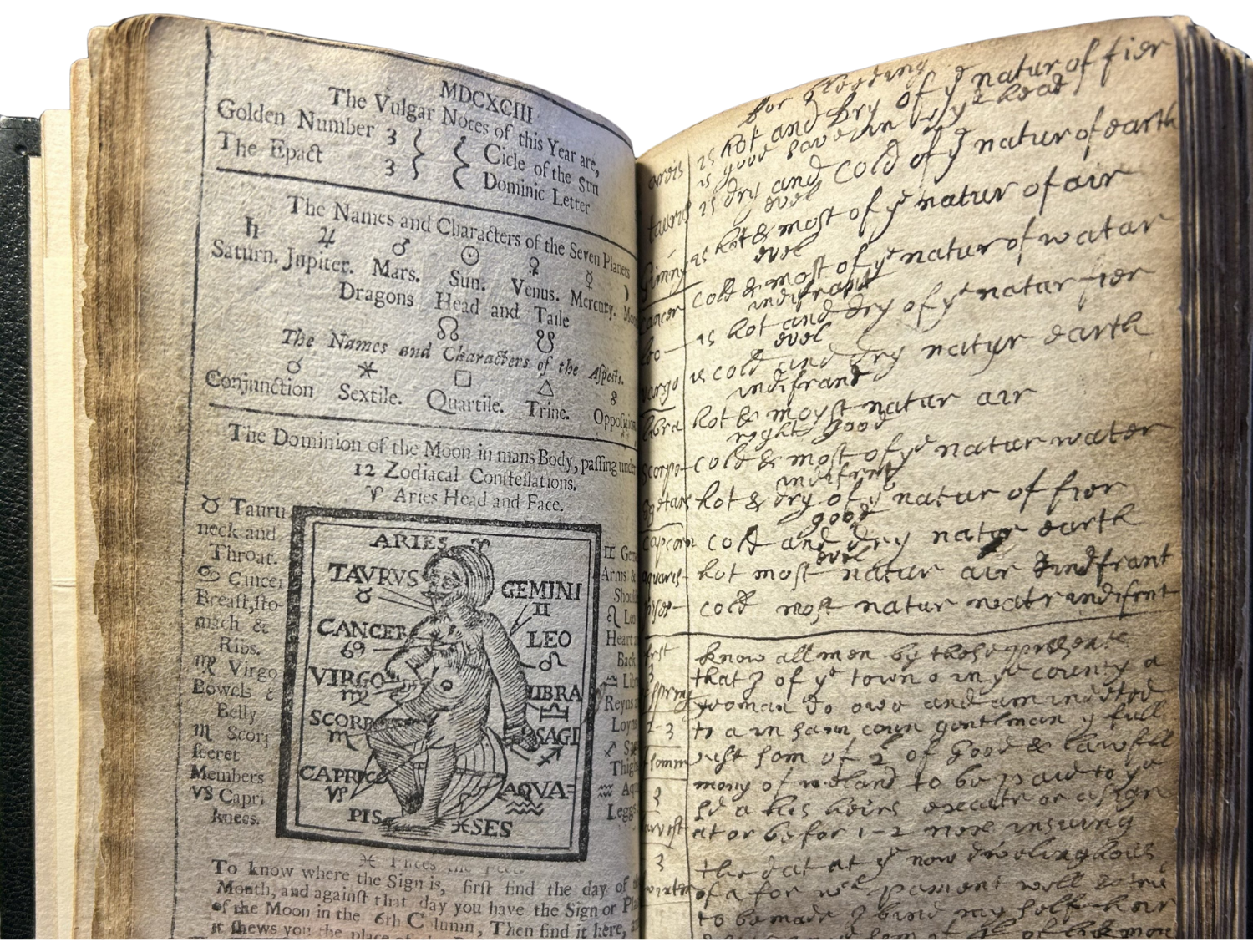
John Tulley (1638–1701), author of a popular series of almanacs, was a teacher of astronomy and navigation from Saybrook, Connecticut. He issued almanacs each year between 1687 and 1702, and was the first to include astrological predictions and weather forecasts. Tulley’s innovations also included starting the year in January instead of March, and his defending the celebration of Christmas Day, a practice long discouraged by the Puritans.
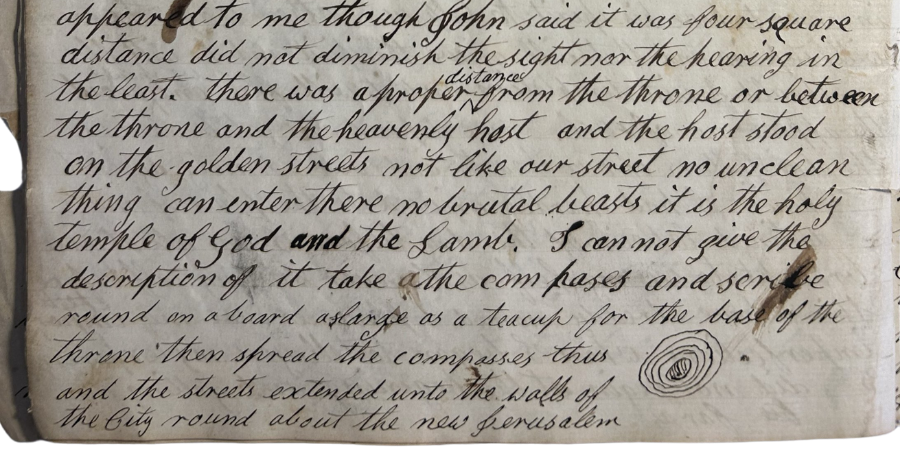
But after years of reading about the antebellum heavens, I cannot avoid concluding that it also gave people something valuable (including the will to resist earth’s petty tyrants). It lent people clear moral purpose during their fleeting lives. I think it’s harder to take encouragement from the heavens of modern astronomy. For some large share of the population, knowing what they know about modern astronomy, it’s hard to avoid the idea that we’re a cosmic accident in a dark, blank mechanism.
Today, astrology is experiencing a resurgence in popularity due, in part, to its ability to adapt to technological innovation in the form of astrology apps such as Co-Star. Since its launch in 2017, Co-Star has been downloaded over 20 million times, and one in four American women between the ages of 18 and 25 have it on their phones. It promises “hyper-personalized, real-time horoscopes” based on all your birth data. Its planetary data comes from NASA satellites and are interpreted by AI, as well as astrologers and a few poets on staff. Astronomical data and astrological interpretation have found a new symbiosis in the 21st century, illustrating how this ancient form of sky reading continues to give meaning to many people’s lives.
At present, as we continue to focus inward, becoming more secluded while simultaneously associating with “imagined communities” that span the internet and social media landscape, we cut ourselves off from understanding those universal and global embodiments that link us on a fundamental level. This has implications for how we conceptualize science in our daily lives but also how we think about and act on global environmental concerns. A connection to the sky has united humanity for millennia. Its decline today parallels a troubling apathy toward science in the 21st century.
Developments & Staff News
Reach for the stars: Look to Clements
Angela Oonk
Director of Development
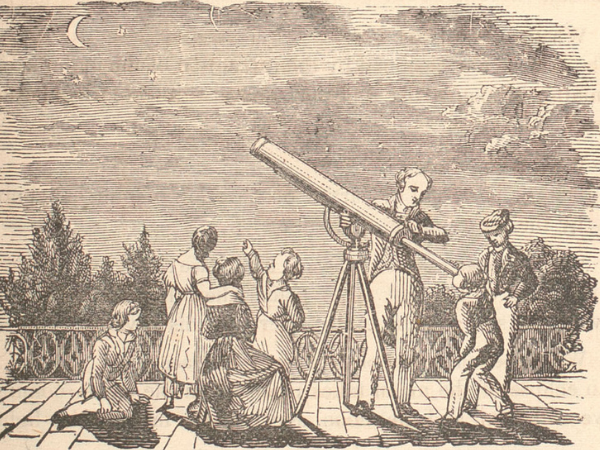
In October, the University of Michigan kicked off a new comprehensive fundraising campaign, “Look to Michigan.” I can’t help but envision something like the excitement and possibility pictured perfectly in an engraving from First Lessons in Natural Philosophy. Why, you ask? Because when we invite you to join us in setting our sights high, we accomplish so much more together.
My team has been writing campaign statements like:
When you reach for the stars, You may not quite get one, But you won’t come up with a handful of mud, either. — Leo Burnett (U-M 1914)
✷ Look to Clements to understand the big moments of history and the details of humanity.
I am always humbled to work with family members entrusting us with their ancestors’ recorded memories that provide precious details of humanity. Lee Rucker Keiser not only donated her mother’s WWII letters, the Marion E. Grusky Rucker Collection, but also proofread the finding aid and wrote a fantastic blog introducing the collection. Each date memorized by students in American history class has as its foundation the individual experiences of real people in the past. Everyday individuals are key to a full understanding of the events that shape our present and future.
✷ Look to Clements online resources for world-wide access to rare historic materials.
Almost every research project today has its beginning online. Catalog records, finding aids, and digitized items are often a researcher’s first point of access to the collections. Scanning fragile Clements materials requires individually handling each piece, making the process expensive and time consuming. With the various 250th anniversaries of the fighting of the American Revolution and the founding of the United States coming up, we were pleased to receive two important grants to aid with the digitization of the papers of the British generals Thomas Gage and Henry Clinton.
✷ Look to Clements fellows to uncover the stories of those we’ve rarely heard from.
The best way to encourage research in unique topics is to provide awards to support visiting fellowships. A new offering for the upcoming fellowship year, the Charles R. Eisendrath Fellowship in Early American Journalism, will enhance the journalism profession by encouraging scholarly work on aspects of journalism in early America. Partnerships with donors to create fellowships on a wide range of topics also enhance the intellectual atmosphere while scholars are onsite.
✷ Look to Clements catalogers and reference staff for a roadmap to the collections through multiple access points.
The quiet, important work of catalogers and reference staff is behind the scenes and often taken for granted. Not only is it difficult to secure funding for additional positions, but the need is never-ending as new materials are constantly being added to the collection. Grants from the Gladys Krieble Delmas Foundation and the Frederick S. Upton Foundation, as well as additional matching funds from individual donors, provided funding for a two-year Historic Visual Culture Graduate Assistant from the U-M School of Information. Annika Dekker is serving her second year in that role and has completed a wide range of projects, including organizing over 3,000 postcards and writing a finding aid for rewards of merit.
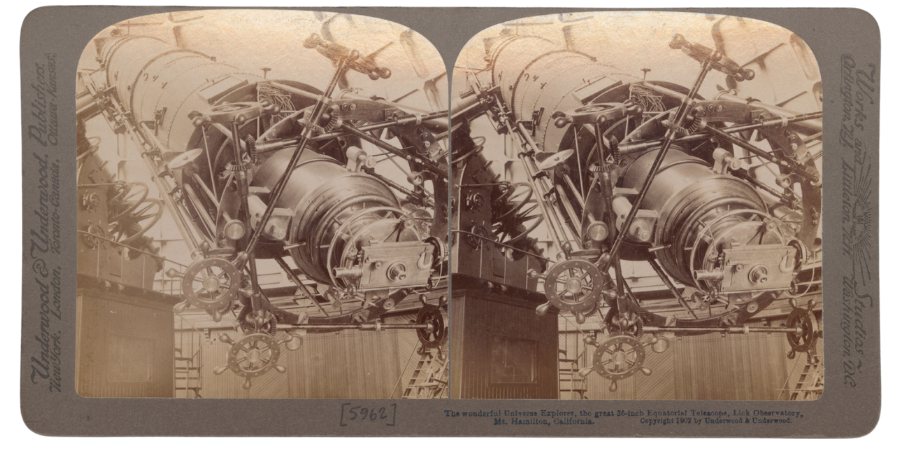
For a literal look to the stars, this stereoview from the recently acquired Vogel collection shows “The wonderful Universe Explorer, the great 36-inch Equatorial Telescope, Lick Observatory, Mt. Hamilton, California” (Underwood & Underwood, 1902). Manufactured in France, upon its completion in 1888 the telescope was the largest in the world.
✷ Look to Clements conservators for top-notch, long-term stewardship of unique historical materials.
Our in-house conservator, Julie Fremuth, works closely with curators to ensure that materials are stabilized, protected, and usable. Conservation materials like acid-free folders, mylar sheets, and specialized papers are expensive. Through the “Adopt a Piece of History” program, donors can help sponsor conservation projects, like a photograph album from Oberlin, Ohio, containing 11 studio portraits, including several images of family members and friends apparently related to a biracial family. This particular item has been adopted by Cinda-Sue Davis. Conservation will include removal of photos, creation of facsimiles to replace originals, stabilization of the binding and torn pages, new housing for the original photos, and a three-part wrap for the album.
✷ Look to Clements curators for the acquisition of historic documents to tell a well-rounded story of American history.
I met Robert Vogel early in my tenure at the Clements and heard about his life-long collecting of images related to engineering and industry. His organization, research, and meticulous notes provided a basis for a finding aid that will serve researchers far into the future. As with many archival materials, there are important layers to uncover as well. While Robert was primarily interested in documenting engineering and technology, these images also often include workers, uncovering clues about work clothes and labor conditions. As objects, the stereoviews can also be studied as an early form of photography. I look forward to seeing the many ways that the Robert M. Vogel Collection of Historic Images of Engineering & Industry will be used in the future.
As we all look to the Clements for the study of American history, it is our donor community, the Clements Library Associates, who are the true stars.
Staff News: New and Familiar Faces
Helen Harding — Business Manager
After working as a generalist in the Development Office since 2023, Helen has stepped into the role of Business Manager. She works with our HR generalist Heather Goodchild, handles finances for the library, and manages our facilities, including our North Campus storage facility. Her development background makes her well-suited to support the library’s mission of collecting and preserving primary sources, making them available for research, and supporting and encouraging scholarly investigation of our nation’s past.
Upon graduating from the University of Michigan with a bachelor’s in American culture, Helen started a successful catering company and restaurant, called EAT. Throughout her career she has successfully run and managed various small businesses, but turned her attention to the nonprofit sector when she pursued a master’s in public administration with a concentration in nonprofit management.

Photo by Marc-Gregor Campredon, Office of University Development, Regents of the University of Michigan.
Katie Jaede- Assistant Director of Development
Our new Assistant Director of Development, Katie Jaede, joins us from the development team at Cranbrook Art Museum. Katie will assist with fundraising, supporting our mission by working on annual giving, stewardship, and event planning. She enjoys connecting donors and visitors with collection items of interest or that coincide with their philanthropic goals, and she loves developing and maintaining relationships with both donors and colleagues.
At Michigan State University, Katie earned a bachelor’s in history of art and visual culture, and a Master’s in arts, cultural management, and museum studies. She’s always had a passion for history, art, and the humanities. She enjoyed promoting and helping to steward the collections of the Cranbrook Art Museum, and she’s excited to bring that same enthusiasm to her work at the Clements!

Heather Goodchild — Human Resources Generalist
Heather was hired in the new position of Human Resources Generalist for both the Clements and Bentley Libraries. She wears a lot of hats, including assisting managers with the hiring process and onboarding, managing timekeeping, and working with HR systems.
The opportunity to help others led Heather to human resources. After graduating from Michigan State University with a degree in business management, her mentors encouraged her to enter the field and she’s been enjoying having the opportunity to help others ever since.
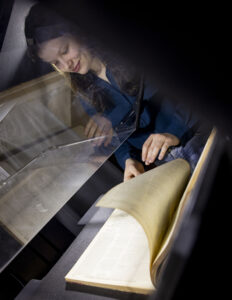
Photo by Marc-Gregor Campredon, Office of University Development, Regents of the University of Michigan.
Ella Johnson — Digitization Specialist
As our new Digitization Technician, Ella’s responsibilities include scanning materials, creating metadata, and processing the images you see on our digitized collection page. Ella is a recent graduate of Carleton College in Northfield, Minnesota, where she majored in art history and worked on various digitization projects in the archives there. She also did digitization work for her local historical society in high school.
Clements Library Board of Governors
Welcome to new board members Wes Cowen (Old Mission, MI), Peggy Harrington (Mill Valley, CA), and Christina Karas (Ann Arbor, MI)!
And farewell to retiring board members Candace Dufek, Thomas Liebman, and Janet Mueller. Thank you for your service!
Farewell….
In her twenty-seven years of service at the Clements Library, Shneen Coldiron wore many hats in her role as Business Manager. Leading business operations, events, facilities, and university partnerships, she was a valuable member of the staff. Thank you, Shneen, for your dedication to the Clements. We are wishing you all the best as you embark on this new adventure!
Shneen with Peter Heydon (l) and husband Brad Coldiron (r).


Randolph G. Adams Director of the Clements Library
Paul J. Erickson
Committee of Management
Santa J. Ono, Chairman
Gregory E. Dowd, Derek J. Finley, James L. Hilton, David B. Walters.
Paul J. Erickson, Secretary
Clements Library Associates Board of Governors
Bradley L. Thompson II, Chairman
John R. Axe, John L. Booth II, Kristin A. Cabral, C. Wesley Cowan, Charles R. Eisendrath, Derek J. Finley, Margaret N. Harrington, Eliza Finkenstaedt Hillhouse, Troy E. Hollar, Martha S. Jones, Christina A. Karas, Sally Kennedy, Joan Knoertzer, James E. Laramy, Ole Lyngklip, Drew Peslar, Richard Pohrt, Catharine Dann Roeber, Estrella Salgado, Anne Marie Schoonhoven, Harold T. Shapiro, Arlene P. Shy, James P. Spica, Edward D. Surovell, Irina Thompson, Benjamin Upton, Leonard A. Walle, David B. Walters, Clarence Wolf.
Paul J. Erickson, Secretary
Clements Library Associates Honorary Board of Governors
Peter N. Heydon, Chair Emeritus
Joanna Schoff, Harold T. Shapiro
Clements Library Associates share an interest in American history and a desire to ensure the continued growth of the Library’s collections. All donors to the Clements Library are welcomed to this group. The contributions collected through the Associates fund are used to purchase historical materials. You can make a gift online at leadersandbest.umich.edu or by calling 734-647-0864.
Published by the Clements Library
University of Michigan
909 S. University Ave. • Ann Arbor, Michigan 48109
phone: (734) 764-2347 • fax: (734) 647-0716
Website: https://clements.umich.edu
Terese M. Austin, Editor, [email protected]
Savitski Design, Ann Arbor
Regents of the University
Jordan B. Acker, Huntington Woods; Michael J. Behm, Grand Blanc; Mark J. Bernstein, Ann Arbor; Paul W. Brown, Ann Arbor; Sarah Hubbard, Okemos; Denise Ilitch, Birmingham; Carl J. Meyers, Dearborn; Katherine E. White, Ann Arbor.
Santa J. Ono, ex officio
Nondiscrimination Policy Statement
The University of Michigan, as an equal opportunity/affirmative action employer, complies with all applicable federal and state laws regarding nondiscrimination and affirmative action. The University of Michigan is committed to a policy of equal opportunity for all persons and does not discriminate on the basis of race, color, national origin, age, marital status, sex, sexual orientation, gender identity, gender expression, disability, religion, height, weight, or veteran status in employment, educational programs and activities, and admissions. Inquiries or complaints may be addressed to the Senior Director for Institutional Equity, and Title IX/Section 504/ADA Coordinator, Office of Institutional Equity, 2072 Administrative Services Building, Ann Arbor, Michigan 48109-1432, 734-763-0235, TTY 734-647-1388, [email protected]. For other University of Michigan information call 734-764-1817.