

ARTS & RESISTANCE
No. 58 (Fall/Winter 2023)
Table of Contents
The Art of Resistance in Early America
Paul Erickson
Randolph G. Adams Director
William L. Clements Library
This issue of The Quarto is a companion to the upcoming Clements Library exhibit that takes up the theme of the Fall 2023 semester here at the University of Michigan’s College of Literature, Science, and the Arts: “Arts and Resistance.” The United States is often described as a nation that was born out of resistance–resistance to oppression of dissenting religious beliefs, resistance to taxation without representation, take your pick. When we think about what that resistance looked like in the late 18th-century colonies, public demonstrations might be the first things that come to mind. Sometimes these were acts of destruction of property, such as the Boston Tea Party in December 1773, or pulling down the statue of King George III at Bowling Green in Lower Manhattan in 1776. Other demonstrations crossed the line into violence, such as tarring and feathering tax collectors, or the street protest in March 1770 that turned into the Boston Massacre. And if we think about the arts of resistance, we may think of visual representations of these events, such as Paul Revere’s famous engraving of the Boston Massacre. But there were other visual traditions of resistance circulating at the time as well.

The Repeal, Or, The Funeral of Miss Ame-Stamp (London?, 1766) shows a funeral procession on the banks of the Thames, carrying a small coffin, containing the remains of the Stamp Act, toward an open vault. At right are the large unshipped cargoes destined for America that had accumulated during the period when the act was in force.
Many readers of The Quarto will be familiar with the satiric prints that appeared in the period of the colonial crisis in the 1760s, often expressing resistance to particular British policies, such as the 1766 print, The Repeal, Or, The Funeral of Miss Ame-Stamp. While some of these satiric prints were produced in the North American colonies, the majority of them were created in London and were thus expressions of internal British political division over its colonial policies. Even so, they circulated widely on both sides of the Atlantic and provided an important visual dimension to resistance against British colonial rule.
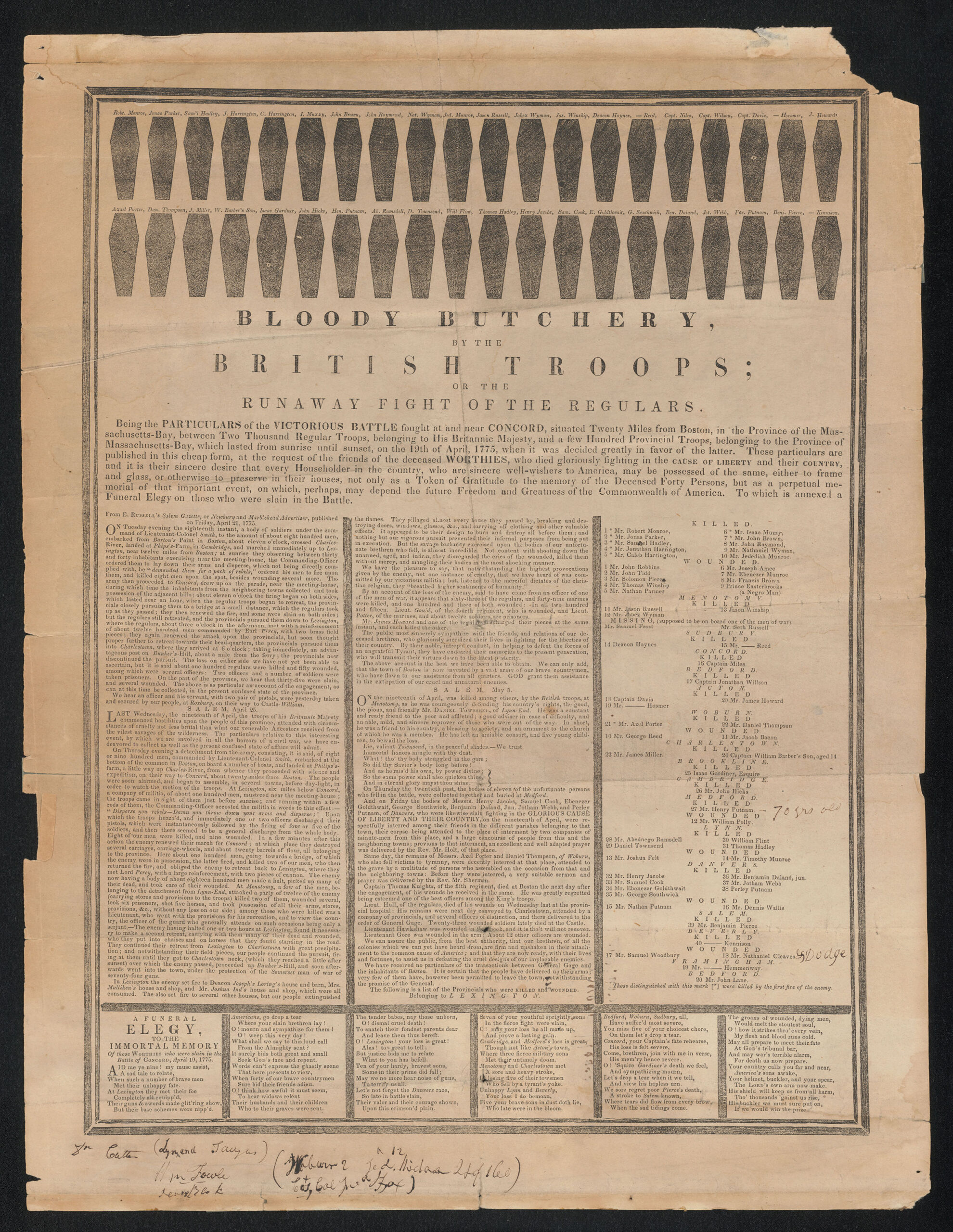
The broadside, Bloody Butchery, by the British Troops (Salem, 1775; reprint, before 1860), is designed to inflame the passions of the public and incite sympathy for the American cause, both with the use of coffin graphics and by excoriating the British troops for “shooting down the unarmed, aged, and infirm, they disregarded the cries of the wounded, killing them without mercy, and mangling their bodies.”
But aside from visual materials, we don’t often think about the role of arts in the rising tide of resistance to Britain’s colonial rule in the 1760s and 1770s. We’re familiar with more contemporary art forms that have been put to use in political struggles, art forms that have histories of their own. For instance, there is a long tradition of protest songs in American music. Scholars have drawn a direct line from the Hutchinson Family Singers’ abolitionist album “Get Off the Track!” of the 1850s to the African American spiritual “Sometimes I Feel Like a Motherless Child” to Billie Holiday’s haunting anti-lynching song “Strange Fruit” of 1939 to Public Enemy’s bracing 1989 call to “Fight the Power.” Similarly, American literature has a long tradition of protest writing in many genres. With the publication of Harriet Beecher Stowe’s Uncle Tom’s Cabin in 1851, the novel supplanted the pamphlet as the primary popular prose genre of political resistance, whether protesting conditions for workers in Chicago’s meat-packing plants (Union Sinclair’s 1906 novel The Jungle) or the oppression of African Americans on Chicago’s South Side (Richard Wright’s 1940 novel Native Son).
But there were no protest novels (that we know of) written in the North American colonies during the 1760s and 1770s. And while there were likely many popular drinking tunes that had rowdy lyrics written at the time, very few of them survive. So what were the arts of resistance to British rule in the run-up to the American Revolution? It should come as no surprise that political opposition was expressed in the most common contemporary genres of what we now call creative writing: sermons and poetry.
Along with sermons, poetry was the written genre most often put to use in colonial America to both respond to current events as well as offer commentary on more enduring questions.
Modern readers may not be accustomed to thinking of sermons as art, even if their undergraduate anthologies of early American literature contained some classics of the genre (Jonathan Edwards’ “Sinners in the Hands of an Angry God” is likely the most familiar). But ministers were typically the most skillful and prolific writers in their communities, and their sermons (some of which found their way into print after being preached) were experienced as literature. One particularly pointed example of protest from the pulpit at the Clements Library is a printed version of a sermon delivered in 1774 by John Lathrop (1740-1816), pastor of Boston’s Second Church. A Discourse Preached December 15th 1774, Being the Day Recommended by the Provincial Congress, to be Observed In Thanksgiving to God for the Blessings Enjoyed; and the Humiliation on Account of Public Calamities (Boston, 1774) may appear to be a typical New England sermon of thanksgiving following the harvest season. But, as Lathrop himself wrote, “the exercises of this day, will… be different from what have been usual…”. Lathrop offered thanks for the year of mild weather that had resulted in Boston’s markets being “filled with a variety of provisions” although he noted the high cost of these “necessities of life.” A footnote indicated precisely why the prices were so high, naming the four British warships that were at the time blockading Boston Harbor. The same footnote identified the thirteen “Regiments…now Stationed at Boston, and at Castle-William.” All of those soldiers and sailors were in Boston to enforce the Intolerable Acts, a series of laws passed by Parliament in response to the Boston Tea Party. Lathrop’s call in his sermon was unmistakable. Although he claimed that “we never will rebel against the Sovereign of the British dominions,” he also wrote: “But when the parent State is contending with us, nothing but the last extremity, –nothing but the preservation of life, or that which is of more importance LIBERTY, can even prevail with us to make resistance.” Lathrop was trying to negotiate the line between “resistance” and “rebellion” all while framing the current upheaval as being evidence of a crisis in the colonists’ relationship with God.

This Portrait of Phyllis Wheatley Peters was issued in the 1950s or 1960s by Associated Publishers, a company established by Dr. Carter Woodson to publish books on Black history and portraits of important African-Americans, enlarged and suitable for framing. This half-tone print was based on the iconic and only known portrait engraving of Wheatley Peters issued as a frontispiece to Poems on Various Subjects (London, 1773).
Along with sermons, poetry was the written genre most often put to use in colonial America to both respond to current events as well as offer commentary on more enduring questions. A particularly striking example of the first case was the large broadside titled Bloody Butchery by the British Troops: Or, The Runaway Fight of the Regulars. Printed by Ezekiel Russell (1743-1796) in Salem Massachusetts, immediately in the wake of the Battles of Lexington and Concord in April 1775, the broadside was surrounded by a heavy black border, with two rows of twenty black coffins across the top, each bearing the name of on the Massachusetts dead. The last line of the broadside’s title advertised an added bonus: “a funeral elegy on those who were slain in battle.” In his History of Printing in America (Worcester, Mass., 1810), Isaiah Thomas loosely attributed this poem to a young woman who lived with printer Ezekiel Russel’s family, although this is far from certain. The beginning of the verse lament appears to be modeled on the opening of the Iliad: “AID me ye nine! my muse assist,/ A sad tale to relate,/ When such a number of brave men/ Met their unhappy fate.” The poet listed each town in Massachusetts that lost men in the battle, while highlighting the unexpected tragedy that the battle (and the upcoming war) would visit on colonial families:
Words can’t express the ghastly scene
That here presents to view,
When forty-two countrymen
Sure bid their friends adieu.
To think how awful it must seem,
To hear widows relent
Their husbands and their children
Who to the grave was sent.
The poetry of Phyllis Wheatley Peters (1753-1784), now hailed as one of the most important American literary figures of the 18th century, would seem to have little in common with this elegy from Salem. And from her first published poem (which appeared in the Newport Mercury when she was only 13) to the title of her 1773 book, Poems on Various Subjects, Religious and Moral, readers would have expected her work to be suffused with polite piety, not political resistance. But it would have been impossible for a book of poems written by an enslaved Black girl to not have been interpreted as a sign of resistance to the accepted social order. And even more, the erudite, polished verses in Poems on Various Subjects (published when she was perhaps 19) did contain some thorns. Perhaps her most explicit expression of protest was the ode “To the Right Honorable William, Earl of Dartmouth,” who had been newly appointed secretary of state for the Colonies. The poem opened with the colonists’ hopes that they would receive better treatment from the Earl of Dartmouth than from his predecessor:
Hail, happy day, when, smiling like the morn,
Fair Freedom rose New England to adorn:
The northern clime beneath her genial ray,
Dartmouth, congratulates they blissful sway
The poem’s third stanza answered a question that the poem imputed to Dartmouth, and likely to other readers: why would an enslaved young woman be writing about freedom? Wheatley’s answer did not pull any punches:
Should you, my lord, while you pursue my song,
Wonder from whence my love of Freedom sprung,
Whence flow these wishes for the common good,
By feeling hearts alone best understood,
I, young in life, by seeming cruel fate
Was snatch’d from Afric’s fancy’d happy seat:
What pangs excruciating must molest,
What sorrows labour in
My parent’s breast?
Steel’d was that could and by no misery mov’d
That from a father siez’d his babe belov’d:
Such, such my case. And can I then pray
Others may never feel tyrannic sway?
By explicitly comparing the colonists’ complaints about “tyranny” with her own experiences of having been stolen from her parents, brought across the ocean, and sold as a slave, Wheatley used poetry–the most popular literary form of the Revolutionary era– to support the colonies’ cause while at the same time undercutting the colonies’ complaint by highlighting the difference between colonial oppression and chattel slavery, between taxation without representation and her parents’ loss of their child. Wheatley Peters’ pen proved an eloquent means of resistance against persecution, both personal and political.
I hope that you enjoy this issue’s exploration of the theme of Arts & Resistance, and that you will visit the Clements later this fall to see the exhibit in the Avenir Reading Room on this theme.