Audi et Alteram Partem: Listen to the Other Side
Audi et Alteram Partem: Listen to the Other Side
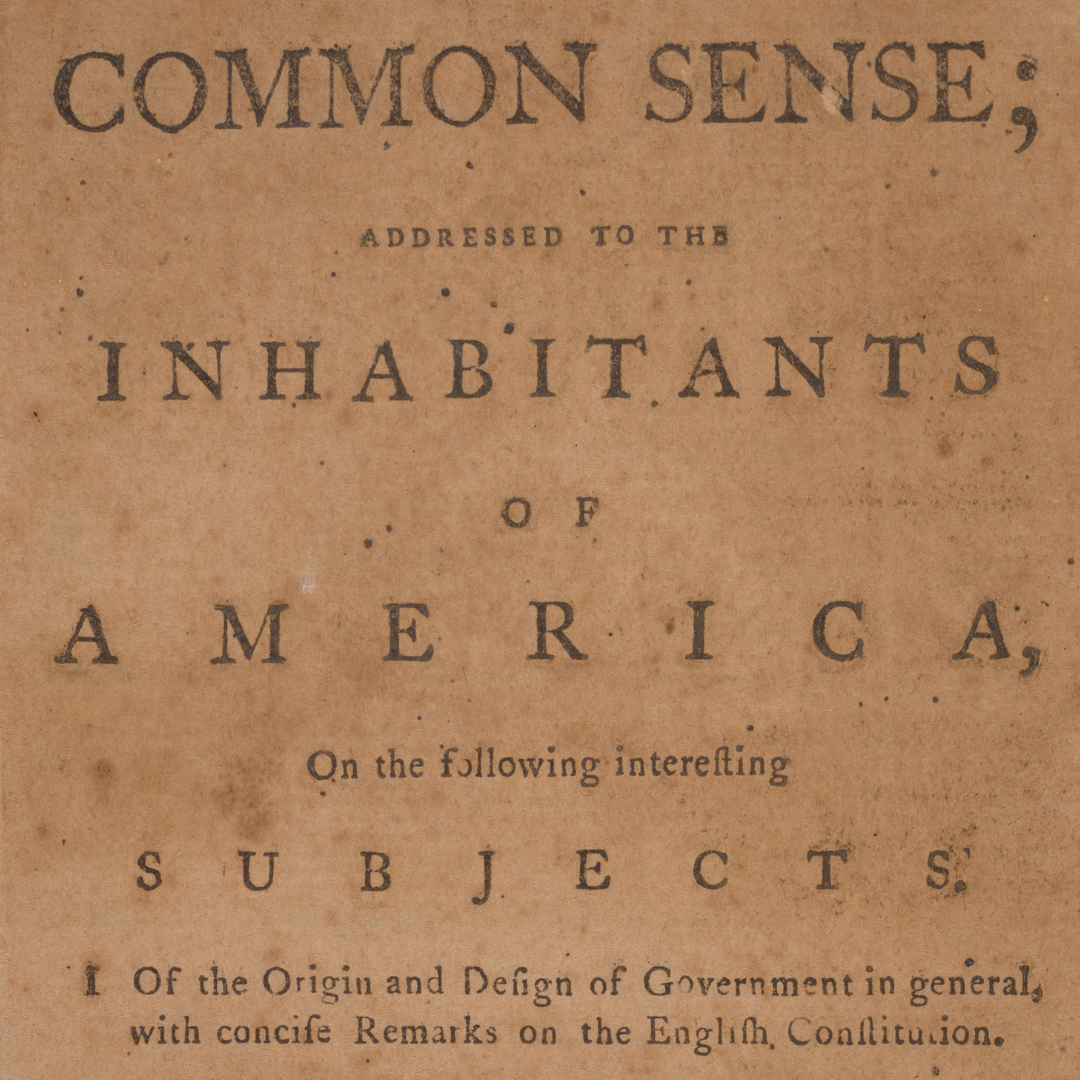
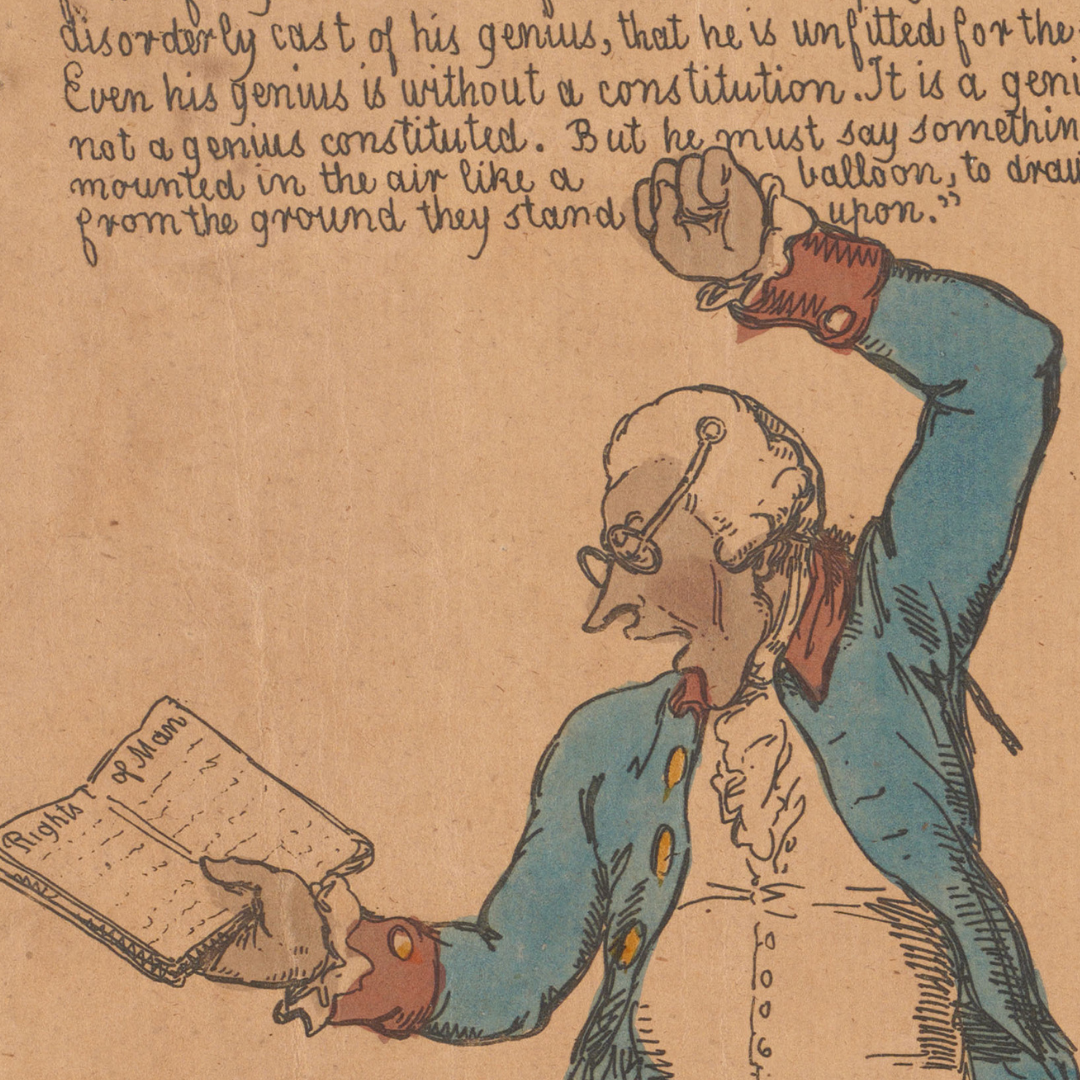
This page offers a snapshot of the reactions and responses to Common Sense, and Paine more generally, that make clear how much controversy he and his work aroused. Both visually and textually, Paine was lionized and vilified as he became an icon synonymous with the ideas he advocated for.
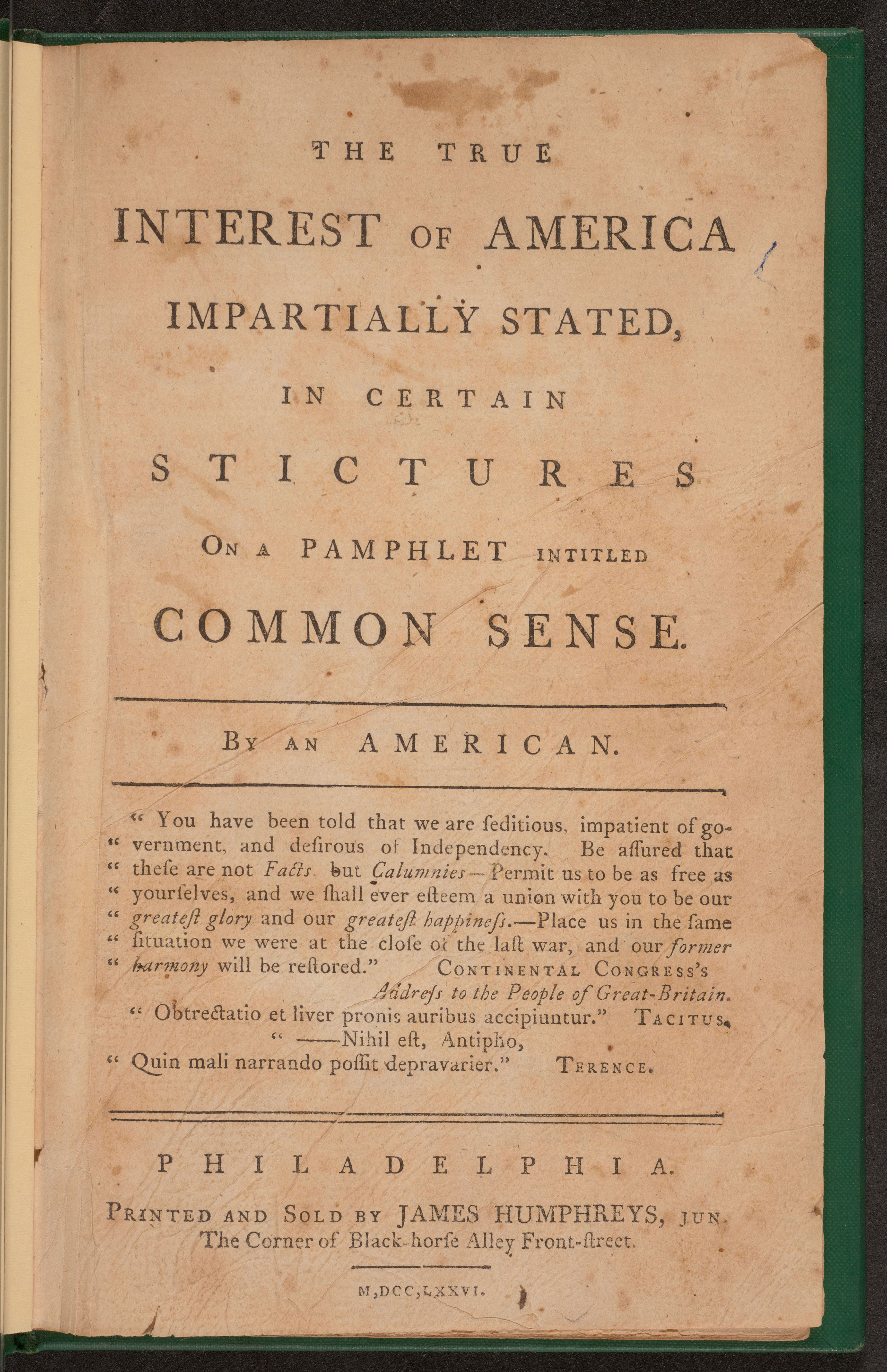
British and American rebuttals to Paine’s vision came in pamphlet form as well as caricatures. Maryland Loyalist James Chalmers maintained a longstanding grudge against Paine, authoring tirades against him even after the war ended. The most famous of these rebuttals was Plain Truth (1776), a staunch defense of Britain’s constitutional order and the appeals of gradual reform. Anglican clergyman Charles Inglis also subjected Common Sense to a searing critique in The True Interest of America (1776). Together, the books demonstrate how pamphlet debates shaped public opinion in the months before revolution.
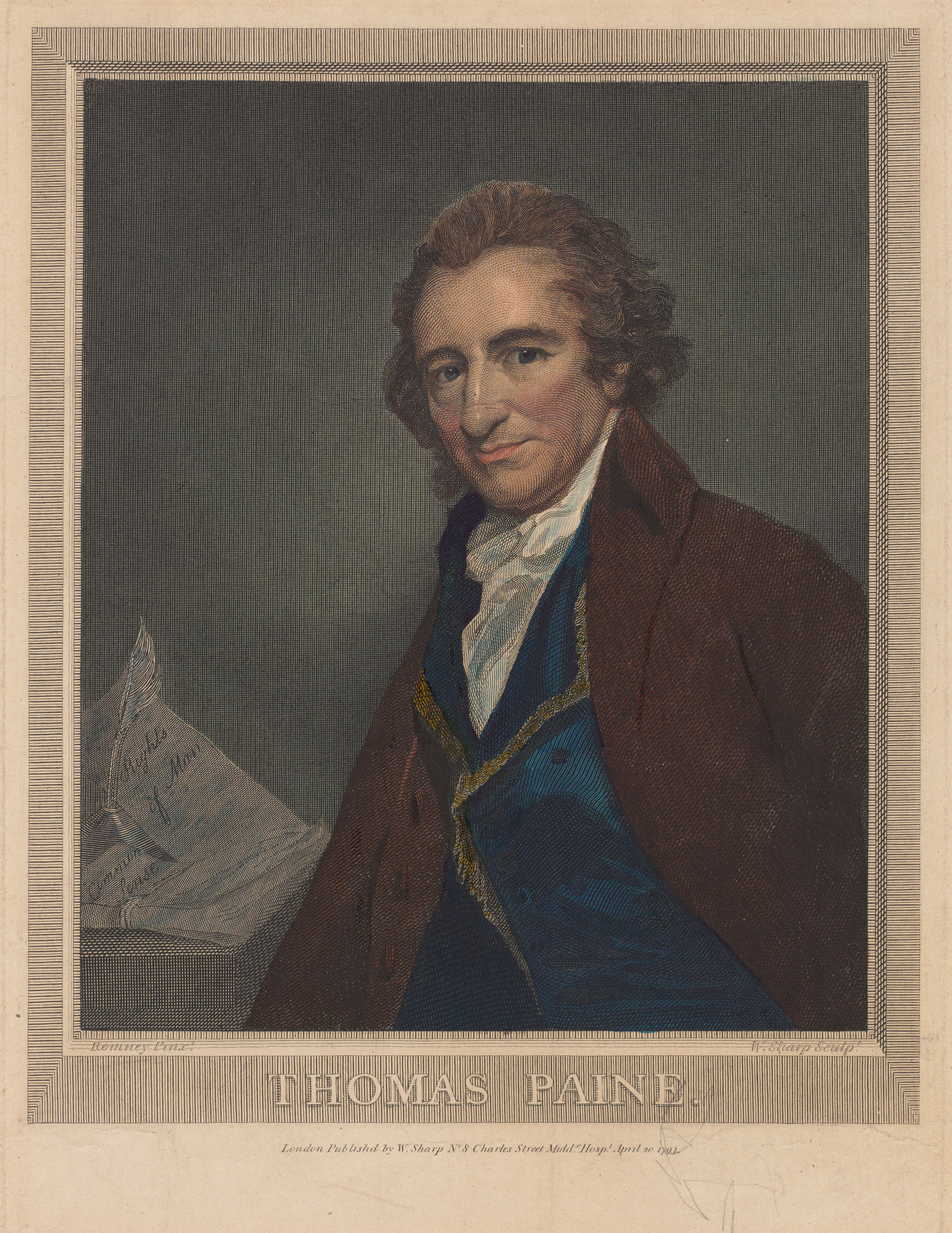
In portraiture, Paine’s image would also be reprinted ad infinitum. The Clements Library’s 1793 engraving of Paine by British artist William Sharp certainly contrasts sharply with the effigies of Paine that were burned throughout England after his publication of The Rights of Man in 1792. It also contrasts with the caricature of Paine as a quack doctor selling the conception of republicanism as a panacea, as seen in the satirical print “Le Fameux Empyrique Anglois Américain.” (1780s).
“Thomas Paine”, London: Published by W. Sharp, 1793.
This portrait of Thomas Paine is a hand-colored engraving by British artist William Sharp and is based on a painting by renowned portraitist George Romney. Romney’s portrait of Paine was made following the publication of Rights of Man, Part the Second, published in 1792. Rights of Man was intended as a response to Anglo-Irish statesman Edmund Burke’s Reflections on the Revolution in France, which had severely criticized the French Revolution. Paine’s response not only defended the French Revolution, but also delved into the issues plaguing European society at the time, including arbitrary government, poverty, and war. Paine then offered solutions such as replacing monarchy with republicanism and imposing an income tax. In the two months that Paine sat for the portrait by George Romney, there was outrage across the nation surrounding Rights of Man. Government agents led mobs, burned effigies of Paine, and convicted him of seditious libel, thus he fled to France in September 1792 to avoid arrest. Like Paine, Romney and Sharp were European political revolutionaries and two of Paine’s few remaining allies in England. Though this portrait shows Paine and his two most famous works in a positive light, it was published at a time and place where his ideas were incredibly controversial.
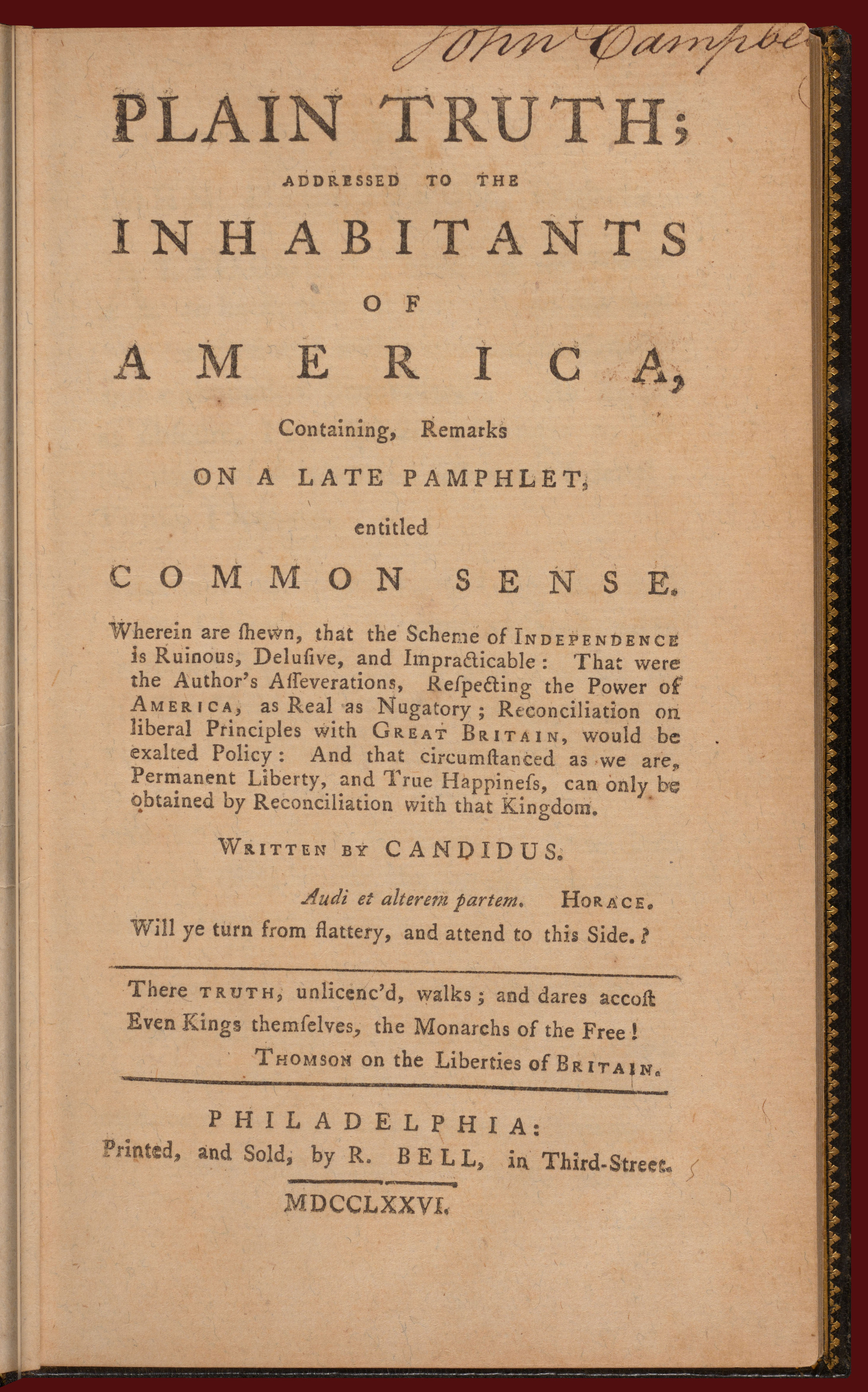
James Chalmers, Plain Truth: Addressed to the Inhabitants of America, Philadelphia: Printed; London: Reprinted for J. Almon, opposite Burlington House, in Piccadilly, 1776.
Under the pseudonym Candidus, James Chalmers wrote the pamphlet Plain Truth as a rebuttal to Paine’s Common Sense. Chalmers was a Maryland Loyalist who came to America from Scotland in 1760 and settled as a wealthy landowner. Plain Truth was used to defend the British political and legal systems, arguing that pure American democracy would lead to chaos. He wrote that Paine’s complaints about the British monarchy were invalid and that there was no chance the thirteen colonies could stand up to the British army. Paine demanded a new system based on equality and natural rights; while Chalmers valued the existing constitution’s balance and gradual reform. He further dismissed Paine’s denunciation of the British constitution as prideful and misguided.
At first, few could read Plain Truth as it was far too dense, especially in comparison to Paine’s Common Sense. However, once Plain Truth circulated widely, it ignited both support and fury. Loyalists agreed with Chalmers’s defense of Britain’s constitutional order, yet many revolutionaries viewed it as a betrayal–sparking riots and forcing Chalmers to flee from angry mobs. This led to Chalmers joining the British Army and serving as a lieutenant colonel during the Revolutionary War. After the war, he was exiled and fled the U.S. Once Chalmers returned to London, he continued to write critical pamphlets against Paine. Chalmers’s Plain Truth stands as an influential counterpoint to Paine’s revolutionary ideas, showcasing the importance of differing ideals of liberty and governance among educated colonists.
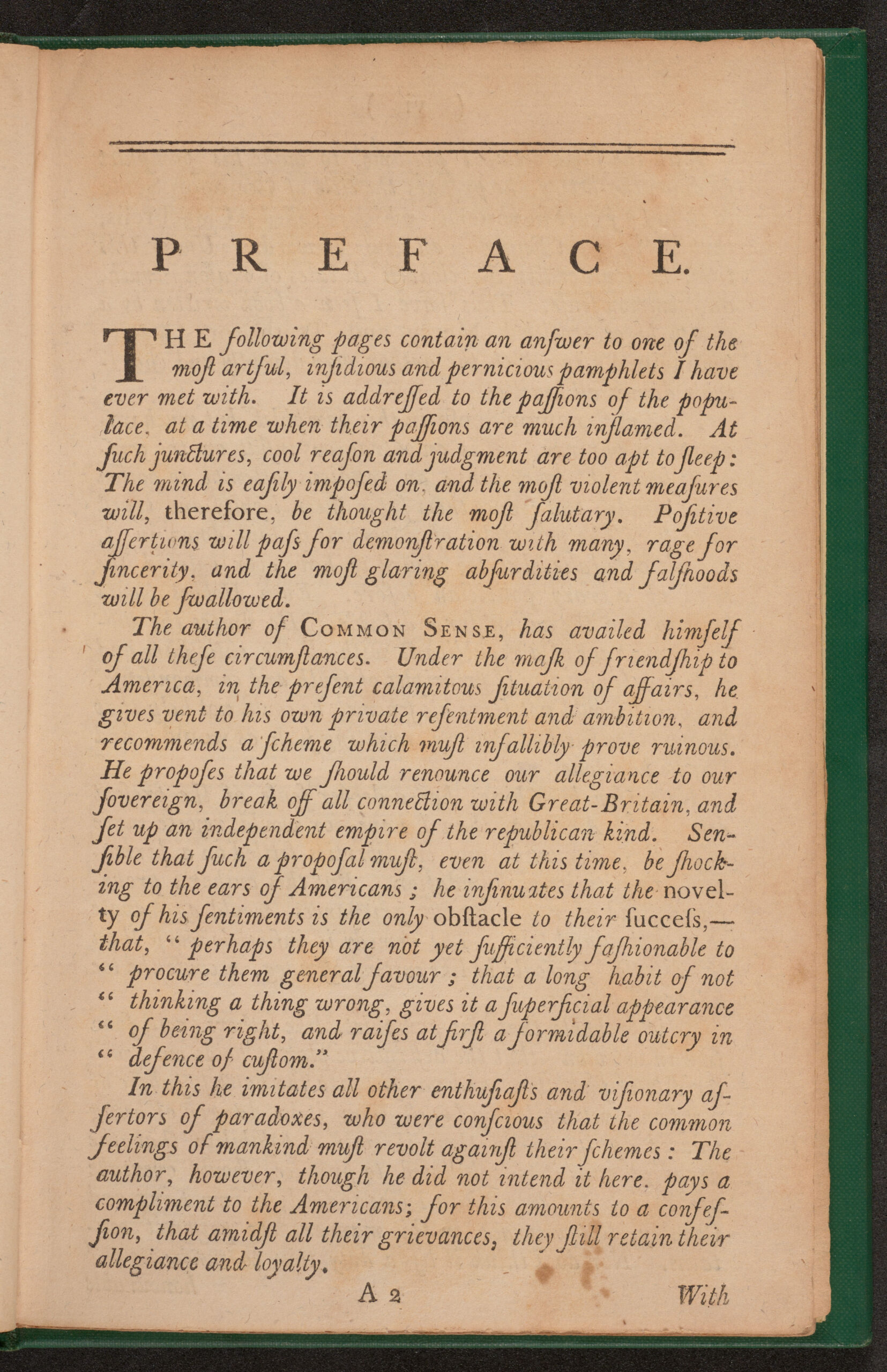
Charles Inglis, The True Interest of America: Impartially stated, in certain strictures on a pamphlet entitled Common Sense, Philadelphia: Printed and sold by James Humphreys, Jun., [1776].
Loyalist and Anglican Charles Inglis criticized Thomas Paine’s argument for the American colonies to separate from Great Britain. In conjunction with the other pieces of this exhibit, this work demonstrates how controversially Paine’s Common Sense was received by the early American populace.
Inglis argued that waging war with Britain would not only cripple the economic and industrial power of the colonies, but also would go against their core religious beliefs as a separation could mean disobedience in the eyes of God. These arguments put Common Sense into perspective of not just a political struggle, but a moral one.
![Le Fameux Empyrique Anglois Américain. [Publisher not identified], 1780s (exact date unknown). Satirical print depicting Thomas Paine as an empiricist selling a bottle labeled "Union" to a crowd. Across from him is a depiction of an "Anglo Peace Commissioner appointed to deal with the United States of America."](https://clements.umich.edu/wp-content/uploads/2026/01/8.-gr-prints-sat.f.c178-thomas-paine-as-medicine-man-scaled.jpg "8. gr-prints sat.f.c178-thomas paine as medicine man")
Left translation: “The famous Anglo-American empiricist [:] I possess the true remedy for the fury of English oppression.
Right translation: “The Anglo Peace Commissioner appointed to deal with the United States of America.”
Le Fameux Empyrique Anglois Américain, [c. 178-?].
This engraving is a political cartoon mocking Thomas Paine and the call to independence in Common Sense. On the left, the artist depicts Paine as an empirical scientist, selling a bottle labeled “Union” to a crowd of onlookers. This parallels how Paine presented independence as a simple remedy for the colonists’ oppression and other grievances. He has exaggerated features, including a long nose and chin, an extremely skinny physique, and a torn coat. These details were characteristic of low social class, power, and income. The right depicts an Anglo Peace Commissioner appointed to “deal with” the United States. He is looking at an official legal document with a magnifying glass, titled “Article 1er Indépendence reconnue,” meaning “Article 1 Independence Recognized.” This document relates to the French Revolution.
This political cartoon conveys the critiques Common Sense received. Empiricists derive knowledge from sensory experience and empirical evidence rather than reason. Analogizing Paine to an empirical scientist suggests that Paine’s arguments for self-governance were irrational. According to the critics, independence was not the solution. Without reconciliation with Britain, the colonies would fall apart because they depended on monarchical rule for their success.