An Uncommon Conclusion
An Uncommon Conclusion
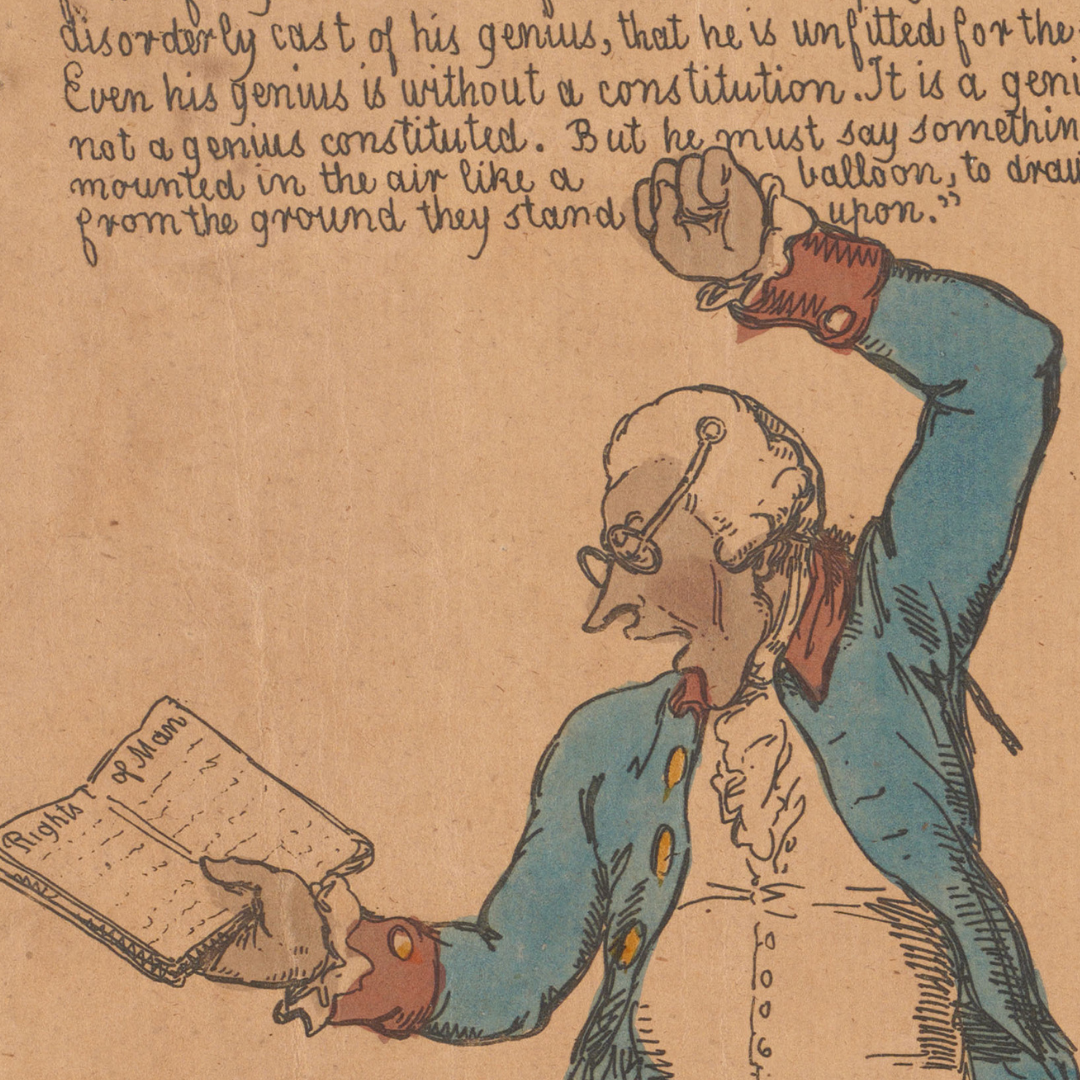
Paine’s revolutionary temperament was not restricted to matters of politics. His 1794 book The Age of Reason: Being an Investigation of True and Fabulous Theology extended his critique to theology and religion, questioning key tenets of the Christian faith, criticizing the institutional dimensions of religion more generally, and espousing Deism as the only faith compatible with human reason. Paine wrote The Age of Reason hastily, in Paris in 1793. During this period, Paine publicly opposed the execution of Louis XVI, leading to his arrest and several months of imprisonment. After his release in 1794, the book was published and sold in both Britain and America. The controversy it provoked proved long-lasting: In 1819, a London jury found publisher Richard Carlile guilty of blasphemy, libel, and sedition for publishing Paine’s work.
To put yourself in the world of the trial, listen to the audio recording below of University of Michigan students performing a scene from the proceedings.
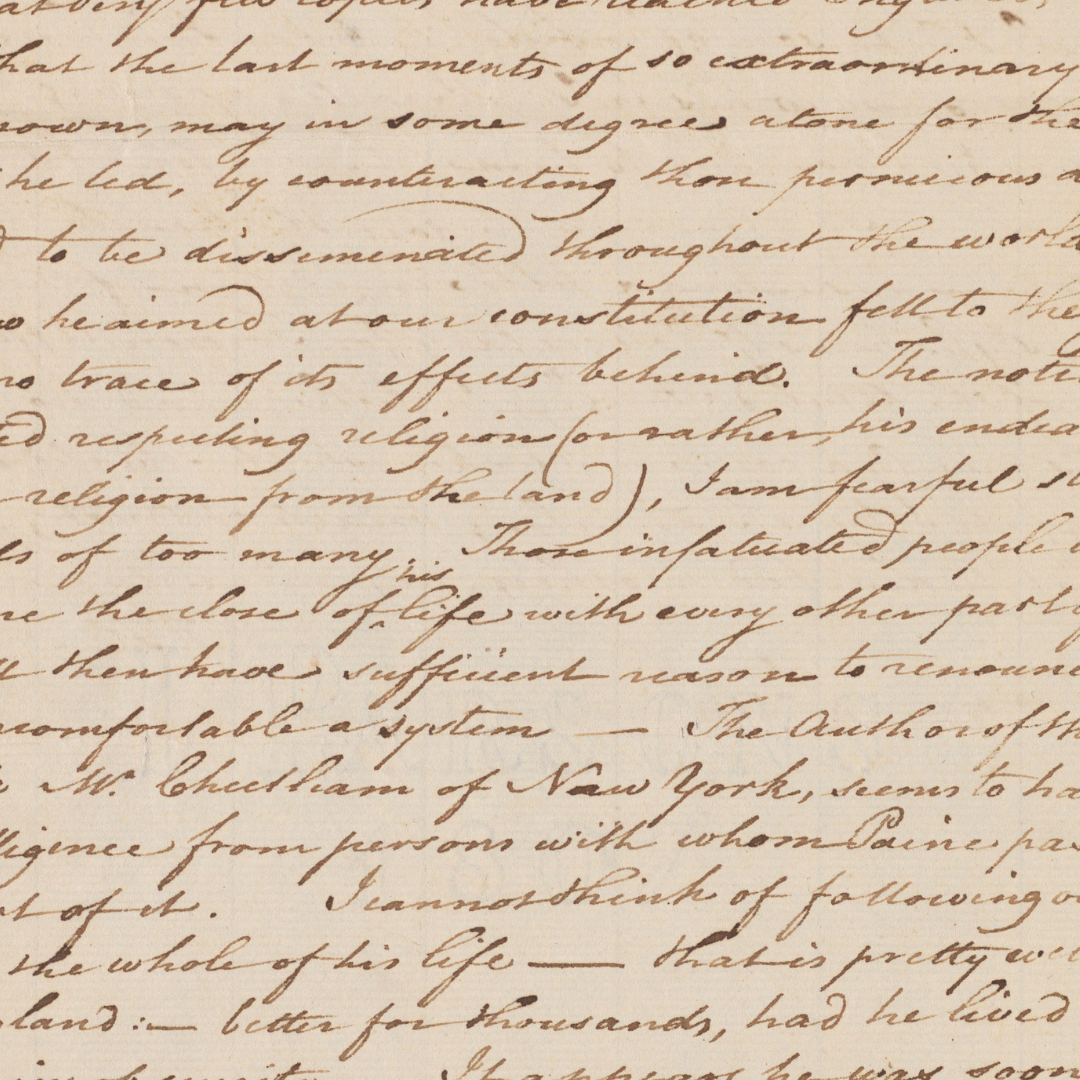
This page also contains a copy of a satirical obituary written for publication in Massachusetts-based newspaper, The Traveller, which castigates Paine in evocative language. Well into the 19th century, Spiritualist treatises would take the opportunity to help Paine’s spirit “communicate” with those still living, and to speak to other departed luminaries (including, in Charles Hammond’s Light from the Spirit World, the Quaker founder of Pennsylvania, William Penn).
By the time he died in 1809, Paine was reviled by many for his controversial views. But he left an indelible mark on the politics of his time, and he continues to be invoked by those seeking freedom and self-government in our own.
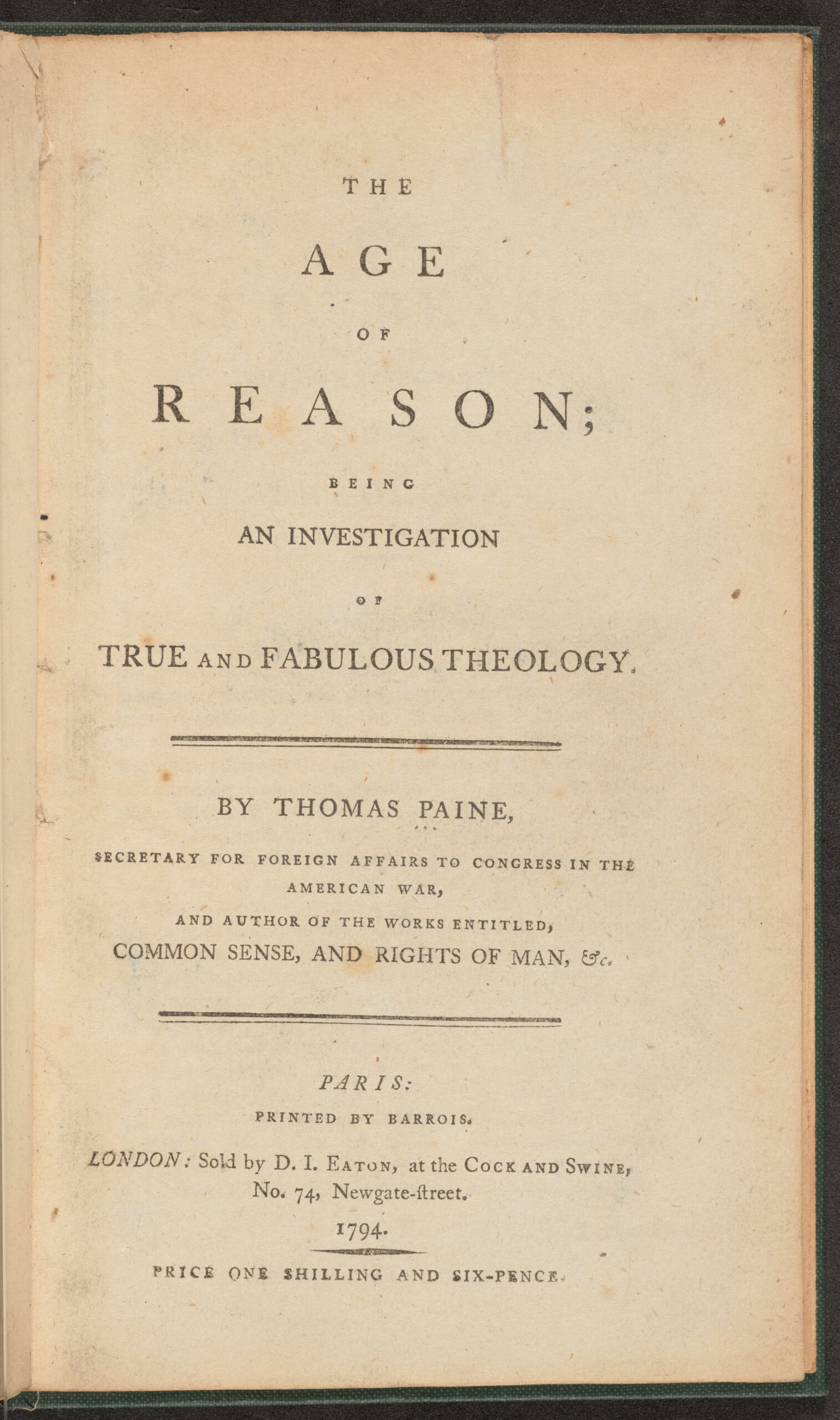
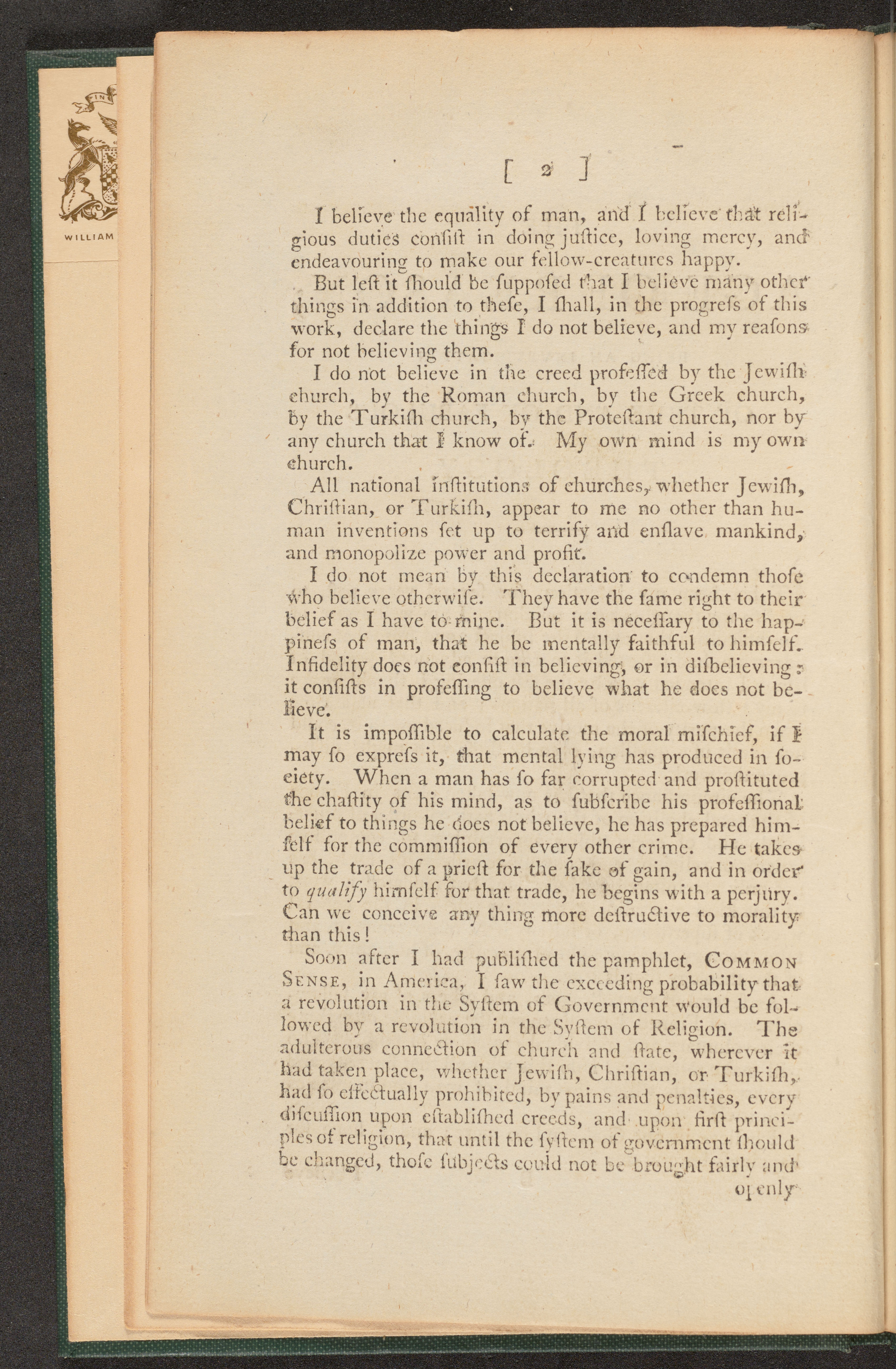
Thomas Paine, The Age of Reason; Being an Investigation of True and Fabulous Theology, Paris: Printed by Barrois; London: Sold by D.I. Eaton, 1794.
Thomas Paine wrote The Age of Reason: Being an Investigation of True and Fabulous Theology hastily in Paris in 1793, in the midst of revolutionary chaos in France. During this period, Paine publicly opposed the execution of Louis XVI, which led to his arrest and several months of imprisonment. After his release in 1794, the book was published by D.I. Eaton and sold in both Britain and America.
The text was largely ignored by the French population due to its critique of Biblical texts being written in such simple and direct language. However, it was very successful in Britain and America, where this thought process was more accepted. Many Americans were already inspired by Enlightenment ideals and found Paine’s advocacy for deism attractive. In fact, in the United States, the text was significant in a temporary rise of deism, while also leading to reactions that led to a resurgence of trinitarian Christianity.
The Age of Reason marked a clear departure from Paine’s earlier works, shifting from his political advocacy for American independence to a philosophical and theological critique of organized religion. While his previous writings had inspired revolution, this work sought to to question the authority of traditional religion and promote the use of human reason instead of blind faith in divine revelation. Its publication sparked widespread controversy and encouraged debate over natural religion and the role of belief.
Because the book was associated with radical political movements, it was seen as shocking and offensive to both clergy and believers. Many accused Paine of atheism, even though he explicitly affirmed his belief in one God. The openly critical view of the Bible provoked strong backlash from religious leaders and communities. In England, The Age of Reason was banned, and booksellers who printed or distributed it were sometimes prosecuted for blasphemy or sedition.
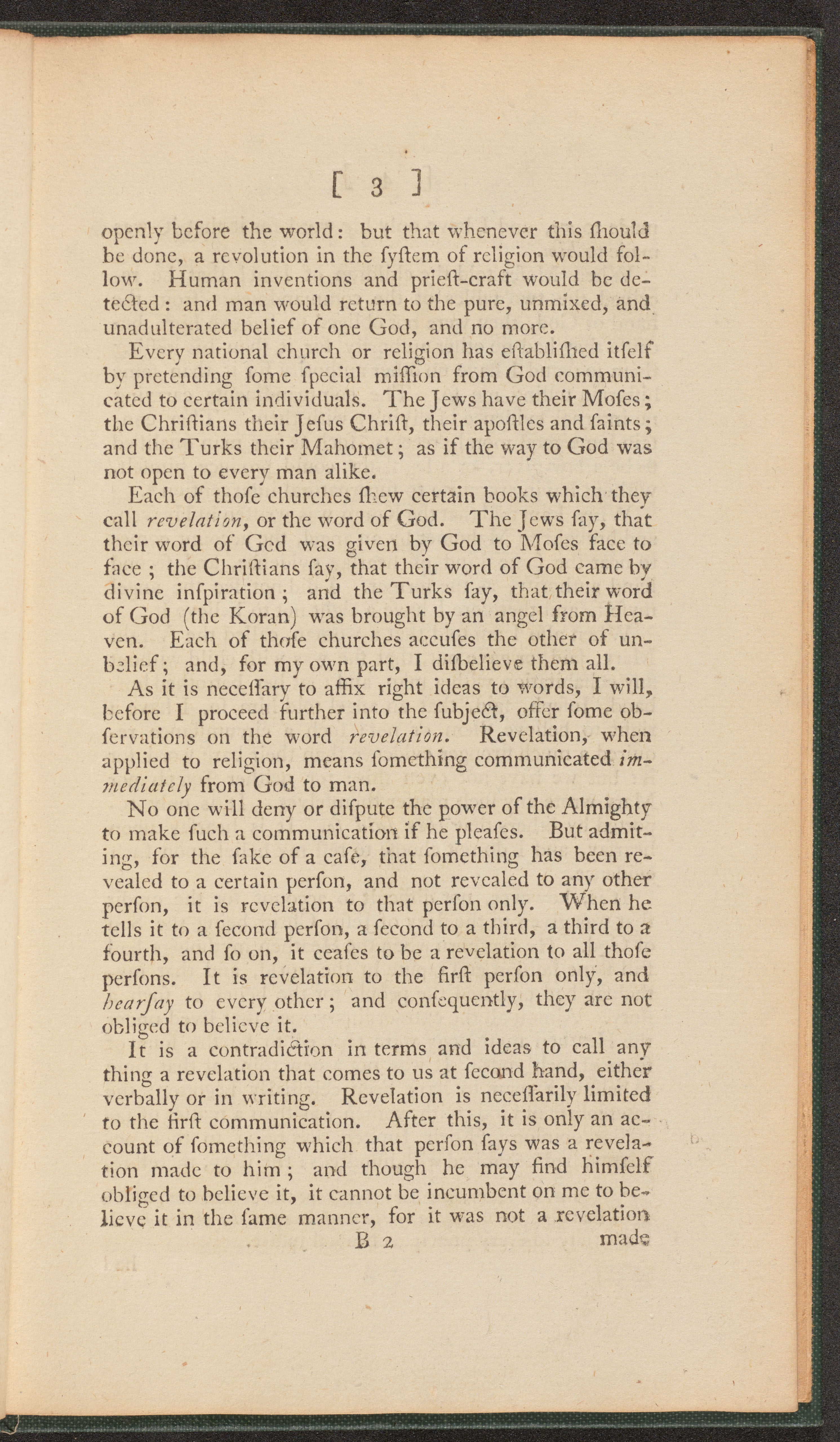
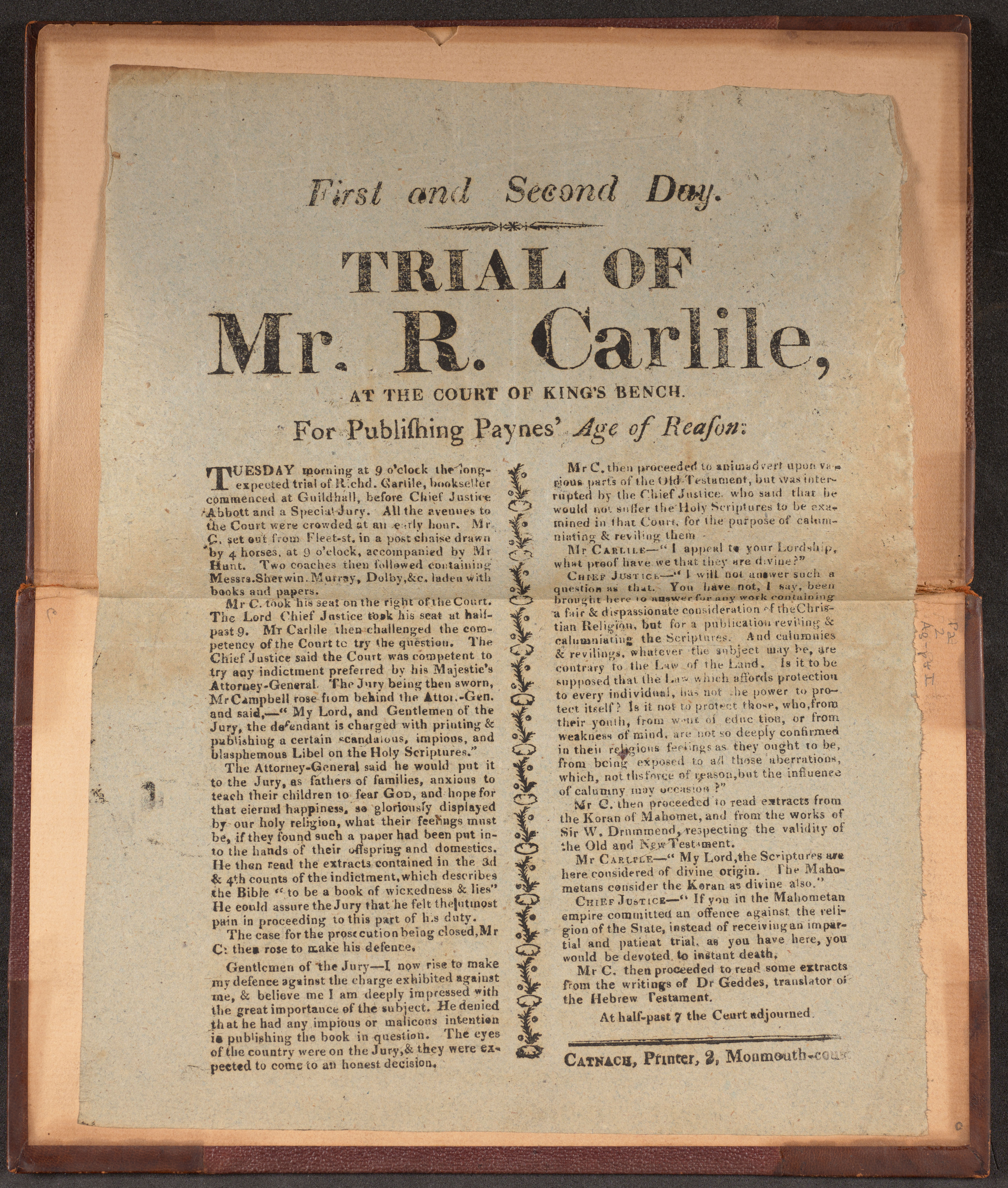
“First and second day: Trial of Mr. R. Carlile … for publishing Payne’s Age of Reason,” Catnach Press, (1819). Pasted into the back of Paine, The Age of Reason, London: Barrois, 1794.
Towards the end of his life, Thomas Paine’s ideas challenging certain widely held beliefs about Christianity and the Bible made him–and those who associated with him–a number of enemies. One of those associates was publisher Richard Carlile, who faced prosecution by the Society for the Suppression of Vice for his publication of Paine’s The Age of Reason. The displayed broadside, printed by the Catnach Press in London, would have been pasted in the city’s public spaces to inform–and inflame–the public regarding Richard Carlile’s trial.
The Society for the Suppression of Vice, founded in 1802 to combat vice and moral decay, alleged that in publishing Paine’s sacrilegious ideas in The Age of Reason, Carlile was guilty of blasphemy, libel, and sedition. Paine’s ideas promoting Deism and rejecting organized religion and its control over the populace, as well as Carlile’s purported endorsement of those ideas, represented a threat to the ruling class and the Church of England. The widespread coverage of his trial attempted to discourage others from endorsing heterodox thought. Carlile was found guilty of blasphemy, libel, and sedition by a London jury in November 1819.
The audio available below is a reenactment of the proceedings from Richard Carlile’s trial in 1819. It includes portions of Carlile’s own testimony, as documented in The Battle of The Press: As Told in the Story of the Life of Richard Carlile, written by his daughter, Theophila Carlile Campbell, and published in London in 1899, as well as arguments made by Chief Justice Charles Abbott during the course of the trial. The reenactment is performed by Sanaya Hoskote, Max Janevic, and David Sandall.
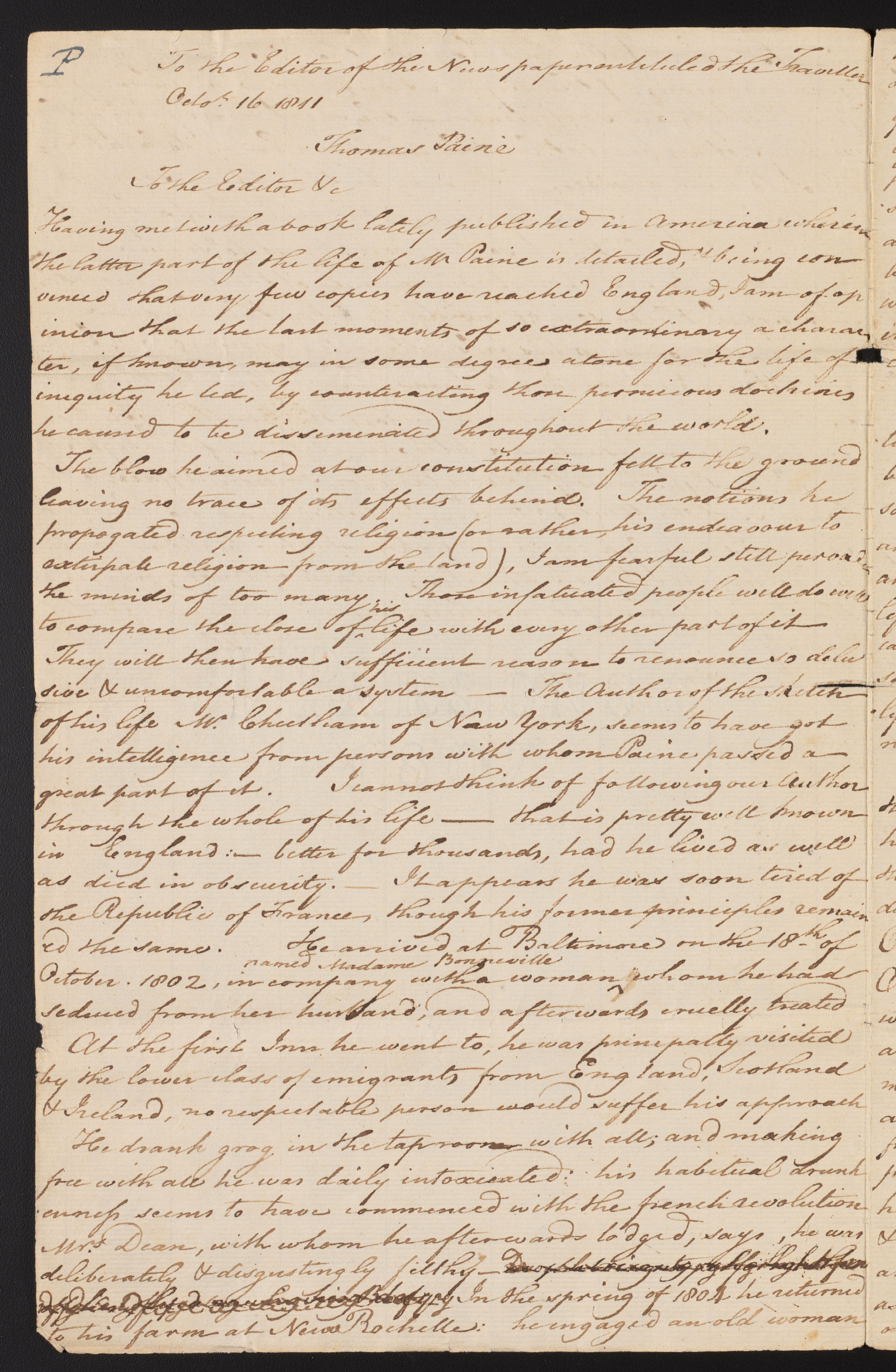
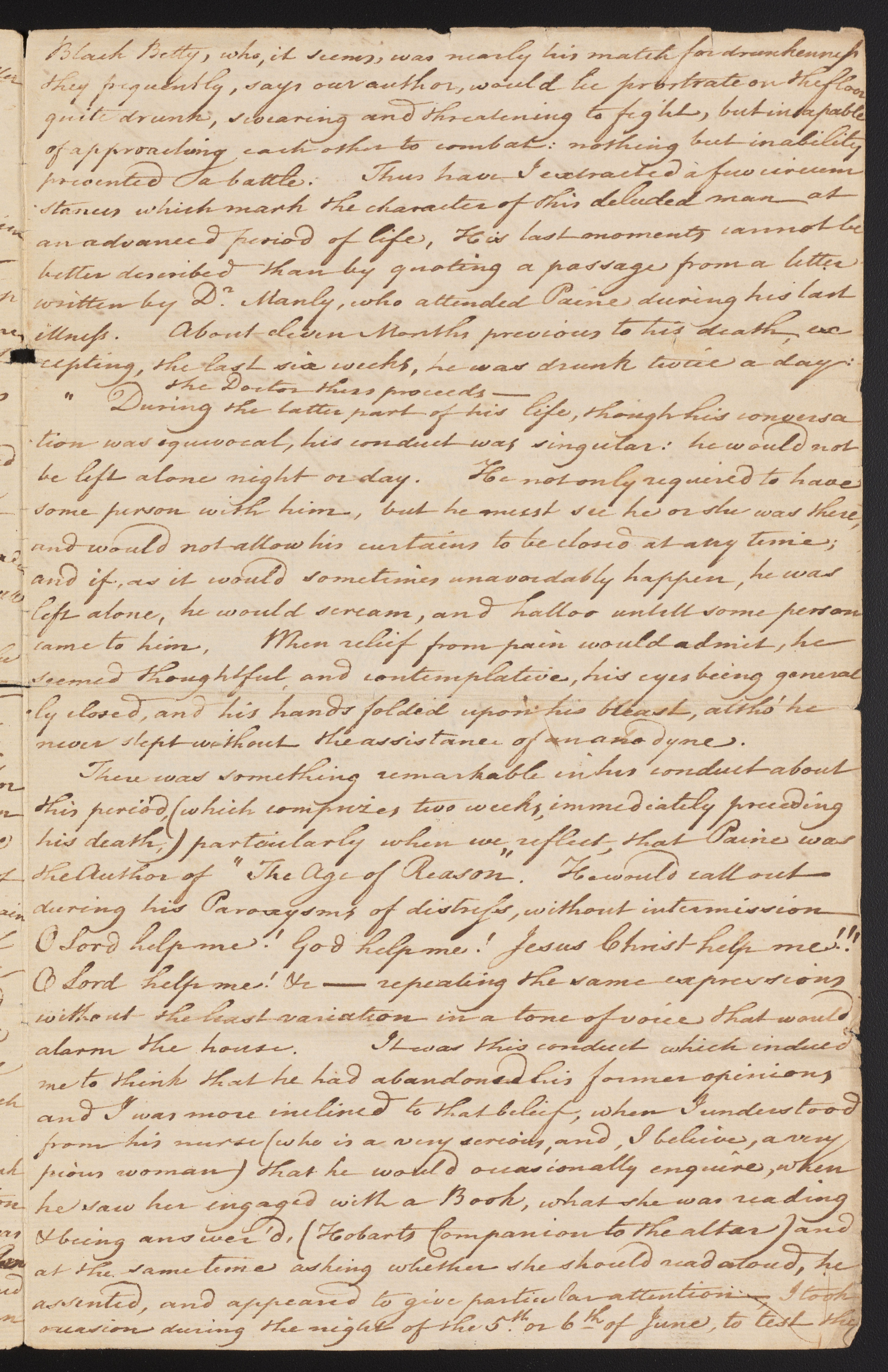
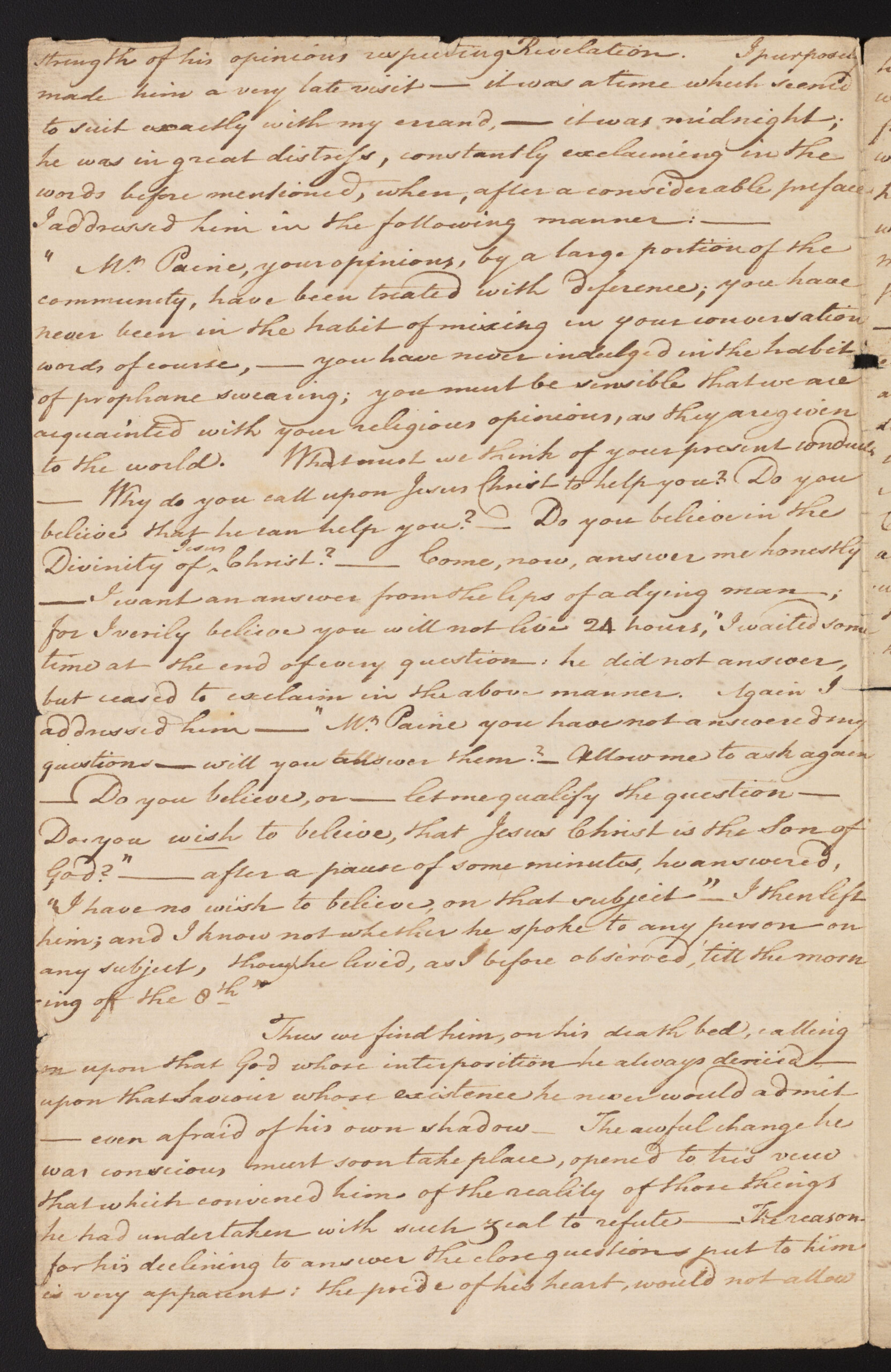
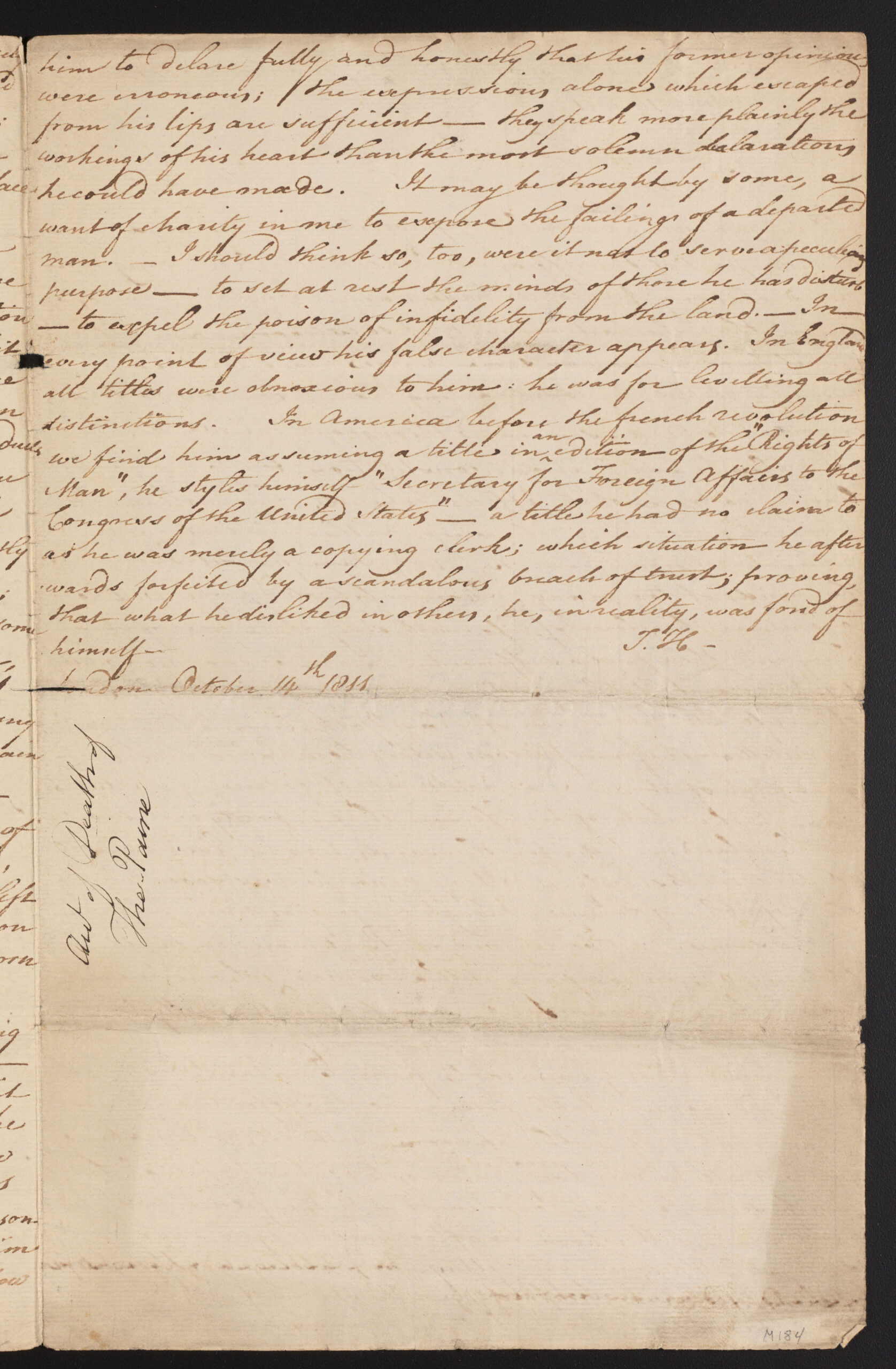
T.H. to Editor of The Traveller, 1811 October 14, Thomas Paine Papers.
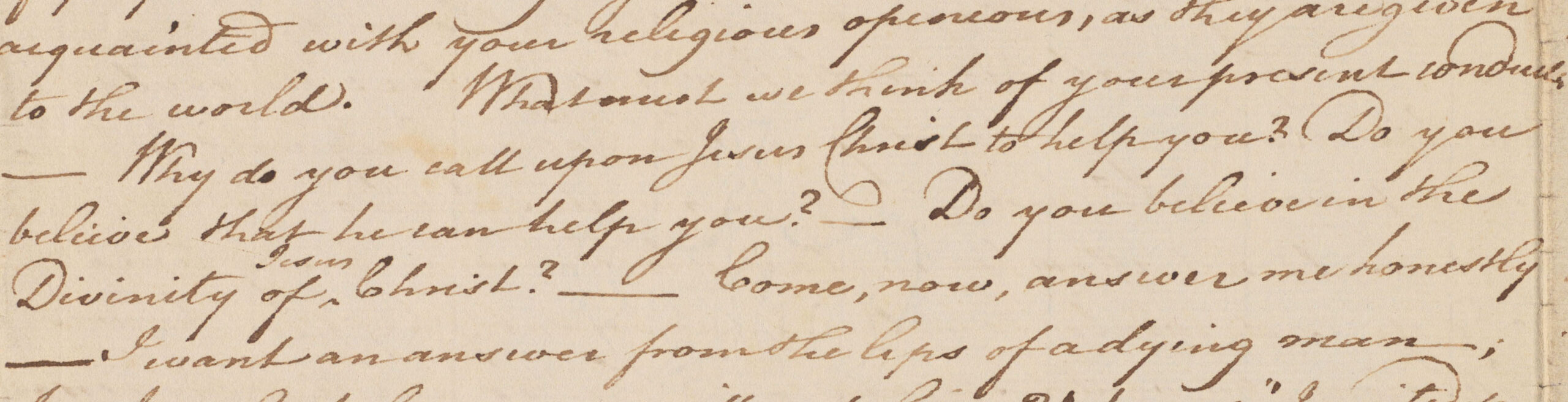
Written by an anonymous author (“T.H.”) in 1811 and submitted for publication in The Traveller, this “obituary” criticized Paine’s ideals and also called Paine out for turning to God in his final moments. The author thinks of Paine as hypocritical because the author believes that while Paine was living, he openly questioned religious teachings and spread doubt about belief in God.
The excerpt in the middle of the text displayed highlights the most intense point of contention within the writing. At this point T.H. directly questions Paine while on his deathbed, and asks him why he turned to a God that he did not believe in (even though Paine never denied the existence of God). Such a question shows just how controversial it was for Paine to interrogate the divine authority of organized religion.
This manuscript shows that even though Paine had written the bestselling book of his time, his later ideas were the subject of just as much (if not more) contention. Paine’s teachings are now considered to be revolutionary, but he was often ostracized late in his career when he came back to the United States after the French Revolution. Many people, including the author of the manuscript, commonly accused him of drunkenness and moral failings; so even though Paine’s ideals are highly respected now, this was not always the reality in the early 19th century.
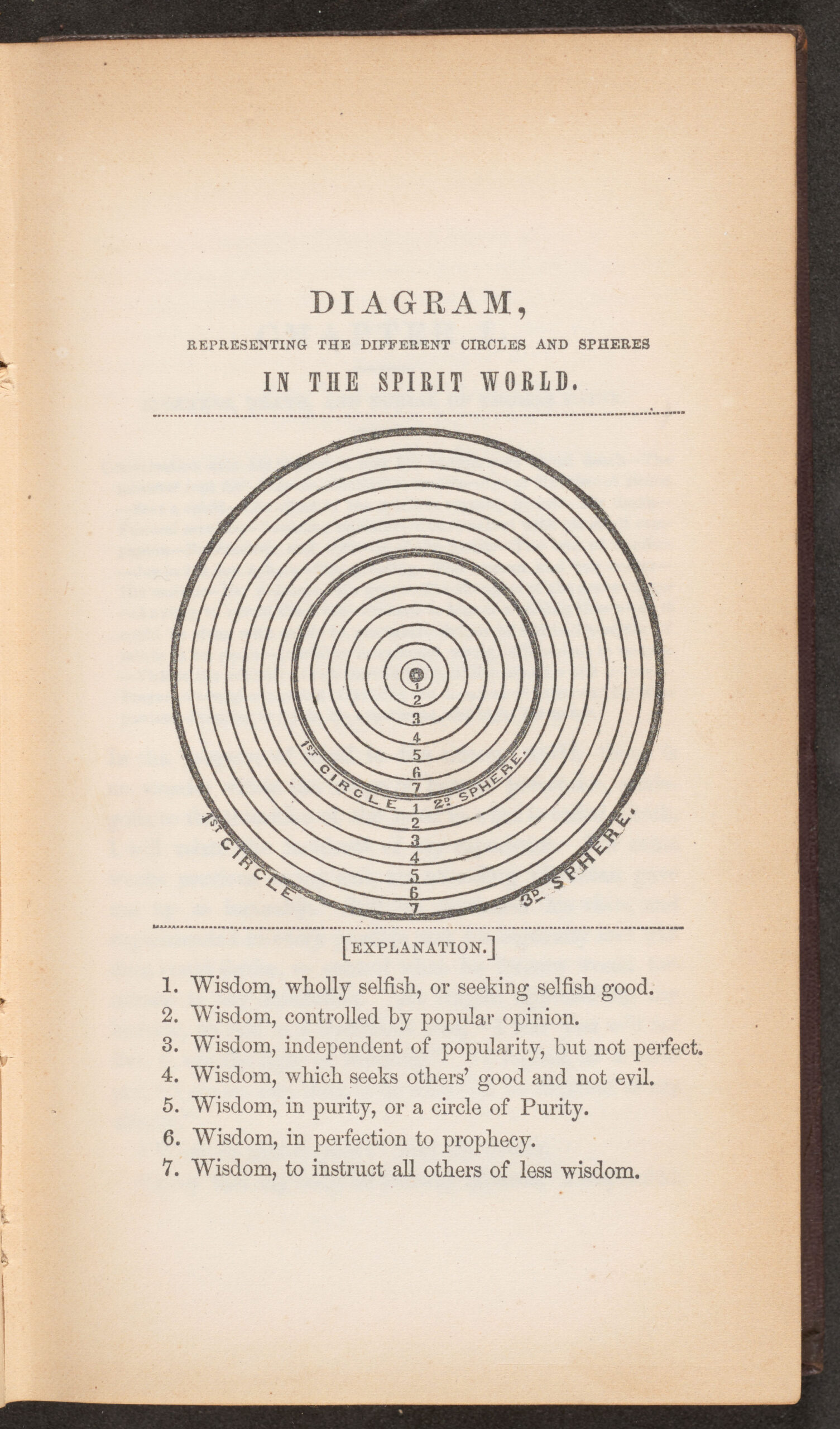
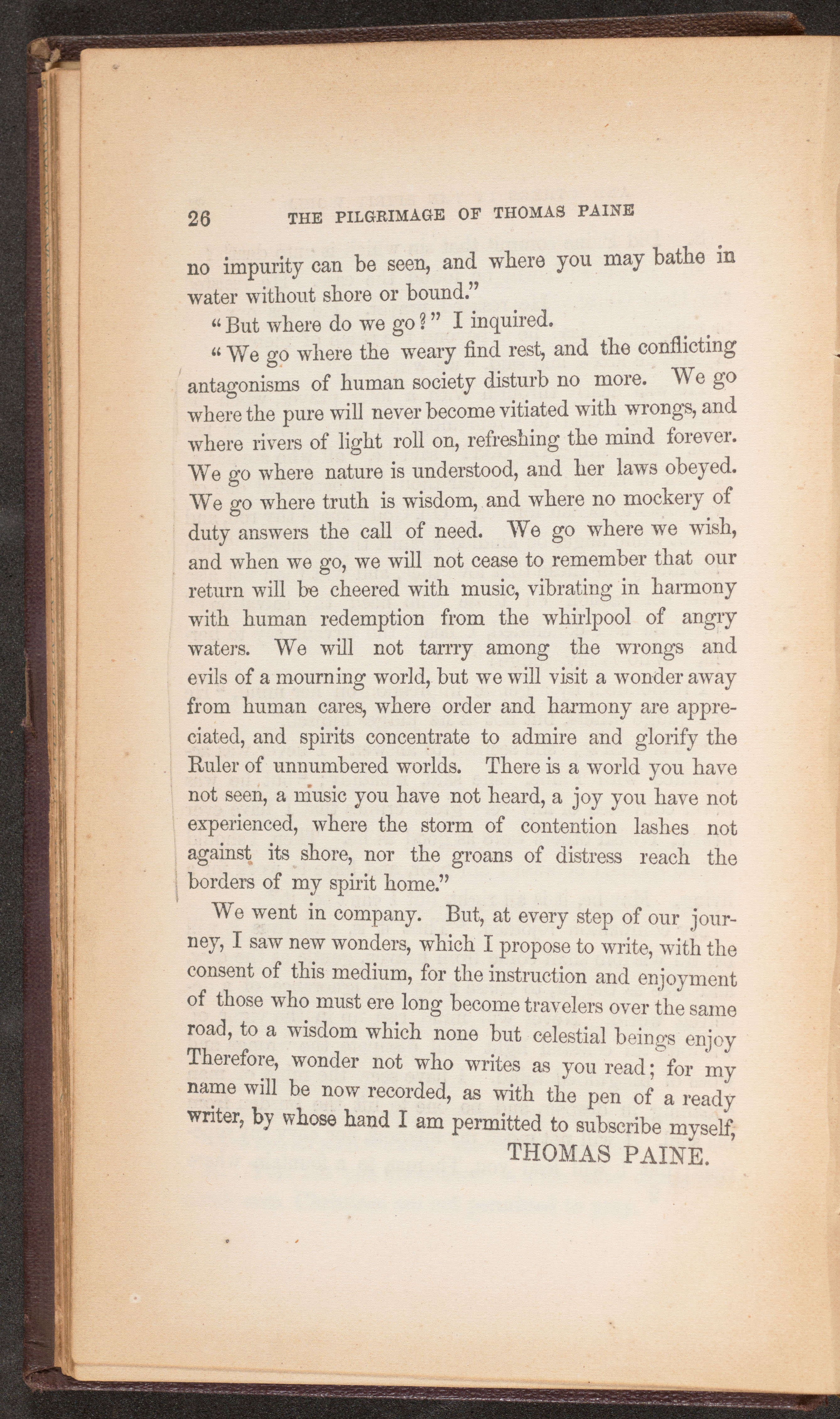
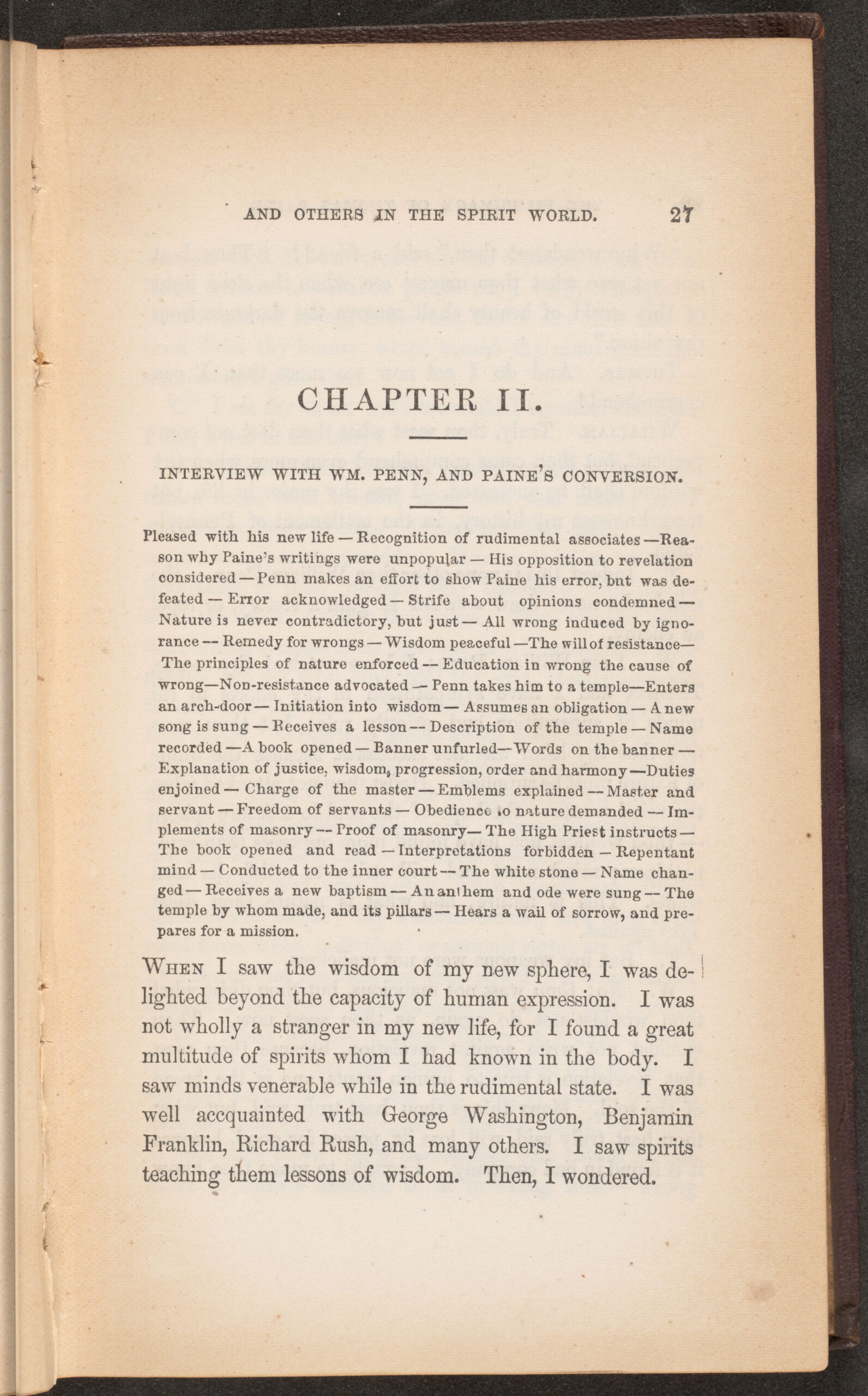
Charles Hammond, Light from the Spirit World: The pilgrimage of Thomas Paine, and others, to the seventh circle in the spirit world. Rochester, New York: D.M. Dewey, 1852.
Thomas Paine’s ideas were not to be buried with him. In fact, the spiritualism movement of the 19th century ensured that even in his death, Paine would continue to engage the populus with the fervor that ruled his life. Light from the Spirit World reveals the grip of the spiritualism movement on the United States during the revolutionary era. Spiritualists believed that they could communicate with dead people through mediums.
Light from the Spirit World is one example of several works written by spiritualists alleging that they were able to connect with Paine after his death and become physical vessels for his metaphysical spirit via electrical currents. Charles Hammond’s work stands out among the rest because it not only involves the central figure of Thomas Paine, but also invokes an ensemble cast of spirits who embark on a pilgrimage together.
The book is open to a conversation between Thomas Paine and famous Quaker and theologian William Penn. This is particularly fascinating given Paine’s history of harsh critique of Quakers as hypocritical. According to Hammond, however, this conversation takes a notably different tone, with Paine coming to admit that he was wrong about opinions he held on religion while he was alive.