Revolution, Reaction, and the Rights of Man
Revolution, Reaction, and the Rights of Man
Fifteen years after the publication of Common Sense, Paine published the first part of his Rights of Man, a defense of the French Revolution. Rights of Man celebrated the French Revolution as heralding a new dawn of liberty and reason, and critiqued Edmund Burke’s 1790 Reflections on the Revolution in France, which had criticized the French revolutionaries, defended traditional, established political norms and institutions, and endorsed gradual reform over wholescale political change.
The publication of Burke’s Reflections inspired not only Paine, but other English and American authors, including Mary Wollstonecraft. Wollstonecraft’s A Vindication of the Rights of Men (1790) took aim at Burke’s conservatism, arguing against his defense of hereditary privilege. More generally, the engraving displayed on this page, “Contrasted Opinions of Paine’s Pamphlet,” includes both Burke and Wollstonecraft in its assemblage of key political figures articulating a range of reactions to Rights of Man.
John Quincy Adams’s 1793 response to Rights of Man shows the extent to which Paine’s defense of the French Revolution and his call for dismantling hereditary privilege resonated across the Atlantic. While respectful of Paine’s role in the American Revolution, Adams regarded his defense of events in France as dangerously radical.
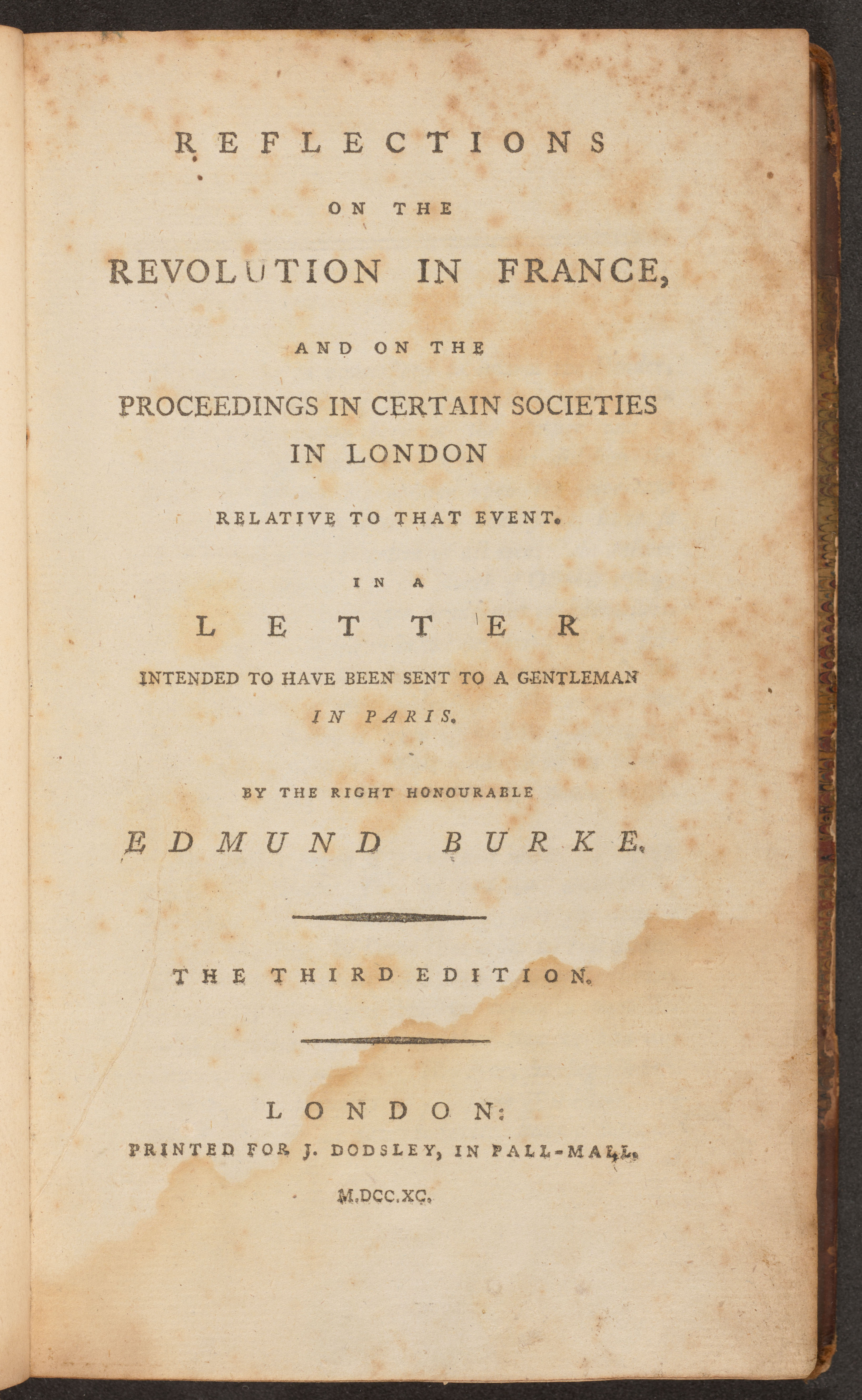
Edmund Burke, Reflections on the Revolution in France, and on the Proceedings in Certain Societies in London Relative to That Event: In a Letter Intended to Have Been Sent to a Gentleman in Paris, London: Printed for J. Dodsley in Pall-Mall, [1790].
In this book, the Anglo-Irish statesman Edmund Burke expresses his disapproval of the initial events of the French Revolution. Addressed as a letter, Reflections is written to a French correspondent while simultaneously disagreeing with British citizens who support developments in France. While Burke acknowledged the common existence of “the rights of man,” he described this notion as a poor foundation for government. He denounced the French National Assembly, their goals, and the negative consequences the political revolt would provoke in Europe. He argues that people should strive for reform, not for revolution. Burke’s conservatism shines through in the book, along with his ideals for traditional European political society. However, his criticism of the French Revolution came as a shock to many, as Burke had previously sympathized with American objections to British policy during the 1770s.
The impact of Reflections can be seen throughout the rest of this page in the exhibit, as it triggered a heated debate among other well-known political figures such as Mary Wollstonecraft and Thomas Paine. For example, Paine felt so betrayed by Burke’s condemnation of the French Revolution that he was inspired to write the book Rights of Man, one of Paine’s best-known works. Notice the back and forth between the pieces, how they interact with each other, and why Burke’s Reflections triggered this cross-Channel debate.
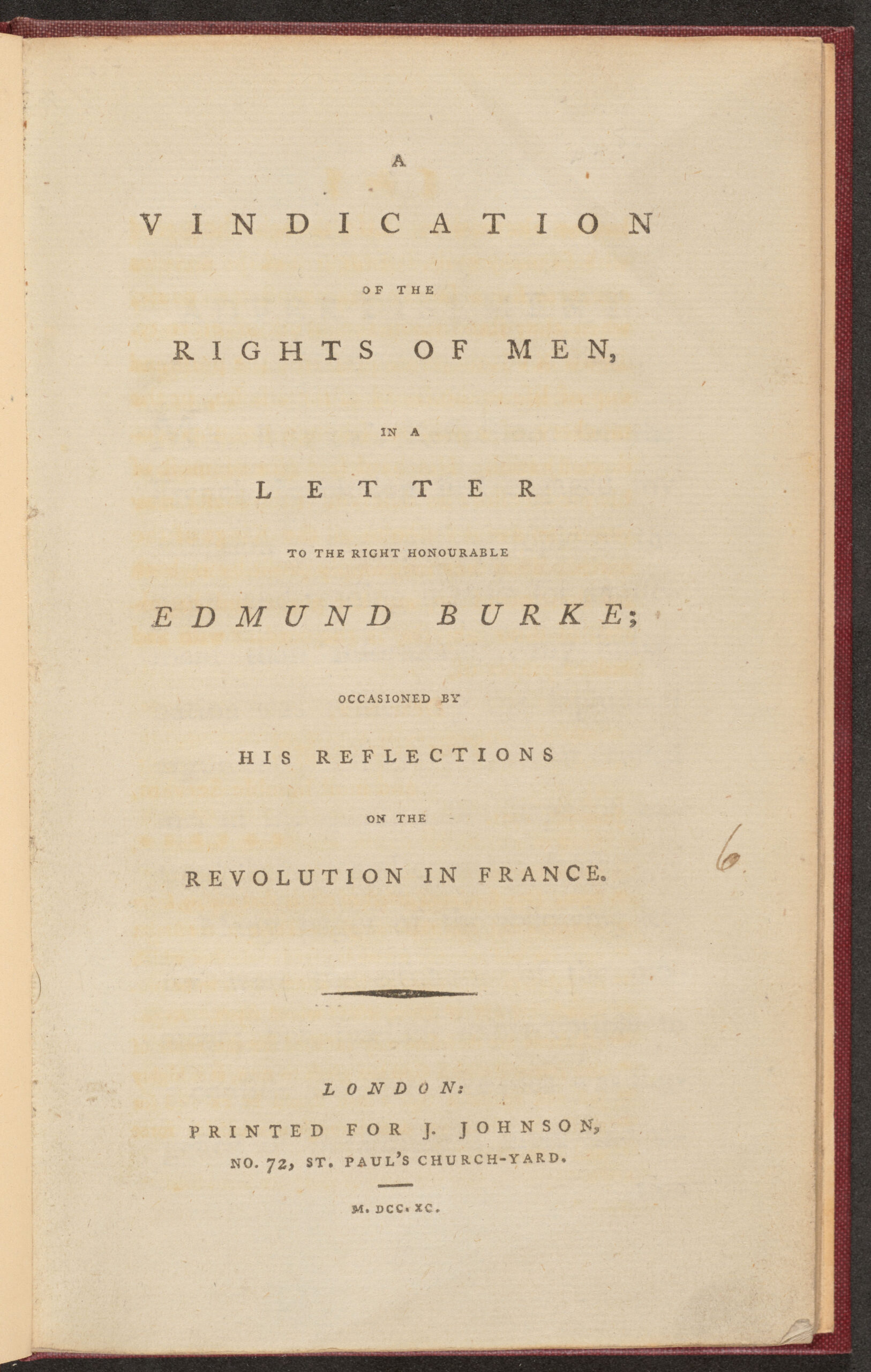
Mary Wollstonecraft, A Vindication of the Rights of Men, in a Letter to the Right Honourable Edmund Burke; Occasioned by his Reflections on the Revolution in France, London: For J. Johnson, 1790.
This is Mary Wollstonecraft’s response to Edmund Burke’s Reflections on the Revolution in France. In her book, Wollstonecraft challenges almost everything that Burke defends and calls for. She ridicules him for his simultaneous sympathy for Marie Antoinette and disregard for ordinary French citizens in lower social classes, and believes that his defense of the monarchy and hereditary power is privileged and corrupt. Wollstonecraft claims, in opposition to Burke, that just because this monarchical institution has existed for a long time, it does not make it just, and it is simply based on tradition. On display here is the first edition, which was published anonymously. Wollstonecraft’s work was not attributed to her until the second edition was published a few weeks later.
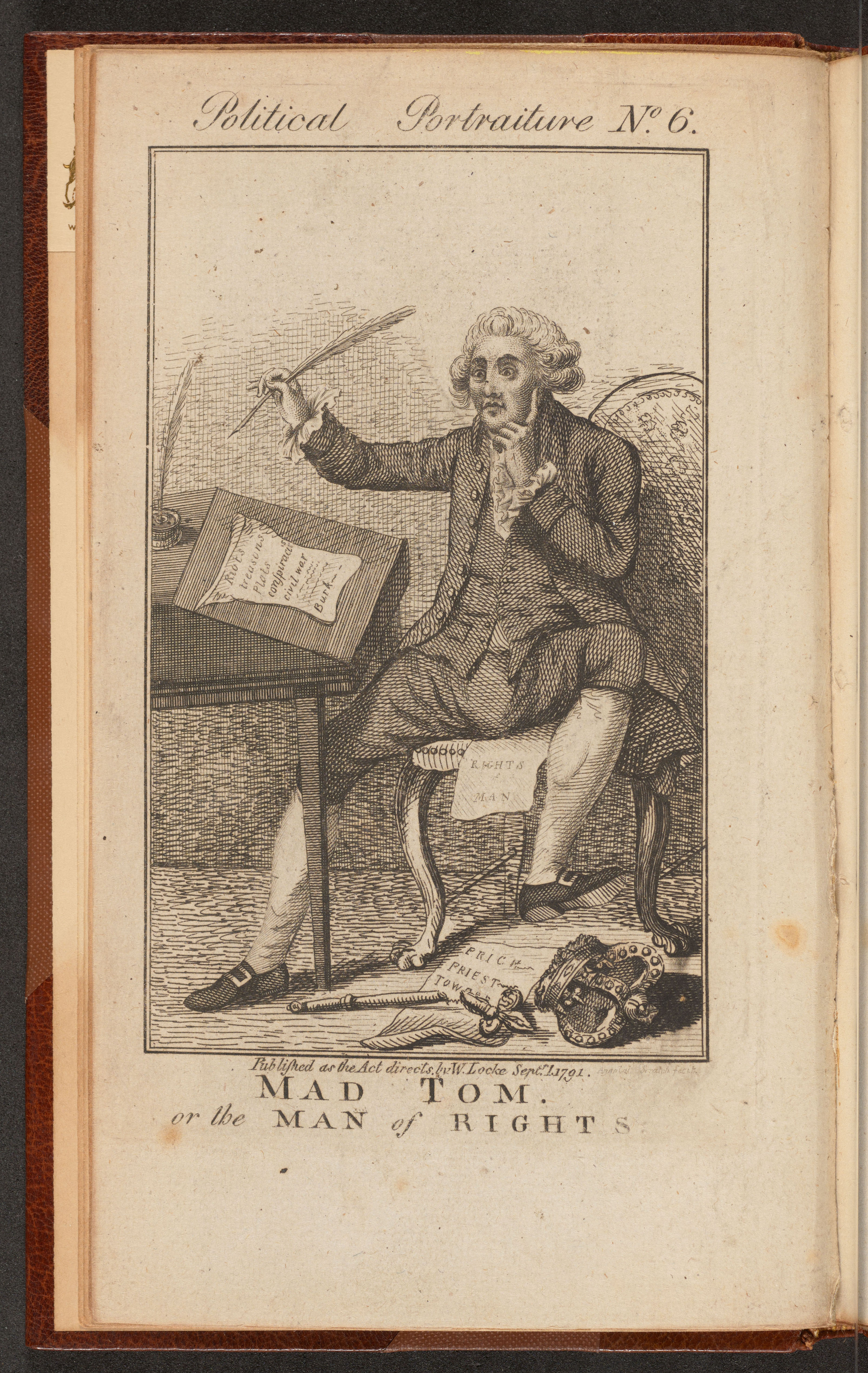
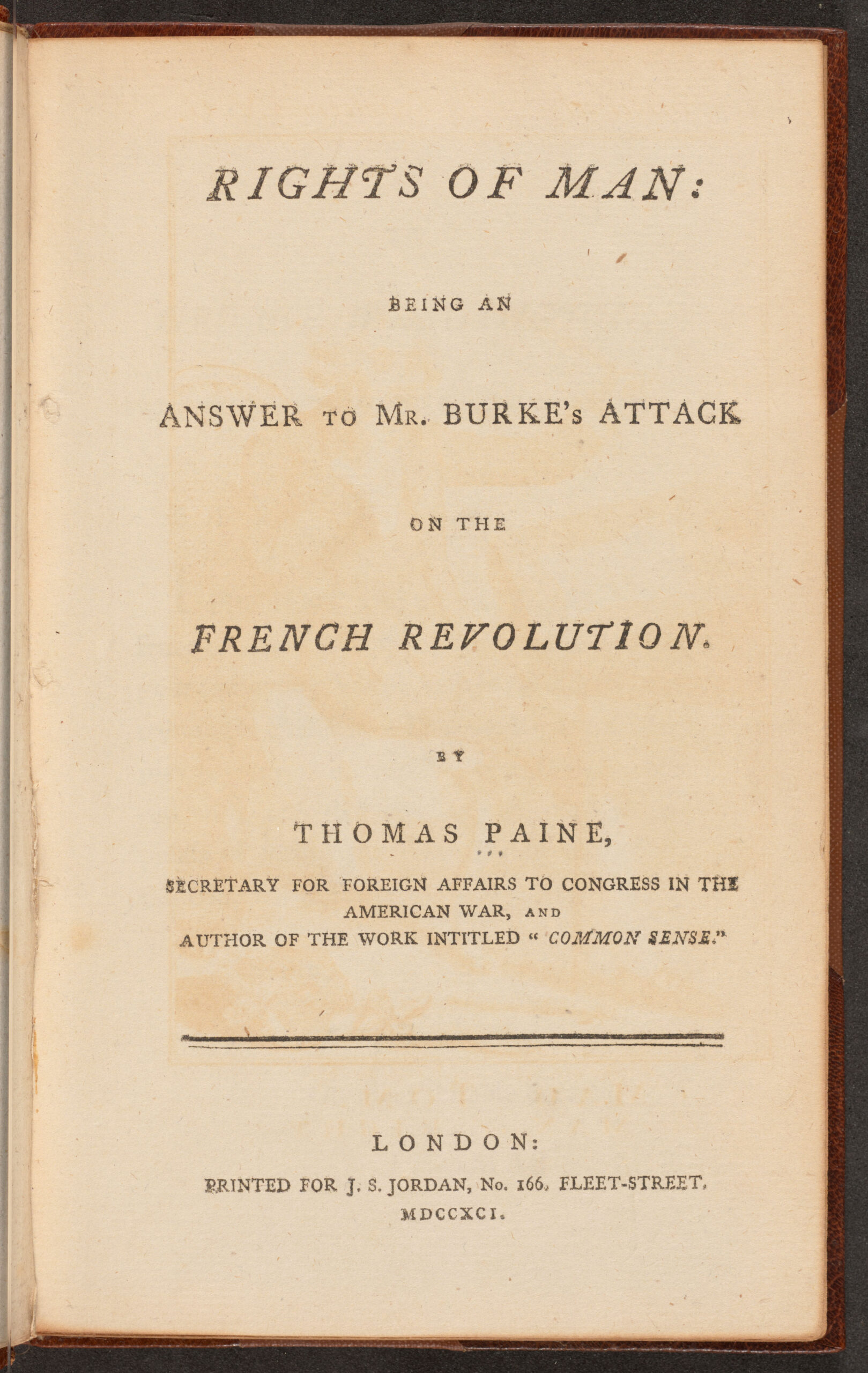
Thomas Paine, Rights of Man: Being an Answer to Mr. Burke’s Attack on the French Revolution, For J.S. Jordan, 1791.
Thomas Paine’s Rights of Man (1791) became one of the most influential political texts of the late eighteenth century. Written in response to Edmund Burke’s Reflections on the Revolution in France, Paine’s work defended the French Revolution. It argued that all people possess natural rights to liberty, equality, and self-government. Rejecting hereditary monarchy and aristocratic privilege, Paine called for sweeping democratic reforms and expanded social welfare. These arguments captivated readers across Britain and beyond, but they also triggered an intense backlash from the government and the public. Rights of Man was banned, seized by authorities, and Paine was charged with seditious libel.
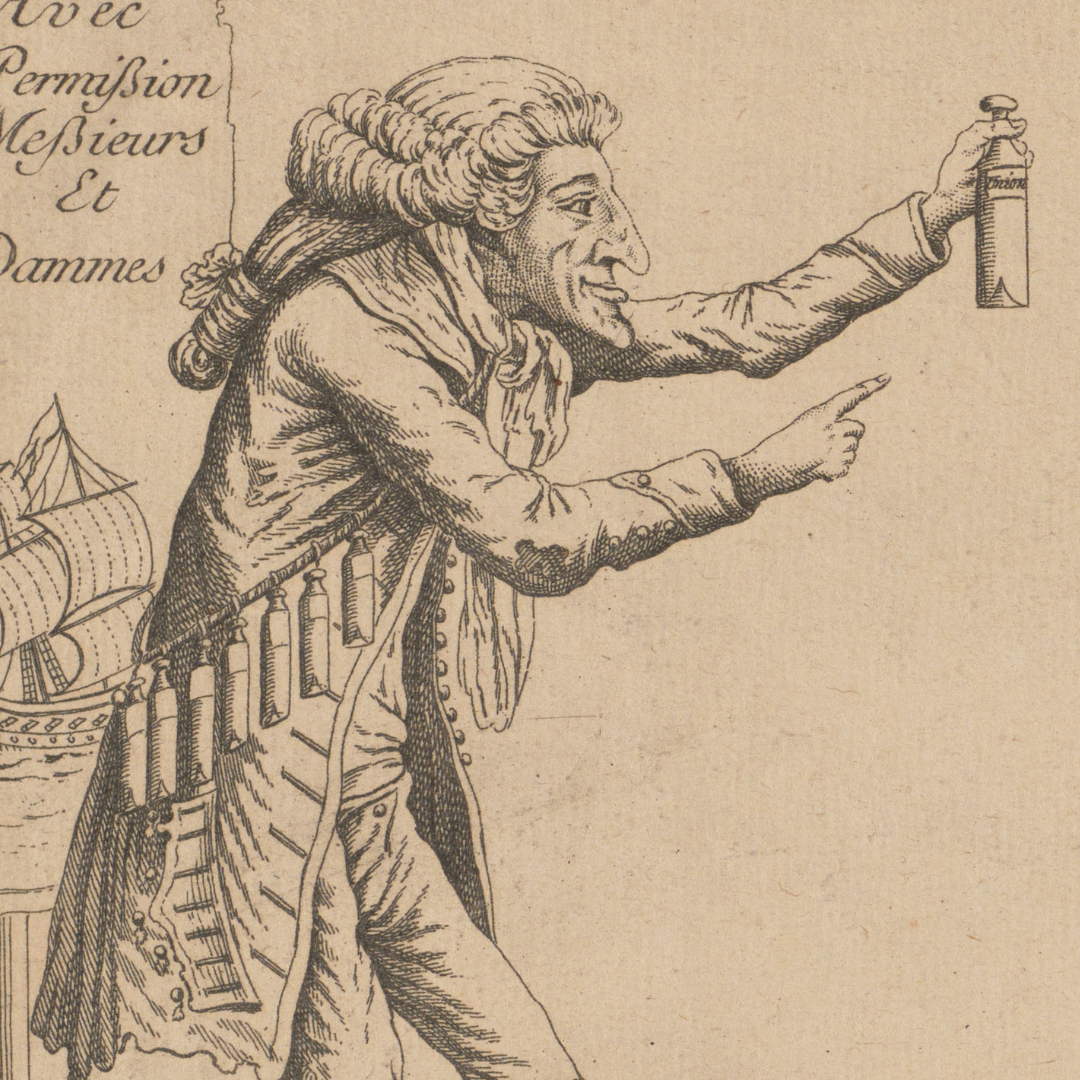
This copy includes the satirical engraving “Mad Tom” (or “Man of Rights”), published in London in 1791, which caricatures Paine as a deranged revolutionary whose ideas would unleash chaos. Inserted into the pamphlet, the image transformed Paine’s own text into a tool of mockery. The pairing very vividly illustrates the political volatility of the 1790s, when Paine could be celebrated as a champion of human rights and simultaneously condemned as a dangerous agitator.
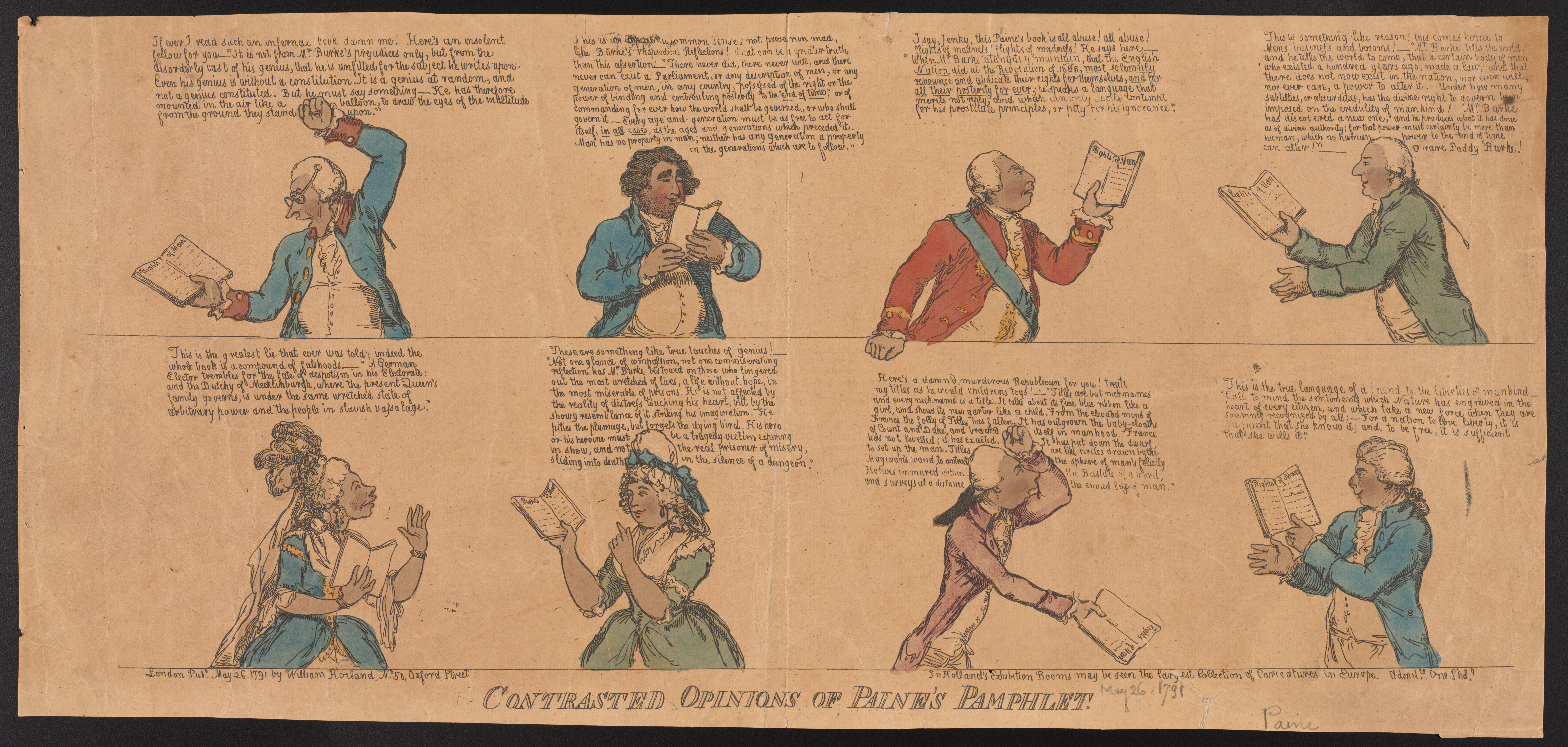
[Frederick George Byron], “Contrasted Opinions of Paine’s Pamphlet”, London: Publ. William Holland, 1791. Loan from Roger Genser – The Prints & The Pauper – Santa Monica, Ca.
This rare print gives insight into the reception of Rights of Man, depicting eight different figures and their reactions to the piece. The artist chose figures and thinkers with paramount importance. The print includes thinkers that contended with Paine’s claims like Wollstonecraft and Burke. We see these household names on opposite sides, with Wollstonecraft calling Paine a genius, while Burke shakes his head at Paine’s lack of respect to tradition. The print also includes political leaders in King George and Queen Charlotte. The print speaks to the discord among these figures at the time, as each of them contrasted their opinions against each other in the public discourse through their writings and speeches. Each cell gives a condensed opinion of the figure which the artist drew below. The Top row includes Anglo-Irish statesman Edmund Burke, English politician and statesman Charles James Fox, King George III of Great Britain, and Charles Jenkinson. Bottom row shows Queen Charlotte of Great Britain, English writer and philosopher Mary Wollstonecraft, Prime Minister of Great Britain William Pitt, and Anglo-Irish playwright and politician Richard Sheridan.
One can read a more in-depth analysis of both Burke’s and Wollstonecraft’s opinions above this print. The existence of the pamphlet speaks to the influence of Thomas Paine’s works in the public sphere of politics. There existed demand for a pamphlet which summarized not only eight influential figures’ own thoughts, but specifically their thoughts on Rights of Man, showing the waves the writing created throughout Western Europe.
John [Quincy] Adams, Esq. An Answer to Thomas Paine’s Rights of Man, Dublin: Printed for Messrs. P. Byrne, J. Moore, and W. Jones, 1793.
On display is a passage from the collected letters of future United States president John Quincy Adams, written in response to Thomas Paine’s Rights of Man. Paine’s defense of the French Revolution and his call for dismantling of hereditary privilege resonated across the Atlantic, but also provoked anxiety among more conservative thinkers. Adams, while respectful of Paine’s role in the American Revolution, regarded his new work as dangerously radical. In these letters, Adams warns that Paine’s rejection of traditional government and inherited institutions threatened to replace stability with chaos. His critique reflects broader tension among early American leaders who were caught between Enlightenment ideals of liberty and the fear that unrestrained popular revolution, as seen in France, could undermine the hard-won order of the new republic.
![Title page of Adams, John Quincy, An Answer to Thomas Paine’s Rights of Man (Dublin, For P. Byrne [Etc.], 1793), 8-9.](https://clements.umich.edu/wp-content/uploads/2026/01/13.-bk-pa-3-ad-an-answer-to-pains-rights-of-man-titlepage-scaled.jpg)
![Page 8 of Adams, John Quincy, An Answer to Thomas Paine’s Rights of Man (Dublin, For P. Byrne [Etc.], 1793), 8-9. Begins with "I believe also, Sir, that the citizens of America are not at present disposed to rally round the standard of any man."](https://clements.umich.edu/wp-content/uploads/2026/01/13.-bk-pa-3-ad-an-answer-to-pains-rights-of-man-pp.8.jpg)
![Page 9 of Adams, John Quincy, An Answer to Thomas Paine’s Rights of Man (Dublin, For P. Byrne [Etc.], 1793), 8-9. Ends with "He is a friend to free inquiry upon every subject, and he will not be displeased to see the sentiments which he has made his own by a public adoption, canvassed with as much freedom as is consistent with the reverence due to his character."](https://clements.umich.edu/wp-content/uploads/2026/01/13.-bk-pa-3-ad-an-answer-to-pains-rights-of-man-pp.9-scaled.jpg)