

DECLARATIONS
No. 63 (Spring 2026)
Table of Contents
Declaring Women’s Rights: From Sentiment to Satire to Suffrage
Christina Karas
Member, Clements Library Associates Board of Governors
When the United States commemorated the centennial anniversary of its independence in 1876, at least one group of citizens did not find cause for unalloyed celebration. They believed that one half of the American people needed a new declaration of liberty, and this they promulgated in dramatic fashion. Their request to formally present a statement at the official ceremonies on July 4th had been refused, with the explanation that there was simply no room in a Centennial designed to celebrate the country’s achievements since its founding, rather than examine its failures. But the image of dignitaries on the platform in Philadelphia’s Independence Square extolling the nation’s success as a democratic republic only galvanized the writers of this new declaration. They decided to seize the stage for themselves.
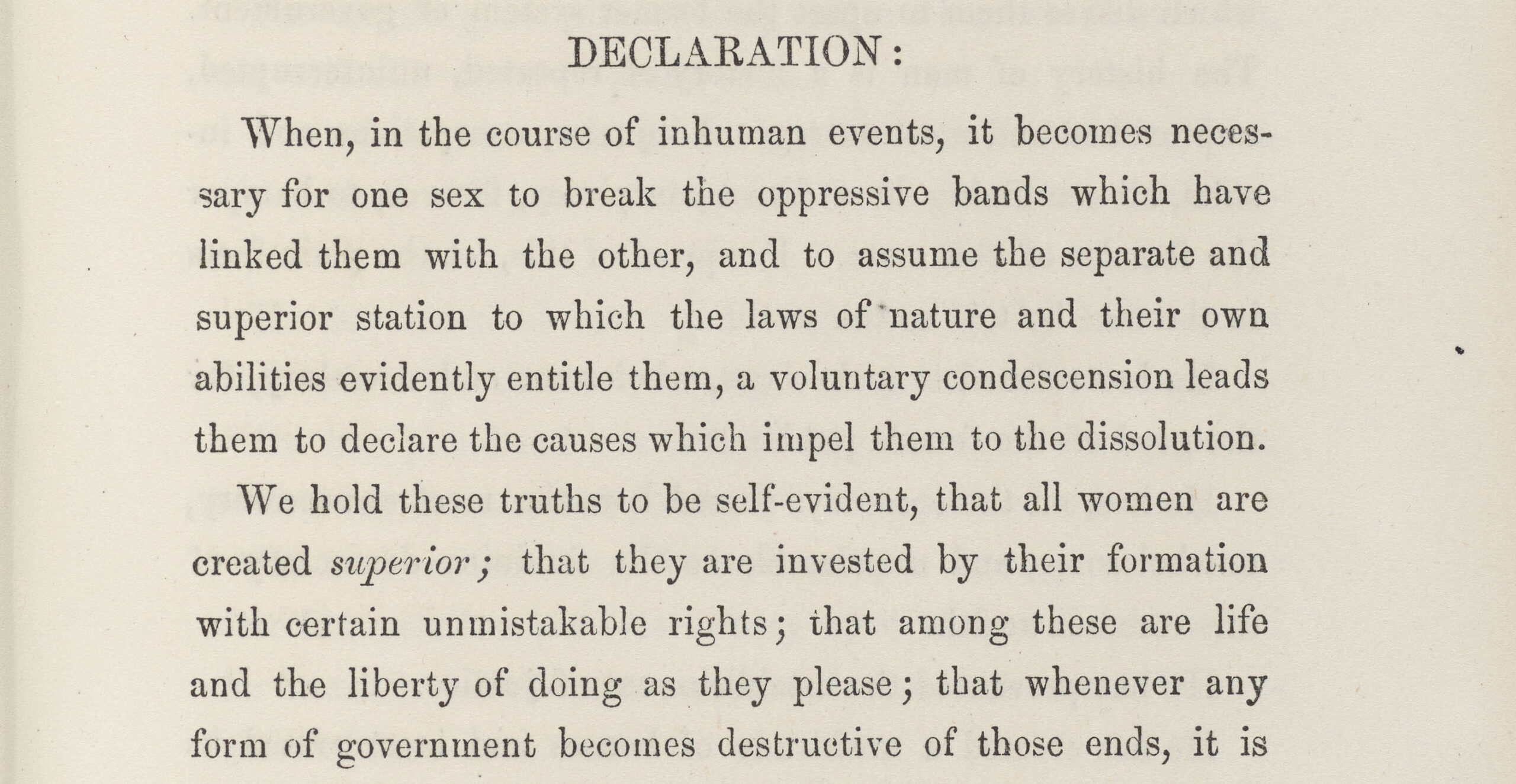
Fictional declaration from A Book for the Times: Lucy Boston; or, Woman’s Rights and Spiritualism: Illustrating the Follies and Delusions of the Nineteenth Century where ‘Fred Folio’ outlandishly satirizes the Declaration of Sentiments.
Among them, Susan B. Anthony had already been arrested for voting in the 1872 presidential election and had spent decades working ardently to advance the rights of women. She and four other representatives of the National Woman Suffrage Association (NWSA) ascended the centennial platform in 1876 immediately following the reading of the Declaration of Independence, bearing their own Declaration of the Rights of the Women of the United States. They were determined to convey the injustices of a nation that, having liberated itself from tyranny one hundred years prior, had yet to liberate their sex. In advance of the Centennial, the NWSA had called on American women to “unite with us in this declaration and protest … that the world may see that the women of 1876 know and feel their political degradation no less than did the men of 1776.” Their “Woman’s Declaration of Rights” invoked Abigail Adams’s famous warning to her husband: eager as she was to learn that the colonies had “declared an independency,” if the rights of “the Ladies” were not provided for, they would “not hold ourselves bound by any Laws in which we have no voice, or Representation.”
Like their Founding Mother, the women of 1876 made their protest insistently yet decorously. Anthony handed their document to the presiding government representative so that it would be entered into the historical record, then she and the other ladies processed from the platform, distributing copies of their Declaration to the mostly male audience, many of whom clamored for one. On the opposite end of Independence Square, Anthony spontaneously read the proclamation aloud to an assembled crowd before the women departed for their own centennial gathering, “scattering another large number of printed copies” in their wake.
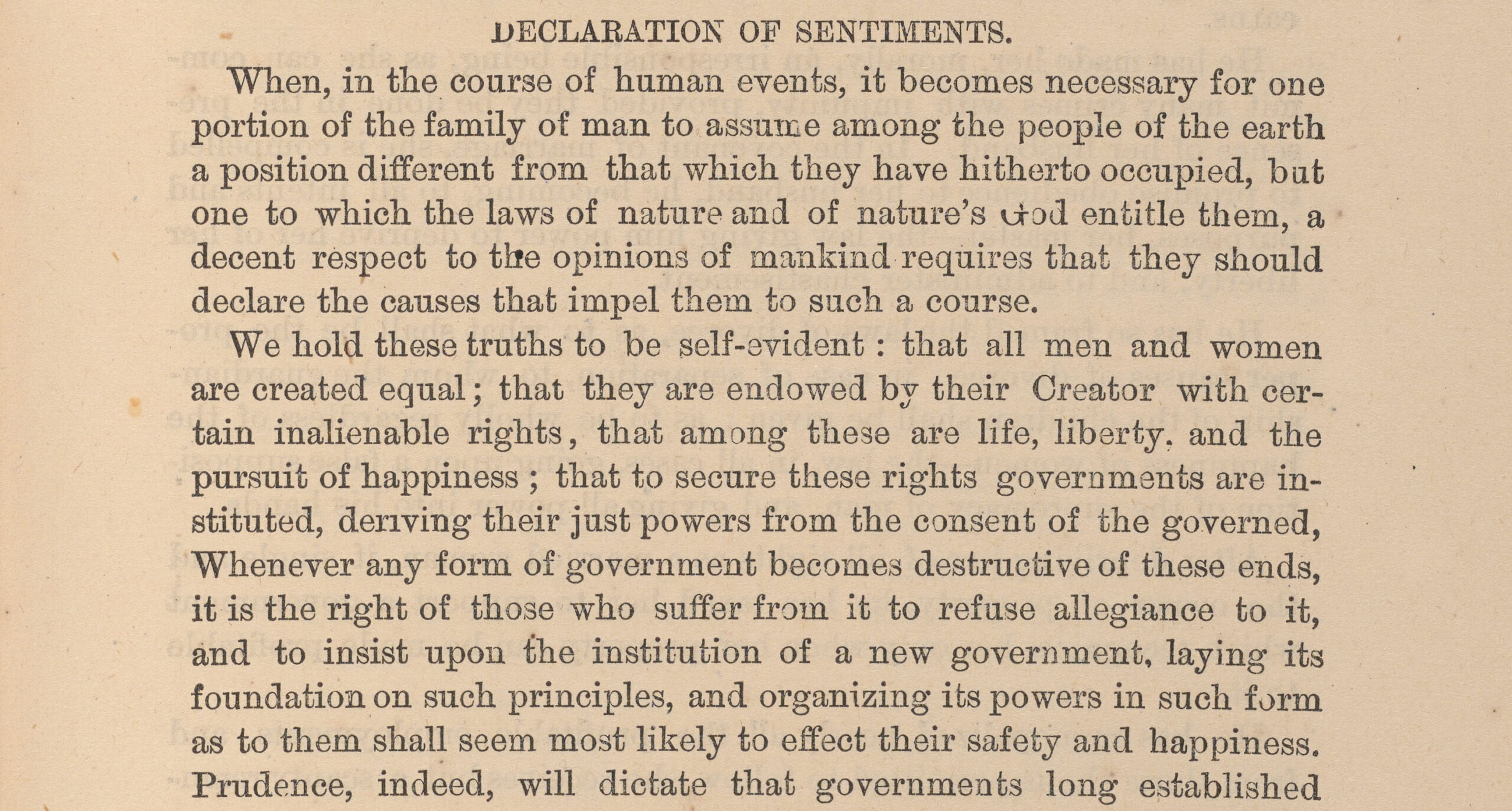
While the opening of the Declaration of Sentiments is notable for its rhetorical subtlety, making slight changes to the preamble of the Declaration of Independence—most importantly, “all men and women are created equal”—the satirical version (previous page) in Lucy Boston proclaims that “all women are created superior” and have “the liberty of doing as they please.” It grows more absurd, but might have accurately reflected the sentiments of women at the time!
The event was recounted, accompanied by the text of the Declaration of Rights, in A History of Woman Suffrage (Rochester, N.Y., 1886), a sweeping record of the movement compiled by Anthony, Elizabeth Cady Stanton, and Matilda Joslyn Gage. Stanton also described the process of writing the Declaration of Rights with co-authors Anthony and Gage in her autobiography, Eighty Years and More (New York, 1898); both of these works can be found in the Clements Library’s collection. She recalled that the women were deliberate in crafting the language, applying “many twists from our analytical tweezers, with critical consideration of every word and sentence.” Less famous than the Declaration of Sentiments issued at the 1848 women’s rights convention in Seneca Falls, the 1876 Declaration expressed many of the same concerns and aspirations but differed in significant ways. It was written in a vastly changed context, in which the discourse of women’s rights reflected debates over postwar amendments to the U.S. Constitution addressing citizenship and its attendant rights and privileges, including suffrage. The Declaration of Rights affirmed the NWSA’s faith in “the broad principles of human rights, proclaimed in 1776” yet exposed the numerous ways in which the Republic had deprived them of those natural rights because of their sex. It catalogued those violations in “articles of impeachment” against the male leaders of the United States, demonstrating how little had improved since the 1848 Declaration. Moreover, it emphasized new obstacles such as the uneven, precarious status of women’s rights across U.S. states and territories, as well as flawed interpretations of the Constitution in recent legal decisions concerning citizenship and voting rights. It also asserted that women’s political equality was essential to “national safety and stability”— a powerful contention at a time when the Civil War was more immediate in the nation’s consciousness than the Revolution.
The Declaration of Rgihts affirmed the NWSA’s faith in “the broad principles of human rights, proclaimed in 1776” yet exposed the numerous ways in which the Republic had deprived them of those natural rights because of their sex.
Popular reaction to the Centennial affair ranged from admiration to derision. Stanton included extracts of press coverage in the History as part of her grand project to frame the legacy of the women’s rights movement. Several newspapers praised the dignity of the women’s conduct and the audacity of their Declaration, speculating that it would live in memory until the next centennial. Others belittled them. The New York Tribune printed a sensationalized account in which the women “pushed their way vigorously through the crowd … [h]ustling generals aside, elbowing governors, and almost upsetting [the Brazilian Emperor] in their charge” (in fact, most reports indicated that the gentlemen courteously stepped aside as the ladies passed). The Tribune ominously predicted that this “very discourteous interruption … pre-figures new forms of violence and disregard of order which may accompany the participation of women in active partisan politics.”
The women were used to this sort of reception. Though revered in the history of women’s rights, the 1848 Declaration of Sentiments did not escape the scorn of the contemporary press and public—nor the nineteenth-century satire industry. The Declaration itself anticipated “misconception, misrepresentation, and ridicule,” and while it concluded with a defiant vow to persist in spite of them, it also revealed the challenge of doing so in a culture that aimed “to destroy [woman’s] confidence in her own powers.” As the Declaration circulated throughout the country, Stanton remarked sarcastically that “every man who could wield a pen prepared a homily on ‘woman’s sphere.’” For some women who originally signed the document, the reaction stirred enough self-doubt that they chose to withdraw their names.
The antislavery newspapers were stalwart allies, however, and one of strongest voices was that of Frederick Douglass, one of the 32 men who signed the Declaration of Sentiments. His post-convention editorial in The North Star called the Declaration “the basis of a grand movement,” yet acknowledged that “the bare mention of this truly important subject in any other than terms of contemptuous ridicule and scornful disfavor, is likely to excite against us the fury of bigotry and the folly of prejudice.” While many papers joined his in support, the reactionary side dismissed the women’s statement as a “ludicrous farce” and “a parody on the Declaration of Independence.”
The ridicule extended to literature as well. The nineteenth century loved a satire, and Stanton herself embraced it, both as an effective mode for countering opponents of women’s rights and for sheer fun. Visiting Ann Arbor in 1869, she joined a good-natured dinner-table debate where “[w]oman suffrage was the target for the combined wit and satire of the company, and, after four hours of uninterrupted sharpshooting, pyrotechnics, and laughter, we dispersed … fairly exhausted with the excess of enjoyment.” But less clever and humorous satire attempted to undermine women’s conviction in their cause.
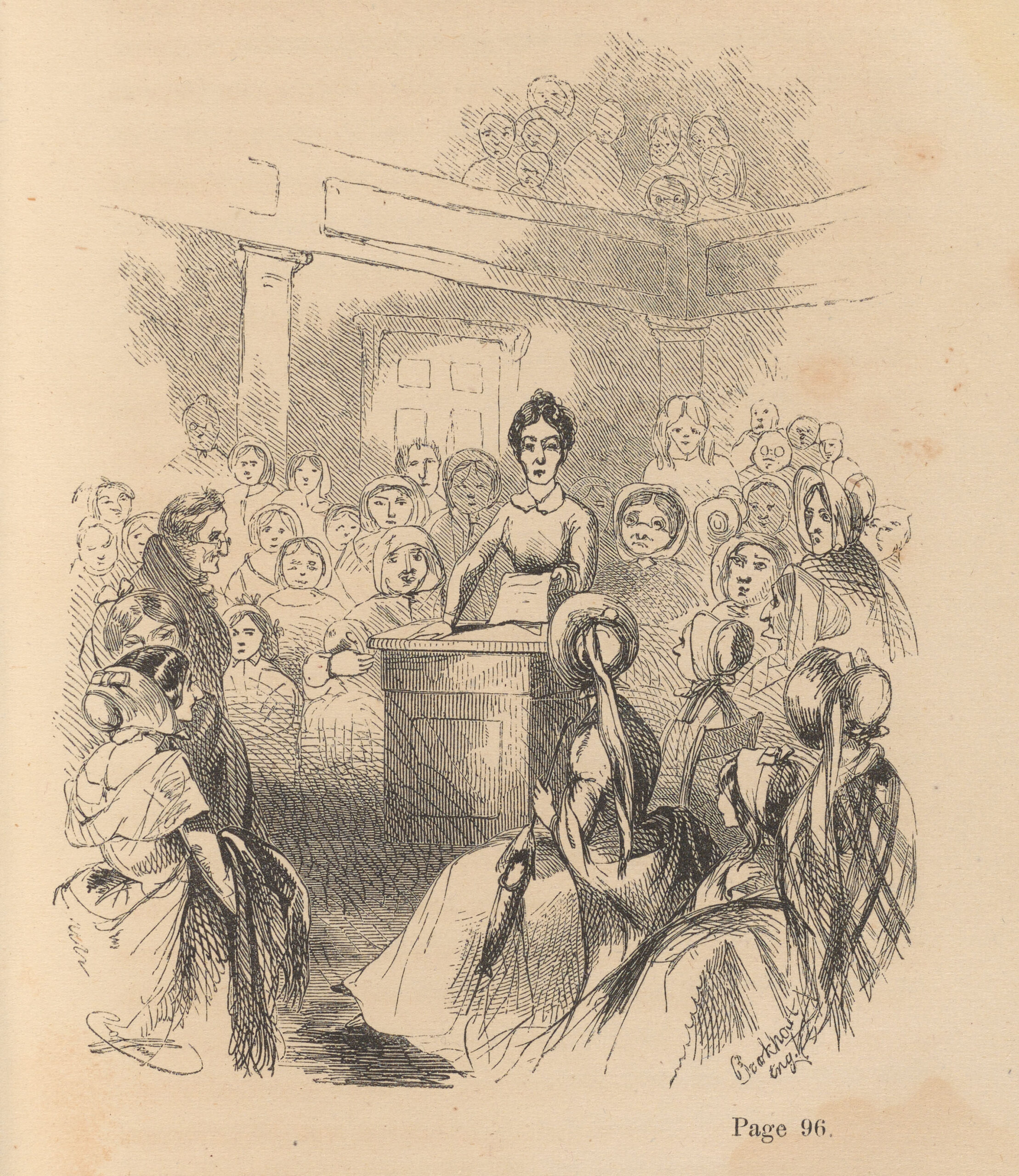
Lucy Boston addressing the women’s rights convention.
The Clements holds an outlandish example of anti-women’s rights satire, with its own intriguing connection to both the Declarations of Sentiments and the Rights of Women. A Book for the Times: Lucy Boston; or, Woman’s Rights and Spiritualism: Illustrating the Follies and Delusions of the Nineteenth Century (Auburn and Rochester, N.Y., 1855) is a satirical novel published pseudonymously by “Fred Folio,” later identified as Rev. Frederick Jackson of New York. Writing in 1855, the author claimed to tell “a history of the future” in which, by the centennial year 1876, the women of New York have overturned the social and political order to become men’s “fair enslaver,” through their own “wiles” and the help of supernatural powers. “Folio” did not disclose precisely how he was able to foretell the triumph—and eventual downfall—of women’s rights; he only alluded to the possibility that his “pen may be but the passive tool of Spiritualism.” He expected that the “fanatical and splenetic, the prejudiced or malicious Spiritualist and Woman’s Rights clan” will “pour out the vials of their wrath” against him for “expos[ing] to public contempt the two greatest humbugs of modern times.”
“Folio” was no Swift or Twain, but the novel is an entertaining, if convoluted, romp across the spectrum of radical nineteenth-century reform movements. Mr. Badger, an unworldly bachelor, is roused from his staid existence by a prophetic revelation from a feminine “Mermaid” spirit who unveils the glorious destiny of women and enlists him as an unlikely Medium for the cause. In quest of the prophecy, Badger sets off for a women’s rights convention and meets lecturer Lucy Boston, in full bloomer costume. The convention is a scene of ineffectual disarray, with Lucy Boston bringing the single moment of clarity in a speech that echoes those of real women’s rights lecturers.
The novel projects forward to the year 1876 and, in a bizarre near-parallel to reality, imagines a rebellious interjection of women’s rights into the July 4th Centennial—complete with a “new Declaration of Independence.” A phalanx of women overtake the state Capitol building and deliver a parody of the Declaration of Sentiments that trivializes the historical document and twists its emphasis on equality into an assertion of women’s “superiority.” The women ultimately declare themselves “free and independent,” with “full power to declare war, conclude peace, contract alliances, establish commerce, forsake their children, enslave the men, let themselves loose, in short, ‘rule the roost’ … .” Their “final maneuver … in this grand stroke of revolutionary policy” is to command the male legislators to amend the state constitution, granting all women— over the age of twelve!—equal political rights, including the right to vote.
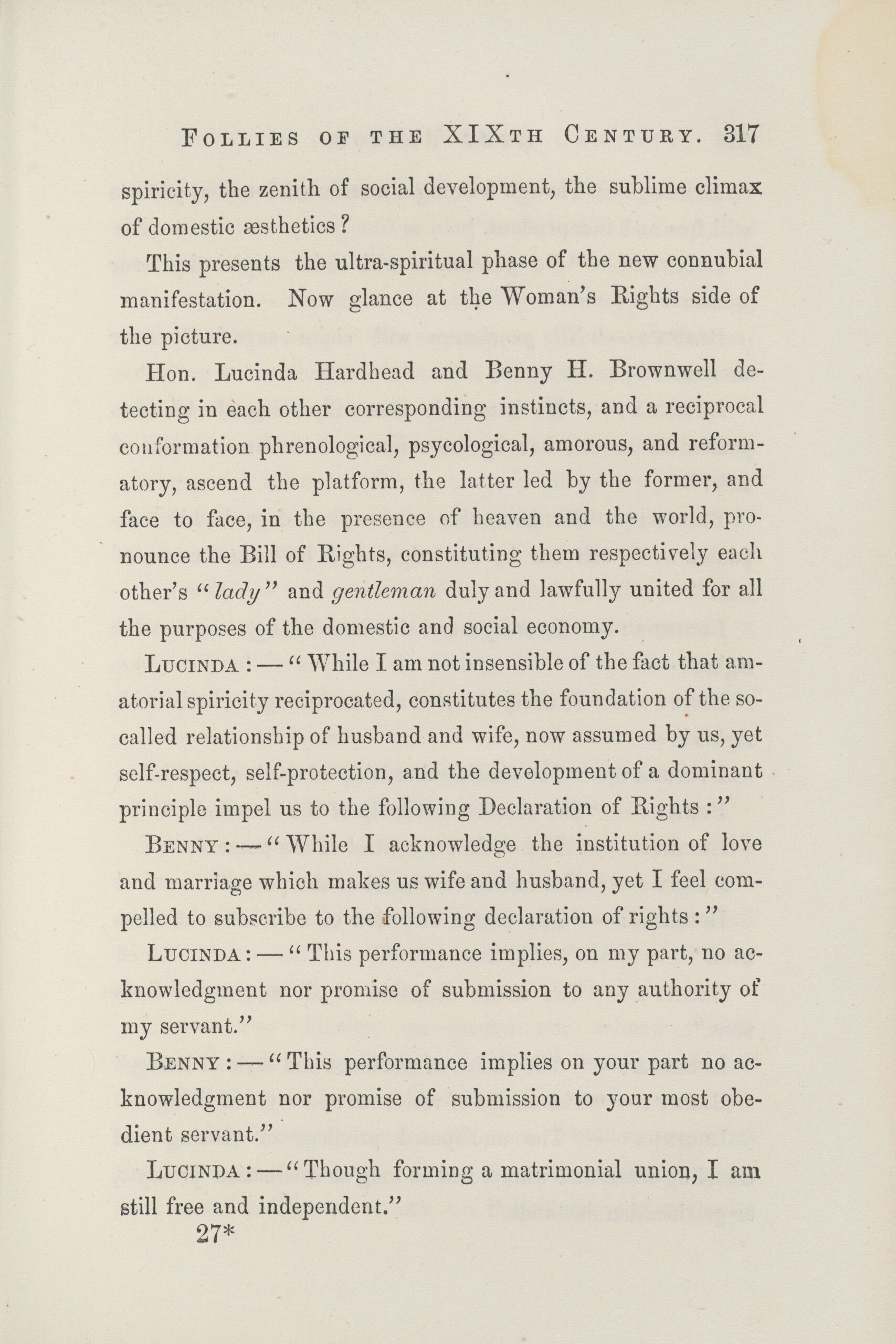
The newly enfranchised women elect Lucy Boston as Governor and a female majority to the state assembly, whose signature legislation is an act to legalize “spiritual marriage,” or “Free Love.” Naturally, by the end of Folio’s tale, women’s ascendancy to power results in “universal stagnation” for business, agriculture, art, communication, and transportation. Only domestic life carries on, having been taken up by the industrious, if sometimes bumbling, men. Governor Boston calls for a restoration of the former political order and women’s return to “the Sphere … and duties for which they were designed.” She then happily abandons politics, women’s rights, Spiritualism, and of course, her bloomers to become the wife of a landlord.
Lucy Boston shows how extravagantly the women’s movement was satirized. It also reflects the irony of the attacks leveled at women when they engaged America’s founding principles in support of their rights. Rather than being taken seriously as political theorists, they were accused of merely parodying the American founders. On the other hand, they were—often at the same time—the target of parody. In spite of their rigorous legal and ethical claims, suffragists were in the frustrating position of defending the Declarations of Sentiments and Women’s Rights against ridicule more than against genuine critique. Lucy Boston expresses this dilemma when she tells Mr. Badger, “The blows of argument we can meet and parry, but against the shafts of ridicule and derision, we have no defense.”
The popularity of Lucy Boston and other contemporary satirical texts and caricatures shows that ridicule can be, in Lucy’s words, a “more formidable” foe than reason. The physical demonstrations of later suffragists are aweinspiring, but it also took true courage for the women of 1848 and 1876 to write and sign their names to declarations that were equally provocative and daring at the time. Still today, we risk provoking mockery and criticism when declaring our beliefs. We can be emboldened by the women of the past who were brave enough to laugh it off.