
DECLARATIONS
No. 63 (Spring 2026)
Table of Contents
What, to you, is the Fourth of July?
Jayne Ptolemy
Associate Curator of Manuscripts
How do you celebrate the Fourth of July? For me, a naturalized citizen who did not grow up with this date having any great significance, it mostly conjures up the smell of a barbecue, sticky summer days, and the sting of sparklers on my fingers. I’m certainly not sitting down reading a copy of the Declaration of Independence. I don’t think I’m alone in being able to faithfully recite, “We hold these truths to be self-evident, that all men are created equal,” before mumbling a bit over the next part about inalienable rights and ending strongly, “among these are Life, Liberty, and the Pursuit of Happiness!”… but nothing else.
And while, yes, that is a bit embarrassing, I also think it’s partially because we live some 250 years removed from it and the Declaration of Independence is more of an idea than anything else. It’s what it tells us about freedom and self-governance that resonates and calls us to action, celebration, or protest. Which is perhaps why each Fourth of July, before I sit in the sunshine and eat a hot dog, instead of reading the Declaration of Independence I think about Frederick Douglass.
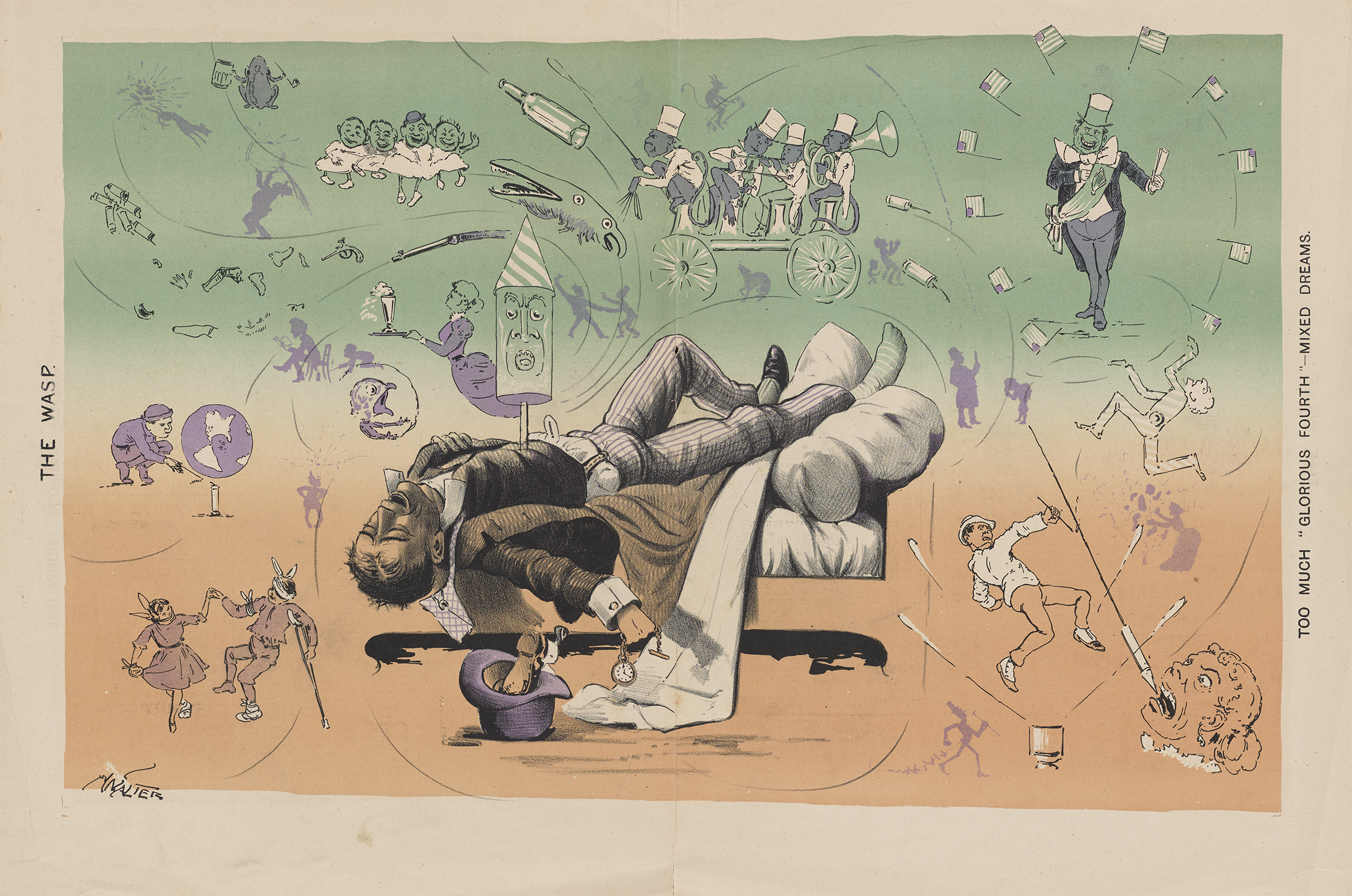
This 1886 satirical print shows a man sleeping off a robust 4th of July celebration, highlighting the presence of explosives, liquor, bands, and patriotic demonstrations…but no declarations.
In part this is because nestled in the Rochester Ladies’ Anti-Slavery Society Papers is a manuscript broadside that has been calling to me for years. It advertises an Independence Day celebration to be given in 1852 “For the purpose of Commemorating the Glorious Declaration of 1776 … After the reading of the Declaration of Independence, an Oration will be delivered by Frederick Douglass, Once a Slave, but now a firm supporter of the principles of the Declaration.”
The text of that speech has been reprinted, excerpted, and taught ever since. In it, Douglass paints a vivid picture of what a nation celebrating its founding doctrines looks like. “Our eyes are met with demonstrations of joyous enthusiasm. Banners and pennants wave exultingly on the breeze … The ear piercing fife and the stirring drum unite their accents with the ascending peals of a thousand church bells. Prayers are made, hymns are sung, and sermons are preached in honor of this day.” But then he turns it on its head by asking, “What, to the American slave, is your 4th of July? I answer, a day that reveals to him, more than all other days in the year, the gross injustice and cruelty to which he is the constant victim. To him, your celebration is a sham; your boasted liberty, an unholy license; your national greatness, swelling vanity; your sounds of rejoicing are empty and heartless; your denunciations of tyrants, brass fronted impudence …”
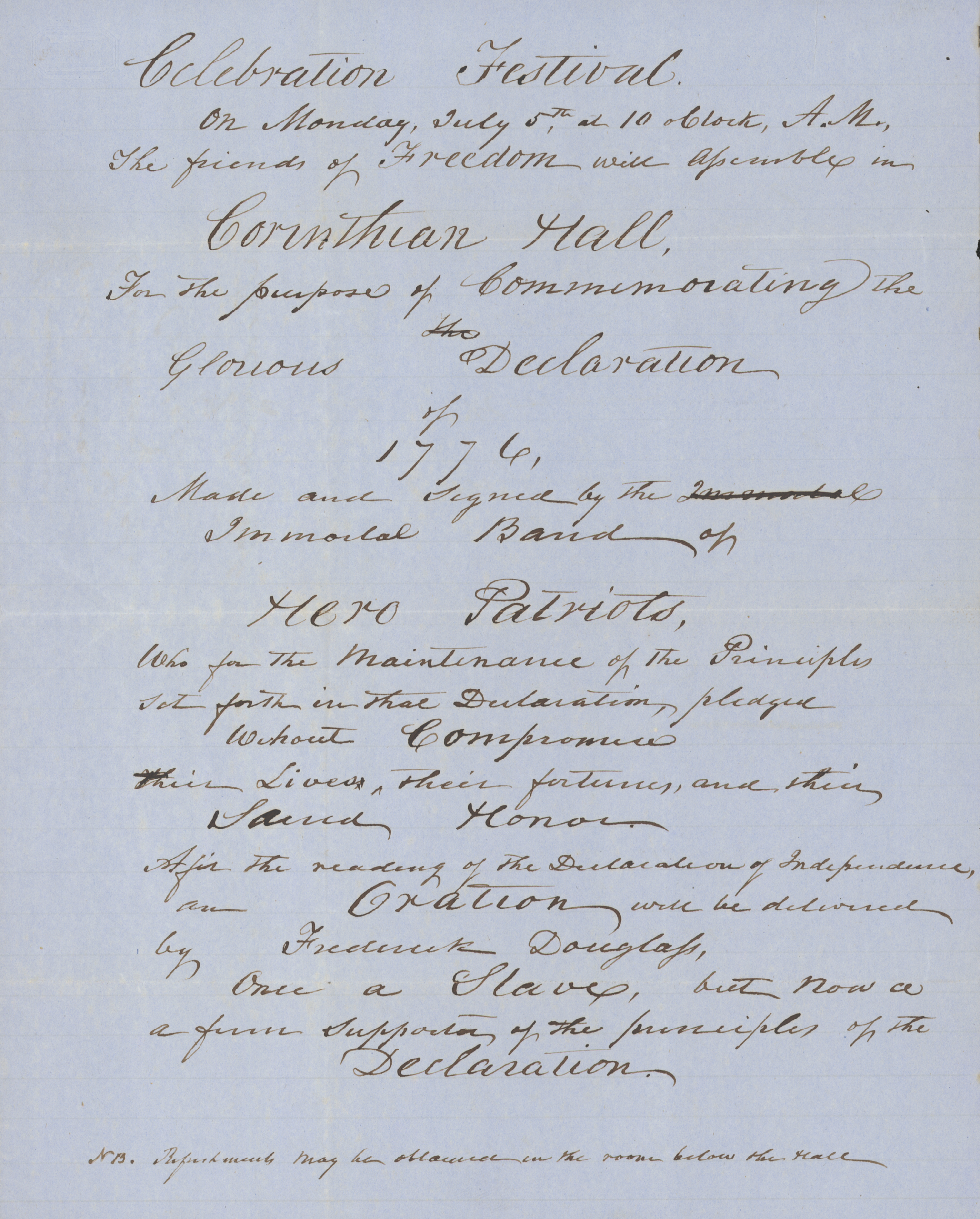
This “Celebration Festival” advertised in the Rochester Ladies’ Anti-Slavery Society Papers would prove to be an iconic moment in the history of abolition and Black oration, when Frederick Douglass unleashed his masterful “What to the Slave is the 4th of July” speech.
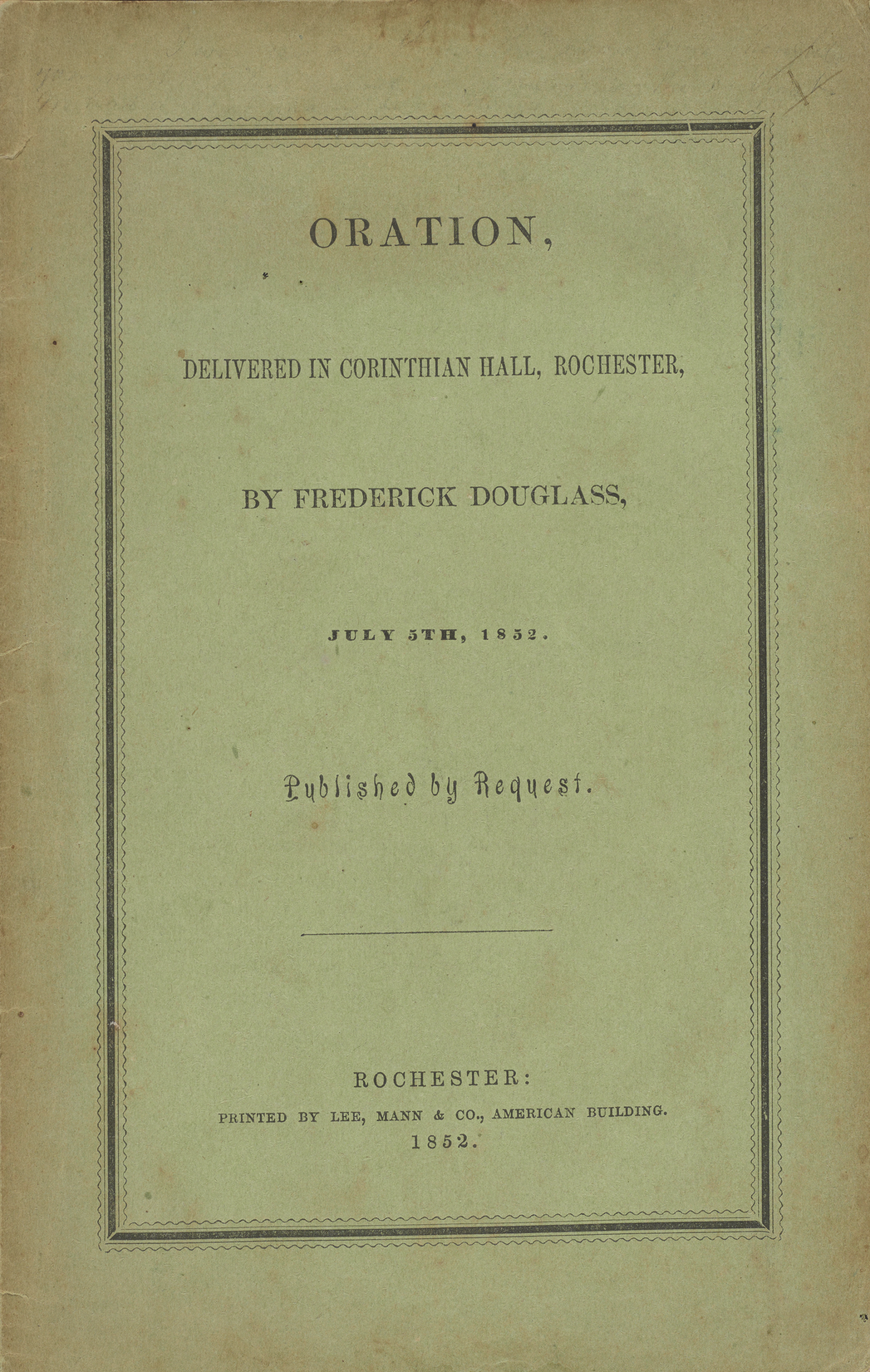
Douglass’s speech was quickly printed and distributed, and it continues to be widely read today.
You can almost hear Douglass booming from the stage. The cadence of his contrast between white celebration and Black suffering skewers the hypocrisy of Independence Day. There’s a reason so many still trot it out to this day on the Fourth of July when they’re feeling disappointed in how we continue to fail to live up to the founding claim that all men are created equal. It’s a powerful reminder of all the work that remains to be done.
But as electrifying as that speech was, and the enduring resonance it continues to have, I find myself less interested in Douglass’s masterful oration than in what declaring independence would have meant for him in that moment. He made this speech some seven years after his autobiography, Narrative of the Life of Frederick Douglass, was first published. The forematter of the book includes a printed letter from Wendell Phillips reacting to the text and Douglass’s bold decision not to cloak any facts that would reveal his identity. “They say the fathers, in 1776, signed the Declaration of Independence with the halter about their necks,” he reflects. “You, too, publish your declaration of freedom with danger compassing about you.” The comparison between the dangers facing both the founding fathers and Douglass as they declared freedom is a deliberate one. Making the ideological connection between the lauded revolutionary principles and abolitionist ones brings Douglass’s fight for freedom within the realm of just causes.
Freedom is absolutely a political matter—we fight wars for it, we elect presidents over it, we define a nation by it. But it is also a deeply personal one that is often brought about with the help of those who love us the most.
If Douglass’s Narrative was his “declaration of freedom,” though, it still obscures his actual act of achieving it. For good reason, as those abetting escapes from slavery would have been committing punishable crimes. While Douglass was willing to take on the dangers associated with publishing real names and places connected to his enslavement, he was not willing to pass that danger on to those who helped him achieve his freedom. He does, however, note that one of his very first acts as a free man was to write to Anna, his “intended wife … informing her of my successful flight, and wishing her to come on forthwith.” They were married just days after she made her way to him a week later
We now know that he was referring to Anna Murray, a woman born to formerly enslaved parents. One of her and Frederick’s children, Rosetta Douglass Sprague, revealed in a printed account in 1923 that Anna played a pivotal role in securing her future husband’s liberation. She saved and shared her earnings, as well as selling “one of her feather beds to assist in defraying the expenses of the flight from bondage.” While we get glimpses of the emotional bond between Frederick and Anna in the Narrative when he acknowledges writing to and marrying her were among his very first acts of freedom, knowing her role in making the escape possible at all further shifts the framing of the story from one of the pursuit of justice to the simultaneous pursuit of love.
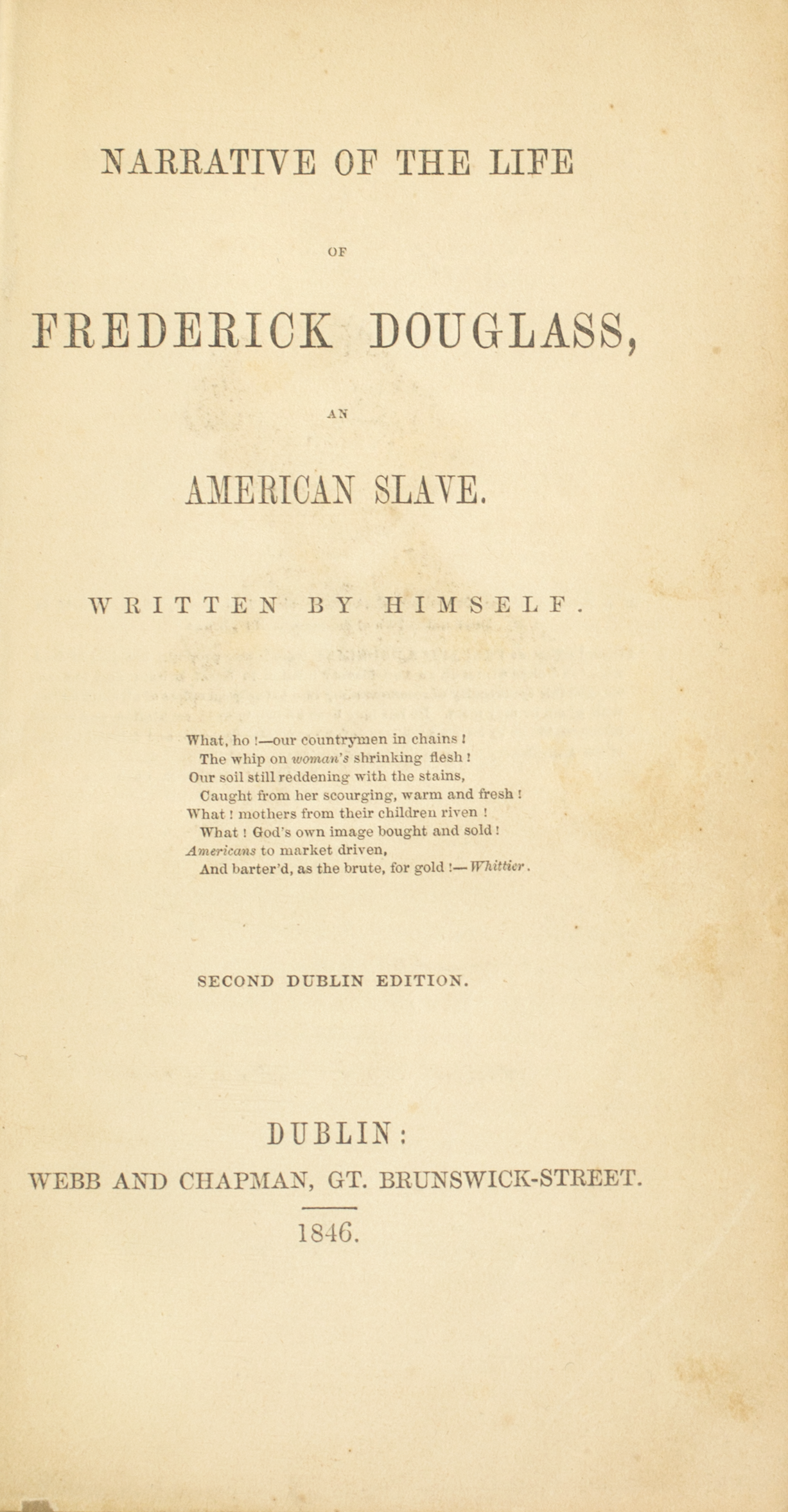
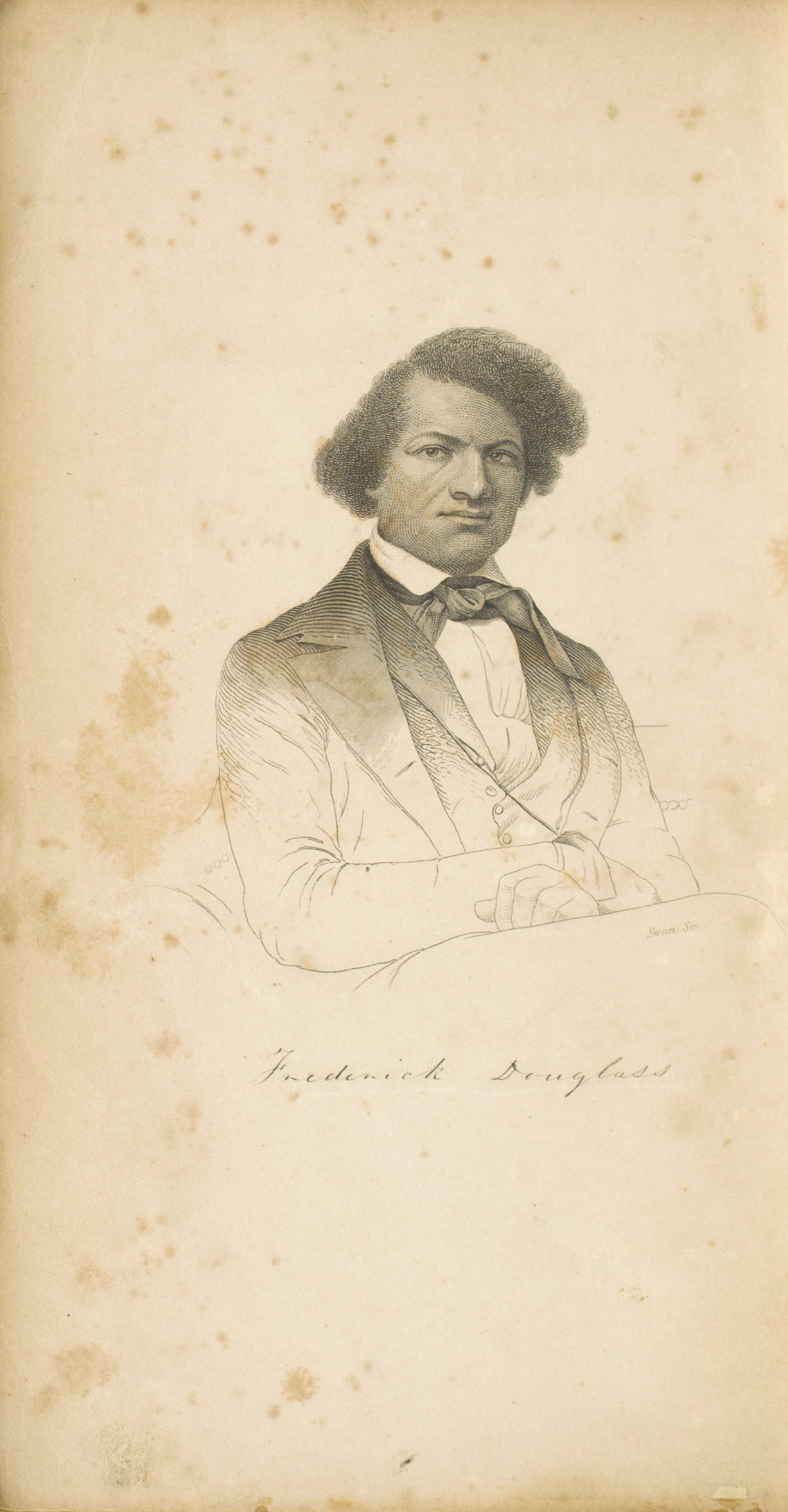
Douglass’ first autobiographical writing was shocking both for his account of slavery’s violences but also for his choice to include real names and places, putting himself at real risk.
Freedom is absolutely a political matter—we fight wars for it, we elect presidents over it, we define a nation by it. But it is also a deeply personal one that is often brought about with the help of those who love us the most. Looking at archives of manumission with that duality in mind, you begin to see those moments of the heart scattered throughout.
Take, for example, the unassuming volume kept by the justices of the peace of Jackson County, Ohio, from 1816 to 1854. Its existence is a relic of the prejudiced Black Laws that restricted African Americans’ ability to settle in Ohio by requiring them to register with the court, pay registration fees and surety bonds, and provide formal proof of their freedom. The bulk of the volume is copies of court forms and other documents that Black Americans carried with them as they migrated to Ohio. But mixed amongst the formulaic legal language—all the herebys and aforesaids and whatnots—is a love story.
“Know all men by these presents that I Edy a free Woman of the County of Louisa and state of Virginia for and in consideration of the natural love and affection which I bear to my husband Charles whom I purchased of David Shepherd dec[ease]d late of the County of Fluvanna and State aforesaid … have manumitted and set free the said Charles as fully and completely as if he had been born free.”
From associated documents in the volume, we know that Edy was about 43 years old at the time, had been manumitted herself some thirty years previously, had a “rather light complexion,” had a scar on the lower part of her neck “occasioned by a burn,” was approximately five feet, four inches tall, and chose in 1824 to appear in open court and proclaim that her natural love and affection was the only justification needed to pursue freedom for Charles. At that time, laws declared enslaved people could make no contracts, so their legal marriages were not possible. Edy’s declaration reads as a pointed refusal to abide such nonsense. Even in the face of legal repression, Edy highlighted the love she and Charles bore for each other, that they knew themselves to be husband and wife regardless of the laws, and that it was worth embedding these facts in the historical record.
So as we approach the 250th anniversary of perhaps the most famous declaration of them all, I can’t help but muse on how declarations of independence might simultaneously be declarations of love. And somehow, reflecting on that possibility helps me look more kindly on the founding fathers, all their oversights and failings, and all the ones that have occurred in the years following. If we stand up for freedom because of the love we bear— either for country, for another, or for ourselves—it makes it feel more possible to face the ongoing costs of making sure that liberty endures. So even if we don’t know all the words to the Declaration of Independence, we still know it’s worth fighting for.
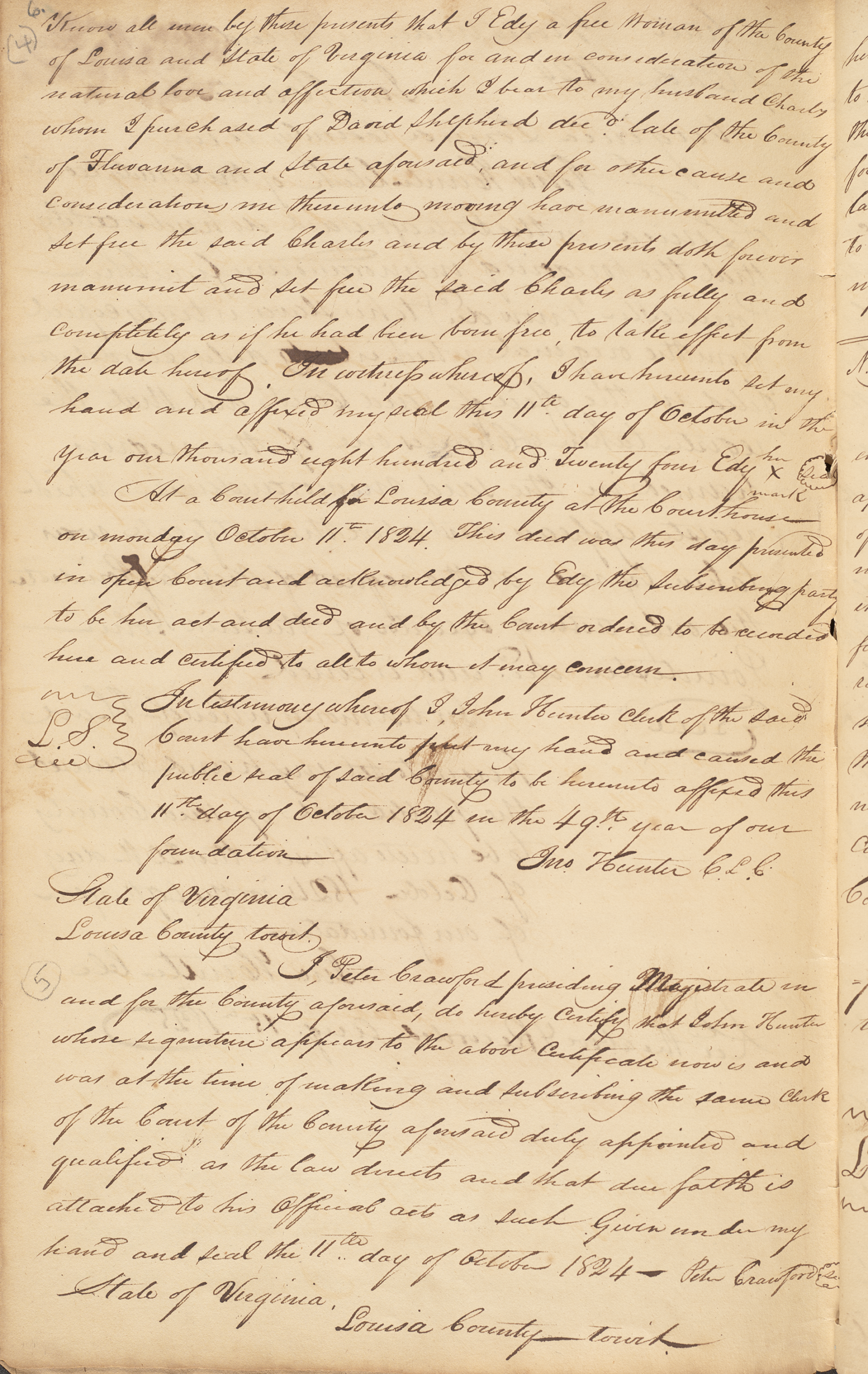
This copy of a legal document tells the entwined stories of the fight for liberty as well as love.