

DECLARATIONS
No. 63 (Spring 2026)
Table of Contents
Religious Declarations
Emma Schneider
Information Resources Assistant
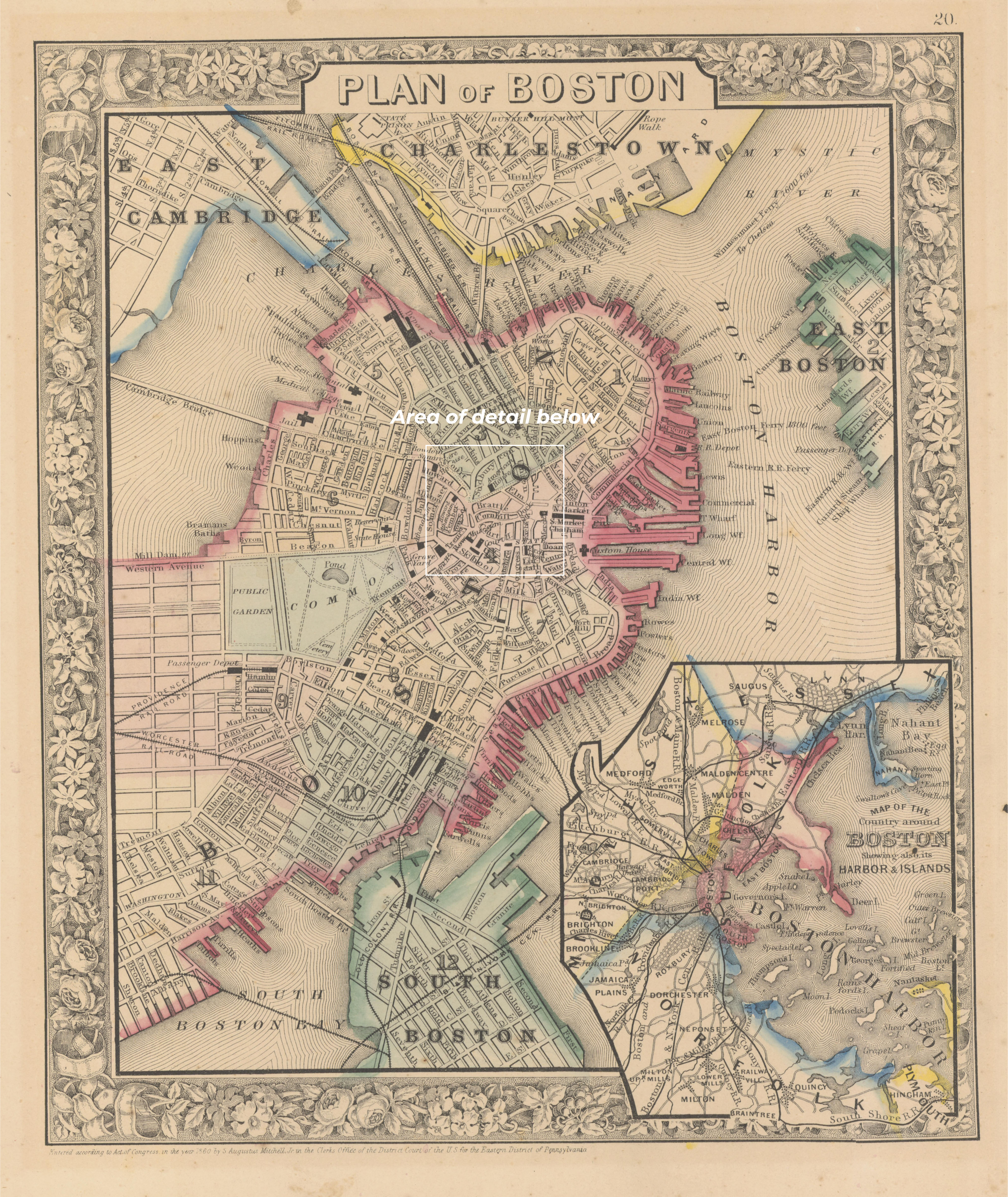
This small map of Boston shows streets, railroads, docks, bridges, and select buildings, providing a snapshot of how people moved, gathered, and lived (Plan of Boston, Small Maps 1860, WLCL).
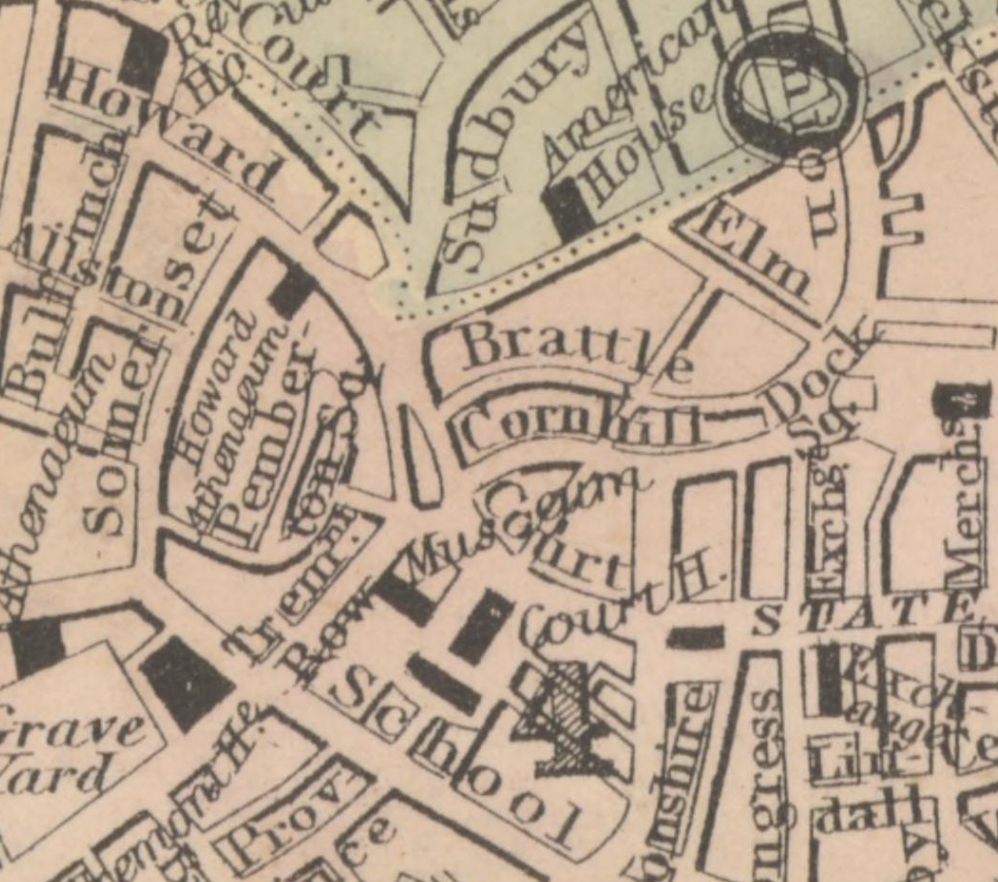
Enlarged detail of map above highlighting Brattle Street at center (Plan of Boston, Small Maps 1860, WLCL).
For many of us, religion is something we are born into. We often believe because our parents believe, making religion a deeply familial practice that can look different for every household. For some, it means going to church with parents every Sunday. For others, it might involve a bar or bat mitzvah, marking a coming of age within a tradition shared across generations of a Jewish family. In some cases, maybe the extent of religious practice was being baptized as an infant. Those raised in a religious family may not need to formally declare belief, dedication, faith, or commitment to religion. Instead, participating in shared traditions and inherited practices can itself be enough of a statement of faith.
But sometimes people deviate from family traditions. They set out to find their own faith and make meaning in a new religious life, or they may reaffirm their faith later in life. In these cases, religious declarations or declarations of faith can take many forms. Adult baptism, conversion, and confirmation (which seals the covenant created during an infant baptism) are examples of more bodily, spoken, and public declarations or reaffirmations of faith.
Declarations of faith are both personally and communally intimate. The act of the declaration itself is a personal expression of belief and trust in God, but when that declaration is made in community with other believers, a sense of connection occurs. This emphasizes the duality that faith and belief are not just private matters, but can be shared and experienced with others.
I encountered the dual intimacy of these declarations of faith while reading the Brattle Street Church diary in the Clements Library’s collection. This diary records the sermon notes and spiritual reflections of an unnamed member of Boston’s Brattle Street Church between March 1772 and April 1775.
The Brattle Street Church was a culturally and historically significant Congregational church founded in 1698, boasting prominent figures of the American Revolution among its members, including John Hancock, Samuel Adams, Joseph Warren, and John and Abigail Adams. It was on Brattle Street in the heart of Boston, Massachusetts (it stood near Faneuil Hall, roughly where Boston’s City Hall now stands).
A small map dated 1860 entitled “Plan of Boston” frames the physical place and space where Brattle Street Church stood, offering insight into how deeply embedded religion likely was in the everyday lives of its members. The church would have been integrated into the daily rhythms of colonial Boston. Located only a short walk from the town’s commercial center, the church stood along routes that congregants travelled constantly. Members would walk down Brattle Street past the church on their way to the shops and markets, on their morning commutes, or while visiting their neighbors, encountering fellow congregants in both business and social settings. Religious, economic, and social worlds all overlapped, making the church a very visible and familiar part of everyday movement.
When examined more closely, the area around Brattle Street reveals a dense spatial layout that reflects a tightly knit community. The close proximity of homes, streets, gathering places, and shops shows that Bostonians lived, worked, and worshipped within a compact environment. This clustering illustrates lived religion, where faith was not confined to formal religious services, but intertwined into everyday routines, encounters, and movements.
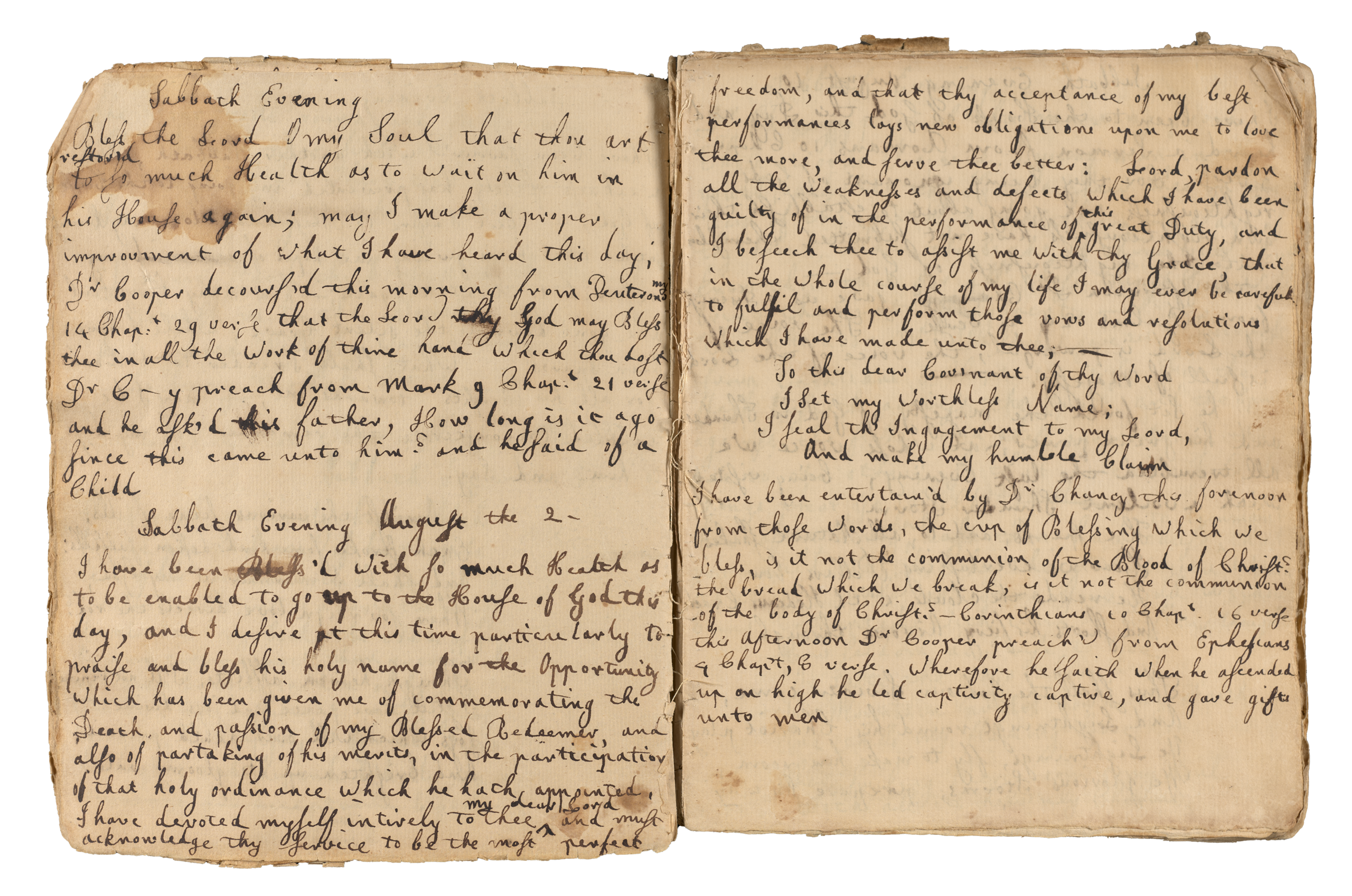
Entry from Brattle Street Church diary dated “Sabbath Evening August the 2.”
The Brattle Street Church diary itself is not glamorous. It’s rather simple-looking in its current condition: coverless, full of loose stitching, fraying edges, and a metal pin that peeks out of the spine. But there is something deeply personal and intimate in its simplicity, the emphasis placed not on the vessel itself, but what it contains. And inside this diary is a rich record that shows the dedication and immense impact that faith and the Brattle Street Church community had on the diary’s author.
Congregationalist churches are autonomous, independent, and self-governing, meaning that each congregation has its own authority to make decisions regarding belief, worship, and leadership. This means that Congregationalist church members were encouraged to engage actively with sermons, scripture, and communal worship. This framework made individual spiritual reflection especially important. Nearly every Sabbath evening, the diarist would give an account of the day’s service, including who preached and from what text, as well as a reflection on their own spiritual condition. Often, the diarist would declare their devotion to God, admit they were falling short spiritually, and ask for forgiveness and divine help in remaining committed to their faith. This level of deep introspection can be seen in an excerpt from the entry from “Sabbath Evening August the 2”:
I have devoted myself intirely [sic] to thee my dear Lord and must acknowledge thy Service to be the most perfect freedom, and that thy acceptance of my best performances lays new obligations upon me to love thee more, and serve thee better: Lord, pardon all the weakness and defects which I have been guilty of in the performance of this great Duty, and I beseech thee to assist me with thy Grace, that in the whole course of my life I may ever be careful to fulfill and perform those vows and resolutions which I have made unto thee–.
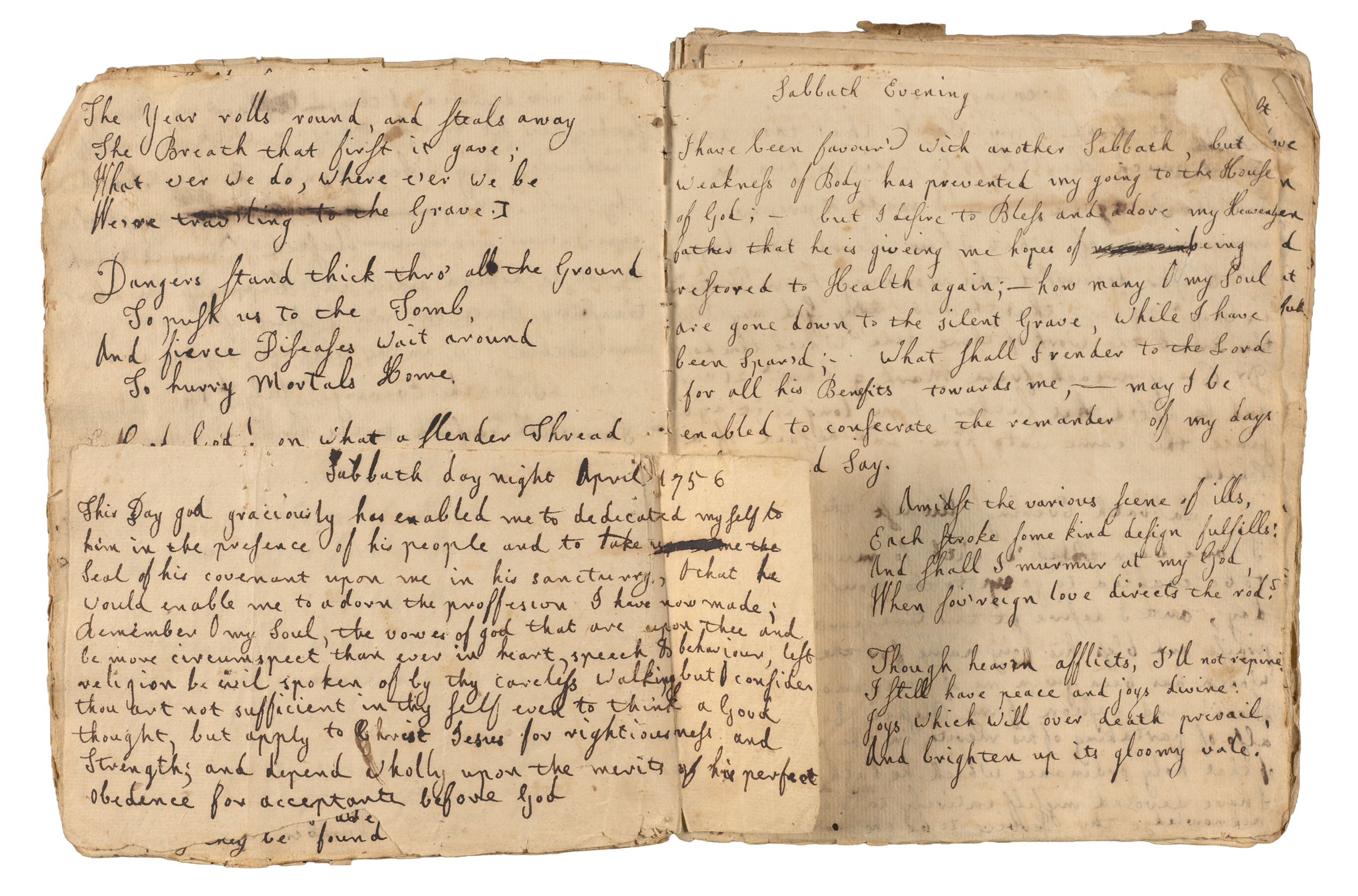
Entry dated “Sabbath day night April 1756.”
There is a deep intimacy in reading this diarist’s innermost thoughts, which show great humility in recognition of their flaws, weaknesses, and religious shortcomings. Furthermore, this contemplation on the diarist’s spiritual life shows that faith and belief operate cyclically. It’s a continuous loop that begins with devotion, moves toward an awareness of personal imperfection, then to a plea for grace, and finally returns to a renewed sense of commitment, with the resolve to do better, to live more faithfully. This pattern of faith, grace, and redemption is rooted in the Great Awakening, which transformed religion into something woven into everyday life.
The religious revivals that swept through the American colonies in the 1730s and 1740s during the Great Awakening reshaped how people experienced faith by shifting focus away from formal rituals and institutional practices and toward personal spiritual devotion, introspection, and individualism. This movement challenged the traditional institutional structure of religion, instead emphasizing a personal and direct relationship with God, where individuals were encouraged to examine their own souls, recognize their own sins, and seek redemption through personal faith.
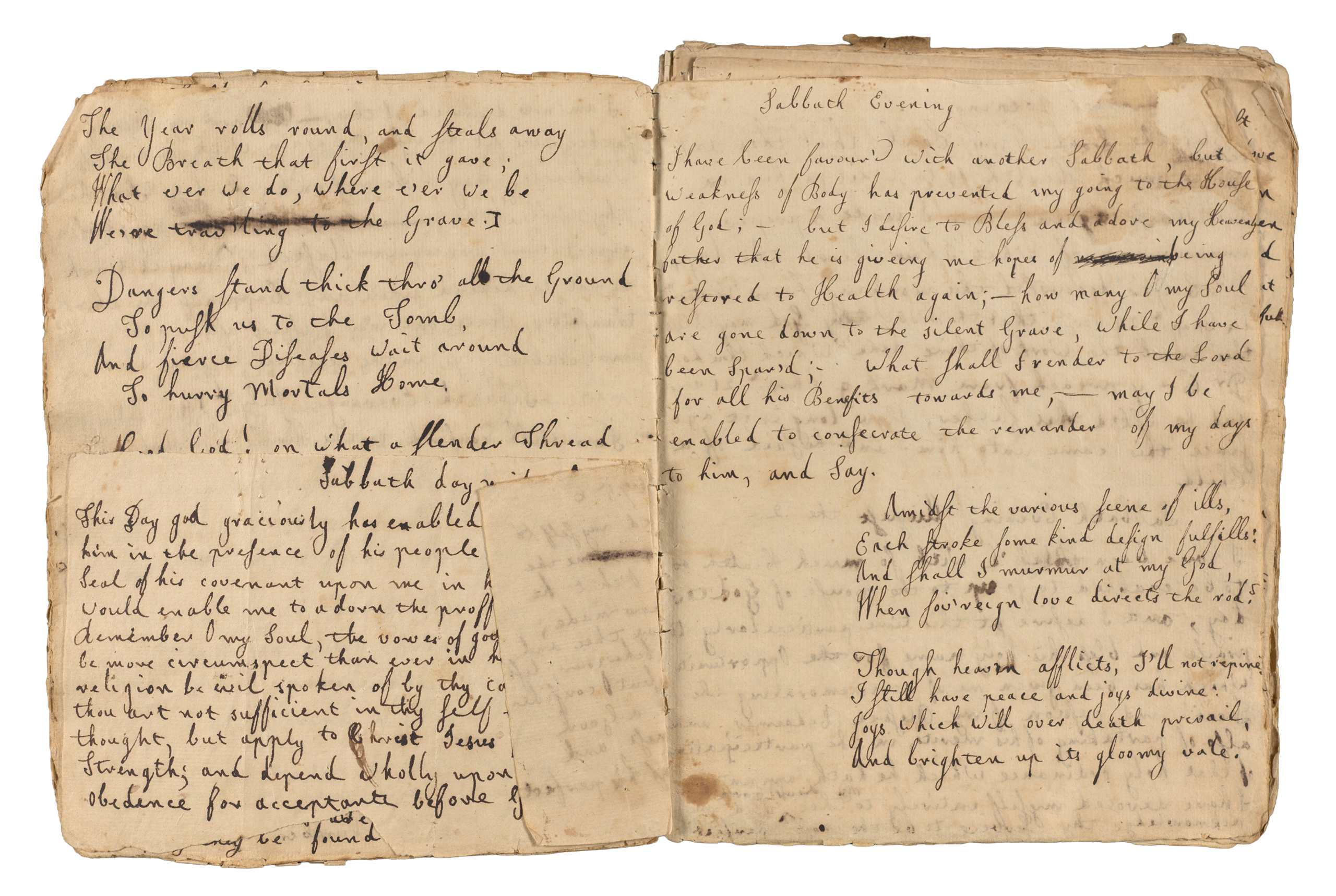
Many of the “Sabbath Evening” entries reflect that deeply introspective and personal faith that would have been widely practiced by the 1770s, but there is one entry that stands out among the rest. Within the diary, there is a half-sheet of paper sewn into the body that is dated “Sabbath day night April 1756,” nearly 20 years earlier than all the other entries.
It reads:
This day god graciously has enabled me to dedicated my self to him in the presence of his people and to take the Seal of his covenant upon me in his sanctuarey & that he would enable me to adorn the profession I have now made; Remember O my soul, the vows of god that are upon thee and be more circumspect than was in heart, speech, and behavior; Lest religion be evil spoken of by thy careless walking but I consider thou art not sufficient in thy self even to think aloud thought, but apply to Christ Jesus for righteousness and strength; and depend wholly upon the merits of his perfect obedience for acceptance before god.
This entry is extraordinary as it represents a deliberate preservation of a key spiritual moment in the life of the diarist. Its addition after the fact may suggest a defining moment of recommitment, and it raises intriguing questions. We cannot be certain this was actually written in 1756, or whether it is instead a memory of an earlier experience that was later recorded and used to center and shape future religious thought. Why physically sew in a memory instead of summarizing it? This choice suggests an intentional act of embedding the experience into the text itself, underscoring that this moment of conversion or reflection carried such significance that it required a tangible and permanent place within the record. This sewn-in declaration can be understood within the contexts of the spiritual cycles evident in both the diarist’s writings and the Great Awakening, reinforcing the idea that faith is not only remembered but actively revisited and reaffirmed. It echoes the patterns of personal conversion central to the Great Awakening, in which individual experiences of sin, grace, and renewal shaped religious identity. This entry fits the pattern of a New Light conversion narrative, a practice that continued in the 1750s as a requirement for church membership.
Page of diary featuring blank space.
The next page of the diary features a deliberate blank space where the overlapping conversion narrative or declaration was carefully written around. More than just an artifact of the volume’s piecemeal construction, the blank space becomes meaningful. It marks a boundary that sets the declaration apart from the surrounding entries and suggests its importance to the writer’s religious identity. As the diarist literally circles their writing around this central profession, each entry is written and read in relation to it, reinforcing the idea of faith being cyclical. By writing after the Sabbath, the diarist moves beyond simple documentation and into ritual practice, in which there is a continual re-engagement and affirmation of religious commitment and identity. Therefore, the diary operates simultaneously as documentation, devotional practice, and devotional object.
The diary ultimately returns us to the idea that religion is often something inherited through family and shaped through everyday practice long before it is consciously chosen. It invites the reader to appreciate the balance and duality between communal worship and personal devotion, emphasizing how religious identity emerges through both shared experiences and individual reflection. At the same time, the diary reflects how religion is deeply woven into the intimate moments of ordinary life, revealing how faith moves beyond formal worship and into family traditions, private contemplation, and routines that quietly shape identity over time. Faith is not only defined by dramatic public declarations of belief, but often by the inherited practices and personal moments that sustain it across generations. The diary itself becomes a private declaration of faith, yet its preservation and study transform it into a moment of communal engagement.