

DECLARATIONS
No. 63 (Spring 2026)
Table of Contents
Declaring Allegiance
Cheney J. Schopieray
Curator of Manuscripts
Seth Perry was on board his sloop, lying in Buzzard’s Bay west of Sandwich, Massachusetts, on a cold day in February 1778. The calm was broken by a beckoning shout from land, which reached Perry on deck. The voice belonged to Mr. Pope, who informed Perry that he must stand before a magistrate and declare his allegiance and fidelity to the State of Massachusetts and to the United States. Though expected, the voice was unwelcome. Seth Perry was among many Americans who were hesitant to make a formal declaration in favor of Revolution. Nearly three years into the war and with no end or certain victor in sight, with a wife and two children, and with friends and family on both sides of the conflict, a formal statement of “which side” could have disastrous effects on their lives. Perry consulted with shipboard blacksmith Ebenezer Raymond and brother-in-law Nicholas Cobb about whether or not to take the oath. The magistrate gave Perry 20 hours to deliberate, and ultimately the mariner refused to declare his allegiance or fidelity.
Military, naval, and civil servants were required to take oaths of office and allegiance during war and peacetime, but the oath presented to Seth Perry was different. It focused instead on any person suspected of being “inimical to the United States.” Who was inimical? Any suspected loyalists (those still sympathetic to the Crown) found aiding or abetting the enemy since fighting broke out at Lexington and Concord (April 19, 1775), or for providing the enemy with intelligence since the Declaration of Independence (July 4, 1776). Who could accuse someone of inimicality? Any two “substantial” freeholders or any single civil or military authority. What evidence was needed? Suspicion was satisfactory grounds to bring someone before the judge to demand a statement.
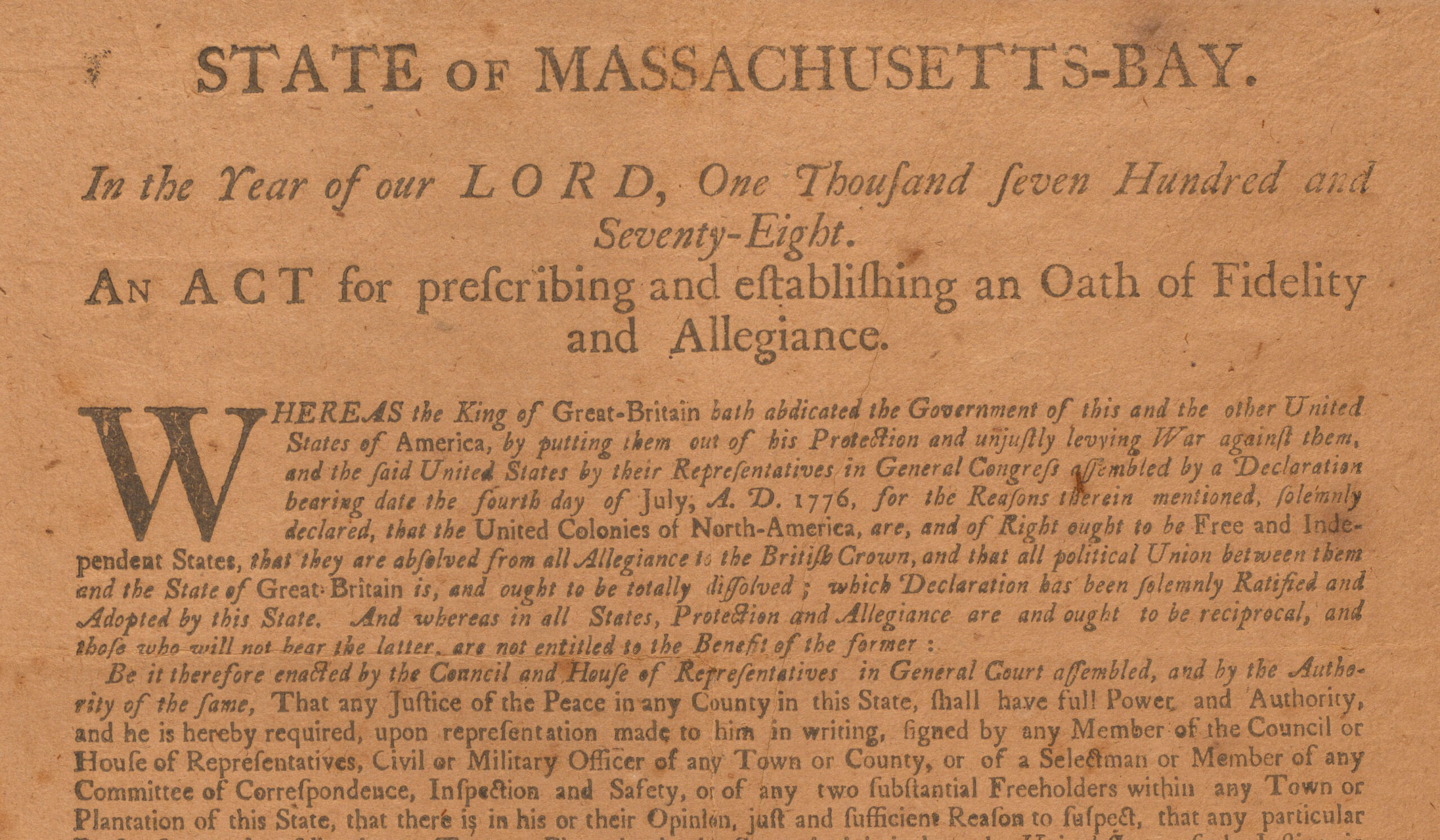
As stipulated in An Act for prescribing and establishing an Oath of Fidelity and Allegiance (Mass. General Court, February 3, 1778), the oath Seth Perry refused to declare was as follows: I A. B. do swear… that I will bear true Faith and Allegiance to the State of Massachusetts-Bay, and will faithfully support and maintain and defend the same against George the Third King of Great-Britain, his Abettors and all other Enemies and Opposers whatsoever, and will discover all Plots and Conspiracies that shall come to my Knowledge against said State, or any other of the United States of America. So Help me G O D.
An Act for prescribing and establishing an Oath of Fidelity and Allegiance (Mass. General Court, February 3, 1778) gave procedures for county justices of the peace to receive intelligence about people suspected of loyalty to George III or his allies; to order suspects to take an oath; to imprison or exile those who refused to declare allegiance; and to punish even to death, without clergy, loyalists returning to Massachusetts after leaving.
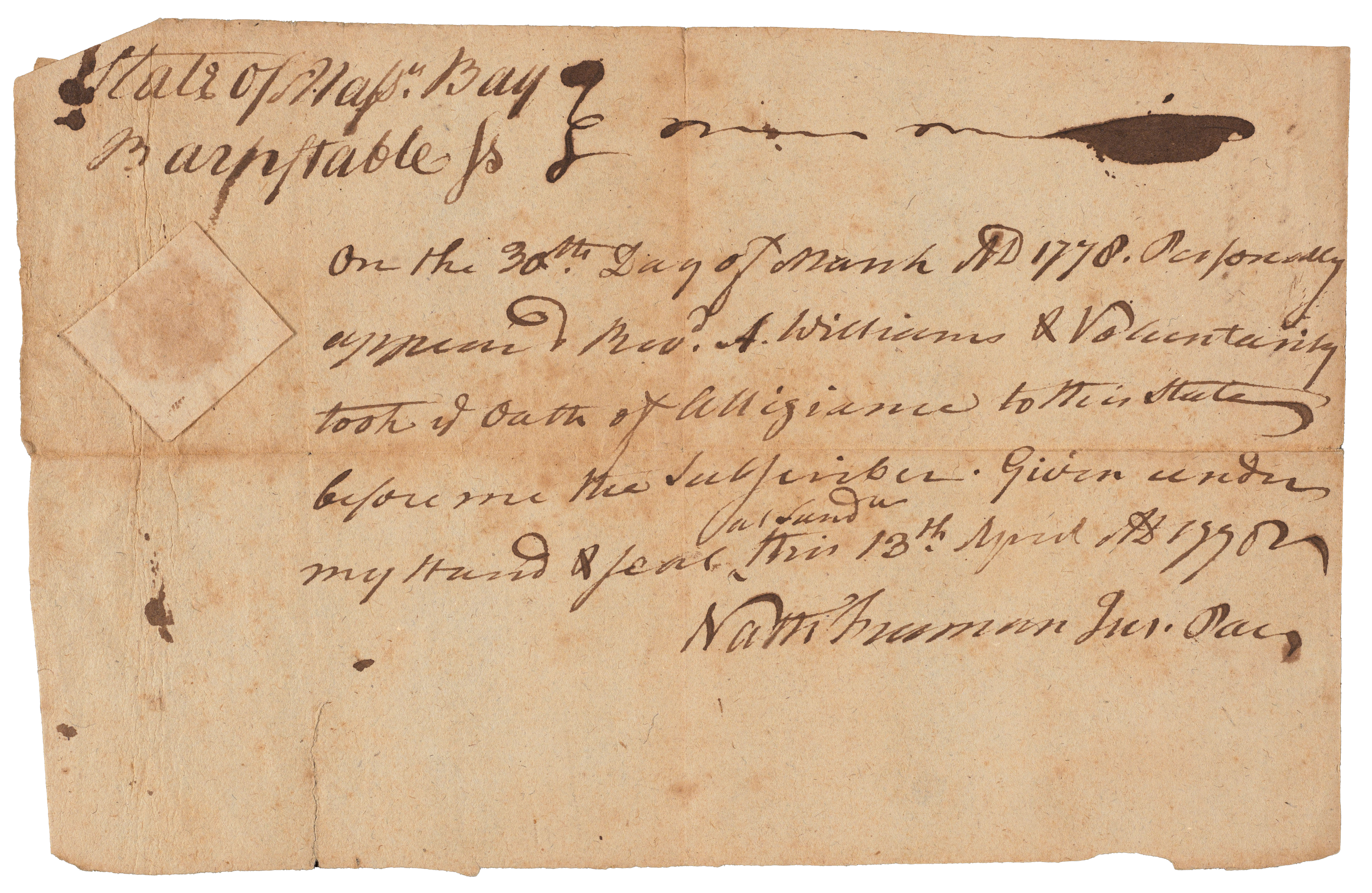
Nathaniel Freeman, as Justice of the Peace, heard oaths of allegiance for Sandwich, Barnstable County, including this example, in which Rev. A. Williams “Voluntarily took ye Oath of Allegiance to this State,” April 13, 1778. With paper seal. Nathaniel Freeman Papers.
For his refusal, Perry was committed to the Barnstable jail on February 26, 1778. He was not alone. The same day Melatiah Bourn, Isaac Knowles, John Jennings, Abiel Ellis, and Prince Tupper—all of Sandwich, Massachusetts—were imprisoned. The editor of the Boston Gazette indicated that once the imprisoned men “who will refuse to take the Oath” were “got rid of,” “the Town [of Sandwich] will be pretty well purged.”
Committee of Correspondence member and Justice of the Peace Col. Nathaniel Freeman took oaths and handled refusals. His papers, held by the William L. Clements Library, shed light on Seth Perry, his relatives, and the community-rupturing events set in motion by the oath of allegiance requirement.
Six of the men in the Barnstable jail, including Seth Perry, sent a joint letter to the court, claiming that they had never seen the language of the Oath before approaching the magistrate. They said they needed more time for consideration, were refused it, and placed in jail. The prisoners informed the court that neighbors brought words against them as unfriendly to American liberty. This raised their resentment and, according to their scruples, they opted to refuse the oath. After time behind bars and reflection on the struggles of their wives and “helpless infants,” they were ready to take the oath—with language modifications laid out in the letter. They also would continue to pay proportions according to state law and their share of funds for raising men for the defense of Massachusetts and the United States (March 20, 1778).
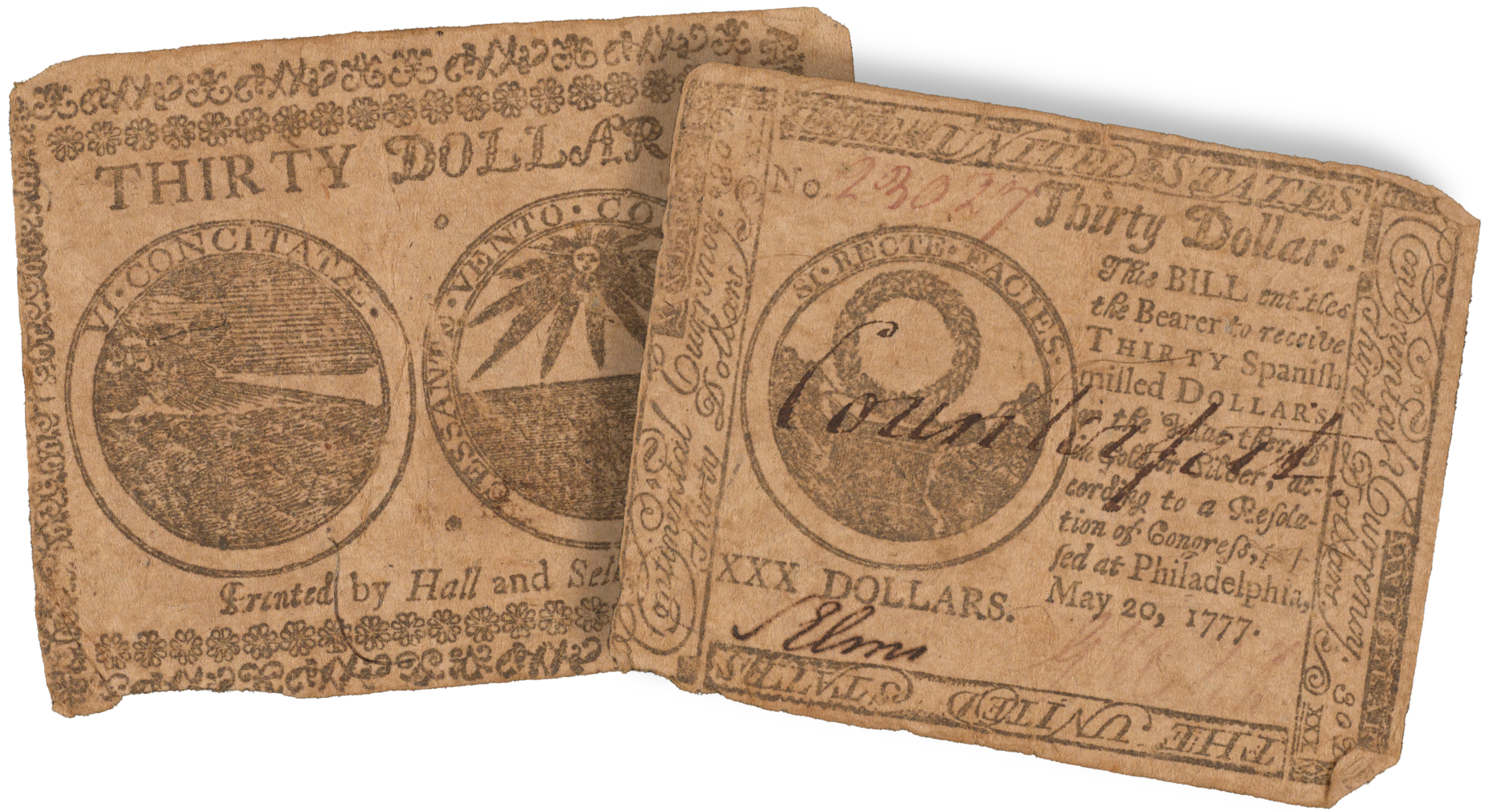
Counterfeit money, such as these two examples of Continental Currency, could wreak havoc on the economy and trust in state and United States governments. The investigations following Seth Perry’s imprisonment discovered him to be in some way involved in a plot to introduce forged bills into Massachusetts in early 1778.
Unfortunately for Seth Perry and the other prisoners, several of the men had a history of activities and statements in support of the Crown, and were known for gathering at a local tavern recognized as a meeting place for loyalist-leaning people. Indeed, eight other men with family ties and friendly connections—Lemuel Bourn, Samuel Perry, Thomas Perry, Stephen Perry, Samuel Perry Jr., Francis Phinney, David Atkins, and John Blackwell Jr.—had already left Sandwich for British-controlled Rhode Island in the fall of 1777. To winnow the reality from a pile of partial truths, Nathaniel Freeman and his associates spent March and April taking depositions from Perry’s extended socio-political network. The results were enlightening.
The depositions in the Nathaniel Freeman Papers include interviews with the accused, the wives of the accused, accusers, Ebenezer Raymond, and others. Carefully read, they include conflicting accounts, vagaries, avoidance of questions, and a surprising amount of corroboration. Edward Davis claimed a Marshfield loyalist promised to pay him to smuggle Tory names and plans (in a hollow cane) to British leaders and spread counterfeit money to distress and embarrass the rebels. He also claimed that he was a Patriot double agent who intended to report everything to Massachusetts authorities. Toward one end or the other, Davis connected with the Sandwich loyalists.
At the same time, Seth Perry, his wife, Lydia Perry, and sister-in-law Sarah Perry, Hannah Bourn, and Elisabeth Bourn swore that Seth’s brothers Samuel and Thomas Perry returned from Rhode Island twice since they left in 1777. On the second trip, Samuel brought a stack of counterfeit 4/4 notes (4 shillings, 4 pence), “maybe as many as a pack of cards,” 20–30 bills, and through various transactions scattered clutches of them to Ebenezer Raymond and into Perry and Bourn family homes. Several of the women, wishing to have nothing to do with the paper, claimed to have burned as much as they could find.
Nathaniel Freeman posed further questions about a rumor that the Perrys either had provided or intended to provide venison to British soldiers at Newport, but heard little to connect Seth Perry to such a plot. Another line of questioning pertained to whether or not Perry spoke seriously about transporting people or goods to/from Rhode Island.
Seth Perry remained in jail almost two months despite having been assured that he would be freed in fewer than 40 days. Concerned for his health and his family, Seth Perry escaped near the end of April 1778. In his cell, he left a letter to his captors:
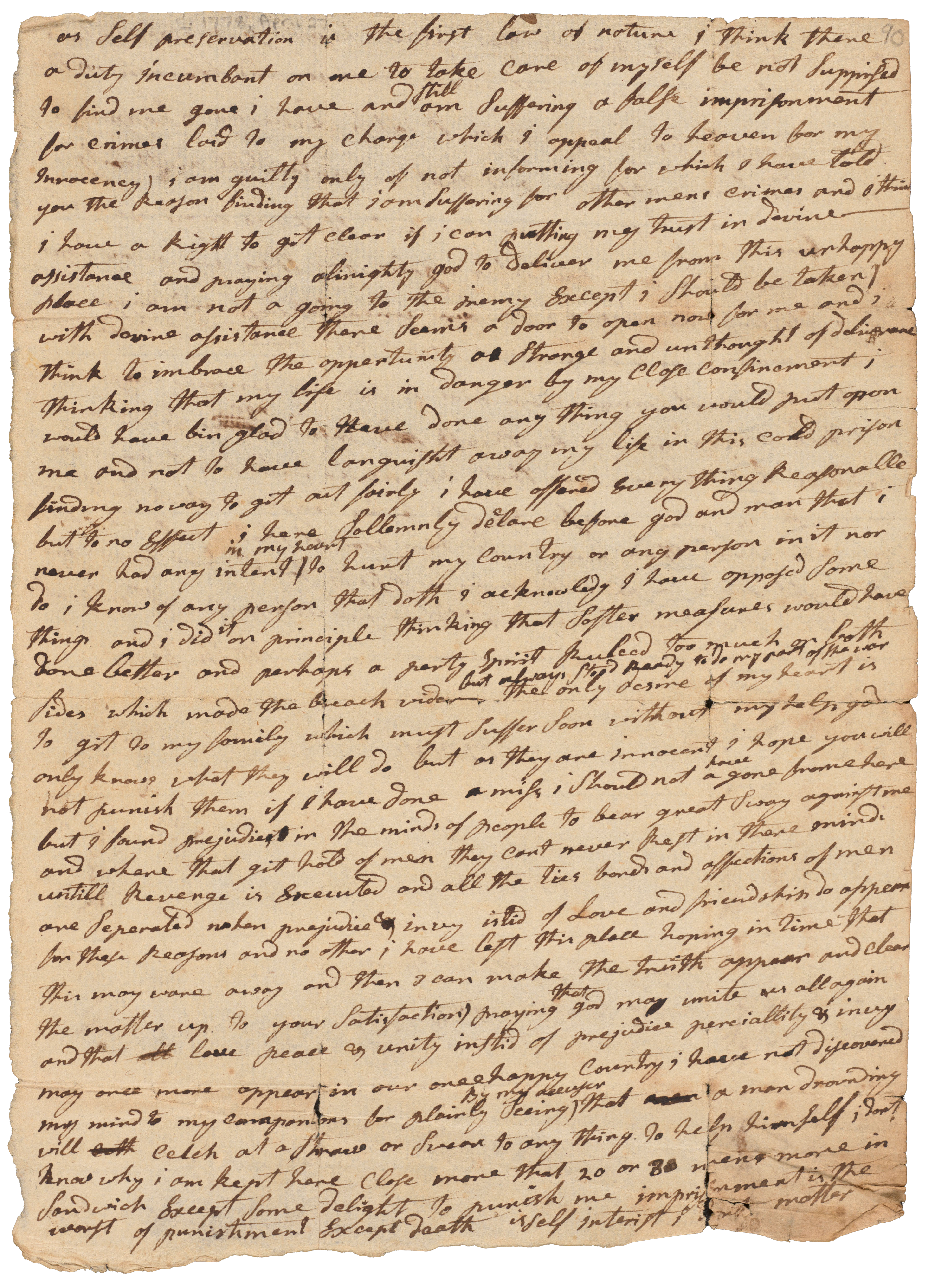
Seth Perry left this letter in his jail cell upon his escape around April 27, 1778. In it, he decried his undue extended imprisonment, claimed his innocence, and lamented the sufferings of his family. He addressed his refusal to declare an oath of allegiance by stating his belief that more moderate means of addressing the conflict were possible and that a “party spirit ruled too much.”
“as self preservation is the first law of nature i think there a duty incumbent on me to take care of myself[.] be not supprised to find me gone[.] i have and still am suffering a false imprisonment for crimes laid to my charge which i appeal to heaven for my Innocency … finding that i am suffering for other mens crimes and i think i have a Right to get clear if i can[,] putting my trust in divine assistance and praying almighty god to deliver me from this unhappy place[.] i am not a going to the enemy Except i should be taken[.] …i have offered Every thing Reasonable but to no Effect[.] i here Sollemnly declare before god and man that i never had any intent in my heart to hurt my Country or any person in it nor do i know of any people that doth[.] i acknowledg i have opposed some things and i did it on principle thinking that softer measures would have done better and perhaps a party Spirit Ruled too much on both sides which made the breach wider but always stopd Ready to do my part of the war[.] the only desire of my heart is to git to my family which must suffer soon without my help[.] god only knows what they will do but as they are innocent i hope you will not punish them[.] if i have done amiss i Should not have a gone from here but i found prejudices in the minds of people to bear great Sway against me and where that git hold of men they cant never Rest in there minds untill Revenge is Executed and all the ties bonds and affections of men are seperated when prejudice & invy instid of Love and friendship do appear[.] … i conclude praying that peace happiness prosperity love unity & friendship may once more possess and flourish in this once happy country whose Rights Liberty & happiness may god long preserve and that no unlawfull authority may Ever be set up over us but that we may yet all unite in love and friendship again and then we may hope for a blessing from heaven on our undertakings and happiness to our country. … from your unhappy & most miserable Humble Servant &c Seth Perry[.] Mr Nye told me after i Refused the oath i might go off my own way within forty days which contract is Broke on you part as well as mine and i think you broke first[.]
Seth Perry removed quickly to Rhode Island, joining his brothers Samuel and Thomas, brother-in-law Ephraim Ellis, in-law John Blackwell Jr., and others from Sandwich. They left behind homes, property, and family. Desiring to be reunited with their husbands/ fathers, on June 17, Marcy Bumpas, Sarah Perry, Lydia Perry, Thankfull Perry, Mary Ellis, and Priscilla Blackwell petitioned Nathaniel Freeman to take up what property they could, and, under a flag of truce, leave Sandwich with their children to Newport. What may have been a temporary relocation was rendered permanent by an Act of Banishment passed at the September 1778 meeting of the Massachusetts Congress. The legislation was crafted to prevent the return of over 300 loyalists. The list of loyalists included prominent Crown officials such as colonial governor Thomas Hutchinson as well as ordinary citizens such as the Perrys, Ellises, and Blackwells. The law forbade their return to the State of Massachusetts on threat of capital punishment. Thus, these families found themselves on ships to Nova Scotia as refugees.
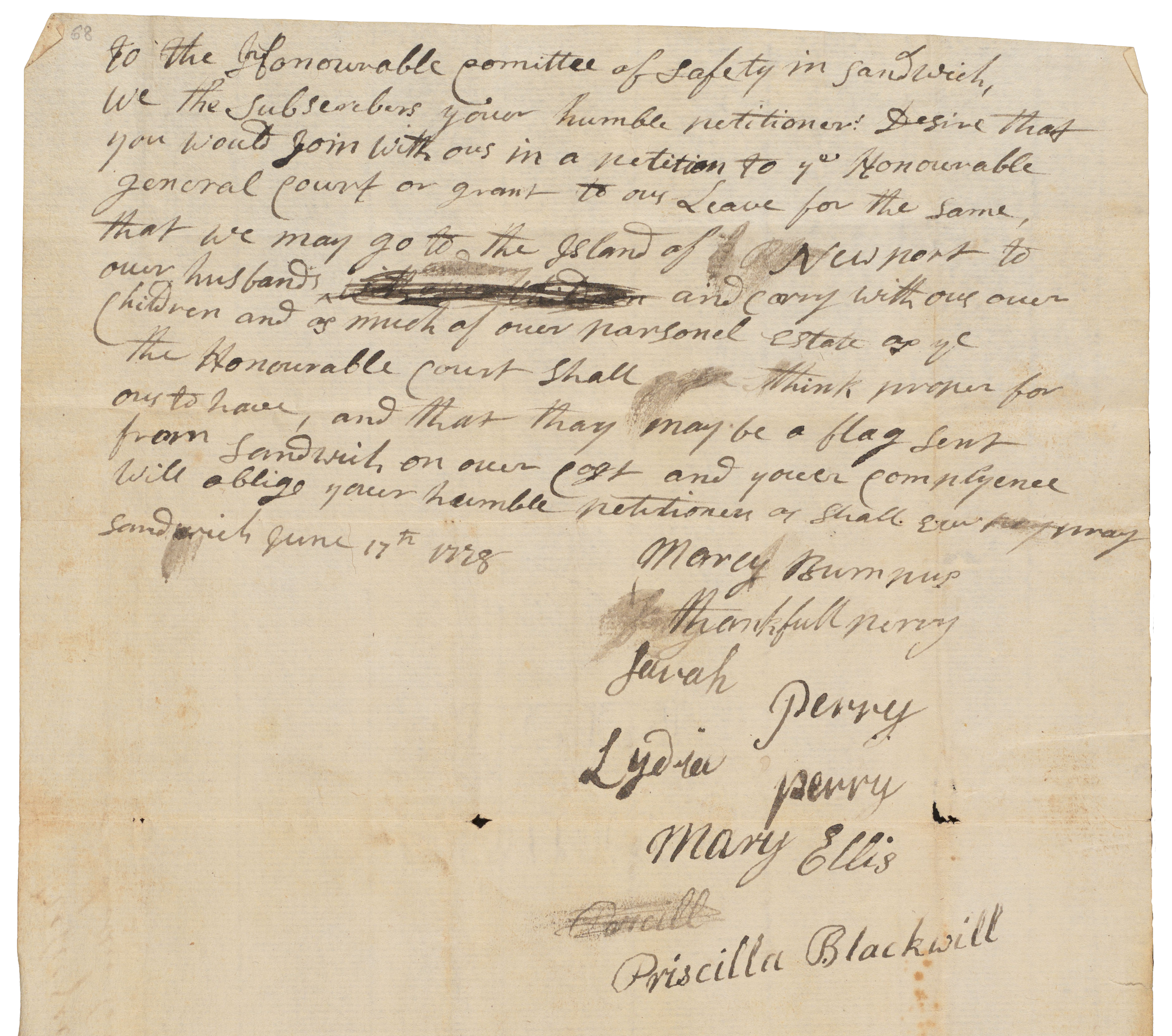
Petition of “Tory wives” of Sandwich, Massachusetts, to safely take their children and moveable property and join their husbands in Rhode Island.
For Seth Perry, his failure to declare allegiance to the rebellious State of Massachusetts resulted in imprisonment, the discovery of his tenuous connection to a loose plot or conspiracy to spread counterfeit currency, his escape from prison, flight to Newport, and the relocation of his family to Canada. Unlike their other family members, Seth and Lydia and their children Nathan and Anne were ultimately able to return home. They declared their allegiance and gained U.S. citizenship in 1788.