

THE HEAVENS
No. 61 (Spring/Summer 2025)
Table of Contents
Cosmography
Mary Pedley
Assistant Curator of Maps
The cosmos, from the Greek word κοσμοσ, incorporates the universe of earth and the heavens. The study of the cosmos is cosmology; the depiction of the cosmos is cosmography. Illustrating the cosmos has been a human pursuit since the advent of writing. A graphic depiction aids understanding of the movement of stars and what were later understood as planets across the sky, and helps trace the path of the sun’s rise and fall each day, as well as the appearance of the moon in all its phases. The heavenly bodies were more than celestial phenomena. Their movements were timekeepers and season markers, augurs of good fortune, heralds of ill. Cosmological maps show the relationship of earth and sky. They attempt to answer the big question: Where are we in the universe? To depict the answer, much depends on the description of the universe.
It is perhaps surprising that the Clements Library has any cosmographies at all, since they bear little ostensible relationship to the history of North America or the history of the United States. But since “discovery and exploration” provided the impetus for the encounter between the Europeans and the inhabitants of North America, it was also a theme that William Clements pursued. The basic notions of cosmology informed a sense of time and an understanding of place for both Europeans and Native Americans. Some of the rarest and most important books of the European Renaissance and the first century of printing were cosmographies, especially the work of the German scholar and professor of mathematics Peter Apian (1495–1552), whose Cosmographicus Liber (Landshut, Germany, 1524) was an influential guide to making maps and locating places, using the grid of latitude and longitude.
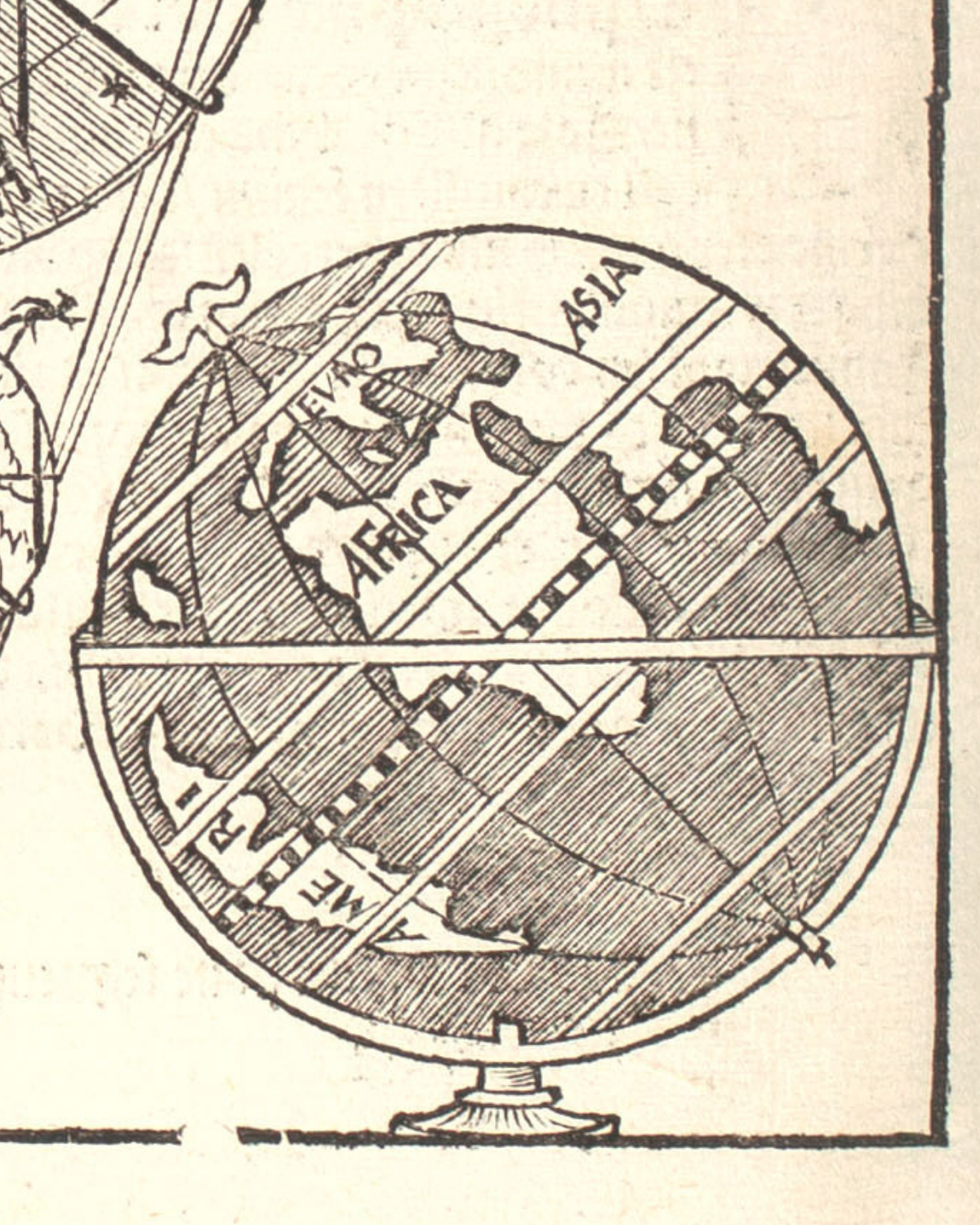
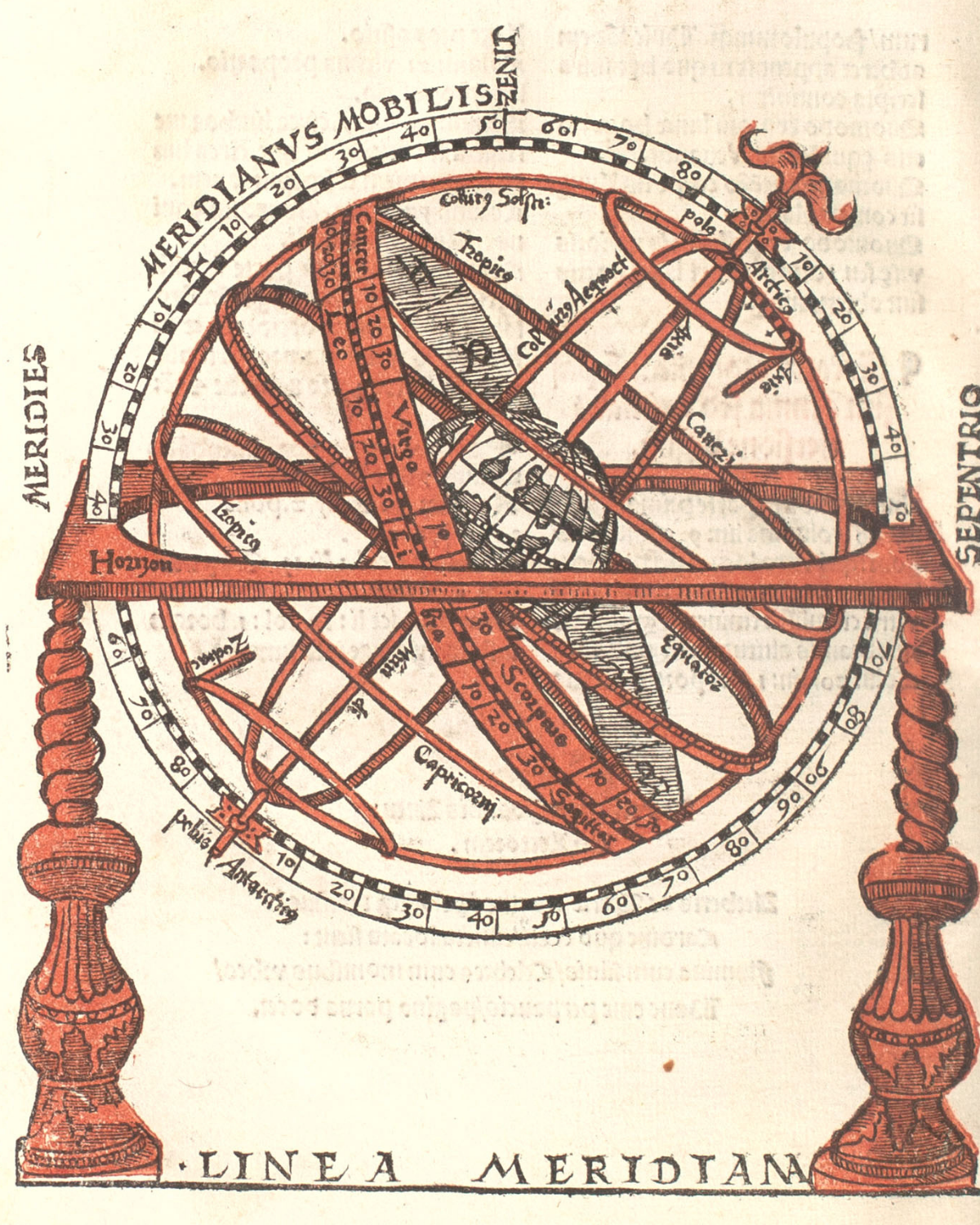
Globes and armillary spheres show the relationship between earth and sky. The appearance and naming of the continent “America” on the globe on the left [detail] made this work important for Mr. Clements to acquire. From Peter Apian, Cosmographicus Liber [Cosmographical Book], (Landshut, Germany, 1524).
Almost all cosmography understands the earth to be a sphere; the heavens too are often understood as a sphere or a domed shape surrounding the earth. Thus many cosmological maps are circular or represented by a globe or a globe within a globe, combined into one instrument known as an armillary sphere. The two previous images from Peter Apian’s work illustrate the concept.
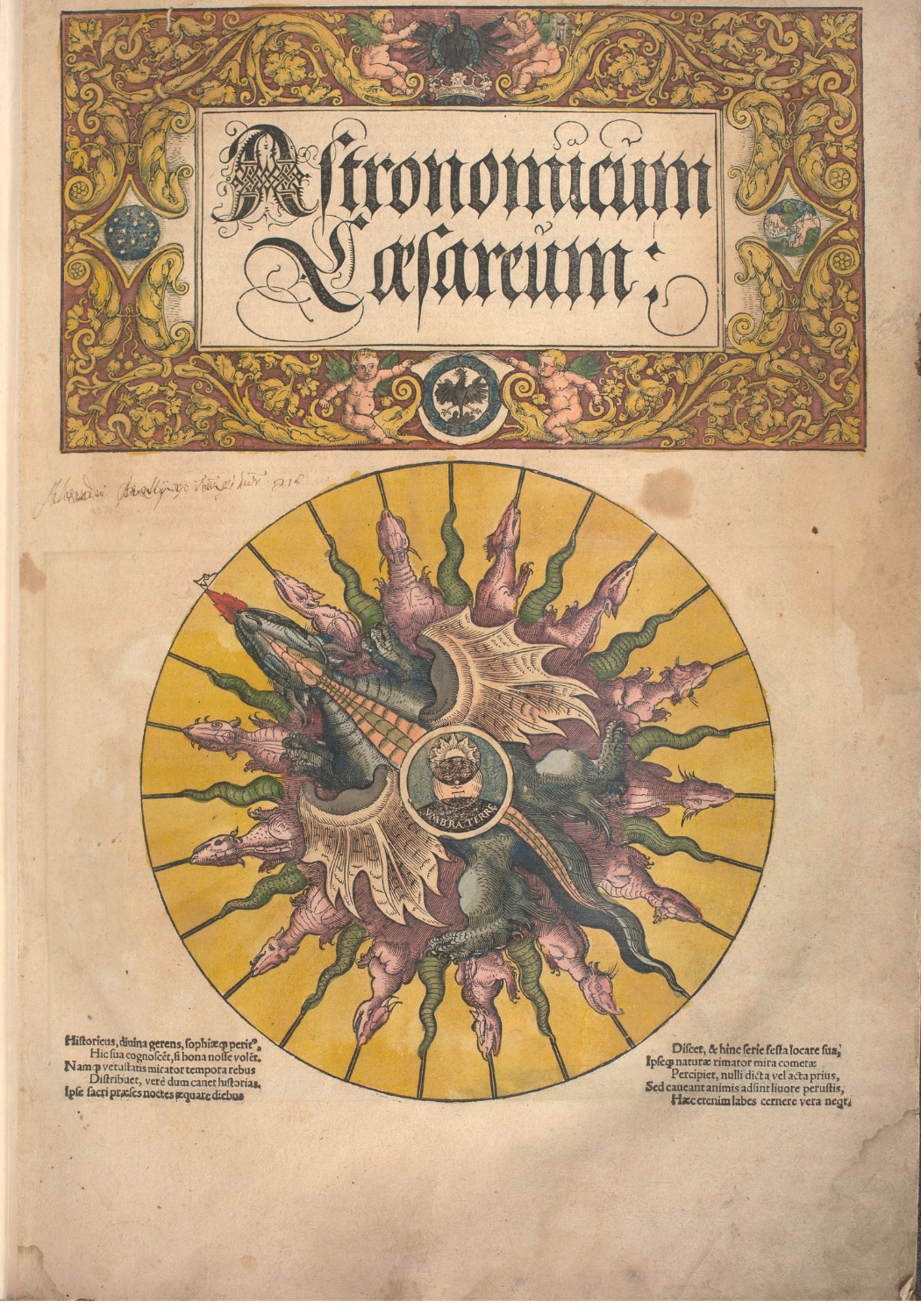
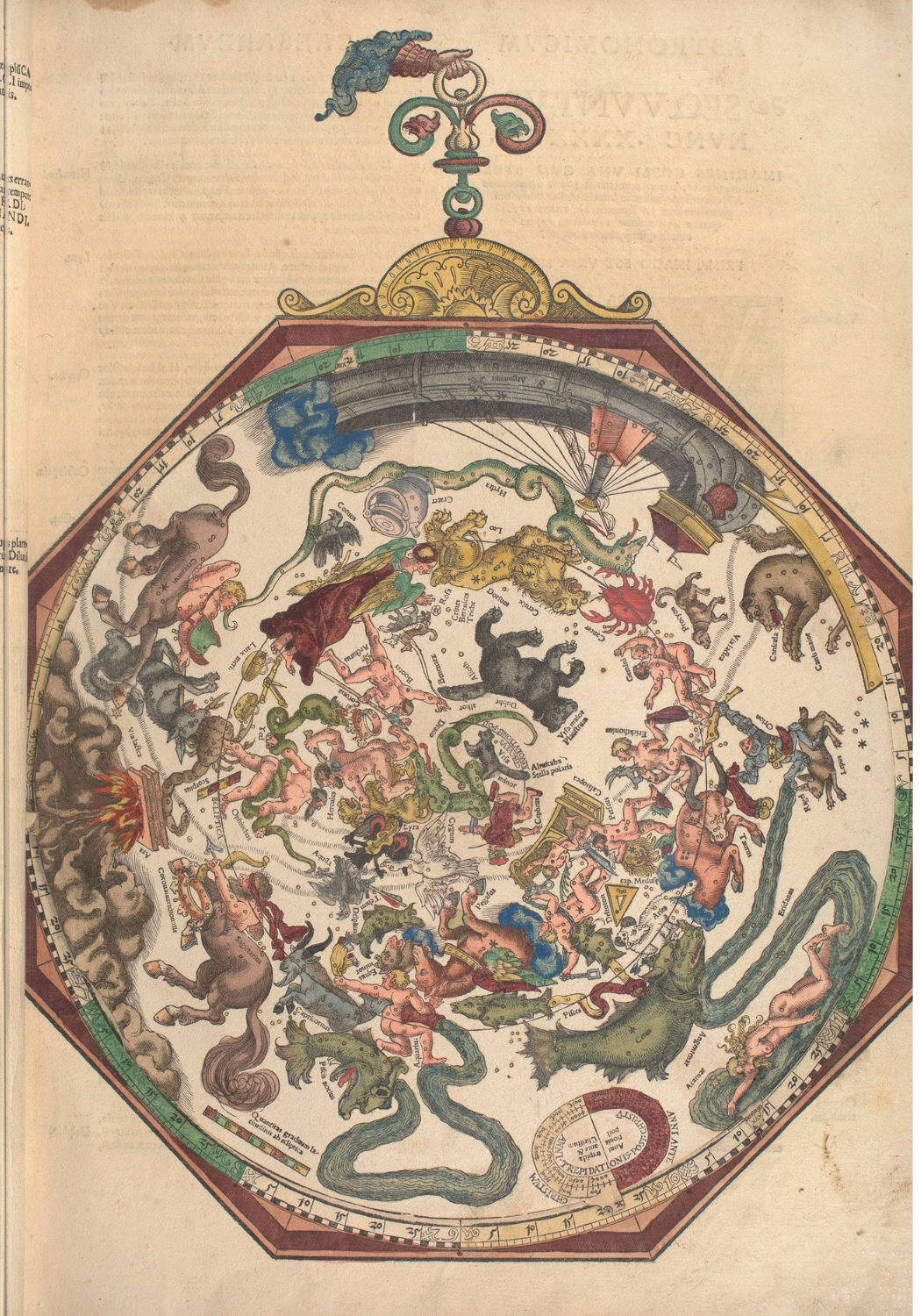
Peter Apian, Astronomicum Caesareum, 1540, title page and one of the star charts inside. The dragon pointer on the circular schema of the title page represents the motus capitis draconis (movement of the head of the dragon), that is, the astronomical arc on the ecliptic that reflects the ascending and descending nodes of the lunar cycle.
Cosmography not only needed to illustrate the basic concepts but also name the parts of the heavens whose movements were most important — the sun and the moon and their eclipses — followed by stars whose relationships with each other remained fixed while their arrangement, or constellation, seemed to move in a predictable pattern across the night sky. These groups are the constellations of the zodiac. The individual stars and the stellar arrangements acquired their own names, in the European West taken from Greco-Roman mythology and/or from the Arabic-speaking scholars and observers of the Mediterranean East.
Apian made the study of stars and other celestial objects the subject of his sumptuous work, the Astronomicum Caesareum of 1540, dedicated to the Holy Roman Emperor Charles V and to his brother Ferdinand I of Spain.
Included in this work were various volvelles, round mobile instruments that could be manipulated to predict lunar and solar eclipses, the rotation of the zodiac throughout the year, the movement of the planets across the heavens, and the precise location of various heavenly bodies on particular days. This helped meet a need for prediction, regularity, and constancy, and ensured some stability in the national and religious calendars. Uniformity and agreement were required for the measurement of time, the determination of specific liturgical and administrative dates, special events in calendars, and even the time of day (something we continue to debate in our views on daylight saving time). Several good YouTube videos demonstrate the use of these volvelles if the reader searches for “Astronomicum Caesareum.”
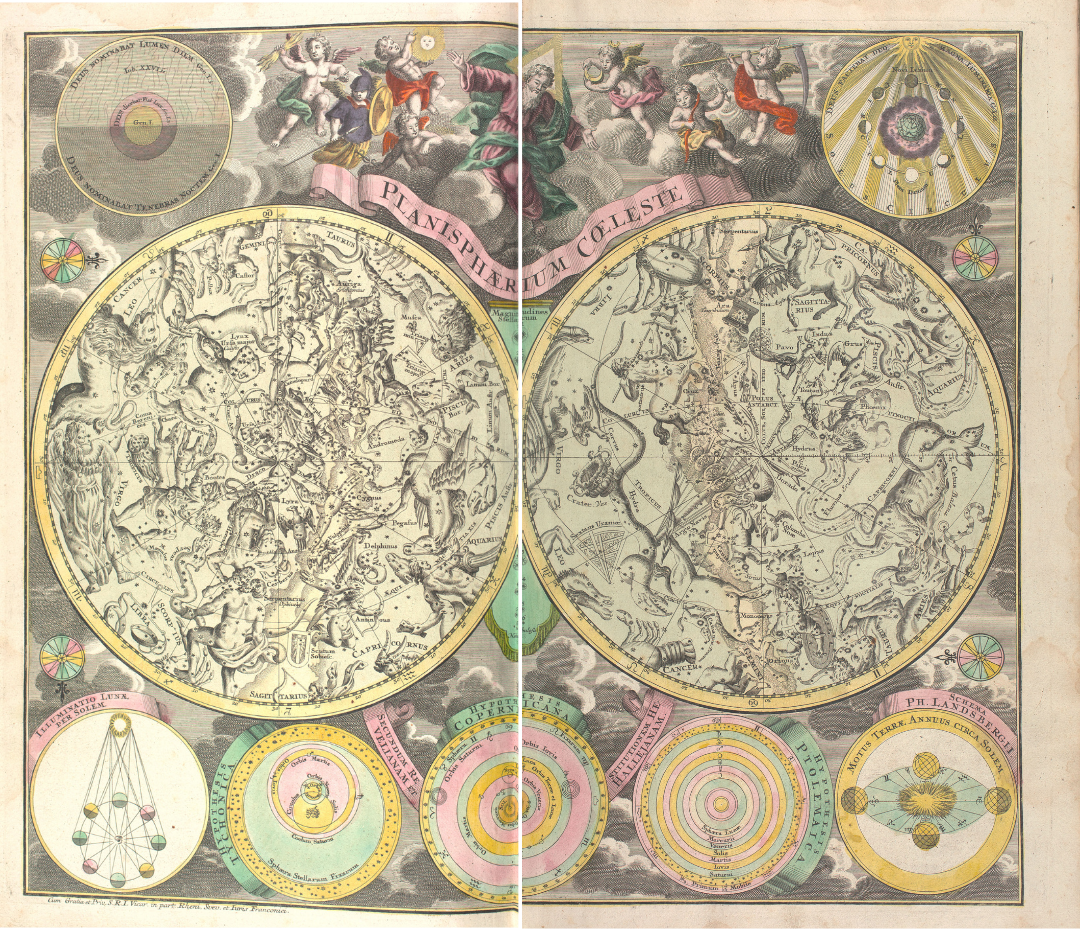
In “Planisphaerium Coeleste,” night and day occupy the upper left and right corners, mythological putti adorned with the attributes of particular gods hold the upper center, and comparative systems of the universe align along the bottom. The two hemispheres show the night sky in the northern (left) and the southern (right) hemispheres. From Atlas Novus Terrarum Orbis . . . by Johann Baptist Homann (Noribergae, [1702–1750]).
The second way the Clements Library collects cosmography is through atlases. These gatherings of maps into one volume are so named because Atlas, the Titan of Greek mythology, was supposed to hold up the heavens on his shoulders. His image often graces the frontispiece or title page of an atlas, as with the following title page for a composite atlas of German maps from the early 18th century. Inside the atlas, particularly in the productions of the 17th and 18th centuries, often a world map titled a Planisphere appeared, surrounded by cosmographical elements such as star charts, depictions of the sun and moon, and various models of the universe, as yet unsettled. An earth-centered solar system, as postulated by the Greek astronomer and geographer Claudius Ptolemy, was gradually being eclipsed (no pun intended) by the Copernican system with the sun at the center. Other theories had some traction too, such as the complex geo-heliocentric system of the Danish astronomer Tycho Brahe, which incorporated rotating spheres circulating around both the sun and Earth.
Cosmography and cosmology covered most of the subjects that developed by the 19th century into the disciplines of physics and astronomy. The invention and expanded use of the telescope and the increased number of observatories added to the number of planets that could be observed and recorded, and the codification of star names and constellations continued. Nonetheless, certain patterns continued unchanged from the Renaissance, including the depiction of the constellations, as shown on this issue’s cover from an atlas of astronomy by Elijah Burritt.
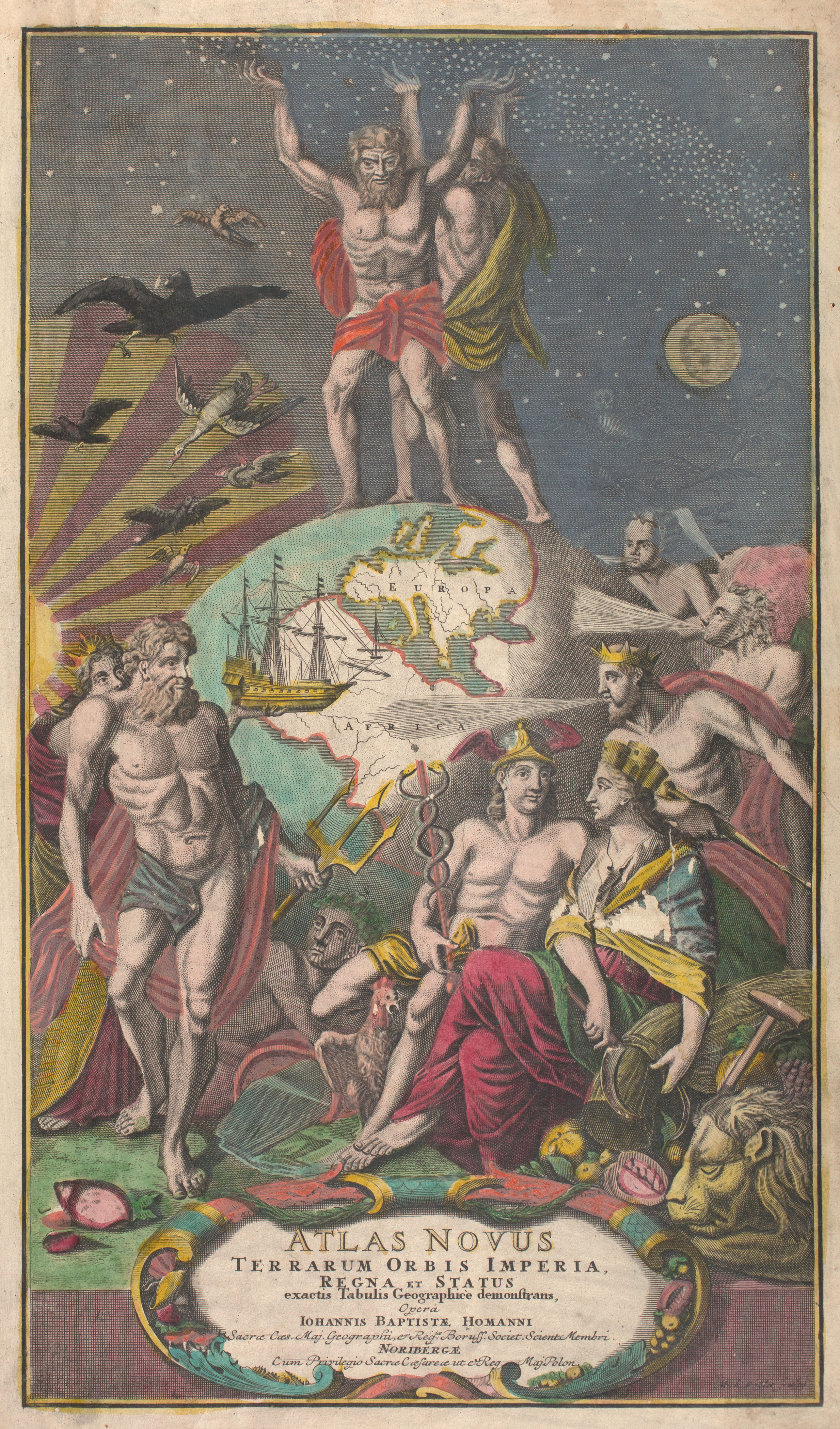
Atlas holding up the heavens, with night and the moon to the right, daylight to the left, and a host of gods: Neptune with his trident, Mercury with caduceus and winged helmet, crowned Jupiter with scepter, the wind gods, and Ceres seated with the bounty of her harvest. Title page, Atlas Novus Terrarum Orbis . . . by Johann Baptist Homann (Noribergae, [1702–1750]).
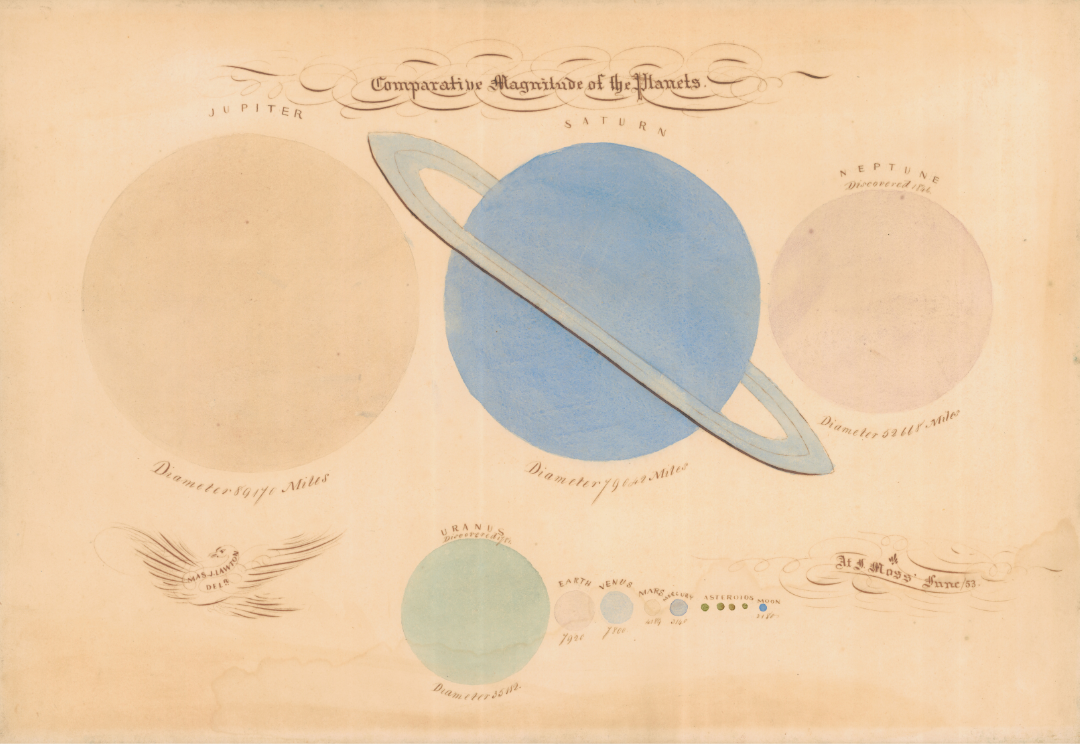
Lawton, “Comparative Magnitude of the Planets,” June 1853. Pen and ink and watercolor on heavy card stock. Probably copied from James Reynolds’ 1846 map of the same name.
With new technologies aiding observation, and with closer examination of the heavens by amateurs and professionals alike, new questions had arisen about the study of the planets, their movements, their sizes, their composition. A recent acquisition demonstrates the fascination of such comparisons for the young student J. Lawton, whose “Comparative Magnitudes of the Planets,” drawn in June 1853, includes the recently discovered Neptune, even larger than Uranus.