

THE HEAVENS
No. 61 (Spring/Summer 2025)
Table of Contents
Life on the Moon in Two Acts
Sierra Laddusaw
Curator of Maps & Graphics
Modern believers of a moon hoax argue that the United States did not put astronauts on the moon in 1969 and base this conviction on the images captured during the moon landing; the positions of shadows, lack of stars, and an apparently “waving” American flag are used to argue that the moon landing was faked. But almost 140 years before the moon landing, there was another moon hoax. Known now as “The Great Moon Hoax,” the sensational story of discovering life on the moon was serialized in the New York-based penny newspaper The Sun.
The first story in a series of six appeared on the front page of The Sun on August 25, 1835, and laid the groundwork for the hoax. The story described John Herschel’s newly built telescope, reported to be much larger than other telescopes in use at the time and incorporating a new lens that could magnify and project the image of distant objects onto a canvas screen. In this first entry, readers also learned of the author, Dr. Andrew Grant, who was supposedly traveling and researching alongside Herschel. To lend an additional air of legitimacy, the article claimed that a more scientific account of the discoveries had been submitted to the British Royal Society and appeared in the Edinburgh Journal of Science.
Wednesday, August 26, brought the second story in the series and included an account of the discovery of life on the moon. The astronomers saw rock formations covered in dark red flowers, vast forests, and vegetation-covered plains. Herschel’s special magnifying lens spotted brown quadrupeds likened to bison, blue goat-sized creatures with a single horn, grey pelicans, black cranes, and amphibious animals. The third story brought more reports of animal and plant life: thirty-eight species of trees, more than seventy different plants, nine mammal species, and five kinds of birds. Some life forms displayed signs of significant advancements — a type of beaver was observed walking upright and making homes in huts that were heated by fire.

Richard Adams Locke, the man behind the “Great Moon Hoax” of 1835, was born and educated in England before relocating to New York City. Reactions to Locke’s ruse ranged from amusement by Horace Greeley, who encouraged readers to purchase the pamphlet, to outrage by Edgar Allen Poe, who was briefly convinced that Locke had plagiarized from his short story, “The Unparalleled Adventure of One Hans Pfaall.”
The astronomers saw rock formations covered in dark red flowers, vast forests, and vegetation-covered plains. Herschel’s special magnifying lens spotted brown quadrupeds likened to bison, blue goat-sized creatures with a single horn, grey pelicans, black cranes, and amphibious animals.
On day four, August 28, The Sun broke the news of a humanoid species living on the moon. Named Vespertilio-homo (bat-men) by the astronomers, these human-like creatures reportedly walked erect when on the ground but could also fly through the air using large bat-like wings. The report described them as standing four feet tall on average, with yellow-toned faces and prominent mouths, and covered in copper hair. The fourth article also included editorial commentary noting that certain facts concerning the bat-men were left out of the newspaper’s story; the editor claimed they would be included in a forthcoming publication from Herschel himself that would be supported by commentary from authoritative figures in government, science, and religion vouching for the credibility of the discovery.
The final stories shared the discovery of a large temple built of blue stone and additional details of Vespertilio-homo. The series came to an end with a report of tragedy striking Herschel’s observatory. Due to improper storage, the telescope’s lens had refracted the light of the sun and started a fire! The fire destroyed a wall of the observatory, but luckily the special magnifying lens survived. However, after repairs to the observatory were completed, the moon was no longer in position to be viewed, ending Herschel and his team’s lunar observations.
The Sun’s reporting of Herschel’s lunar discoveries was a sensation. Other newspapers reprinted the story and The Sun claimed an increase in circulation. It wasn’t until September 16, 1835, that the story was revealed to be untrue. Later a reporter for The Sun, Richard Adams Locke (1800–1871), claimed authorship, stating that he wrote the series as satire and never thought the public would believe it to be real. In 1859, Locke republished the six newspaper articles in a single volume, The Moon Hoax, or, The Discovery that the Moon has a Vast Population of Human Beings (New York, 1859). The added introduction expounded on the power of human imagination and placed Locke’s moon hoax in the same category as Thomas More’s Utopia, Jonathan Swift’s Gulliver’s Travels, and Daniel Defoe’s Robinson Crusoe. “It appears to be as natural for the human mind to be craving after the wonderful, the mysterious, the marvellous, and the new discoveries, as it is for the physical appetite to desire food, drink, and sleep, and thereby as it were constantly attempting to lift up the veil that hides incomprehensibilities from our vision.”
Both Herschel and his wife, Margaret, had opinions on the false story purporting to describe discoveries by him. In 1836, Margaret commented on the hoax in a letter to Herschel’s aunt: “Have you seen a very clever piece of imagination in an American Newspaper, giving an account of Herschel’s voyage to the Cape with an instrument [omitted] feet in length, & of his wonderful lunar discoveries. Birds, beasts & fishes of strange shape, landscapes of every colouring, extraordinary scenes of lunar vegetation, & groupes of the reasonable inhabitants of the Moon with wings at the backs, all pass in review before his & his companion’s astonished gaze — The whole description is so well clenched with minute details of workmanship & names of individuals boldly referred to, that the New Yorkists were not to be blamed for actually believing it as they did for forty eight hours — It is only a great pity that it is not true.” Herschel complained of the hoax in the postscript of an 1837 letter to his aunt: “I have been pestered from all quarters with that ridiculous hoax about the moon — in English French Italian and German!” (Herschel at the Cape, by D.S. Evans, et al. Austin, 1969).
While the stories in The Sun were indeed a hoax, at the Clements Library you can read evidence of the actual 1969 moon landing. The Manuscripts Division holds a copy of the transcription of the commentary among Buzz Aldrin, Neil Armstrong, Michael Collins, and NASA Mission Control that was provided to reporters shortly after the moon landing. An attentive reader of the transcript will note the Clements Library copy lacks the addition of the letter “a” to Armstrong’s famous quote — “That’s one small step for [a] man, one giant leap for mankind.” The addition of the letter “a” was requested by Armstrong himself, appears in later copies of the transcript, and is considered by NASA to be the official version of the quote. Armstrong stated that even though “a man” can’t be heard in the recording, it is what he said or at least was what he intended to say. Also lacking in the transcription are any reports of bat-men or other life forms on the moon.
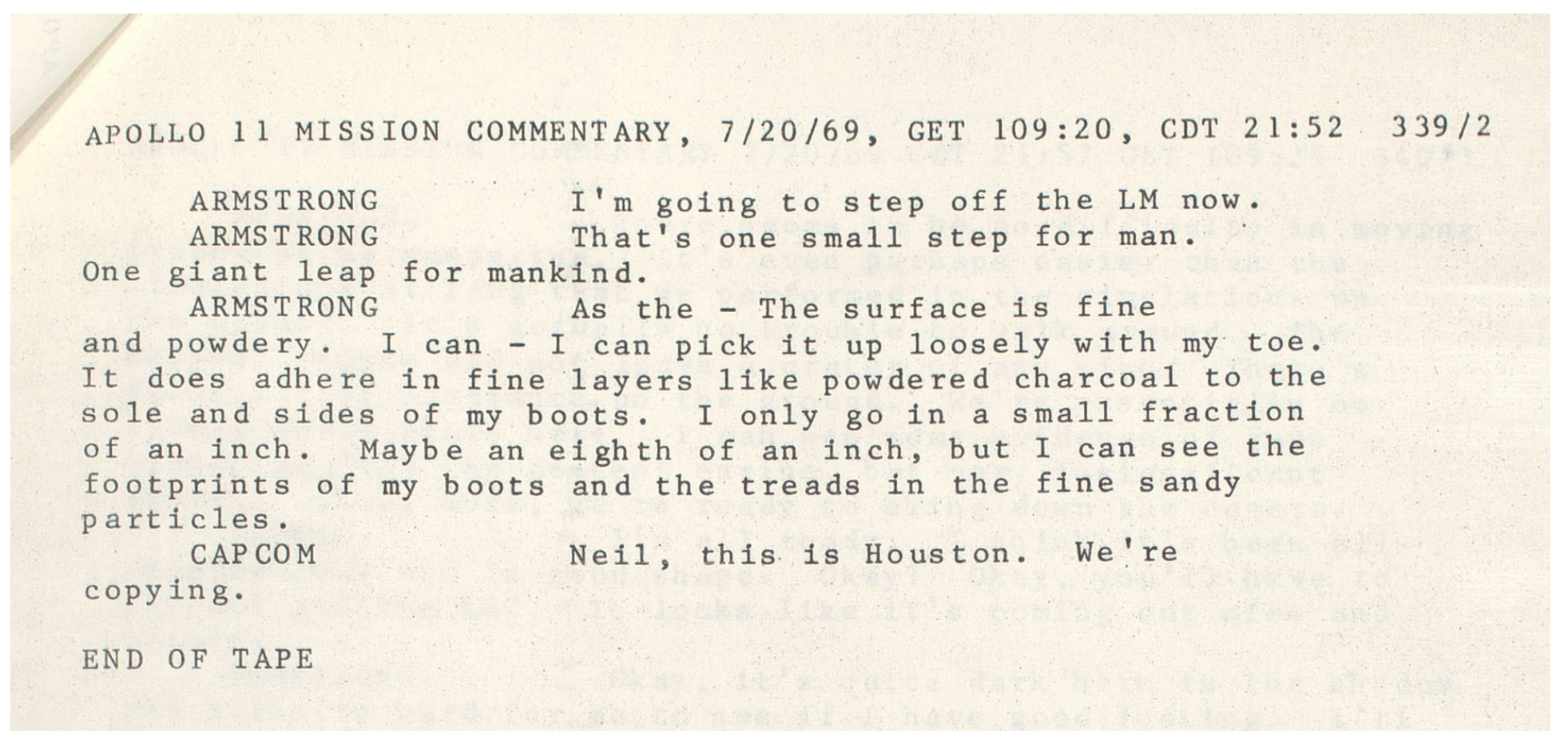
Although unlikely to persuade any of the moon hoax adherents, reading the typescript evokes a powerful and exceptional moment in human history.