

THE HEAVENS
No. 61 (Spring/Summer 2025)
Table of Contents
Empire of Spirits
Jayne Ptolemy
Associate Curator of Manuscripts
Mid-19th-century America was a confusing time to contemplate life after death. Through their well-publicized communication with spirits who rapped on the walls of their home in western New York, Margaret and Catherine Fox had popularized the idea of spiritualism and the ability of gifted individuals to serve as mediums between the living and the dead. At the same time, however, scientific inquiry and technological advances made it easier than ever for skeptics to try to debunk any such encounters. The widely distributed periodical Scientific American ran numerous articles explaining just how spirit photographs were captured, how slates were manipulated to create spirit writings, and how mechanical devices might produce spirit rappings. “We live in a profoundly civilized age,” one article from September 1854 begins, “knowledge is increased, and the lights of science and philosophy are shed around the footsteps of high and low in all places. Yet with all our claims to superior enlightenment, that faculty of man and woman, curiosity, is made the subject of as gross deception now, as it was when kings kept astrologers and soothsayers to direct them when to go up to battle, to make new laws, and to read their dreams.” The stars, the heavens, the great realm of the unknown had long inspired both wonder and innovative ways to try and interpret life’s meaning. The combination of deeply held spiritual beliefs, expanding scientific knowledge, and genuine curiosity and hope made for a charged environment for Americans to grapple with questions of the heavens and afterlife.

Americans’ interest in angels and the heavens was widespread, even in musical culture like this illustrated sheet music for The Love Star Schottisch (Boston, 1853).
Henry Murfey, a bank clerk from Cleveland, Ohio, knew this all too well. He was only three years old when his baby sister Mary died in 1831. In an era when infant and child mortality was high, the loss of a young family member may have been common enough but it was still a devastating trauma that people carried throughout their lives. While Henry likely held no active memories of his sister, in 1856 he received messages from her through a medium, 25 years after her death. He recorded them in a letterbook now held at the Clements Library. Mary’s spirit recounted her final moments, being welcomed into the afterlife by an angel, and watching her family mourn her. “[I]t pained me to see those dear ones shed tears — But I was comforted by my kind guardian who told me I should some day speak to those friends.” The belief in a continued existence and the potential of future contact with loved ones was surely a consolation to those left grieving.
The combination of deeply held spiritual beliefs, expanding scientific knowledge, and genuine curiosity and hope made for a charged environment for Americans to grapple with questions of the heavens and afterlife.
But Mary’s messages went beyond merely affirming that the human spirit continued after death, also touching on where they continued. Her messages described a vibrant community of spirits with cities, temples, and places of learning. “I found that home was not in a house like yours but the heavens themselves were a vast tabernacle where we could enjoy each others society, and join in the blessings given us by our good Father.” Not only did the spirits dwell in the heavens, but they hailed from various heavenly bodies. Mary’s guide explained that “spirits from every planet sought that place being called the studio of developed minds” and invited her to visit them. “O, how pleased was I when I saw that he was so kind and that I could visit those planets that I admired looking at when on earth.” She and her guide went on a trip to Saturn, where instead of the “green grass and flowers & trees & s[h]rubs like Earth,” the flora was “all transparent and can be looked through.” The inhabitants were “very small and beautifull. Wearing no raiment but as nature made them perfectly pure and without stain they converse with each other panterminically, or by signs and their food is the transparent fruit that grows on dwarfish trees very small and so perfect that scarcely a bend or knot can be formed on any limb.” Mary’s message depicted a beautiful life in the heavens that spirits could move through freely.

19th-century Americans confronted the devastating losses of infant mortality in many ways, including with artistic reimaginings as in Birdie in Heaven (Philadelphia, 1868).
While these fantastical descriptions are attention-grabbing, it is notable that they included scientific concepts. “We can travel at a rapid rate,” she asserted, “all most as fast as thought. We have not eyes like thine for our spirits are visions of themselves[.] our good is the attraction that we have towards all those particles that compose our spiritual bod[ies].” The visit to Saturn was not just a narrative flourish — it also referenced ideas of how interplanetary travel and existence could be physically possible. Mary’s spirit relayed the challenges of trying to pass through the “density of the outer Stratas of atmospheric air” surrounding Saturn, indicating this trip was happening in actual space and that her audience would have questions about how the spirits confronted practical environmental issues. The unfathomable spiritual elements combined with scientific ones, both of which would have appealed deeply to 19th-century Americans steeped in a culture that valued both. The heavens, after all, were both a spiritual destination and a site of scientific inquiry. Henry Murfey’s recording of the messages from his “Angel Sister” show us how the two could come together.
Published accounts of spiritual interplanetary travel echoed this meshing of world views. Journeys into the Moon, Several Planets and the Sun (Philadelphia, 1837) provided a translated account of the German medium Pauline Dorathea Beuerly, whose spirit while in a “periodical state of Somnambulism” was able to rise “from the Earth into higher regions, and was enabled to see things, which remain concealed to the terrestrial eye . . . from the hitherto unknown empire of spirits in those worlds, that glisten on the firmament.” Beuerly recounted voyages to the moon, Mercury, Venus, Jupiter, dwarf planet Ceres, Saturn, Uranus, and the Sun. In addition to describing the climate, built environment, and spiritual residents of these places, Beuerly at times also referenced elements of the astronomical understandings of the day. Of the moon, she noted it was “the nearest body to our Earth” and affirmed it was “nearly forty times smaller than the Earth we inhabit.” The sun she described as an “uncommonly large body,” and that “We inhabitants of the earth believe the sun to be a real ball of fire, which he by no means is. The sun does not move, and beyond the sun are still millions, nay an uncountable number of stars, which are always visible; in one of them is the city of God, but this is also a sun.” Accounts of interplanetary spiritual travel reverberated with both religious and scientific belief, entwining and reinforcing each other.
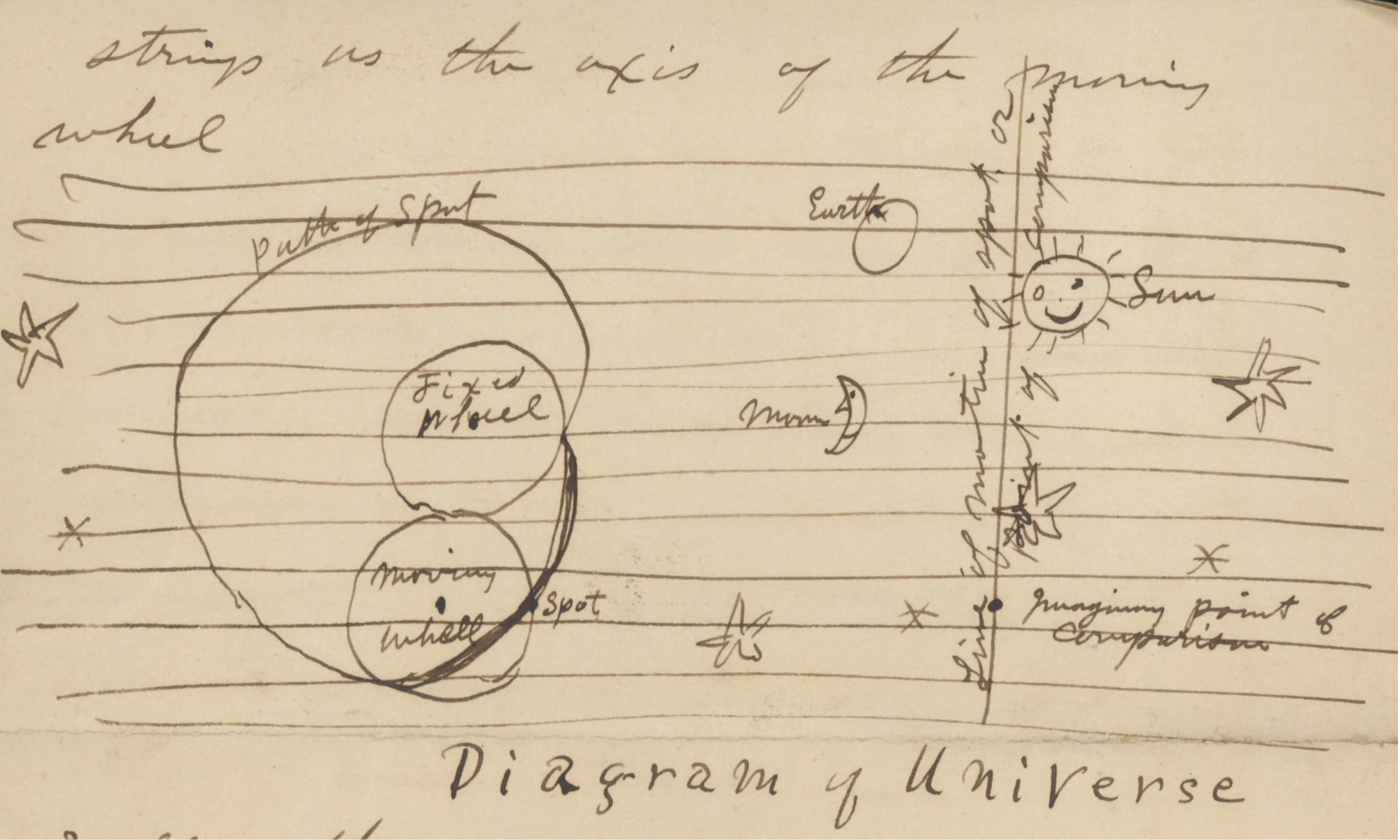
This “Diagram of [the] Universe” in the Brownell Family Papers was likely drawn by Ned Brownell in the 1850s, showing how Americans engaged with astronomical science in their daily lives.
In the messages relayed from Mary’s spirit to her brother, she provided several pieces of advice, including a suggestion of how he might respond to people inquiring “who are your associates or what is your belief.” “Tell them that Angels can and that they do communicate with Earth’s Inhabitants, and that all can hold intercourse with heaven. These interesting messages are not given to excite the marvellous or to clash with man’s inner feelings — They are given to enable the doub[t]ing mind to look forward with joy to the happy time of laying down on the bed of Death.”
Henry did not record his reactions to these messages, but we know he felt compelled to communicate with his sister even 25 years after her death. Wondering over the unknown possibilities of the heavens was reason enough.