THE HEAVENS
No. 61 (Spring/Summer 2025)
Table of Contents
A Miscellany: Signs of the Zodiac and the Planets
Cheney J. Schopieray
Curator of Manuscripts
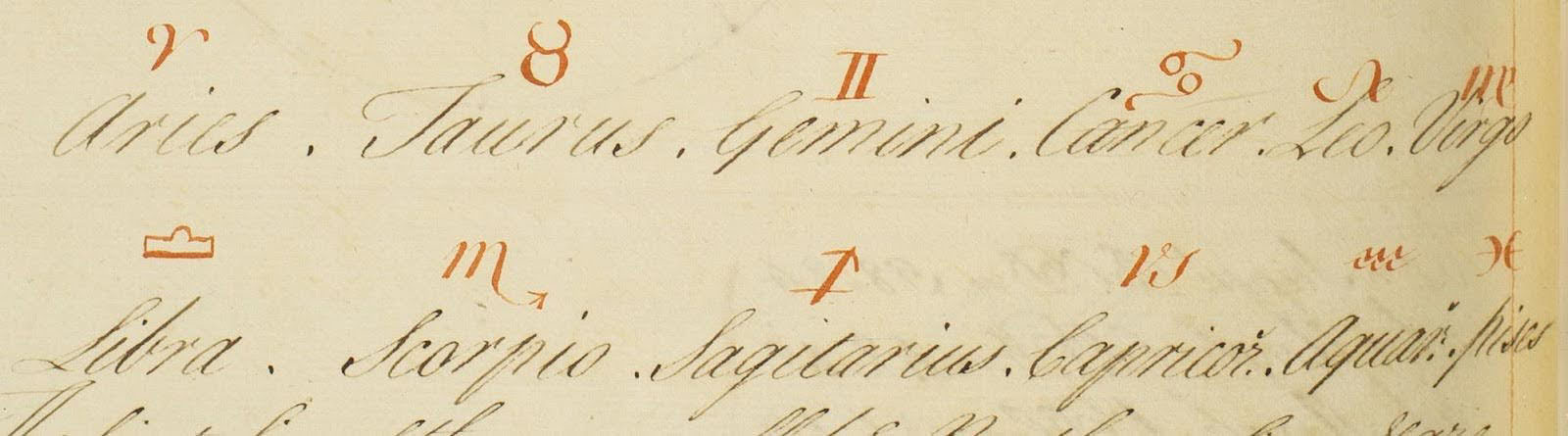
The anonymous author of “Practical Mathematics” included a list of the signs of the zodiac along with their Greek symbols as part of extensive definitions and problem sets relating to algebra, geometry, trigonometry, navigation, and surveying.
The University of Michigan’s collecting units, taken together, cover a broad sweep of human history, from ancient Babylonia and Greece to contemporary art and politics. There are few constants that persist across such a span of time and space, but there is at least one: a continuing belief in the influence of heavenly bodies on earthly matters. For millennia, people have recorded what they observed in the sky in order to lend meaning to what they experienced on the ground. A constant tension throughout this body of writing is between the accumulation of specialized knowledge and the desire to apply that expertise in accessible ways.
To take one example: “The Ecliptic, is a great Circle intersecting ye: Equator in two opposite points & making an Angle with it equal to ye: Suns greater Declination, (which is 23°..29°) & is that circle which ye: Sun is supposed to describe by his Annual Motion round the Earth, this Circle is usually divided into 12 equal parts call’d Signs, each Sign containing 30°..00°; begining from the intersection of the Equinoctial, & number’d as follows . . . .”
The above definition of “the ecliptic” is taken from a mid18th-century manuscript titled “Practical Mathematics” in the Duane Norman Diedrich Collection at the Clements Library. Does it seem opaque to the casual reader? Be not afraid! It merely offers a concise description of a set of celestial “signs” (i.e. constellations marking a portion of the sky) that travel along the path of the sun and seem to rise and fall over the course of a 12-month year. The sections of the ecliptic where each of these signs appear are what English speakers call the zodiac (from the ancient Greek ὁ τῶν ζῳδίων κύκλος, literally “circle of little animals”).
To help visualize the ecliptic, try to imagine a line beginning at the sun, passing through the Earth, and extending indefinitely out into space. As the Earth travels 360° around the sun, that line creates an imaginary flat plane. The swath of sky 8–9° above and below that plane is the ecliptic, where particular constellations appear. On the surface of the Earth, we look up at the seemingly fixed stars overhead, and the constellations of the ecliptic slowly change over the course of the year. From the 2nd century BCE, Babylonian astronomers interpreted the night sky by dividing the ecliptic into a yearly cycle of twelve parts (each covering 30° of Earth’s trip around the sun).
Claudius Ptolemy documented ancient Greek use of the same system in his Almagest (mid-2nd century CE), which established the names of the Zodiac signs that are still in daily use by horoscope-watchers nearly 1,900 years later: Aries (Ram, ♈︎), Taurus (Bull, ♉︎), Gemini (Twins, ♊︎), Cancer (Crab, ♋︎), Leo (Lion, ♌︎), Virgo (Maiden, ♍︎), Libra (Scales, ♎︎), Scorpio (Scorpion, ♏︎), Sagittarius (Archer or Centaur, ♐︎), Capricorn (Goat-Fish or Sea Goat, ♑︎), Aquarius (Water Bearer, ♒︎), and Pisces (Fish, ♓︎).
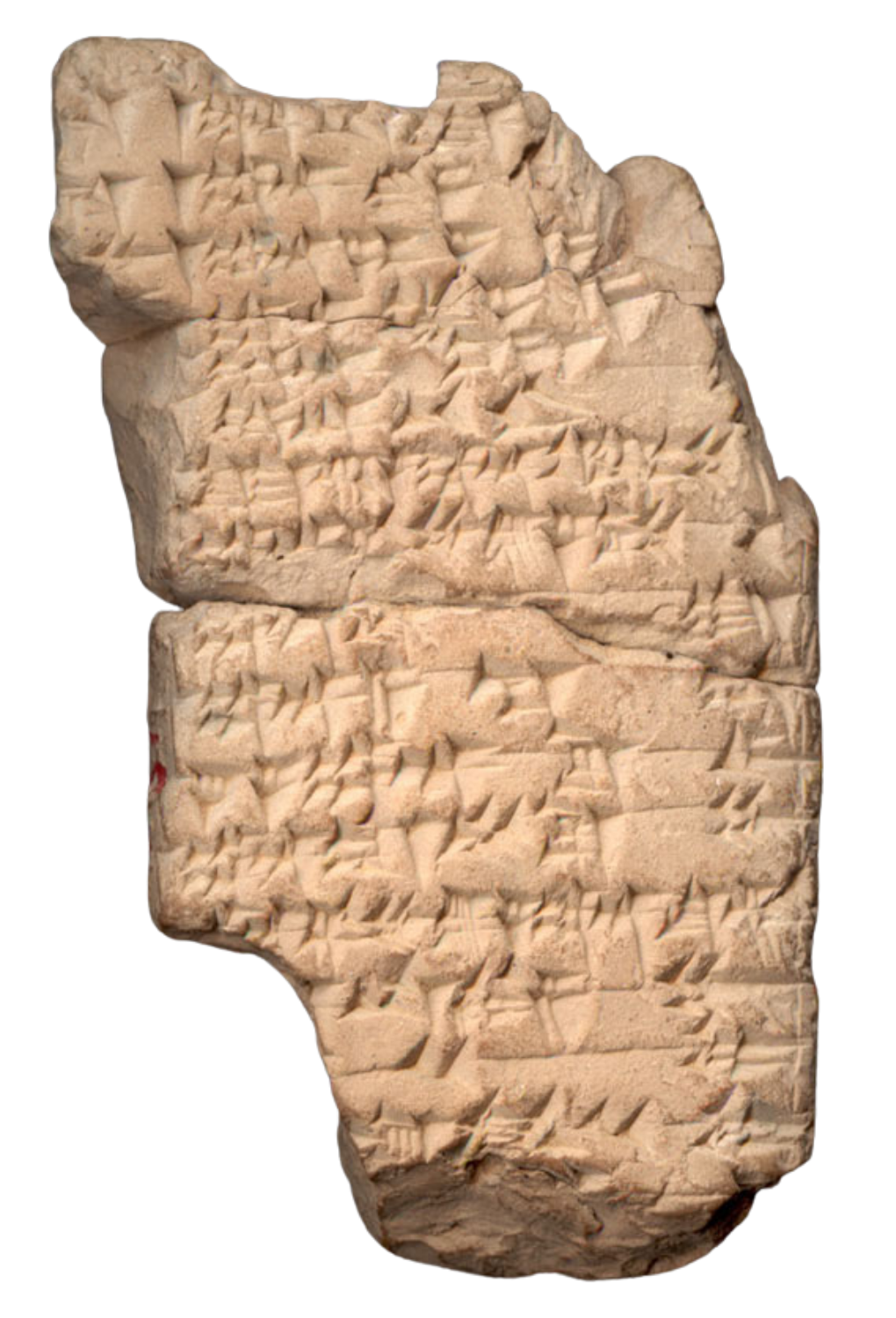
This surviving portion of a Cuneiform Tablet with Ziqpu Star List offers descriptions of stars from constellations not found in the ecliptic, including Lady of Life, the Demon with the Open Mouth, the Stag, the Old Man, and the Crook. The tablet, likely produced in Babylon and dating from the final three quarters of the first millennium BCE, is held by the Kelsey Museum of Archaeology: Kelsey Museum 89551, University of Michigan.
One of the reasons for observing and understanding the movements of the planets and the fixed stars was the persistent belief that different signs of the zodiac had particular relationships to various parts of the human body. The richly symbolic frontispiece of Ars Magna Lucis et Umbræ (Rome, 1646) by the German Jesuit priest and scientist Athanasius Kircher (1602–1680) showed a man holding a caduceus with its snakes intertwined around signs of the planets. Printed on his skin were signs of the zodiac — Gemini (twins) on his arms, Capricorn (goatfish) on his knees, and so on — to indicate correspondences between bodily ailments and the times of the year, as well as the correct times for medical treatments for those parts of the body. The Homo Signorum or Man of Signs appeared in numerous types of early American publications, notably in farmers’ almanacs of the 18th and 19th centuries. The one shown on the previous page is from Benjamin Banneker’s Almanack, accompanied by a rhyme intended to help remember the order of the signs and which body part they were believed to influence.
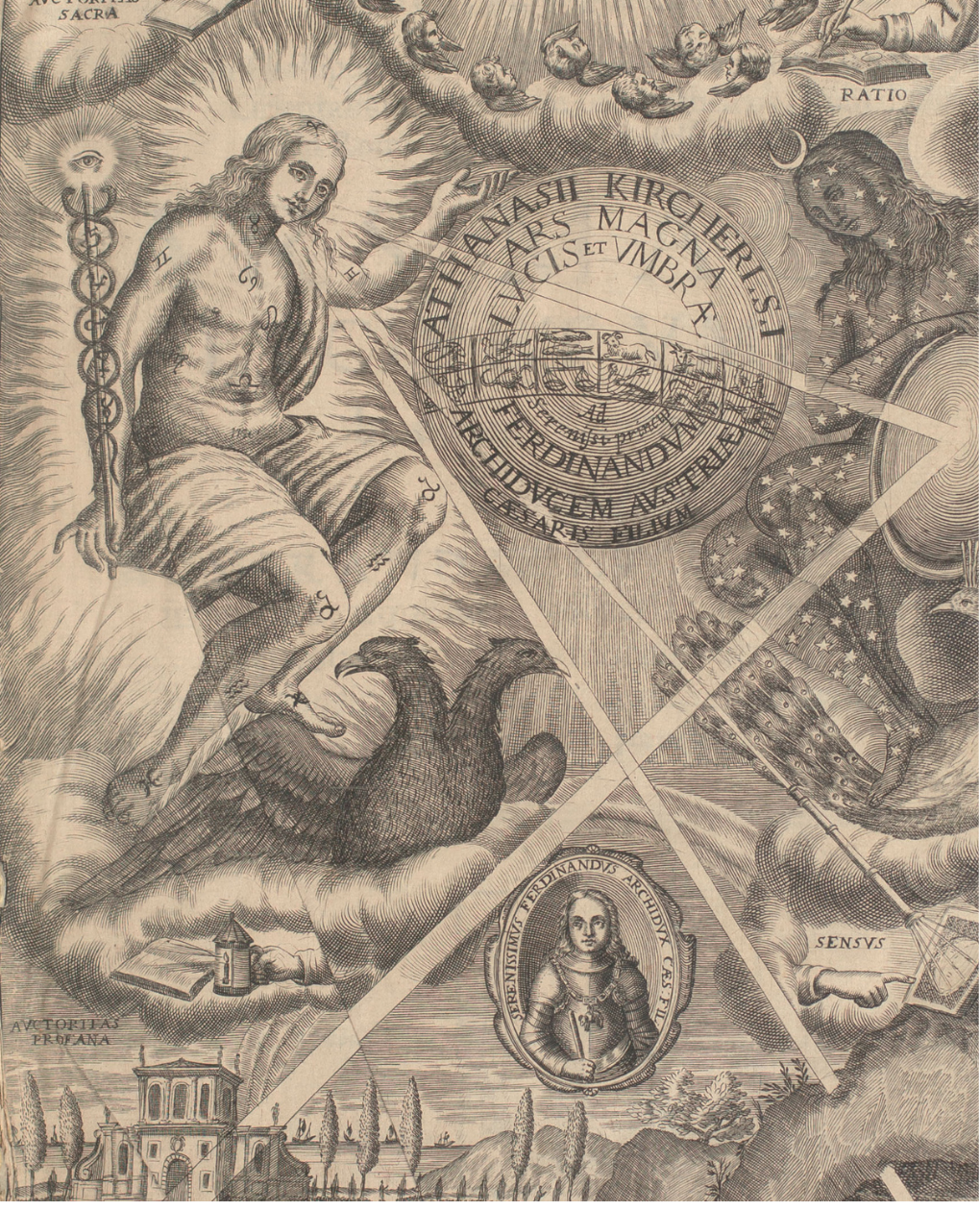
Detail from the frontispiece of Athenasius Kircher, Ars Magna Lvcis et Vmbræ (Romae: Sumptibus H. Scheus, 1646). Courtesy Special Collections Research Center (SCRC), University of Michigan.
Almanacs were among the most widely printed and consumed books of the period, and their astrological elements were part of everyday popular natural philosophy. People in early America looked to signs in the sky for literally down-to-earth reasons, seeking guidance from the stars on when to plant and harvest crops, as well as how to navigate the open sea. Celestial bodies were understood to guide the weather, which helped farmers and sailors anticipate floods and storms. Thus, a sound knowledge of how to interpret the zodiac could quite literally be the difference between feast and famine in the fields, or between life and death at sea.
By the early 18th century, clerical debates over astrological subjects had largely settled on a picture of a God who created the celestial bodies, as well as their practical uses and what influences they had on terrestrial matters. Astrology was considered a recognition of the creator’s marvelous design and not a subversive or unorthodox element in popular culture. This was, however, clearly understood to be “natural astrology,” focused on natural phenomena, and not a “judicial astrology,” which predicted social or political outcomes in human society. Judicial astronomy was uncommon enough that Protestant clergy were more often upset over the nude depiction of Men/Women of signs than the astrological content itself.
Human explorations of the causes, effects, and influences of celestial bodies on earthly affairs were also incorporated into different threads of religio-philosophical-mysticaltechnical traditions described together as Hermeticism. Hermetic beliefs were remarkably widespread in early America, appearing in sources created even in the northeastern backwoods.
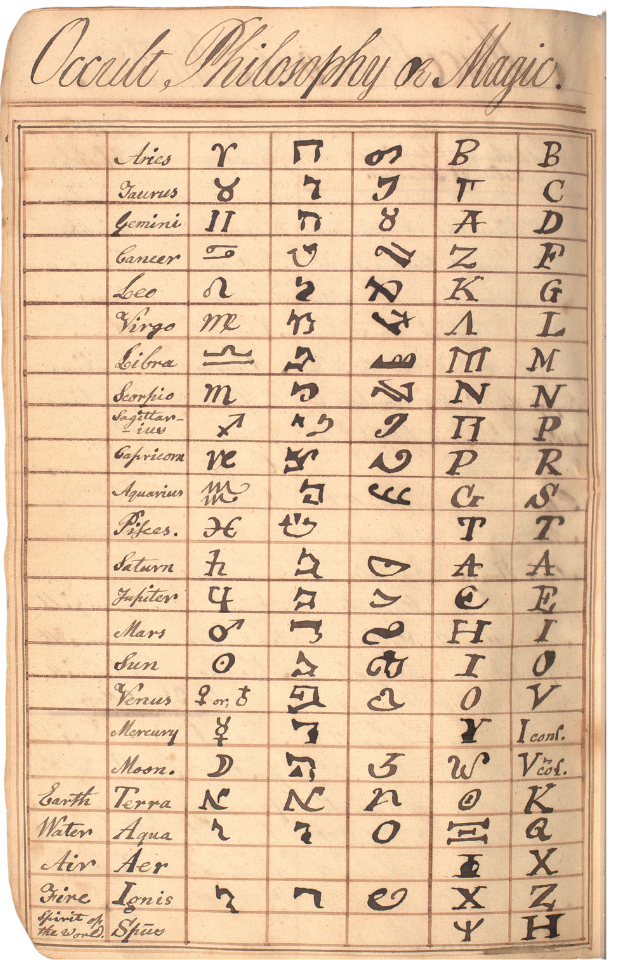
The Clements Library holds a tattered volume with a shrunken, limp leather binding that was created and used by an itinerant schoolteacher in New Hampshire and the District of Maine between 1789 and 1811. Along with the expected assortment of instructional materials for students (mathematical exercises, basic legal and financial forms for students to copy, readings, penmanship practice statements) is a section on “Occult Philosophy or Magic,” where the schoolteacher copied selections from Heinrich Cornelius Agrippa von Nettesheim’s Three Books of Occult Philosophy (London, 1651). The table shown here connected the divine origins of the stars of the zodiac, planets, and spirits with the signs and sounds of their names. Left to right are the astrological names and symbols, Hebrew characters, chiromatic signs, Greek letters, and Latin letters.
The Enlightenment of the 18th century, with its elevation of reason and scientific inquiry, permitted a clearer understanding of the boundaries between knowable reality and speculation. This combined with technological advances in the creation of glass lenses made it possible for astronomers to observe the motions of heavenly bodies with a new level of precision. This precise observation did not supplant traditional beliefs in the influence of the stars and planets on human life, but refined it. This period saw divergence in the use and meaning of the terms astronomy and astrology, with the former referring specifically to observational science and the latter a blend of formerly held beliefs with new scientific discoveries.

In the prefatory illustration “The Anatomy of Man’s Body, as governed by the Twelve Constellations” from Banneker’s Almanack and Ephemeris (Baltimore, 1796).
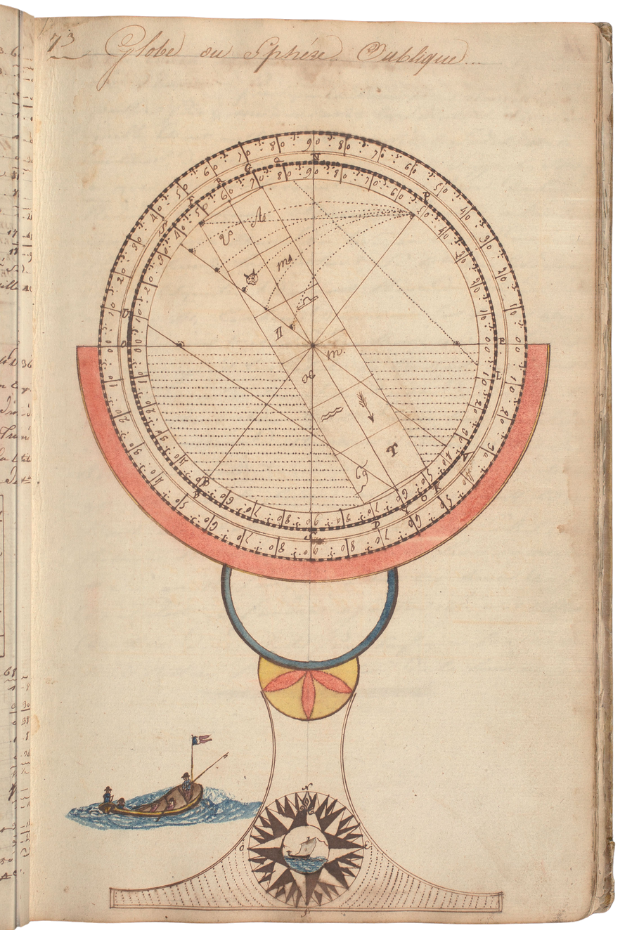
French sea captain Francis Naghel (1779-1843) carefully drew and colored this “Globe ou Sphére Oublique” in his book of navigational exercises around 1798. The globe is viewed from an angle such that the curved ecliptic appears straight. Naghel Exercise Book.
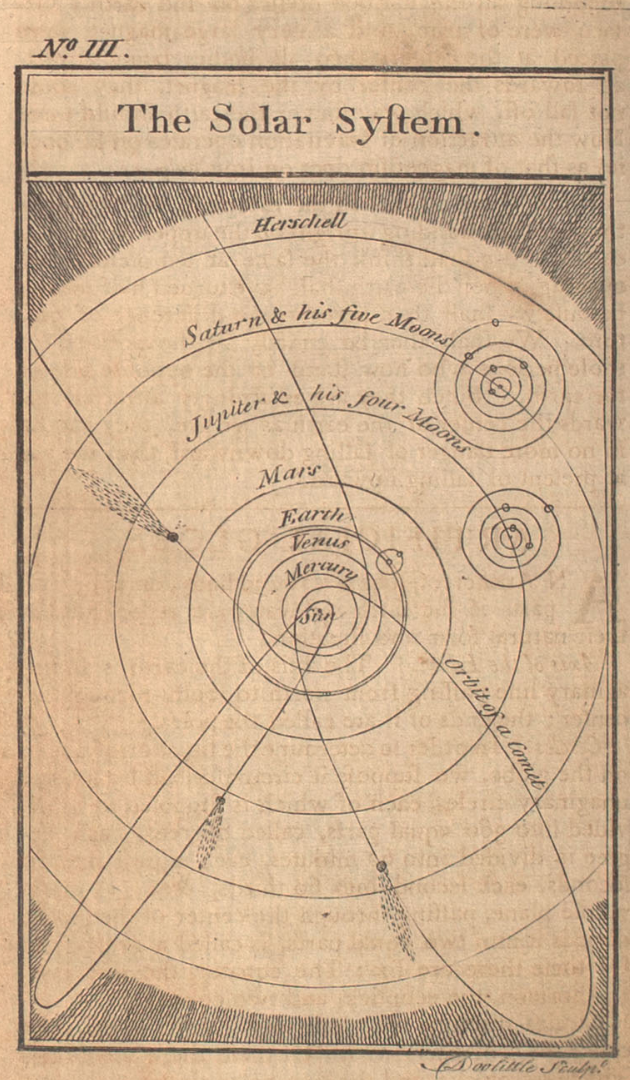
Perhaps the most extraordinary discovery of the 18th century was made by Hanover-born William Herschel (1738–1822), a musician and astronomer. Herschel ground and polished large and fine lenses for systematic observation of subtleties not easily seen by inferior telescopes, such as the relative movements of groupings of stars that appeared nearly as one. In March 1781, he observed the movement of an object thought to be a fixed star. After further observation and corroboration — as well as the calculation of its orbit by astronomer Anders Johan Lexell (1740–1784) — it was found to be a planet.
The discovery was literally and figuratively astronomical. Mercury, Venus, Mars, Jupiter, and Saturn are visible to unassisted eyes from Earth. They were known to ancient peoples and incorporated into cultures over the course of thousands of years. This new planet expanded the solar system to nearly twice the size once believed.
The known planets had names and generally adopted signs that were Romanized and Christianized variants of Greek and alchemical symbols: Mercury (☿), Venus (♀), Mars (♂), Jupiter (♃), and Saturn (♄). What to call the new planet? In celebration and recognition of William Herschel for his 1781 observations, the name “Herschel” spread as a contender. Herschel himself rejected his own name in favor of “Georgium Sidus” (George’s Star) after King George III. Without a naming process that transcended geo-political boundaries, French publications tended toward the name “Herschel,” as did the fledgling United States.
The name Uranus was suggested as early as 1782 and regularly adopted by the mid-19th century. It was suitable for a variety of reasons, not least of which was that in the Greco-Roman pantheon, Uranus was father of Saturn, who was father of Jupiter. As for a sign (notably absent from the 1798 Catechism’s table of planets earlier in this article), differing parties used either the first letter of Herschel’s name seated atop a globe (♅) or the character also adopted for platinum (⛢).
Taken as a whole, then, the body of materials on the University of Michigan campus that deal with the influence of heavenly bodies on earthly matters reflect the consistent belief in such influence, the flexibility to incorporate new scientific discoveries into long-standing belief systems , and the separation of deserving scientific study from astrological prediction. Newly discovered planets and stars challenged and demanded revision of some previous belief systems, while at the same time slid seamlessly into frameworks that offered readers in the past knowledge that was both meaningful and useful.
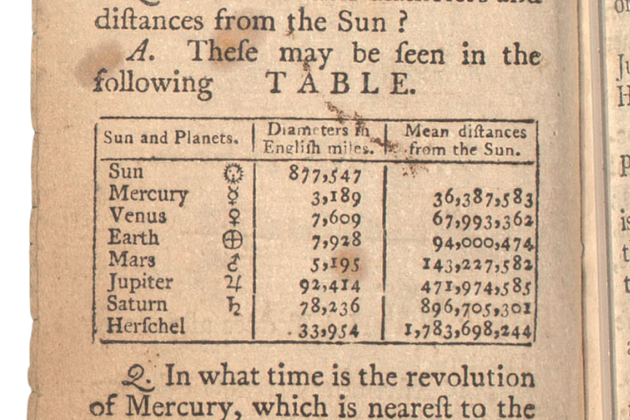
An aptly titled question-and-answer textbook for children, An Astronomical and Geographical Catechism (Boston, 1798) by Caleb Bingham (1757–1817) includes a table of the planets, their signs, their diameters, and their mean distances from the sun (in English miles). The distance of planet “Herschel” from the sun is here noted as just over 1.78 billion miles, compared to the next closest, Saturn, at less than 897 million miles.
The discovery was literally and figuratively astronomical. Mercury, Venus, Mars, Jupiter, and Saturn are visible to unassisted eyes from Earth. This new planet expanded the solar system to nearly twice the size once believed.
(left)
New England Schoolmaster’s Teaching Book, Duane Norman Diedrich Collection.
(right)
With the discovery of this new planet, printers of educational books and almanacs had to revise their texts, and decide what to call the new planet. Above: Amos Doolittle’s engraving of the solar system in Jedidiah Morse’s Geography Made Easy (Boston, 1790) shows the outer planet “Herschell”; John Payne opted for “Georgium Sidus” in his A New and Complete System of Universal Geography (New York, 1798). Curiously, William North abandoned both in The Mirror, or, Carolina and Georgia Almanac (Charleston, 1804) for the rather unusual “Herschelium Sidus”!