
By Digitization Specialist Ella Johnson
For the last year, the digitization team at the Clements Library has been hard at work on digitizing one of our cornerstone collections. Nearly 3,500 letters from the Weld-Grimké collection will shortly be digitally available, allowing remote access to these important documents. Stretching from 1740 to 1930, these letters document the lives of the Weld and Grimké families in South Carolina, Philadelphia, Massachusetts, and Michigan. Centered around sisters Angelina and Sarah Grimké, these correspondences highlight the work of women as political actors, religious leaders, and medical practitioners. I had the honor of working through this collection page by page, taking over 13,000 images of these letters and in this blog I’d like to share a brief biographical sketch of the Grimké family and then I will be back to share a bit more about the digitizing process and my interest in this collection.
Sarah Grimké and her sister Angelina were born into a slave-owning family in Charleston, South Carolina. Both sisters found the expectations, limitations, and compliance expected of them as young upper-class women to be grating and unsatisfactory. The treatment of enslaved people within their household and the larger Southern society horrified them and they began to wrestle with religious ideas. They felt there was a glaring contradiction between how the Bible instructed Christians to act and how the Episcopal church that their family belonged to put their faith into action. First Sarah, then Angelina left that church and converted to Presbyterianism. Although more accepting of the sisters’ growing hatred of slavery and “rebellious spirit,”1 they quickly found that their beliefs were too radical for that church and again Sarah led the way, moving north to Philadelphia and converting to Quakerism. In 1829, Angelina followed her sister north and a new chapter opened before them2.
In the northern Society of Friends, the sisters thought at long last they had found a religious and moral home. More and more they found themselves called to work and speak out against slavery. While the Quakers of Philadelphia were generally opposed to the slave system of the South and held gender equality as one of their founding principles, the Grimkés found that the old orthodox Quaker families resisted and shut down their pushes for a more radical movement. As distance grew between the sisters and their Quaker community, they found themselves drawn into the growing Abolitionist movement in Philadelphia. Writing and speaking against slavery took a larger role in the sisters’ lives even as many of their Quaker friends discouraged them from such public and un-ladylike displays of politics. In 1836, Angelina wrote and published her treatise “An Appeal to the Christian Women of the South” which elevated her profile as an abolitionist and further complicated her relationship with both her family in the South and the Quaker Orthodoxy in Philadelphia. After much struggle to decide how to proceed, both sisters agreed to become the first female agents of the American Anti-Slavery Society.
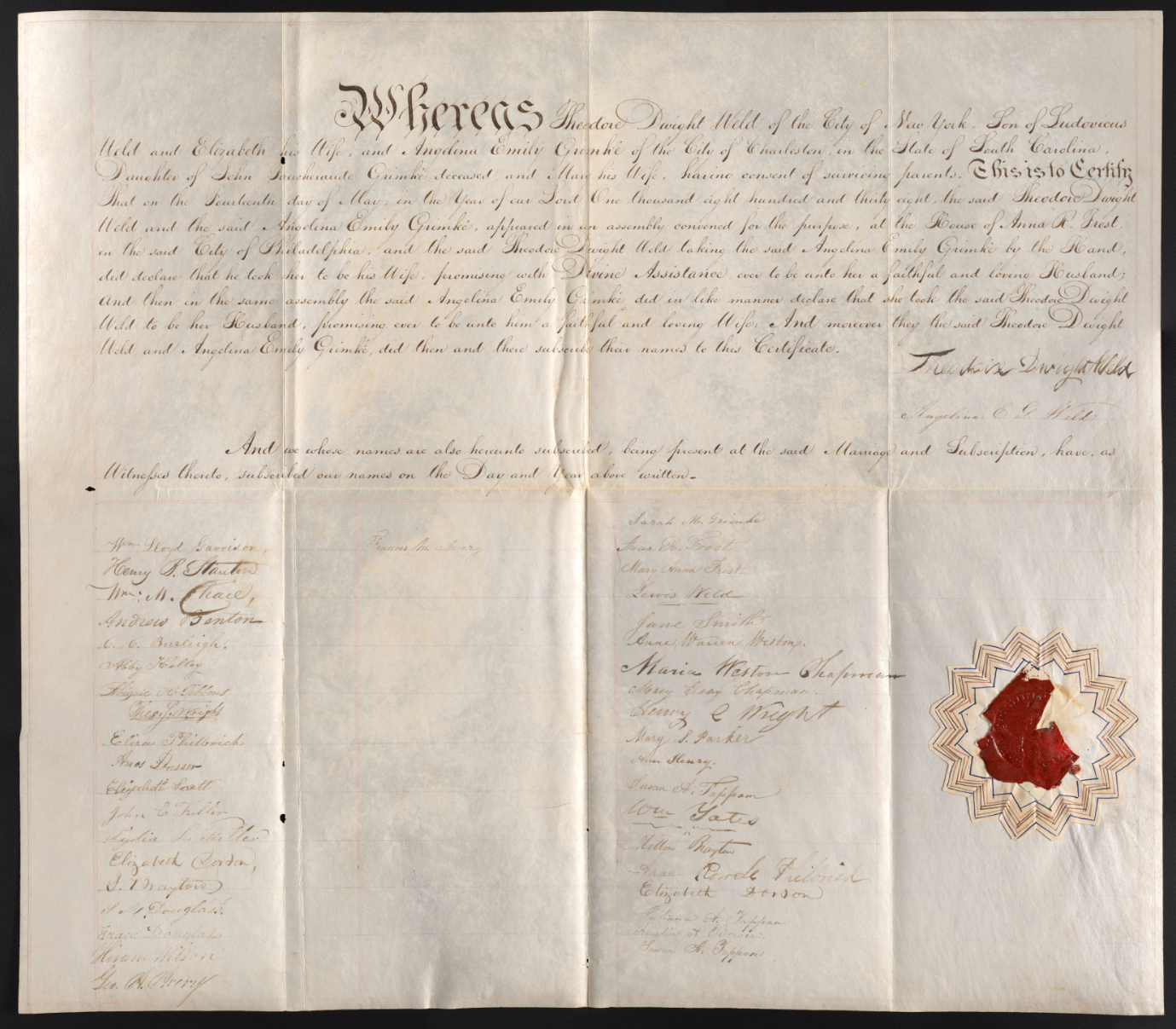
Marriage certificate of Angelina Emily Grimké Weld and Theodore Dwight Weld
In November 1836, the sisters attended a convention held by the American Anti-Slavery Society to train agents, where they encountered Theodore Dwight Weld. An abolitionist with an already impressive reputation as a fiery speaker and impassioned religious rebel, Theodore caught Angelina’s interest: “I [Angelina] never heard so grand & beautiful an exposition of the dignity & nobility of man in my life…”3 As the sisters began to travel and speak to crowds, they struck up a healthy correspondence with Weld, discussing their struggles, the movement, and their religious beliefs. Angelina and Theodore were married on May 14, 1838, with a mixed-race crowd, a cake and wedding clothes made without enslaved labor, vows which they had written themselves, and no minister to officiate. Their untraditional union held fast to the couples’ beliefs on slavery and women’s rights. Shortly after, Angelina and Theodore moved to Fort Lee, New Jersey, along with Sarah, who would continue to live and work with the couple for most of her life.
![Detail from letter from Sarah Moore Grimke, Belleville, New Jersey, to Theodore Dwight Weld, Philadelphia, Pennsylvania, 1843 February 7.] Scribbled “kisses” from Charley and Sody Weld to their father.<br />](https://clements.umich.edu/wp-content/uploads/2026/07/Weld-Grimke-2.png "Detail from letter from Sarah Moore Grimke, Belleville, New Jersey, to Theodore Dwight Weld, Philadelphia, Pennsylvania, 1843 February 7.] Scribbled “kisses” from Charley and Sody Weld to their father.")
Detail from letter from Sarah Moore Grimké, Belleville, New Jersey, to Theodore Dwight Weld, Philadelphia, Pennsylvania, 1843 February 7.] Scribbled “kisses” from Charley and Sody Weld to their father.
Theodore split his time between the American Anti-Slavery Society and farming while the sisters helped with writing and research for the movement while running their household. In 1839, Angelina had her first child, Charles Stuart Faucheraud Weld, after periods of poor health. Shortly after the family moved to Belleville, New Jersey, where they continued to work on Anti-Slavery causes, even as farming, Angelina’s health problems, and caring for little “Charley” took more of their time and energy. In 1841, another son, Theodore “Sody” Grimké Weld joined the family. During this period, the larger Abolitionist movement went through a schism as the “Woman Question” became a larger issue. The little family did not feel clearly led to one side or another even as Angelina and Sarah became more invested in women’s rights. As financial constraints impacted the family, Theodore took a job lobbying for Abolitionist causes in Washington, D. C. His distance was difficult for the rest of the family as Sarah took on more childcare and household tasks that Angelina could not help with due to her ill health and a miscarriage she suffered in 1843. The family was united in 1844 when Theodore returned to the farm and their last child, Sarah Grimké Weld, was born. Theodore’s abolition work weighed heavier and heavier on the family, both because of the time away from home it required and the little pay it reaped. As the children aged, the three adults worked hard to give them a worthy education, and soon other children of their abolitionist friends came to Belleville to be educated. By 1851, the house in Belleville boarded 20 young scholars4.
![Weld-Grimke Family daguerreotype, approximately 1850] Likely taken by Theodore’s brother Ezra Greenleaf Weld, this image shows the family posed together with young Charley nestled between his father’s legs, Sody tucked against his mother behind the protective arm of his brother, and Sarah cradled in Angelina’s arms.](https://clements.umich.edu/wp-content/uploads/2026/07/Weld-Grimke-3-pt2.png "Weld-Grimke Family daguerreotype, approximately 1850] Likely taken by Theodore’s brother Ezra Greenleaf Weld, this image shows the family posed together with young Charley nestled between his father’s legs, Sody tucked against his mother behind the protective arm of his brother, and Sarah cradled in Angelina’s arms.")
Weld-Grimké Family daguerreotype, approximately 1850] Likely taken by Theodore’s brother Ezra Greenleaf Weld, this image shows the family posed together with young Charley nestled between his father’s legs, Sody tucked against his mother behind the protective arm of his brother, and Sarah cradled in Angelina’s arms.
As a teacher, Theodore found an outlet for his passion and care for his students which is clearly demonstrated by the number of letters in the collection from former students which address him with love and kind reminiscence. Sarah and Angelina too, built strong relationships with the young people they watched over, although Angelina was limited by her continued poor health, a prolapsed uterus, and other complications that kept her weak and in great pain. Sarah, ever present in her sister’s life, took on the brunt of childcare duties, developing deep relationships with her nieces and nephews. Many letters testify to her calm and warm presence in the children’s lives. After growing the school at their farm in Belleville, the trio was invited to run the school at a new cooperative community in Perth Amboy, New Jersey. This community, Raritan Bay Union, aimed for citizens to live their best religious, moral, and community-based lives. Many other abolitionists bought into the community and sent their children to the school the Weld-Grimké family taught at. The vision for Raritan was short-lived but the school, renamed Eagleswood Academy, continued to be run by the Weld-Grimké trio. Years later, with Charles and Sarah out of the house and their middle son, Theodore, struggling with mental and physical limitations, the trio moved to Hyde Park, Boston, Massachusetts. They would live there for the rest of their days, becoming icons of the abolition movement.
According to our reference records, the Weld-Grimké papers are our fourth most used collection, and the most used pertaining to the 19th century. With increased digital access to the papers, my hope is that more researchers, students, and history buffs will study the fascinating lives of the Weld-Grimké family.
1 Letter from Sarah Moore Grimké, New York, to Theodore Dwight Weld, 1837 March 10
2 The Grimké Sisters from South Carolina: Pioneers for Women’s Rights and Abolition. Gerda Lerner, p. 60
3 Letter from Angelina Emily Grimké and Sarah Moore Grimké to Jane Smith, Philadelphia, Pennsylvania, 1836 November 19-1836 November 21
4 The Grimké Sisters from South Carolina: Pioneers for Women’s Rights and Abolition. Gerda Lerner, p. 221