
By Evelyn Best, Graduate Books Assistant
When life-long book collector Ed Surovell lost his eyesight, he wanted to ensure that his books would be preserved and made accessible for research well into the future. In December 2021, Surovell generously gifted the Clements Library his carefully curated collection of Native American language materials. With over 300 items, this collection represents books printed in more than 20 different Native American languages from North America, with a particular interest in material from the Great Lakes region. Because of this gift, the Clements Library now houses a significant collection of Ojibwa language materials that are available for study. With generous support from the The Gladys Krieble Delmas Foundation, I have had the opportunity to work as a Clements Library graduate student fellow to catalog the English and Ojibwa portions of Surovell’s collection.
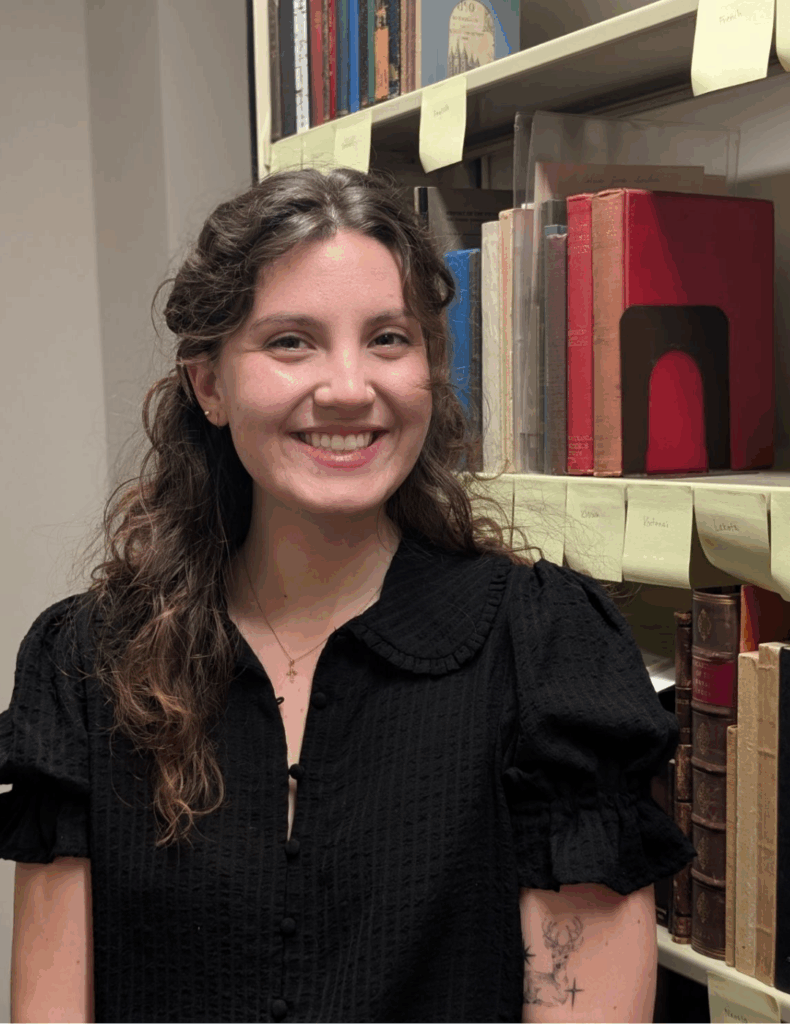
I first had the pleasure of meeting Ed Surovell at a Clements Library Associates Board of Governors meeting, where he easily recalled information about every book in the collection–down to the year it was published and the color of the binding. I quickly realized that, collector and cataloger alike, Surovell and I found meaning in the details of these books. Little morsels of knowledge, like how a book’s cover looks or which specific words are on a title page, help us understand histories from our place in the present. Cataloging these books, or creating a digital record of those details, is how I contribute to keeping the past within our reach.
Cataloging is all about organizing the details of a book into a clear, concise, and uniform record, so users can easily find information and where it is held. While learning to catalog was a long and difficult process, it became my favorite daily challenge at the Clements. Working on the Surovell collection was a particularly exciting project; I got to engage with multiple languages, different types of printed materials (like books, pamphlets, and music books), and both Indigenous and settler-colonial histories. This made for quite complicated, but exceedingly rich records. The Surovell collection was so fascinating, I barely noticed myself falling in love with rare book cataloging.
A Complicated Collection
Most of the items in the Ojibwa and English portions of the collection represent settler colonial perspectives, written by white authors of English or European descent. Specifically, many books and other printed materials represent the work of religious missionaries as they tried to convert Native Americans to Christianity. These works manifest as missionary narratives, school and church periodicals, hymn books, and translations of portions of the Bible. As such, most of the language material in the Surovell collection represents settler-colonial versions of Native languages, which settlers learned and used for religious conversion, trade, or other colonial projects.
Despite this majority, there are several Native authors, compilers, and translators highlighted in the collection, such as Peter Jones, Andrew J. Blackbird, William Soney, and Simon Pokagon. It is also clear that much of the collection exists because of hidden Native labor. The breadth of Native language knowledge, understanding of Native worldviews, and even the work of Native Christian missionaries all point towards the information extracted from Native communities and repurposed for colonial gain. For example, in this collection we repeatedly see Native languages being used to assimilate Native students in boarding schools.
While the Surovell collection does highlight how Native languages have been weaponized by settlers, it also represents the extraordinary survivance of Native language materials—that is, the active presence, survival, and resistance of Native ways of knowing—despite the widespread eradication of Native traditions and language by settlers. One poignant example of this complicated survivance is the Holy Childhood Boarding School’s periodical, the Anishinabe Enamiad, printed by Native students at the school in Harbor Springs, Michigan. On one hand, this periodical serves as a painful reminder of the traumatic experiences many Native students endured at Holy Childhood. On the other, the very survival of this work gives modern individuals the opportunity to investigate their culture’s history and understand their ancestors. Though colonial settlers used Anishinabeemowin, or the Ojibwe language, to assimilate its Native speakers, the archival remnants of this kind of violence can actually be reclaimed to give once silenced Native voices renewed access to their stories and languages.
19th-Century Dictionaries
Another fascinating part of working with the collection was learning how to use 19th-century Ojibwe dictionaries to translate titles into English. At first, I wanted to rely on Native-made language materials because it was important to me to include Native voices in my process. Modern Anishinaabemowin speakers have created valuable tools for language revitalization, modernization, and standardization. For example, the Ojibwe People’s Dictionary combines cultural heritage research with structured dictionary entries and grammatical features, all accessible digitally.
I quickly realized that modern resources alone could not account for the early language conventions used in these books. Rather than Native speakers, Missionaries and other settlers were among the first to write Anishinaabemowin down, using phonetic spellings in Latin script shaped by English, French, or German conventions. Because the books in the collection were also colonial works, I needed dictionaries that reflected those same 19th-century conventions to fully decipher their titles.
This is why the context behind early language materials matters. Although many 19th-century dictionaries were originally created to support religious conversion, they remain important tools for interpreting historical texts. For instance, Father Baraga’s A Dictionary of the Otchipwe language (1878), originally published for missionaries, became invaluable to my translation work. By using a dictionary created with religious and colonial projects in mind, I was able to effectively translate the books in the collection that shared the same historical backgrounds. Baraga’s dictionary was especially helpful as I dealt with differences in spelling conventions between early and modern Ojibwe.
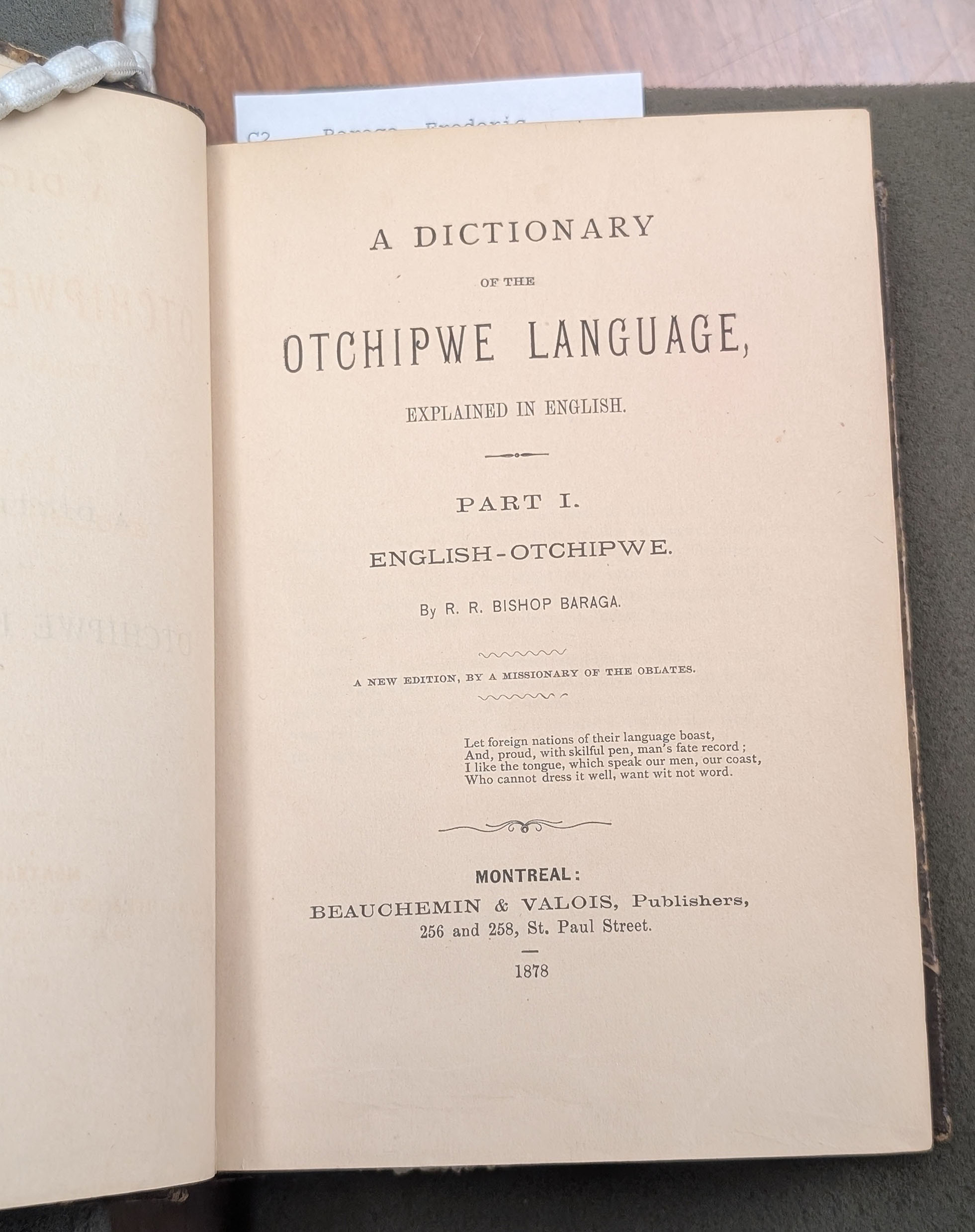
Baraga’s 1878 dictionary identifies him as “a missionary of the oblates” and reads “Let foreign nations of their language boast, / And, proud, with skilful pen, man’s fate record; / I like the tongue, which speak our men, our coast, / Who cannot dress it well, want wit not word.”
Compare and Contrast
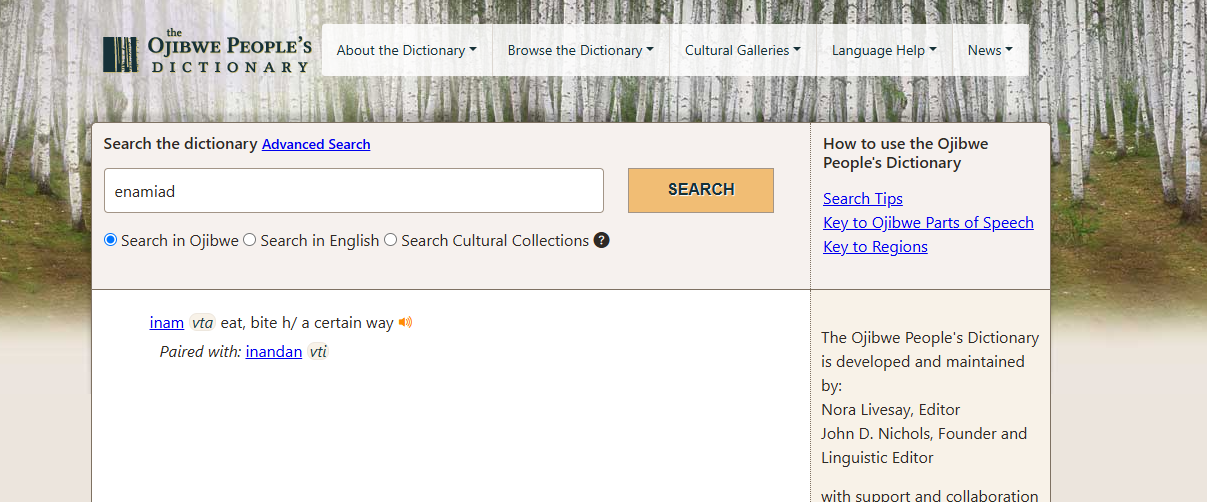
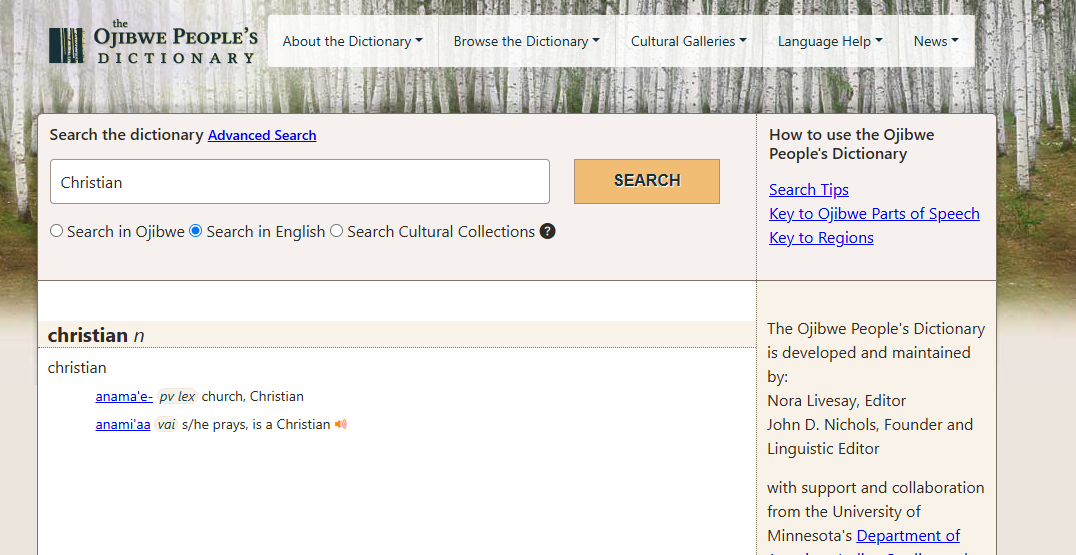
Let’s compare and contrast some sections from the Ojibwe People’s Dictionary and Baraga’s 19th-century dictionary. One word that came up often in the collection was “Christian.” Baraga uses the word “Enamiad” for “one who prays, a Christian.” If you search “Enamiad” in the Ojibwe People’s Dictionary, it doesn’t yield what we think it should. However, if you search for “Christian” in English, the result is a word that is spelled differently than “Enamiad,” but is pronounced very similarly!
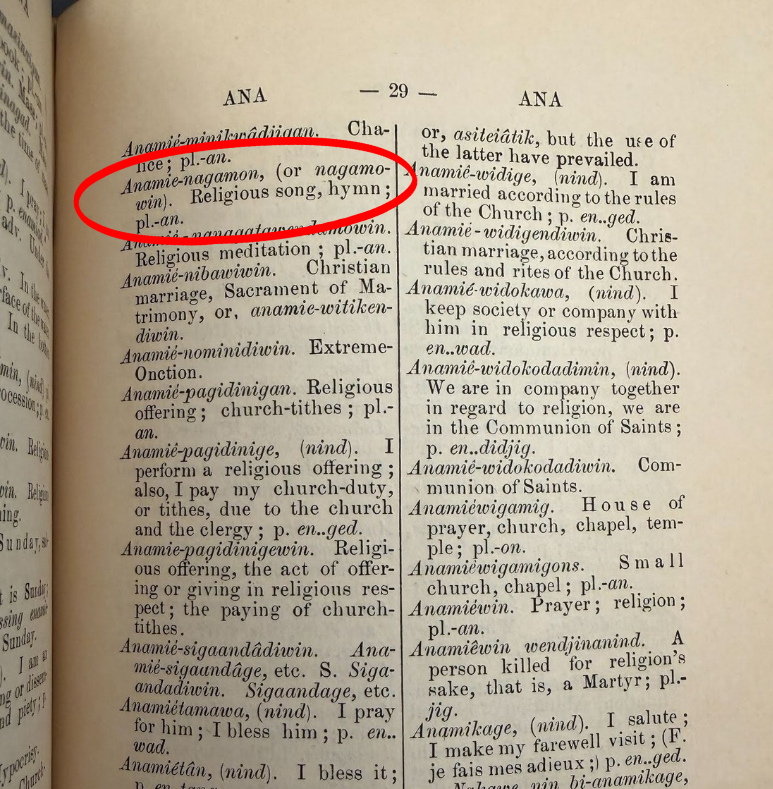
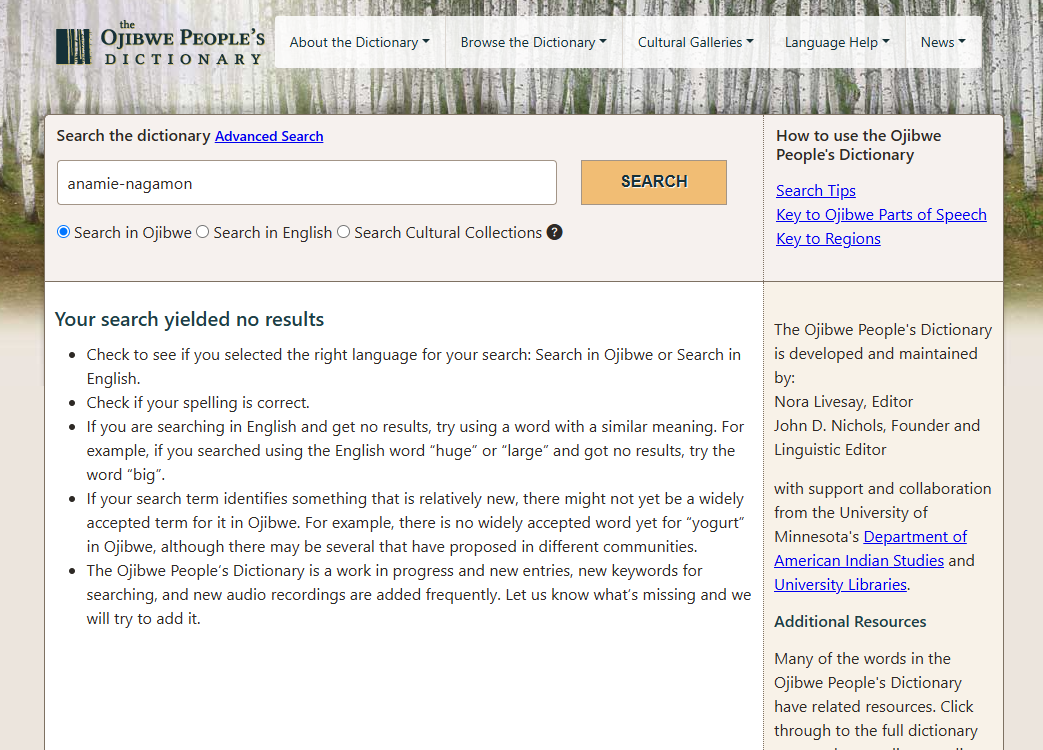
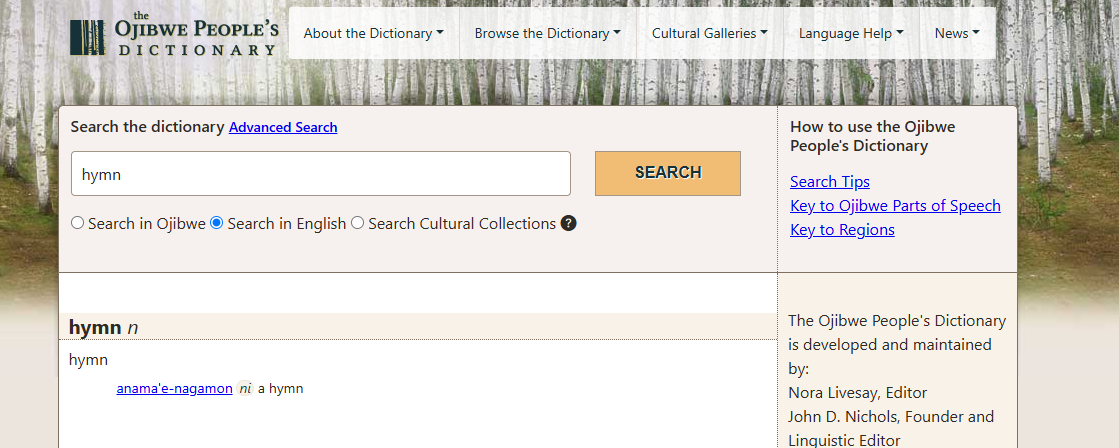
Another challenging example for me was the language for “hymn” or “religious song”, which Baraga calls, “Anamie-nagamon”. When you search for this word in Ojibwe, in the online dictionary, no search results come up. When you search for “hymn” in English, you will see a word that sounds very similar to Baraga’s.
Both examples show how 19th-century Ojibwe and modern Anishinaabemowin sound extremely similar, but are spelled differently due to the development of more standardized spelling conventions. For the modern translator, spelling differences like these can make it much easier to use the primary source language material to decode their titles. I used Baraga’s dictionary to construct my translations, and then modern resources to check my work!
Baraga defines “Enamiad”:
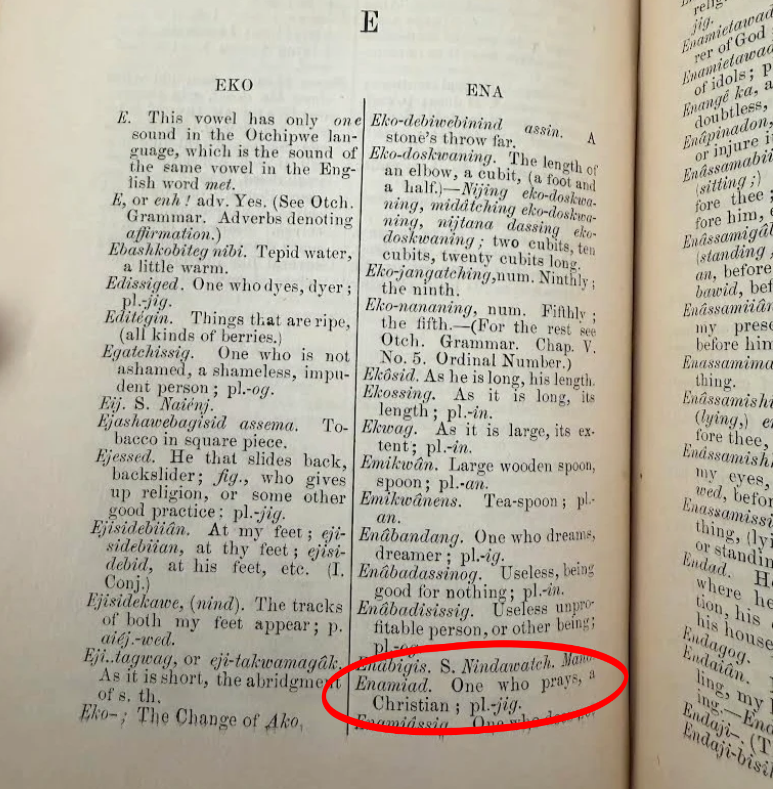
Ojibwe People’s Dictionary searches for “Enamiad”:
Baraga defines “Anamie-nagamon”:
Ojibwe People’s Dictionary searches for “hymn”:
Signifying the conclusion of my fellowship work, there are over 120 new catalog records available in our online catalog that represent their physical works, which are now accessible to study. From grammars and dictionaries, to hymn books, to personal narratives, the Surovell collection is full of items which beg every reader to ask what kinds of histories they might unveil. To find a great catalog record is to open up a door, and I’m sure our researchers will discover incredible details on the other side.