
On this day in history, in 1837, Michigan was admitted as the 26th state.
A map of Michigan is easily at hand for most people, whether it is on the phone in their pocket or demonstrated by simply holding up their hand! It wasn’t always that simple. The shape of the state took centuries to be fully realized on a map. Read on to learn more about three early maps of Michigan, dating from 1744-1836.
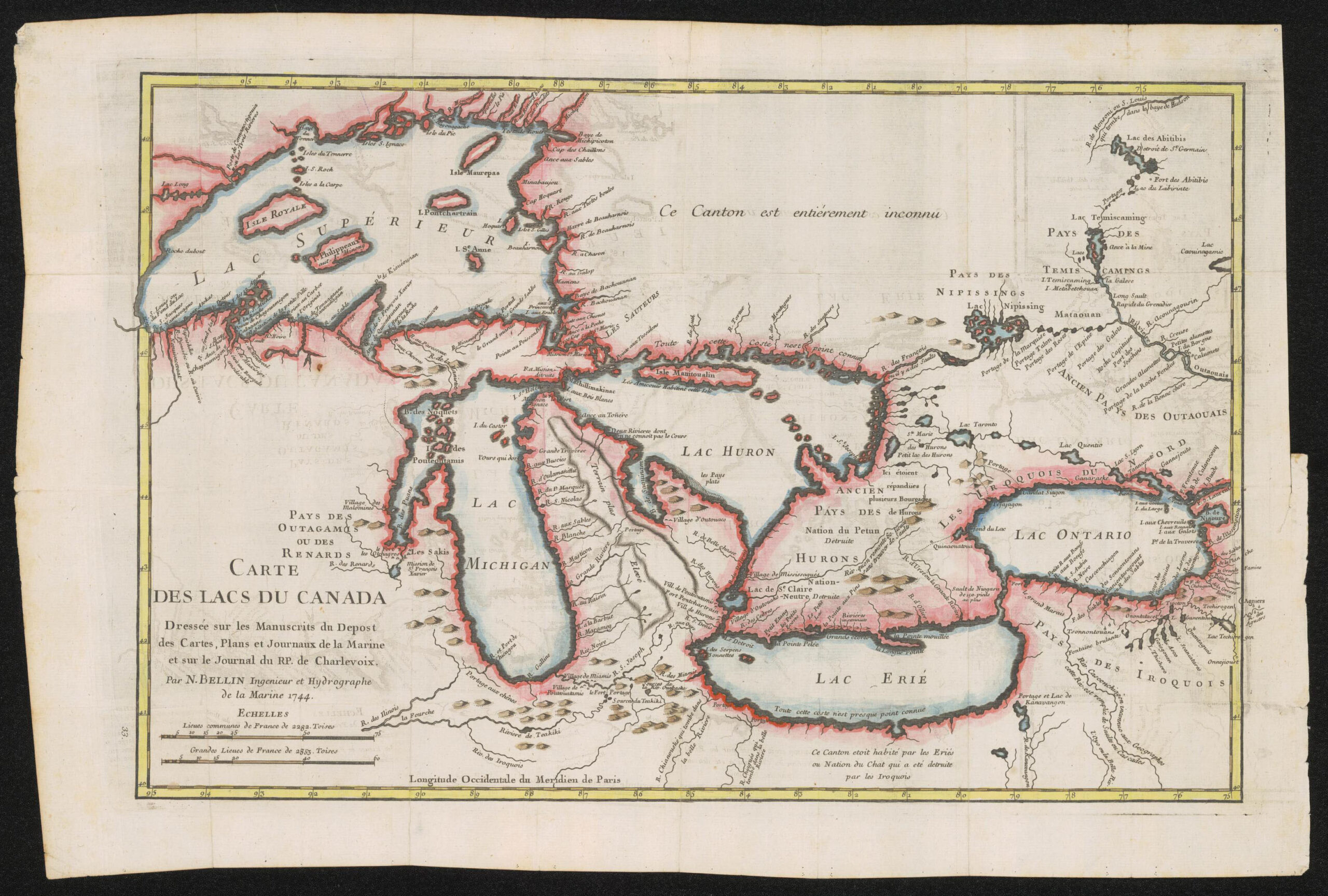
Bellin 1744 Carte des Lacs du Canada (in Charlevoix)
1 map : col. ; 28.9 x 44.7 cm.
Jacques-Nicolas Bellin (1703-1772), a mapmaker in the employ of the French Navy, produced his maps by compiling and assessing all available sources, from manuscript maps and travel accounts to the printed work of other mapmakers. He drew the maps and plans for the three volume account travels in New France by the Jesuit priest, Pierre François Xavier de Charlevoix (1682-1761), Histoire et description générale de la Nouvelle France, 1744 (Paris: Ganeau, vol. 3, p. 176). Bellin was perhaps the first to isolate and name the five large bodies of water as a group “the Great Lakes,” and to make them the focus of a single map. At the beginning of Volume Three of the Charlevoix work, Bellin published an essay (Memoire) detailing the sources and his process of assessment for the maps in the work. He is quite clear that his map does not rely on the maps of earlier French geographers Guillaume Delisle or Nicolas Sanson or others before him but was based on other resources in the Dépôt de la Marine (the French navy archives) and personal accounts, such as that of Charlevoix. Of particular surprise is the number of large islands in Lake Superior, far more than appeared on previous maps. Bellin does not account for these islands individually, remarking only that innumerable islands were reported but unnamed and unmeasured in terms of distance or size. More recent scholarship has looked into the sources available to him in the Dépôt de la Marine, particularly the maps and papers of a French trader named Louis Denis de La Ronde, who took command of a fur trading post at the western end of Lake Superior in 1731 in a bid to search for copper and other mineral deposits in the region. La Ronde’s notes and sketch maps named the larger the islands in the lake for the members powerful Phélypeaux family who across three generations served the monarch in the administration of the French Marine, i.e., Comte de Pontchartrain and Comte de Maurepas, and the smaller ones for the two officials who protected his claims, that is, Gilles Hocquart, the fiscal intendant of New France, and the Marquis de Beauharnois, governor general of New France. The islands themselves had not yet been explored or surveyed; they were based on indigenous reports. Thus geographic uncertainty allowed for prudent sycophancy.
![The United States of America. [1801] map of the Eastern half of the United States. Includes the Great Lakes and a misshapen Michigan.](https://clements.umich.edu/wp-content/uploads/2026/01/wcl1ic_1002_WCL001096_wcl001096_3397x2435-scaled.jpg "wcl1ic_1002_WCL001096_wcl001096_3397x2435")
Matthew Carey 1801 United States (east of the Mississippi) From: Carey, Mathew. Carey’s American pocket atlas …, 1801
1 map : col. ; 25.1 x 32.2 cm.
This small map (25.1 x 32.2cm.) from The American Pocket Atlas was assembled by the entrepreneurial publisher Mathew Carey, in Philadelphia in 1801. It shows the Great Lakes much as the French mapmakers of the eighteenth century had depicted them and presents the outline of both peninsulas of the Great Lakes as part of the Northwest Territory, a function of the peace treaty of 1783 and the following Northwest Ordinance of 1787.
By contrast to earlier Francophone maps, this Anglophone map omits any reference to indigenous presence: native American bands have seemingly disappeared along with almost all French place names. The numerous large islands of Lake Superior remain, but are unnamed. Not long after the publication of this map, in 1805 Michigan became a territory of the United States and maps of the lower peninsula as a coherent identity began to appear.

John Farmer Improved map of the territories of Michigan and Ouisconsin 1836 Improved map of the territories of Michigan and Ouisconsin (pronounced Wisconsin) on a scale of 30 geographical miles to an inch
1 map : col. ; 52 x 84 cm.
New York born John Farmer became a Detroit based surveyor and schoolteacher, working for the early University of Michigan as principal of the Lancastrian School in Detroit. He benefitted in his survey practice from the increased business engendered by the Northwest Ordinance of 1787, which mandated the survey of the newly acquired territory using a rectilinear division of land into township and range, based on geodetically measured meridians and baselines. This land-based grid ignored the network of waterways and lakes that had been the transportation system for indigenous peoples, fur traders, missionaries, and early settlers. Enterprising surveyors like Farmer produced guidebooks to attract emigrants to the new territories. In 1830 he published The Emigrants’ Guide or Pocket Gazetteer of the surveyed part of Michigan, and included this map.
Farmer’s map covers not only Michigan and Wisconsin but extends further west to the Mississippi and Missouri Rivers. It places the Great Lakes region in the larger context of the westward expansion of the United States and links them to the two great waterways of these western rivers. Native peoples hold a much-reduced place compared to the French maps of a century before. The “Explanations of signs” shows different symbols for trading posts, Indian Village, and Residence of Indian Agents, the telling vestiges of the old stories of fur trade and missionaries. The surveyed counties, divided into township and range, creep as far north as Gladwin and Arenac counties. The treaty negotiated the cession by indigenous peoples of nearly 14 million acres in northwest Lower Peninsula and eastern portion of the Upper Peninsula to the Michigan Territory, over a third of the area of the state. When Michigan became a state the following year, in 1837, many of the counties had already been surveyed and divided into township squares, ready for sale.