
The Manuscripts Division, including grad student intern Naomi Yu, have processed many archival collections that have recently been made discoverable online. The detailed finding aids they have created for each collection will be vital for future researchers utilizing our digital search tools.
Angier family letters, 1817-1832
This collection consists largely of letters to Elizabeth Angier of Southborough, Massachusetts, from her children and grandchildren between 1817-1832. Topics include health and medical treatment, mental health, mention of a suicide attempt, motherhood, family life, and more. Multiple authors wrote in single letters.
Love Baker letters, 1799-1801
This collection consists of four letters Love Baker wrote between 1799 and 1801 from Trenton, New Jersey, and New Orleans, Louisiana, principally about commercial interests in the West Indies, international maritime concerns such as privateering and British impressment, politics, and yellow fever. Two letters are addressed to Thomas Wardell of Crosswicks, New Jersey.
William S. Delany diary, 1872
William S. Delany of Atkinson Mills, Pennsylvania, kept this pocket diary while seeking employment and working as a carpenter at planing mills, in lumberyards, and at various construction jobs in Chicago in 1872. In daily entries, he recorded his experiences as a blue-collar laborer in post-Great Fire Chicago, amid violent police tensions and re-building efforts. He mentioned organized labor activity, witnessed police arrests and homicides (and was himself arrested), reported on fires, and recorded aspects of health, weather, leisure, entertainments, and time spent with fellow laborers (many from Irish families).
Arthur A. Ingersoll letters, 1888-1889
This collection consists of 17 letters by Treasurer of the Academy of Music (Haverhill, Mass.) Arthur A. Ingersoll to his father, John G. Ingersoll of Boston between 1888 and 1889. Ingersoll wrote on official printed stationery about shows put on by the Academy and at the City Hall, attendance and ticket sales, concerts, and operas. He specifically mentioned Boucicault, Maude Banks, “The voyage en Suisse,” “The Mikado,” “Fantasma,” “Michael Strogoff,” “Hole in the Ground,” “Ruddigore,” “Two Sisters,” and Gilbert and Sullivan’s “The Yeoman of the Guard.” Ingersoll noted the popularity of minstrel shows, expecting “a rushing door sale” (January 14, 1889). The letters also include family news, discussions of the weather, incidents of crime and fire, carriage and train travel, and church attendance.
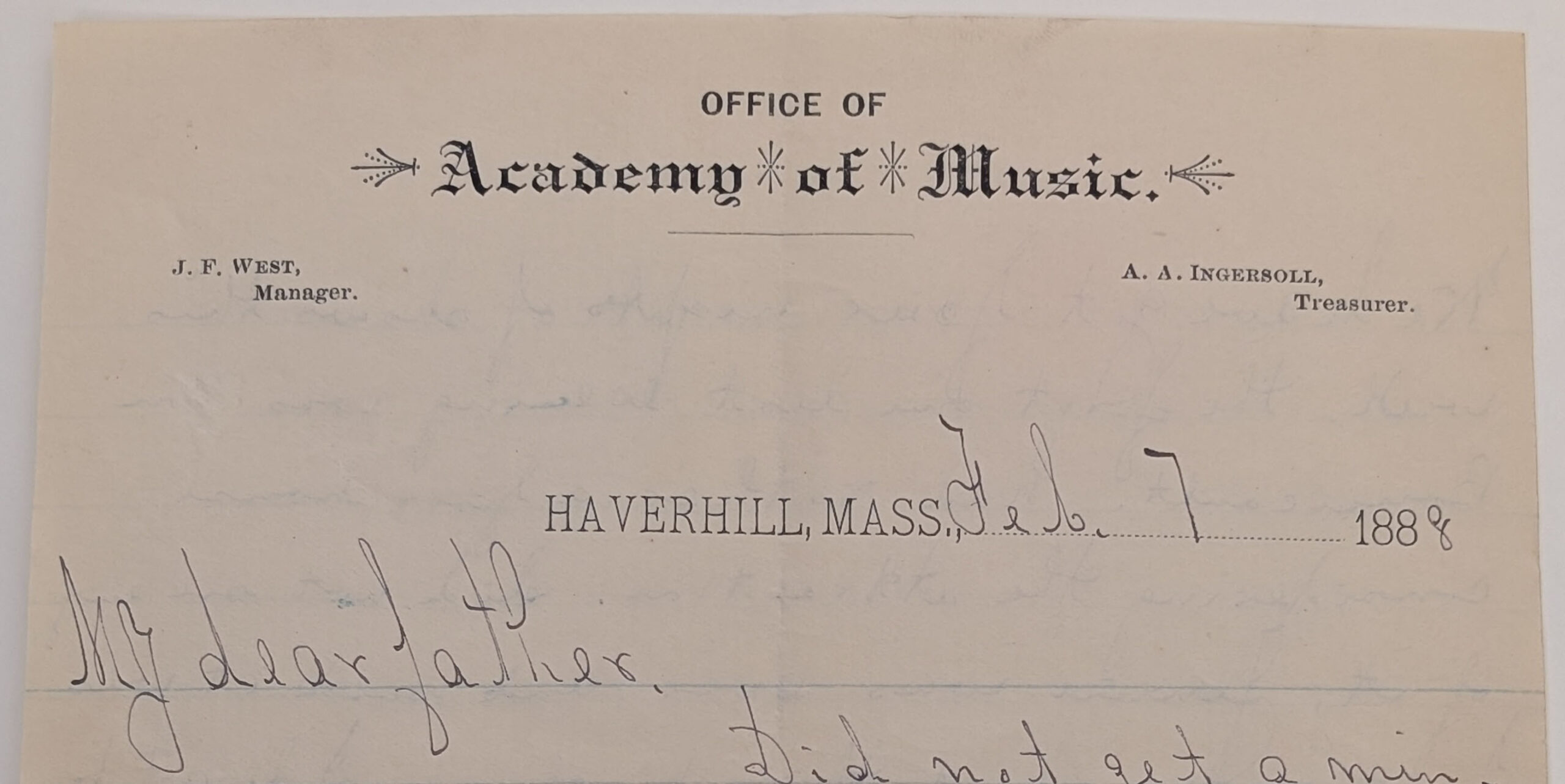
Piece of correspondence from the Arthur A. Ingersoll letters with “Office of Academy of Music” printed letterhead.
Mary Elizabeth Lawrence diary and scrapbook, 1916-1918
Mary Elizabeth Lawrence kept this diary and scrapbook in 1917 and 1918, documenting her experiences as the daughter of an American missionary in Kasganj, India, the family’s voyage to the United States, and their subsequent return to Mainpuri, India. In addition to descriptions of Asian and trans-Pacific travel and the social world she encountered, Lawrence observed and remarked on military and naval activities relating to World War I. The volume includes pen-and-ink drawings as well as pasted in photographs, letters, and travel ephemera related to the family’s trip.
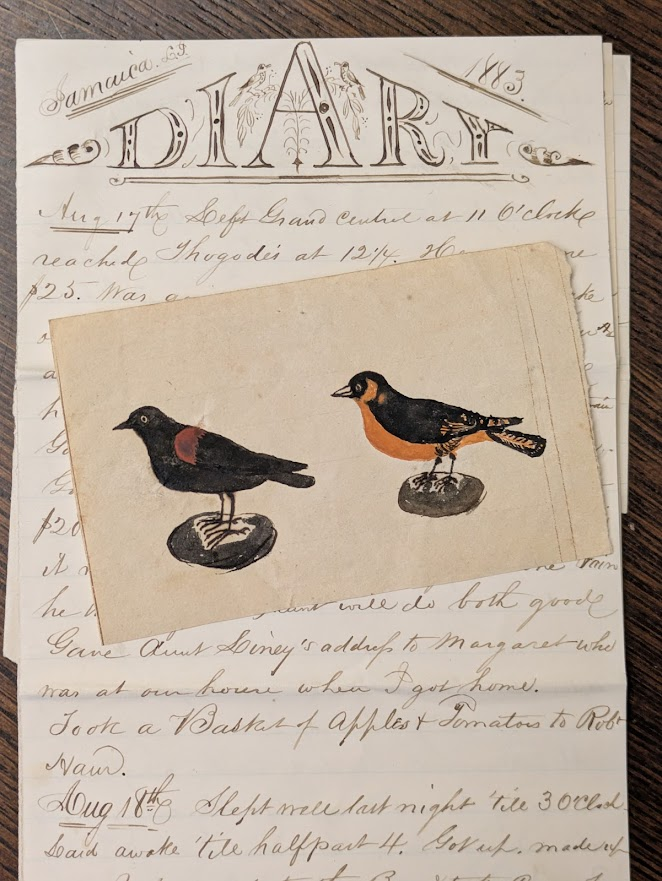
Correspondence from the Leech family papers, along with an ink and watercolor illustration of two birds.
Leech family papers, 1827-1884
This collection consists of correspondence sent to members of the Leech family of Jamaica, Long Island, between 1827 and 1884, along with fourteen ink and watercolor illustrations of animals. The letters predominantly regard social affairs in Jamaica, religious services, temperance, and the everyday life of farmers.
Henry Loewenberg papers, 1864-1900
This collection consists of 14 items produced between 1864 and 1900 relating to the work of inventor Henry Loewenberg/Henry Löwenberg, who aimed to thwart fraud through the development of methods to prevent the reuse of postal and revenue stamps. Insoluble ink and self-canceling stamps were among the methods discussed. The bulk of the papers is incoming correspondence to Loewenberg or government officials. One document pertinent to patent-seeking; a printed patent issued to George T. Jones of Cincinnati, Ohio, in 1870; and a (possibly spurious) letter from a patent attorney dated April 17, 1900, complete the collection.
Markley family papers, 1871-1917
This collection includes correspondence, documents, photographs, and ephemera relating to the Markley family of Belle Plaine, Kansas, centering on Lewis Cass Markley, his wife Sallie Markley, and their children from 1871 to 1917. In addition to content relating to social life and education in Kansas in the late 19th and early 20th centuries, the collection includes photographs taken by Elsie Pauline Markley Pipkin while she was working at the Wolf Point Mission Boarding and Day School on the Fort Peck Reservation in Montana in the 1910s. The photographs document Assiniboine and Sioux students and their families, school buildings, and white female teachers.
J. S. Morton scrapbook, 1835-1839
J. S. Morton used this volume to paste in clippings of artwork he made between 1835 and 1839. Most of the pieces are pen-and-ink or pencil drawings, with dominant themes of domestic and exotic animals, nature, transportation, buildings, hunting, and military life.
New Hampshire student’s cypher book, 1815
This cypher book contains mathematical rules, examples, and exercises copied and completed by an unidentified New Hampshire student, written in 1815. Sections include addition, subtraction, multiplication, and division. Examples and questions are related to measures and weights. Measures include cloth, long, wine, ale, beer, and dry goods. Weights include Tory, Avoir du pois, and Apothecary. The author wrote phonetically. Portsmouth and Exeter are mentioned in a problem, both ports in New Hampshire. Currency in this volume includes British pounds and the U.S. dollar. There is mention of General Washington and Issac Newton, as well as playing a game of marbles. The cypher has contemporary newspaper added as covers by the former owner; the newspaper has been folded in half, is upside down relative to the manuscript, and covered in autographs and markings in ink. There is significant loss and damage to covers and manuscript; the covers are stab sewn with white thread.
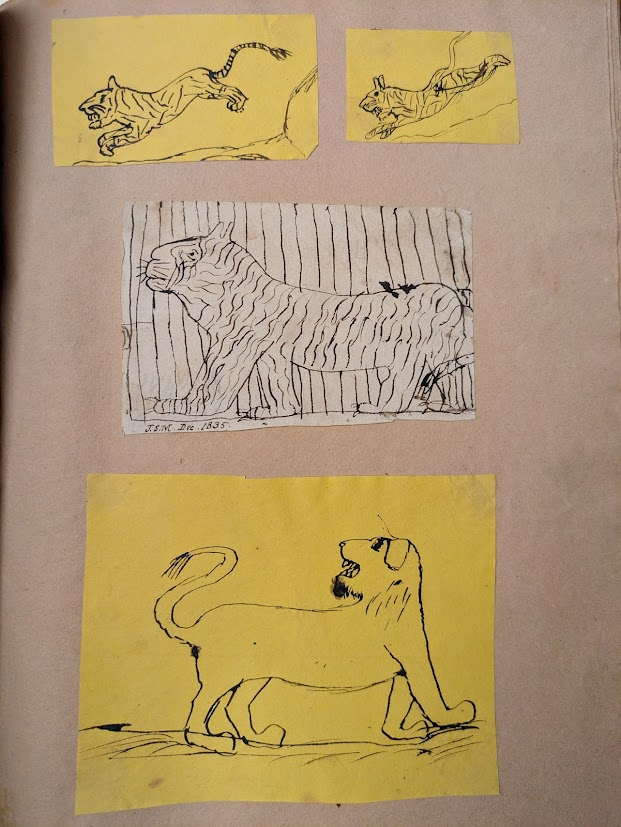
Pen and ink animal illustrations from the J.S. Morton scrapbook.
Roger E. Perkins v. Joseph C. Thompson depositions, 1824
This collection consists of eight depositions taken by Justice of the Peace Samuel Kimball at Andover, New Hampshire, relating to plaintiff Roger E. Perkins’ claim that his colt was undersold at auction (for $49) in 1823. The deponents recollected the sale, a hail storm that occurred during bidding on the horse, and purported rigged bidding by auctioneer Joseph C. Thompson and his family. They also supplied estimates of the colt’s actual worth (around $80-100). Fees and expenses included costs of subpoenas and summonses, travel, and justice’s fees. Kimball indicated on one deposition that the witness was too intoxicated to be reliable. Also present is a statement by Kimball on July 17, 1824, which was also used as a wrapper to enclose the depositions; an out-facing note by Kimball indicated that the case would be heard in the August term of the New Hampshire Superior Court, Merrimack County.
Elbridge Snell notebook, “Commonwealth of Massachusetts Government of 1871”, 1870
This 57-page bound volume, apparently kept by Elbridge Snell of East Stoughton, Massachusetts, is a manuscript list of government officials in the Commonwealth of Massachusetts in 1871. The entries contain birth dates, places of birth, prior governmental roles, and political parties. Additionally, Snell included statistical lists, the recapitulation of senators and representatives, pluralities, and vote tallies for different offices. A note near the end of the volume, dated November 8, 1870, Snell, a boot factory worker living in East Stoughton, added “I voted for Wendell Phillips Labor Reform and Prohibition for Governor and William P. Lynch of East Stoughton Labor Reform for Representative, Elbridge Snell” (page 57).
Daniel L. Orcutt correspondence, 1862-1900
This collection consists of 13 letters written to Daniel L. Orcutt from friends and family between 1862 and 1900, while he was living near Elmira, New York. His correspondents wrote largely from Chemung, New York, and they relate to family affairs, visits, his sister’s teaching, clothing, hunting, and courtship. Several items refer to the Civil War, including Orcutt’s enlistment (October 11, 1863).
Serial Romance scrapbook, ca. 1880s
An unidentified individual repurposed a manuscript ledger to paste in clippings of two printed serial romances that were printed in the Courier-Journal: H. N. Adair’s “In the Dark; or, After Clouds–Sunshine” and Daisy Deane’s “Fairest Among Women”. The compiler filled in missing printed text with handwritten substitutions. Two loose newspaper clippings are laid into the volume, including an article about Mark Twain. The inside back cover features a pencil drawing of a man.
Stephentown (N.Y.) tavern daybook, 1829-1830
This daybook from Stephentown, New York, contains daily financial accounts kept between 1829 and 1830 for what was possibly a tavern and general store. Included are patron names and numerical identifiers, purchases, and amounts for goods purchased or payments received.
W. E. Thompson notebook, 1878-1882, 1915-1945
W. E. Thompson, a student from Bath-on-the-Hudson, New York, kept this notebook between 1878 and 1882 to complete schoolwork on geography, American history, literature, and art. The volume also includes copied proverbs and maxims, original and copied poetry, essays, lists, and drawings.
Jacob Townsley ledger, 1795-1834 (majority within 1795-1797)
Jacob Townsley maintained this ledger of customer accounts for goods purchased at his general store in Steuben, Maine, between 1795-1834, with the bulk of entries falling between 1795-1797. Customers purchased fabrics, tools, housewares, foodstuffs, and tobacco (“sticks of twist”), with Townsley noting payments received via cash, labor (haying, sawing wood), or barter (brick, lumber).
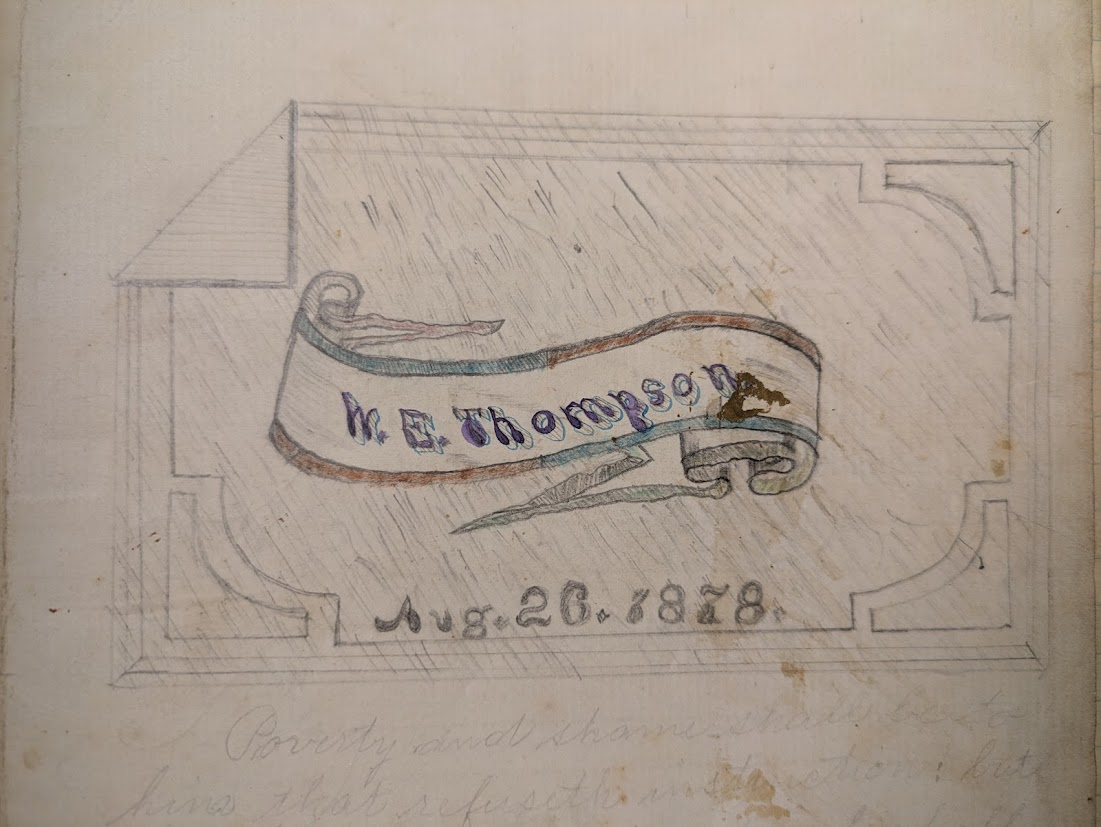
Manuscript nameplate from the W.E. Thompson notebook.