
The Clements Library is thrilled to make another large batch of manuscript collections available for research. Included in this batch are colorful sample checks, documents penned by poet James Whitcomb Riley, and a fan diary recording celebrations of the 4th of July over the years!
Baby Shoes manuscript and memorabilia, [ca. 1870s-1880s?]
The Baby Shoes collection includes one manuscript—knitting instructions for two-colored baby shoes—and six memorabilia items, including four leather children’s shoes, a miniature book-shaped pincushion, and a pair of cloth hearts attached by a ribbon.
Abner Barden account book, 1836-1855
Abner Barden, a hatter, cider brewer, and farmer from Richmond, New Hampshire, kept this account book between the years 1836 and 1855.
Katharine Lee Bates collection, 1911-1928
The Katharine Lee Bates Collection primarily consists of letters sent and received by the poet and English professor between the years of 1911 and 1928. The collection also includes photographs, 20th century commemorative envelopes, copies of her poems, and other materials.
Gift of Duane Norman Diedrich, 1996-2010.
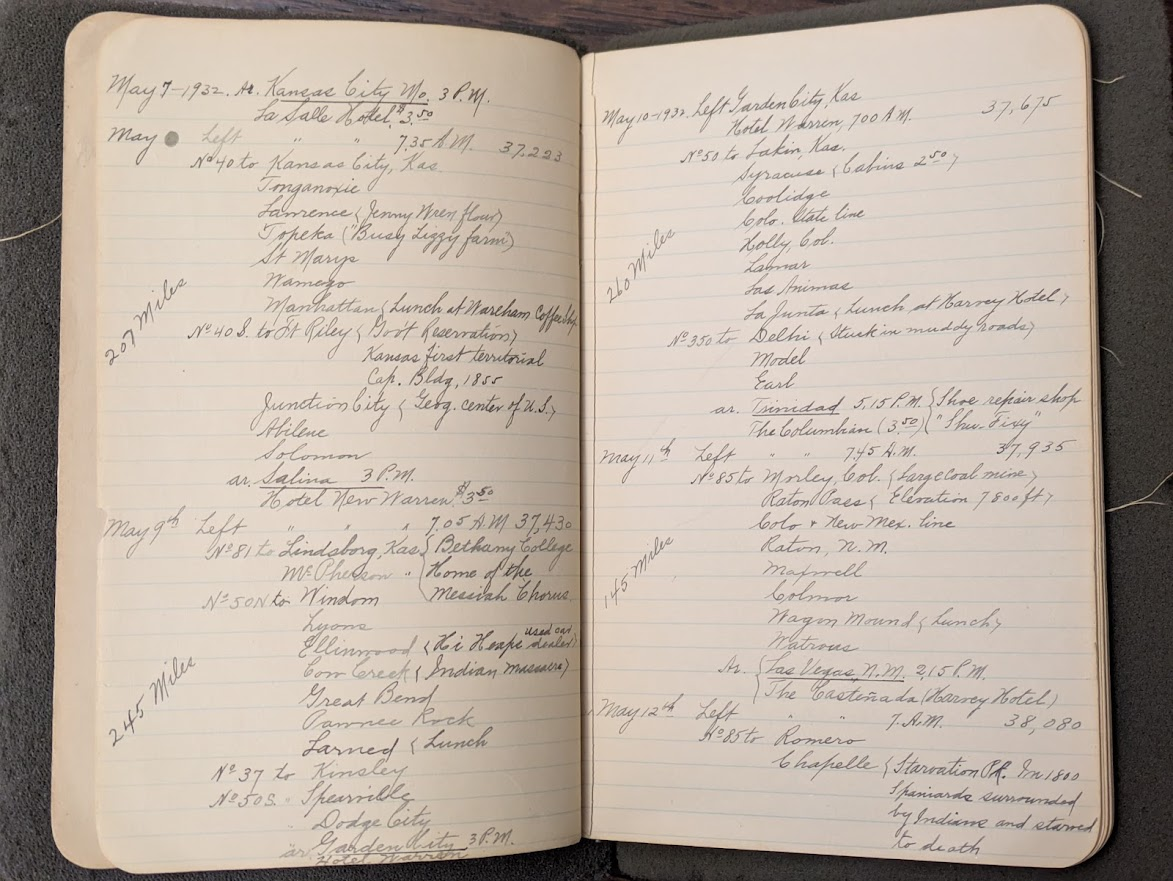
Luella and Helen Crugar travel logs, 1930-1937
Louella and Helen Crugar, sisters from Madisonville, Ohio, kept these two travel logs to document their automobile travels between 1930 and 1937. They kept records for individual trips, documenting dates they were driving, their departure times, roads they traveled, and places they stopped. Entries often included brief notes about interesting sites or events, many relating to history and the environment. Longer trips included milage and gas calculations.
Gift of Martha Becker Valen, 2026.
Corlies, Macy & Co. sample checks, [1890s]
This sample book contains 15 different sample checks produced by Corlies, Macy & Co. of New York, N.Y., in the 1890s. Some samples are printed in bright, colorful ink and adorned with decorative elements. The samples have been produced on several varieties of patterned “safety tint” paper (including Condor, Blue Nassau, Miller, Amber Nassau, Suydam, and Primrose safety tint) as an anti-counterfeit measure. Some sample checks have been partially filled out.
Collection processed and finding aid created by graduate intern Diana Baxter.
Doten family letters, 1871-1890
This collection consists of sixteen letters written by various members of the Doten family of the area around Minot, Maine, from 1871 to 1890 to Frank R. Doten of Columbus, and later Cincinnati, Ohio. They wrote about family and local news, education and Ella Shaw’s teaching, finances, Ella and Frank’s sibling relationship, farming, and caring for their father in his old age.
Herman Baldwin Dean Hand Fan Diary, 1871-1905
This hand fan belonged to Reverend Herman Baldwin Dean and contains manuscript diary entries written on its leaves. Dean wrote one entry per year, on the July 4th Independence Day holiday, between the years of 1871 and 1905. His brief entries include the date and location, the names of acquaintances Dean spent the holiday with, and short comments about the day.
Collection processed and finding aid created by graduate intern Diana Baxter.
Dollhouse Collage and Cashbook, 1879-1882, [ca. 1880s]
This volume (13.25″ x 8.25″), originally a cashbook with entries dating from 1879 to 1882, was later repurposed by an unidentified youth as a paper doll house. It contains 27 rooms, each backed with a different wallpaper and decorated with clippings of printed images such as household furnishings, lighting, and other objects. Most clippings are printed in black and white, though some are in color, and almost all rooms are labeled in pencil. The first page, labeled “Front Door,” has a cutout arched doorway with a handwritten house number (“732”) and name (“Vanderbuilt”) above the door.
Collection processed and finding aid created by graduate intern Diana Baxter.
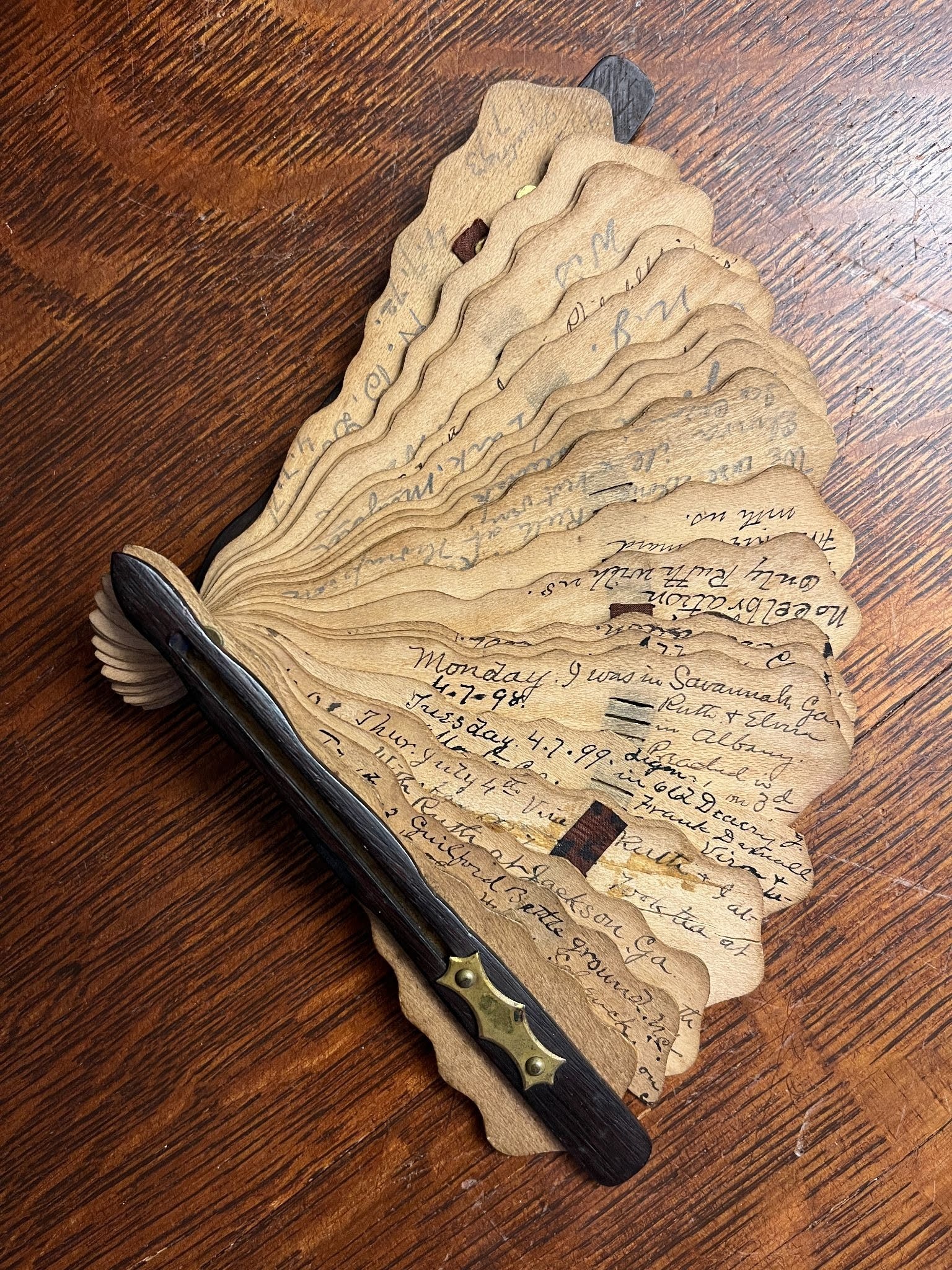
Herman Baldwin Dean kept track of his Independence Day celebrations with this unique diary.
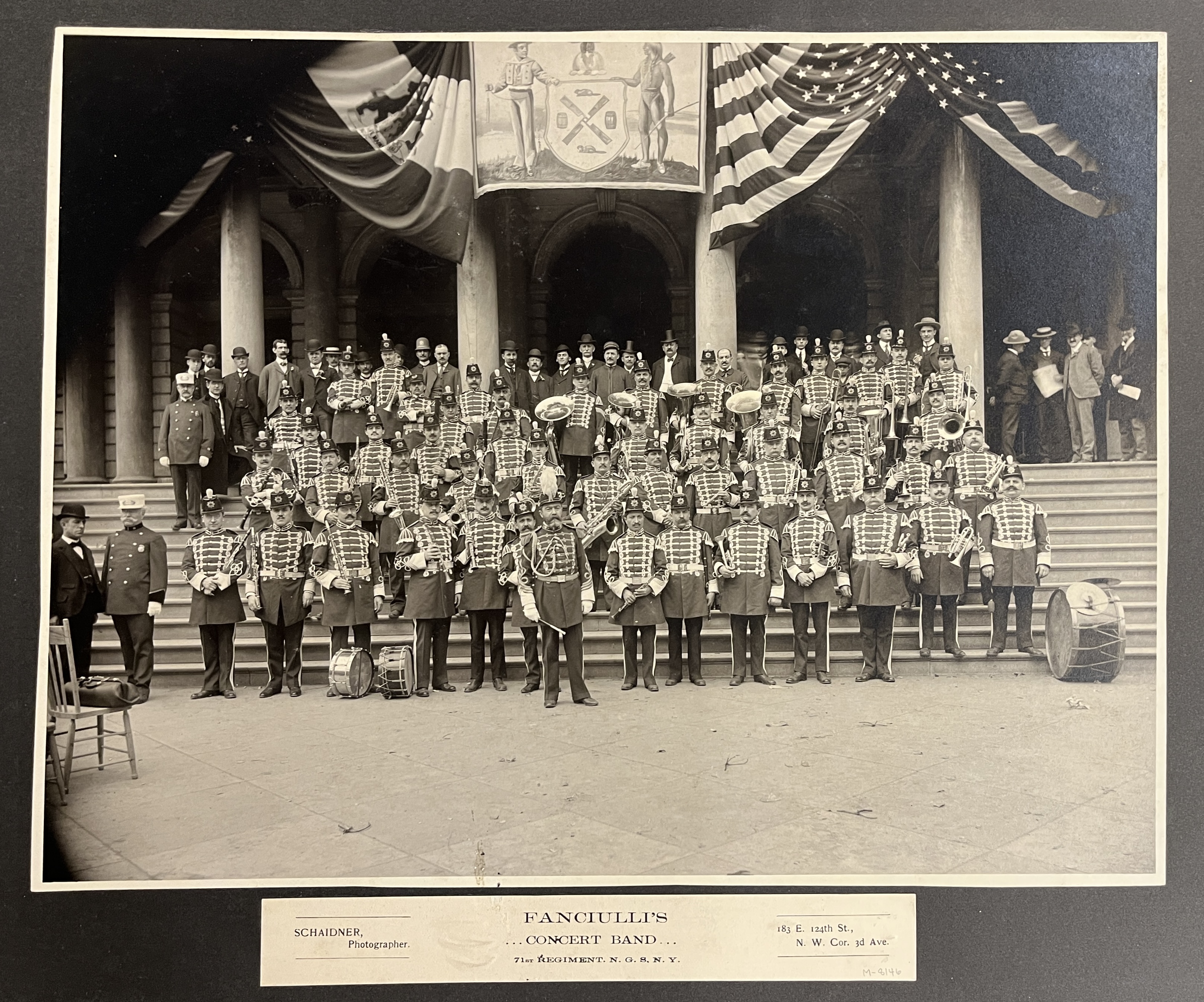
Fancuilli’s Concert Band
Francesco Fanciulli family papers, 1868-2024
The Francesco Fanciulli Family Papers consist of correspondence, musical and other compositions, contracts, photographs, ephemera, printed items, objects, and other materials related to the prominent bandmaster, composer, and music teacher Francesco Fanciulli and his family. The nearly 1,500 items largely date to the period between Fanciulli’s immigration to the United States in 1876 and his death in 1915. Fanciulli’s leadership of the United States Marine Band, New York’s 71st Regiment Band, and Fanciulli’s Concert Band, along with performances at the inauguration of Grover Cleveland, the Pan American Exposition in 1901, the 1904 World’s Fair, and in Central Park are highlights of the collection. Correspondence, photo albums, scrapbooks, and other documents belonging to Fanciulli’s wife Amanda Schile and children are also included.
Gift of Steve Bornemann, 2024.
Fierke-Redman-Howard-Alwin family papers, 1863-2001
The Fierke-Redman-Howard-Alwin Family Papers contain materials, stretching from 1863 into the early 21st century, related to members of the Fierke, Redman, Howard, and Alwin families of Minnesota. The first part of the collection, the Edwin W. Fierke series, includes correspondence, photographs, and documents from Fierke’s service during World War I. The second part of the collection, divided into the Fierke-Redman Family, John R. Howard, and Howard Family series, is made up of genealogical records kept by Edwin W. Fierke’s son Bill Fierke and is arranged according to his methodology.
Gift of Carol Fierke, 2017.
William R. Foote papers, 1912-1920 (majority within 1918-1919)
The William R. Foote Papers are comprised of correspondence, documents, ephemera, photographs, and other material belonging to World War I Young Men’s Christian Association (YMCA) volunteer William “Will” Foote. The collection spans from Foote’s voyage to Europe with the YMCA in April-May 1918 to his service in France and England, and his eventual discharge and return to the United States in April 1919. A few materials dating before and after Foote’s time abroad can also be found in the collection.
Gift of Tyler Putnam, in memory of Phil Balyeat, 2021.
Fosdick v. Leach, Dress Goods and Housewares inventory, 1793
The Fosdick v. Leach, Dress Goods and Housewares Inventory is a 21-page inventory of dressmaking items and miscellaneous housewares. A docket indicates that this inventory was used in a case between Fosdick and Leach in October 1793.
John A. Hayles correspondence, 1944-1946
This collection contains 250 letters, cards, and postcards Royal Canadian Air Force leading aircraftman John A. Hayles sent his girlfriend and later wife Frances Morlan of Detroit, Michigan, between 1944 and 1946. During this period, Hayles was stationed at Camp Borden in Ontario where he worked as a truck and ambulance driver. In his correspondence, Hayles commented on life and work at camp and his budding relationship with Morlan.
Gift of Terri L. Renshaw, 2019.
Clarence H. Hoxie scrapbooks, 1944-1946
Clarence Henry Hoxie, an African American man in the armed forces during World War II, kept these two scrapbooks while serving in Japan, the Philippines, and New Guinea. They include photographs of Hoxie and other Black servicemen, photographs of family members, friends, Japanese women, Filipino women, Papua women, and various natural and cultural sites in Japan, the Philippines, and New Guinea. Copies of official “memorial picture for the Allied Forces” are also present, including images of signing of the 1945 Japanese Instrument of Surrender, General Douglas Macarthur, and American soldiers. Other materials include newspaper and magazine clippings relating to Jazz music and American entertainment, Japanese currency, humorous certificates for crossing the 180th meridian, Japanese postcards, a military-themed valentine, and more.
Collection processed and finding aid created by graduate intern Theresa Azemar.
Joseph O. Hulbert artwork, 1896-1903
The 16 items in this collection were made by Joseph O. Hulbert, a Sunday school teacher at St. James Episcopal Church (Glastonbury, Connecticut), between 1896 and 1903. They include calendars, Christmas and Easter cards, birthday cards, and hymnals containing brightly colored original calligraphy and a mixture of original and mimeographed illustrations. The items are addressed to Carl Smith, also of Glastonbury (“Naubuc”), one of Hulbert’s Sunday school pupils. Motifs that appear frequently include cats, birds, and seasonal markers like Easter bunnies and Christmas trees.
Collection processed and finding aid created by graduate intern Diana Baxter.
Iron City Commercial College Practice Ledger, 1867-1872
This practice ledger, with printed cover title “Ledger for Practice in Learning Book-Keeping, in the Iron City Commercial College of Western Pennsylvania,” was published in 1856 in Pittsburgh, Pennsylvania. It contains 10 pages of bookkeeping entries written in German and dating between 1867 and 1872. The names Charles Lennig, Christian Liebert, and Franz Kellermann appear frequently in the entries. Included with the volume is a four-page printed prospectus from December 1857 advertising the school as the “largest and most thorough commercial school in the West. Emphatically the business man’s college.” The prospectus also contains descriptions of the courses of study offered by the college and “Opinions of the Press.”
Collection processed and finding aid created by graduate intern Diana Baxter.
U.S. Internal Revenue Special-Tax stamp books, 1878-1885
This collection contains six volumes of special revenue tax stamps issued by the United States Internal Revenue between the years 1878 and 1885. Each volume followed a standard format, was created for a specified category of taxpayer (fourth class peddlers, wholesale liquor dealers, brewers of more than 500 barrels, and brewers of less than 500 barrels), and was used in a different tax district. The volumes in this collection include both used and unused tax stamps.
Isabella Batchelder and Thomas Potts James papers, 1808-1818, 1852-1918 (majority within 1852-1874)
The 84 items in this collection primarily consist of letters addressed to or written by Isabella Batchelder James and her husband, Thomas Potts James, of Philadelphia, Pennsylvania, and Cambridge, Massachusetts. The items date between July 19, 1808, and September 17, 1918, with the majority falling between 1852 and 1874. Isabella notably served as the president of the Pennsylvania Freedmen’s Commission after the Civil War, and her husband was a botanist and bryologist. In addition to correspondence, the collection also contains an 1877 codicil to the will of Isabella’s father, Samuel Batchelder; a copy of the will of Silas Wheeler (enclosed in letter of date March 18, 1888); and a bundle of genealogical research on Cotton Mather and the Mather family (undated).
Collection processed and finding aid created by graduate intern Diana Baxter.
Junior Order United American Mechanics Pledge Book, 1898-1907
This book records the pledges of approximately 200 members of the Junior Order United American Mechanics (Jr. O.U.A.M.) between May 14, 1898, and January 23, 1907. The final ~45 pledges are undated and record only the members’ names and ages. Pledges ranged in age from 10 to 70 years old. Most were born in Ohio, though others were from Virginia, West Virginia, Illinois, Pennsylvania, and other states. The text of the pledge reflects the nativist and anti-immigration sentiment of the Jr. O.U.A.M.
Collection processed and finding aid created by graduate intern Diana Baxter.
John Kenny letters, 1895-1923 (majority within 1897-1899)
The John Kenny Letters contain approximately 60 letters Sergeant John Kenny of the 8th Massachusetts Volunteer Infantry sent his girlfriend and future wife Jane Webb of Somerville, Massachusetts, during and immediately after the Spanish-American War. Kenny trained in Georgia and Kentucky between June and December 1898. For three months starting in January 1899, Kenny was stationed at an American camp in Matanzas, Cuba, where he wrote about his work as a prison guard and postman, as well as his strong desire to return to Massachusetts and marry Webb. Kenny sent Webb an additional 20 letters while working as a traveling salesman before and after his service.
Elias Langdon papers, 1862-1878 (majority within 1862-1865)
The Elias Langdon Papers consist of 66 letters Elias Langdon of Traverse City, Michigan, sent to his wife Melissa during the Civil War; two letters from Elias to his sisters; and two newspaper clippings. The papers cover Langdon’s service as a private with the 26th Michigan Infantry Regiment, Company A, from their organization in Jackson, Michigan, in the fall of 1862 through their initial dispatch to Alexandria, Virginia, participation in the Siege of Suffolk in spring 1863, service in New York Harbor, and return south with the Army of the Potomac in late 1863 and early 1864. Langdon was discharged in June 1865.
Gift of Janice K. McAdams, 2021.
Laskey family papers, 1851-1963 (majority within 1944-1952)
This collection contains correspondence, scrapbooks, financial and business records, books, magazines, photographs, and other items pertaining to several generations of the Laskey family of Grand Rapids, Ohio. The 397 items date between 1851 and 1963, with the majority dating between 1944 and 1952. The collection primarily pertains to George Laskey Jr. (1824-1899), George’s son Edward G. Laskey (1852-1925), and George’s great-grandson Carl L. Laskey, Jr. (1926-2003). The Account Books series contains six account books detailing George and Edward G. Laskey’s operation of a general store in Grand Rapids, Ohio, between 1861 and 1905. Carl L. Laskey, Jr.’s military service in World War II and the Korean War is documented in the Correspondence and Documents series, the Photographs and Photograph Albums series, the Scrapbooks series, and the Printed Items series.
Collection processed and finding aid created by graduate intern Diana Baxter.
Gift of Cathy and Mark Zumberge, 2025.
Newton Spaulding Manross papers, 1856-1857
This collection consists of four letters written by Newton Spaulding Manross to Charlotte (“Lottie”) Royce, between 1856 and 1857 while he was serving as a metallurgist with expeditions seeking mineral deposits in Panama and Mexico. He commented on the progress of his work, plans on where he would travel to next, difficulties traversing the countryside, local landscapes, and challenges sending and receiving letters. One undated pencil drawing of Fort San Ramón, Peru, sketched by Manross is also present.
Massachusetts Sunday School Library Register, [late 1860s]
This volume (16.25″ x 14″) bears the embossed cover title “Sunday School Library Register. Sold by Mass. Sabbath School Society, 13 Cornhill, Boston. Ray’s Patent, September 5th, 1865.” Patented by William T. Ray, the register was to be used by Sunday School libraries to keep track of outgoing loans for all library patrons. This specific volume was used by an unnamed Sunday School library, likely in or around Essex County, Mass. It contains the names of several prominent Massachusetts families, including Abbott, Ballard, Bunker, Farnum, Hoyt, Osgood, and Tilton.
Collection processed and finding aid created by graduate intern Diana Baxter.
Margaret Conchy Mitchell estate settlement ledger, 1825-1839
When Margaret Conchy Mitchell died in 1824, William R. Bell, an associate of her late husband William Mitchell, was appointed as executor of her estate. Bell used this volume to record and tabulate payments made and received on behalf of Mitchell’s estate between 1825 and 1839. In 1839, the remaining assets were transferred to Mitchell’s two orphaned daughters.
New Jersey Questionnaire notebook, 1912-1913
This 113-page questionnaire notebook was created by an unidentified author, likely a high school student at Hackensack High School in Hackensack, New Jersey. The author circulated this notebook to friends and classmates to fill in a series of questions about their contact information and nickname; favorite things (school, book, author, song, college, sports, town, boy, girl, names for each gender); how they define a kiss, hug, and love; their greatest ambition, and the current date. Answers provide insight into reading practices, career goals, and reflections on courtship and gender norms. The volume also includes clipped printed images of men and women, mainly from magazines, pasted on blank verso pages.
Collection processed and finding aid created by graduate intern Theresa Azemar.
Maria P. Noyes diary, 1888-1895
Maria P. Noyes, a schoolteacher in Chicago and New Hampshire property owner, kept this diary between the years 1888 and 1895. Noyes was an experienced educator and recorded her thoughts on students, other teachers, and administrators in her diary. Other topics included Noyes’s thoughts on various preachers, her drawing classes, her interest in the trial for the murder of Patrick Henry Cronin, and her support of the Republican Party. Twenty-six loose documents, including two letters Noyes wrote then-New Hampshire Commissioner of Immigration Nathum Bachelder in 1890 and notes she may have made at the 1893 Chicago World’s Fair (Columbian Exposition), are enclosed in the diary.
Edward St. Croix Oliver letters, 1867-1874
This collection contains correspondence written by Edward St. Croix Oliver, a ship captain from Boston, Massachusetts, while at sea. The letters are dated April 17, 1867; June 22, 1873; and January 27, 1874. They were sent from Leghorn (Livorno, Italy), the Guañape Islands (Peru), and Santa Cruz (likely Santa Cruz de Tenerife, Canary Islands), respectively. The final letter contains an addendum from Oliver’s wife, Sarah (“Sallie”) Jane. Oliver’s correspondence focused primarily on his sea voyages. He discussed a storm that devastated the port at Valencia, Spain; the Europeans’ astonishment over U.S. Monitor warships; and the birth of his son aboard ship off the coast of the Guañape Islands.
Collection processed and finding aid created by graduate intern Diana Baxter.
William H. Parrott expense book, 1870-1881
This sample book, with cover title “Specimens of Printing Types by R. & J. & A. W. Lindsay, New York,” was re-purposed by William H. Parrott to keep track of his expenses. Dated entries range from August 22, 1870, to April 29, 1881. Parrott pasted receipts and other financial records and ephemera onto 23 pages of the volume, with additional materials laid in. Most receipts were issued by businesses in Bridgeport, Conn., where Parrott lived. The receipts primarily record the purchase of clothing, furnishings, and foodstuffs. Some of the tipped-in items contain color sketches and doodles on their versos.
Collection processed and finding aid created by graduate intern Diana Baxter.
James Whitcomb Riley collection, 1874-1910
The James Whitcomb Riley Collection consists of letters, poems, and other documents penned by Riley or otherwise related to his literary career. The collection includes five letters from Riley sent between the years 1874 and 1895. It also includes Riley’s original manuscript of “The Old Man and Jim,” four short poems, a poetic eulogy, two notes written by Riley, and a copy of Riley’s 1909 poetry collection, Riley Roses. A significant portion of material relates to the humorist Edgar Wilson “Bill” Nye. Two portraits, one of Riley and one of Nye, can be found in the collection.
Gift of Duane Norman Diedrich, 2016.
Ella Russell visiting book, 1876-1877
This collection is a visiting book kept by Ella Russell of New York City between October 1876 and June 1877. Russell visited and received visits from men and women mostly residing in midtown and lower Manhattan.
Shawneetown (Ill.) Woman’s travel diary, 1855
The currently unidentified author of this diary chronicled her life and observations between January and October 1855. She was a resident of “Shawnee” (now Old Shawneetown), Illinois, and went on extended trips to Nashville and Watertown, New York. She was bookish and social reform-minded, a supporter of women’s rights, temperance, and abolition. In two notable entries, the diarist recorded conversations she had with enslaved or formerly enslaved people.
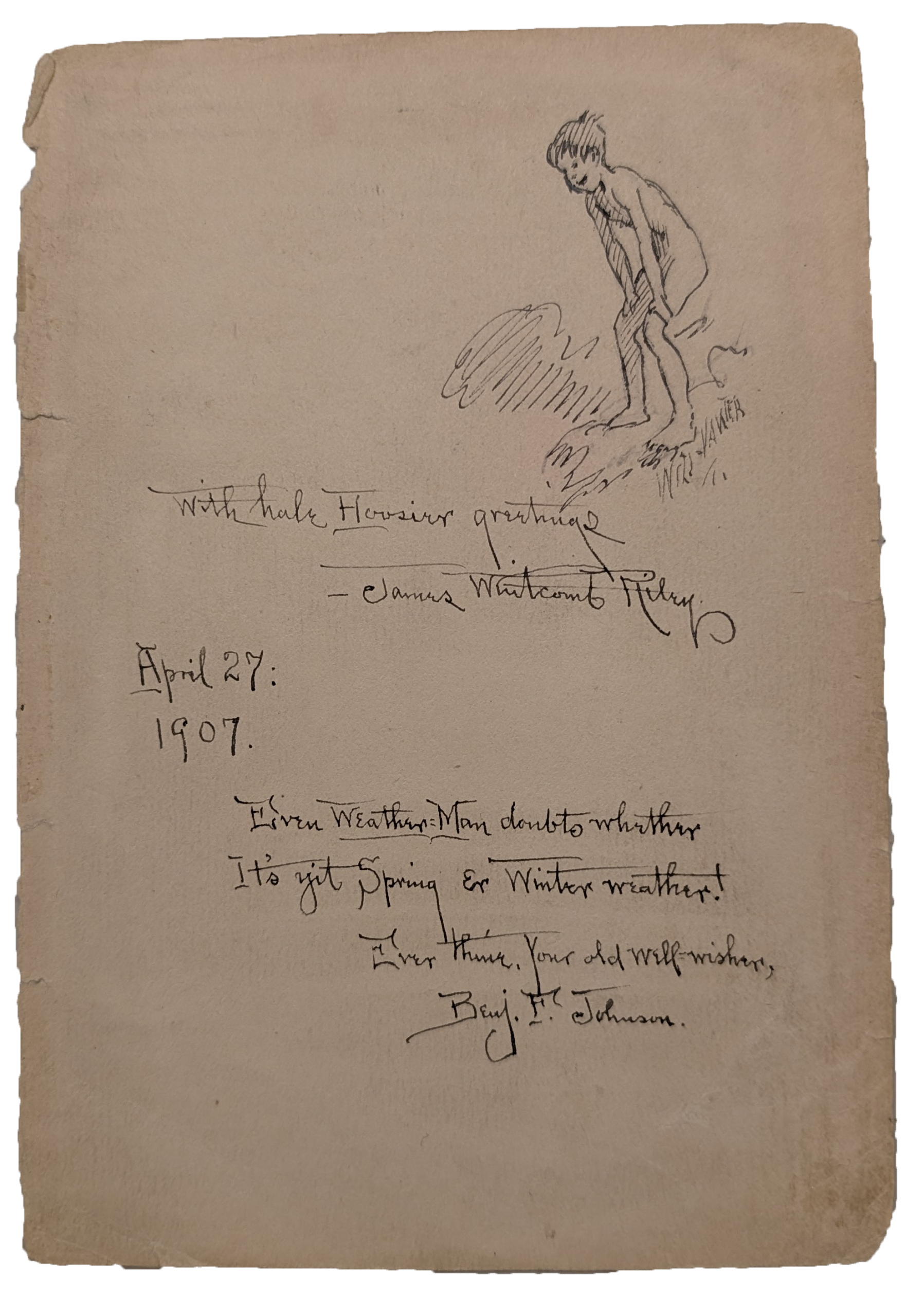
James Whitcomb Riley’s illustrated autograph and illustration of boy at the Old Swimmin’ Hole, addressed “With hale Hoosier greetings.”
William H. Stevens Letters, 1837-1875
This collection contains 19 letters, primarily written by William H. Stevens to his brother Captain Ebenezer Stevens of Meredith, New Hampshire, after William moved from New Hampshire to the Upper Midwest. Two letters were written by William and Ebenezer’s brother John Stevens after he joined William there. The letters date between July 1, 1837, and June 6, 1875, and the majority were written in Garnavillo, Iowa, in 1853. The letters primarily concern William’s attempts to obtain a divorce from his wife Sophronia Hutchinson Stevens, who he left in New Hampshire when he resettled in the Upper Midwest. By 1853, he had already married another woman, Mary Clark, and started a new family. In addition to the matter of William and Sophronia’s divorce, the letters also address settlement and land speculation.
Collection processed and finding aid created by graduate intern Diana Baxter.
Stonebraker, Parson & Co. bookkeeping index, 1884
The Stonebraker, Parson & Co. bookkeeping index contains 38 pages of customer and account names, arranged alphabetically. A manuscript note on the front pastedown reads “Stonebraker, Parson & Co. July 14 / [18]84.” The account names are accompanied by numbers, which correspond to page numbers in a separate volume. Some accounts represent specific goods, like “Flaxseed a/c,” “Hominy,” “Oats on Store,” and “Potato a/c.” Of note, alphabetized page tab dividers have been cut by hand along the right and bottom edges of each page to facilitate use and navigation of the volume.
Collection processed and finding aid created by graduate intern Diana Baxter.
“Thoughts of 1862” Poetry notebook, 1862
This notebook of original poetry was compiled by an unidentified writer. It contains an opening introduction and approximately 363 poems dated between January 2, 1862, and December 31, 1862. Recurring subjects include Saturday choir rehearsals, semiweekly Bible study readings, and the Civil War. The poems touch on themes of Christian faith and character, nature, time, human behavior, grief, and writer’s block. Of note is a poem dated September 18, 1862, in which the author meditates over the description of a dead man as “only a solider”. Also of note is the poem dated October 23, 1862, which is an ode to Ojibwe Chief Hole-in-the-Day.
Collection processed and finding aid created by graduate intern Theresa Azemar.
George J. Vining autobiography, 1907-2020 (majority within 1907-1908)
The George J. Vining Autobiography contains 15 documents related to an autobiography penned by a 71-year-old Vining in 1907 and 1908. Presented as a letter to his children, Vining’s autobiography covered his entire life from an early, and difficult, childhood in Bristol, England, and Pine Bluff, Arkansas, to his service in the Civil War and later years as a grocer and family man. This collection contains three versions of the autobiography, a short essay by Vining, a letter from Vining’s son, and research documents kept by Vining’s great-grandson Daniel Vining, Jr., in 1979 and 1980.
Nathaniel and George White collection, 1841-1845
This collection primarily contains correspondence between Nathaniel White of Quincy, Massachusetts, and his son George between July 12, 1841, and December 27, 1845, while George was a student at Phillips Exeter Academy. It also contains two “Hard Times” tokens produced in response to the financial crises of the 1830s and 1840s. In his letters, Nathaniel discussed the decline of his shoemaking business following the Panic of 1837, the monetary assistance he provided for his son’s education, and Quincy’s mid-term election of 1842. In George’s letter to Nathaniel, he discussed Exeter’s term schedule, provided an account of his expenses, and mentioned his involvement in the school’s Golden Branch literary society.
Collection processed and finding aid created by graduate intern Diana Baxter.