
As always, the Manuscripts Division has been diligently processing unique collections to make them available for research.
All are welcome to research at the Clements Library, so request an appointment if any of these collections are calling your name!
Manuscript Magazines and Newspapers collection, 1840-1917
This collection comprises 38 volumes (27 titles) of American handwritten magazines and newspapers dating between 1850 and 1917, with the bulk dating from the nineteenth century. The larger portion were created by school children, clubs and literary societies, friend groups, and individuals in Northeast States, though examples from Michigan, Kentucky, California, and elsewhere are represented. The most common features include calligraphic mastheads and headers, articles, essays, stories, poetry, jokes, conundrums, parodies, songs, advertisements, “publication” information, and illustrations.
Frederick H. Wippermann letters, 1917
This collection consists of four letters written in 1917 by Frederick H. Wippermann, Superintendent of the Central Wesleyan Orphan Asylum of Warrenton, Missouri, to Charles Senser, a farmer from Corder, Missouri. The two men were corresponding about orphaned boys to hire for work on Senser’s farm. Wippermann provided details about available children to hire from the Orphan Asylum, noting their age, disposition, and how to manage their behavior. They also corresponded about boys placed on Senser’s farm, payment of their wages, and replacing those who were not good fits.
Mary Woodman private library manuscript inventory, [circa 1928?]
This 80-page loose-leaf binder titled “Books of Mary Woodman” contains an inventory of over 500 titles from the private library of Mary Woodman (1842-1928), eldest child of Cyrus and Charlotte Flint Woodman. The books in Woodman’s library were published as early as 1711 and as late as 1928. They include poetry collections, essays, histories, autobiographies, scientific works, travel guides, foreign language dictionaries, cookbooks, religious texts, and novels. Many entries contain provenance notes indicating previous owners, books given by one Woodman relative to another, books given directly by their authors, inscriptions, and other notable features.
Collection processed and finding aid created by graduate intern Diana Baxter.
People v. Arthur Mayhew collection, 1896
The People v. Arthur Mayhew collection contains correspondence, court documents, attorneys’ notes, witness statements, and a photograph related to the trial of Arthur Mayhew. Mayhew was accused of the March 7, 1896, murder of Stephen Powell in Hempstead, New York. Materials related to John Albert Wayne, the accused accomplice and most significant witness in Mayhew’s trial, are also included.
Merrimack County (N.H.) Jail register, 1883-1909
This register lists the names of individuals confined at the jail in Merrimack County, New Hampshire, between 1883 and 1909, their offenses and associated charges, date of their discharge or additional sentencing, and payment of fees.
Thomas Barlow book of advice, 1856
This wallet-style diary (3.5″ x 2.25″) contains fatherly life advice and aphorisms written by lawyer Thomas Barlow and presented to his 20-year-old son George Thomas Barlow, apparently when George left New York for Ohio in 1856. The father recommended that the son keep respectable company; further his education; be frugal; mind his health; avoid alcohol, tobacco, and profanity; and court only chaste and virtuous women. He also provided thoughts on the importance of playing music and gave instructions for skinning birds.
Benjamin Bailey account book, 1831-1847
This 423-page account book was compiled between December 31, 1831, and May 28, 1847, by Benjamin Bailey (1768-1858). The volume documents transactions pertaining to Bailey’s work as a shoemaker, tanner, and currier in Wilkes-Barre, Pennsylvania. Page 254 is mostly blank apart from the words “B. Bailey & Son.” Subsequent entries begin to reference D. G. Bailey, suggesting that Benjamin’s son Daniel Gore Bailey became involved with his father’s business.
Collection processed and finding aid created by graduate intern Diana Baxter.
Winifred Harper Bonnell scrapbook, 1916-1919, 1936 (majority within 1918-1919)
This 97-page scrapbook contains photographs, letters, picture and photographic postcards, programs, permits, tickets, clippings, insignia patches, a ration book, and other ephemeral items compiled by Winifred Harper Bonnell while she worked as a stenographer for the U.S. Army Nurse Corps during World War I. The volume she pasted into was a guestbook titled Sporting Days: A Book for Visitors and House Parties (E. W. Savory, Ltd., Fine Art Publishers, Bristol, 1907) that contains printed illustrations by different artists as well as blank pages for entries.
Collection processed and finding aid created by graduate intern Diana Baxter.
Gift of Anne Hiller, 2026.
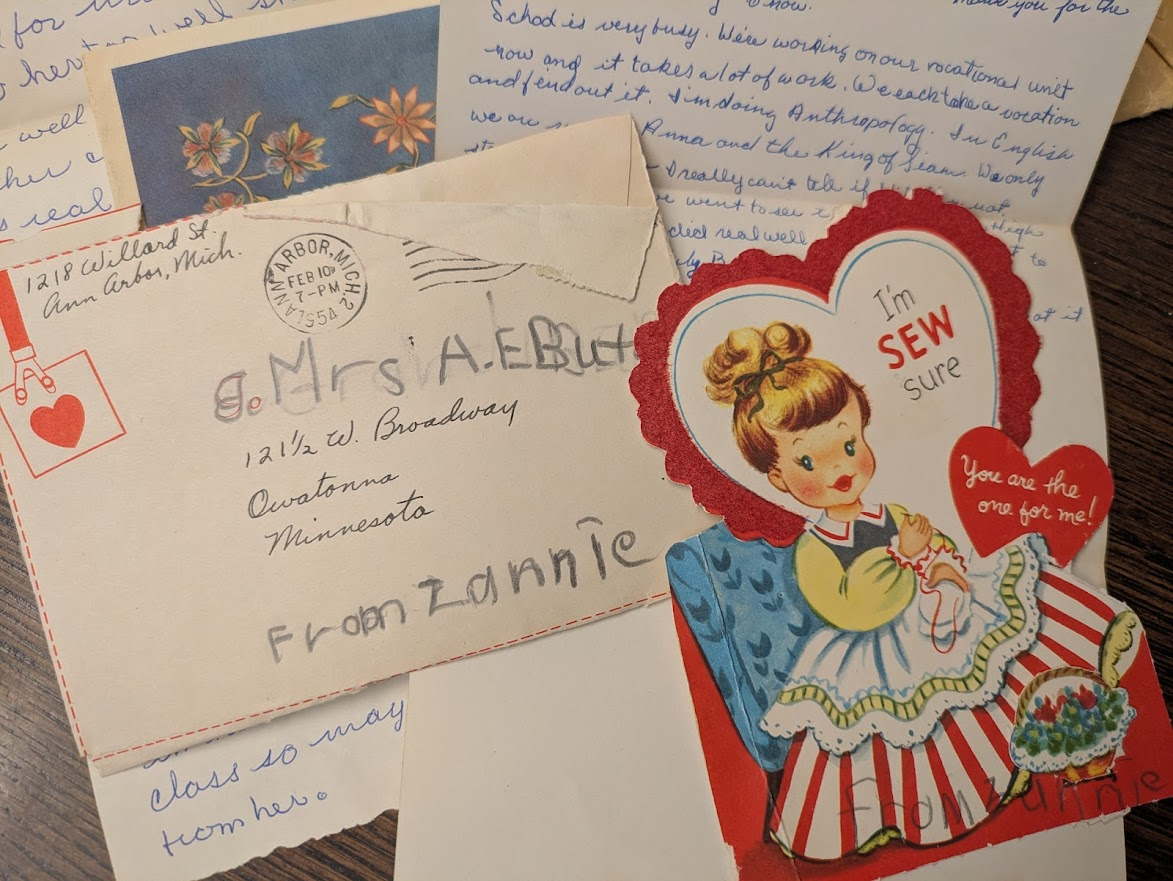
Butsch family papers, 1935-1969
This collection consists of correspondence, documents, scrapbooks, and printed material primarily relating to the World War II service of Robert, James, and Thomas Butsch of Owatonna, Minnesota. The bulk consists of the correspondence home to their parents, Josephine and Albert Butsch, respecting their training and service in both the European and Pacific fronts. The collection details Jim Butsch’s death while serving with the United States Air Forces during the war, the family’s efforts to gather information relating to it, and the aftermath. Additional content relates to Bob Butsch’s work with the Barbados Museum in the 1930s, Geraldine Clayton’s service with the Women’s Army Corps during and after the World War, and Josephine and Albert Butsch’s relationship with their grandchildren who were living in Ann Arbor in the 1950s and 1960s.
Gift of Elizabeth Cardinal, 2026.
Charlie S. Curtis diary, 1865-1866
Fourteen-year-old Charlie Curtis’ 1865-1866 diary documents daily life on his family’s farm in Somerset, Vermont. Curtis participated in and wrote about a number of activities on the farm, from logging and chores to making maple syrup and attending school.
Gardening Lists notebook, 1868-1873
This volume contains six pages (and three laid-in sheets) of lists of flowers, fruits, and vegetables. The lists were written in a blank book, Autumn of 1869. Daniel Hoffman & Co. Wholesale Dealers in Hats, Caps, Furs, Robes and Umbrellas. 354 Broadway, New York, [1869].
Beverly T. Thompson reading list, 1857-1864
Beverly T. Thompson of Saline County, Missouri, kept this 17-page reading list, plus index, between 1857 and 1864. He read works of philosophy, ancient and modern history, politics and government, travel accounts, novels, poetry, Shakespeare, and serials. When Thompson read multi-volume works, he indicated which volume he was reading at a given time.
U.S. Internal Revenue Assessment Book, 1865-1868
This volume contains U.S. Internal Revenue Service (IRS) assessments for North Carolina’s second and fifth collection districts, located along the state’s northern border, during the years 1865-1868. Representatives of the IRS, which levied excise taxes on high-value goods and high-income occupations, recorded taxed individuals, their locations, tax rates, and the totals due.
Globular Sailing Cypher Book, [18th century]
These 40 disbound pages originated from a larger cypher book. They provide instruction and practice exercises in globular sailing, a mathematical approach to maritime navigation that accounts for the spherical shape of the Earth. They contain intricate, hand-colored calligraphic illustrations, flourishes, and lettering. Illustrations depict birds, angels, feathers, fish, and people. Definitions, explanations, and practice exercises are provided for the following concepts: sailing to windward, globular sailing, parallel sailing, Mercator’s sailing, and middle latitude sailing.
Collection processed and finding aid created by graduate intern Diana Baxter.
William Wolcott Guild Poetry Book, 1847-1865
This 132-page book of original poetry was compiled by William Wolcott Guild (1827-1904). It contains approximately 85 poems dated between March 11, 1847, and April 30, 1865. Guild’s poems touch on themes of love, religious faith, nature, and family. Entries include odes to places Guild has lived, remembrances of deceased loved ones, and acrostic poems and “Poetical Letters” addressed to friends. Of note is Guild’s poem “Poor Sambo’s Epitaph” (May 26, 1851), in which he memorializes an unidentified enslaved man and reflects on the inhumanity of chattel slavery. Also of note is “The Phases of Secession Jeff Davis the Barometer” (undated; laid into volume), which tracks the evolution of Jefferson Davis’s manner and attitude over the course of the Civil War.
Collection processed and finding aid created by graduate intern Diana Baxter.
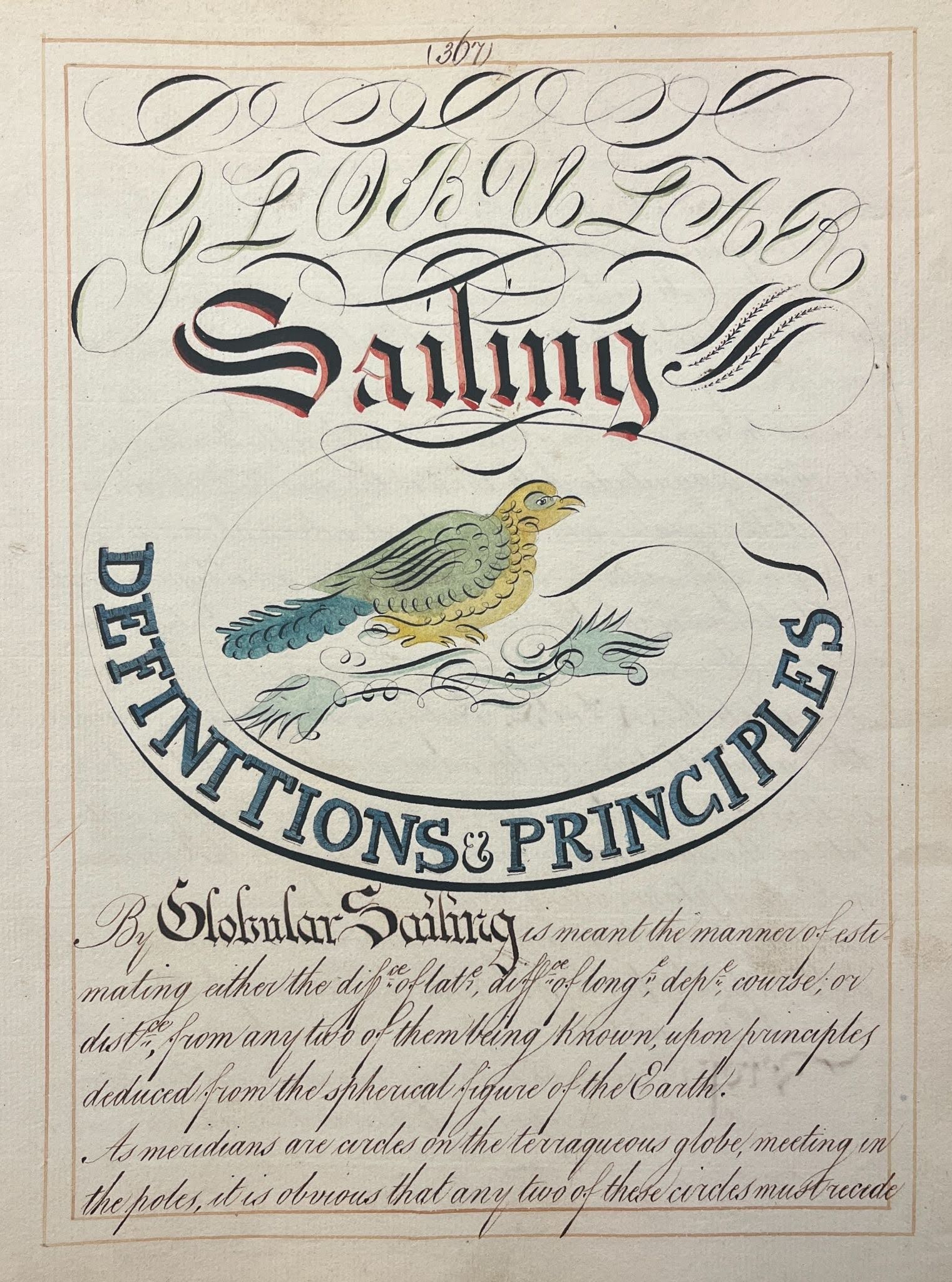
The Globular Sailing Cypher Book was created by a skilled writer, whose calligraphy, script, and illustrations make these pages visually appealing as well as informative/educational
Johnson-Brown-Chew-Stephenson family papers, 1772-1968
These voluminous papers consist of correspondence, documents, business records, notebooks, photographs, and other materials belonging to six generations of the prominent Philadelphia-based Johnson, Brown, Chew, and Stephenson families. The collection spans from the late-18th century to the mid-20th century and is especially strong in matters related to the family’s businesses, international travel, and estate disputes.
Gift of Nancy D. Stephenson, 1998.
Louisiana (Mo.) diary, 1860
This diary belonged to a Sunday School teacher in Louisiana, Missouri, and contains daily entries from January 1, 1860, to June 14, 1860, and from October 26, 1860, to December 31, 1860. The author was also employed as a teacher and, evidently, an administrator at the Louisiana Institute. The diary entries cover topics such as the weather, his studies, the day’s work, the author’s frustrations and pleasures, the quality of students’ attention in class, social engagements and lectures, and Church gatherings such as prayer meetings and “Love Feasts.” The author frequently mused on success, struggle, hard work, education, morality, propriety, and duty.
Collection processed and finding aid created by graduate intern Diana Baxter.
![The title page of a mid-18th century manuscript volume belonging to Moses Moon: "Mysterious Nothing, A Poem; With an Allegory of Life and Futurity; An Elogy [sic.] on the Death of Jeremiah Langhorn, Esq; To which is added, Providence, a Poem," by William Satterthwaite.](https://clements.umich.edu/wp-content/uploads/2026/06/Moon-family-papers-1748-1821-Poem.jpg "Moon family papers, 1748-1821 Poem")
The title page of a mid-18th century manuscript volume belonging to Moses Moon: “Mysterious Nothing, A Poem; With an Allegory of Life and Futurity; An Elogy [sic.] on the Death of Jeremiah Langhorn, Esq; To which is added, Providence, a Poem,” by William Satterthwaite.
Moon family papers, 1748-1821
The Moon Family Papers are made up of 14 documents and one volume belonging to this devout Quaker family of Bucks County, Pennsylvania. The papers include copies of speeches made at Quaker meetings, copies of writing related to Quaker faith, and personal documents such as wills, journal entries, and financial accounts. A single volume contains a manuscript copy of a rare work of poems written by William Satterthwaite and printed by Benjamin Franklin in 1736. The manuscript title is “Mysterious Nothing, A Poem; With an Allegory of Life and Futurity; An Elogy [sic.] on the Death of Jeremiah Langhorn, Esq; To which is added, Providence, a Poem.”
Gift of Clarence Wolf, 2018.
Independent Order of Odd Fellows, Eulalia Lodge No. 196 minute book, 1857-1874
This volume contains the meeting notes of the Eulalia Lodge No. 196 of Morristown, Ohio, a branch of the Independent Order of Odd Fellows. Various secretaries, elected for yearlong terms, kept minutes during the Lodge’s weekly meetings between 1857 and 1874. The notes recorded meeting activities, financial matters, motions, passed resolutions, and the elections of new members and promotions of existing ones.
Gift of Patricia Ryckman, 2014.
Gardner Ruggles memorandum book, 1801-1850
Gardner Ruggles of Hardwick, Massachusetts, kept this memorandum book during the first half of the 19th century, recording a handful of family notes and financial accounts.
Maurice Salts cypher book, 1792-1793
This sailcloth-bound cypher book contains over 300 pages of notes, mathematical rules, practice exercises, and unit conversion tables written by Maurice Salts partly between December 19, 1792, and March 8, 1793. The practice exercises largely relate to commerce and finance. Sections include cloth, sand, liquid (wine and Winchester), and dry measures; troy, avoirdupois, and apothecary weights; and addition, subtraction, multiplication, division, inverse proportion, reduction, the rule of three, and fractions. Salts also learned simple and compound interest, brokerage (“brokage”), loss and gain, barter, rebate, and discount.
Collection processed and finding aid created by graduate intern Diana Baxter.
M.B.S. sketchbook, [19th century]
This sketchbook was created by “M.B.S.” in the 19th century, possibly in Pennsylvania. The volume contains numbered drawings of buildings of different architectural styles, homes, fences, signs, bridges and overpasses, a tombstone, tools, keys, scissors, dishware, housewares, a shoe, a water pump, ashcans, decanters, a spade and basket, a wheelbarrow, a plow, a wagon, birds and a birdhouse, decorative designs, sailboats, animals, a monkey shaving in front of a mirror, a man fishing, and people.
Springfield (Me.) daybook and account ledger, 1844-1845
This daybook and account ledger (approximately 140 pages) contains a record of the purchases, payments, and other transactions of a business—seemingly a tavern, stable, and store—in Springfield, Maine, between October 28, 1844, and November 29, 1845. The entries are organized chronologically and grouped by customers’ names. Revenues (debit entries) include stable fees and charges for alcohol (rum, gin, brandy, wine, etc.), meals, dry goods (barley, oats, wheat, etc.), produce (potatoes, corn, etc.), and sundries. Expenses (credit entries) include labor and barter of goods.
Collection processed and finding aid created by graduate intern Diana Baxter.
Charlotte F. Torrey diaries, 1914-1919
This collection consists of two diaries belonging to Detroit high society woman Charlotte F. Torrey. Both were kept during family vacations: a 1914 trip to Italy and France, and a 1917 trip to California. Torrey recounted the family’s daily activities, from sight-seeing and automobile trips to meals with friends.
Wadsworth-Burrows family papers, 1843-1907 (majority within 1864-1907)
This collection consists of 40 letters and documents relating to the intertwined Wadsworth and Burrows families, primarily focused on Eva Wadsworth of Pennsylvania, her fiancé and then husband Frederick Burrows of Little Rock, Arkansas, and their children. The bulk of the content relates to Eva Wadsworth’s early education, her relationship with her father, and her engagement and marriage to Frederick Burrows. Later letters include material written by their children, including three letters written by Dudley and Ethelbert Burrows while they were working with banana exporters in Panama. Other content in the collection relates to their extended family, with items on marriages, family tensions, and health.
Van Cleve-Baker-Day family collection, 1859-1919
The Van Cleve-Baker-Day family collection is largely comprised of outgoing letters of David C. Baker between 1859 and 1865 and letters by his daughter Clara Day to her niece Charlotte Collins between 1916 and 1919. The earlier papers offer detailed accounts of life in and the development of Liber, Indiana. Clara Day of Richmond, Indiana, wrote six letters on family life and aspects of World War I. The papers also include two copies of Margaret “Peggy” Van Cleve’s “diary”/autobiographical sketch, beginning with her birth in 1778 and discussing the family’s settlements in Ohio from the 1790s to 1819.
Gift of Lisa Keeney, 2025.
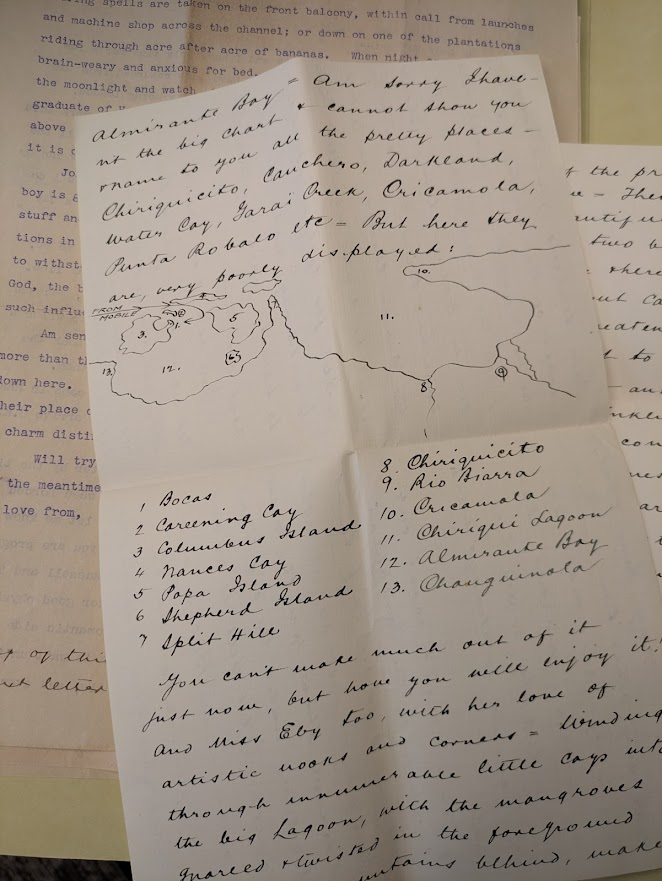
Letters in the Wadsworth-Burrows family papers regarding banana exportation from Panama include this manuscript map of the area.
Wadsworth (Nev.) General Store daybook, 1880-1881
This 240-page daybook contains a record of the daily transactions of a general store in Wadsworth, Nevada, from June 1, 1880, until December 22, 1881. The goods purchased from the store include tobacco, produce and other groceries, alcohol, dry goods, medicine, and hardware. Several entries pertain to “Borax Consignment” accounts (pages 2, 30, 46, 64, 164, 209, 228, 238, et al.), Other customers include Epperson and Griswold (pages 22, 139, 141, 144, 162, 164, 167, et al.). Also of note, page 148 includes a delivery to a “Reservation Store” of fishhooks and line, onions, potatoes, flannel clothing, apples, and seeds, among other items.
Collection processed and finding aid created by graduate intern Diana Baxter.
W. Scott Westerman, Jr. papers, 1943-1945
The W. Scott Westerman, Jr. Papers cover the one-and-a-half year period from November 1943 to June 1945 during which Westerman served in the 86th Infantry Division of the United States Army. In approximately 165 letters home to his parents in Gallipolis, Ohio, Westerman described daily life in U.S. Army camps and, later, while deployed in France and Germany. A handful of other material, including an essay Westerman wrote about a trip to Hitler’s compound in Berchtesgaden, Germany, is filed at the end of his papers.
Gift of W. Scott Westerman, Jr., 2013.