
This past month, 19 new manuscript finding aids were made available online. Seven of those were written by our wonderful student interns! These collections offer glimpses into the everyday lives of a farmer and a sheriff, reflections on experiences as a prisoner of war, business records, and more.
Edward L. Bigelow penmanship book, 1848
This 24-page volume contains penmanship exercises of Edward L. Bigelow, likely of Marlborough, Massachusetts. Bigelow sewed and adhered a textured paper cover over a pre-printed blank book and added “Edward L. Bigelow Book / Dec 12 1848” to the front. On the covers, Bigelow wrote his name repeatedly in a crisscrossing pattern and sketched floral designs within borders created by his name. The penmanship exercises include repeated letters, words, and Massachusetts place names, mostly arranged alphabetically. On the last page, Bigelow practiced writing his name alongside “Marlborough, Mss.”
Finding aid by graduate student intern Diana Baxter.
Henry C. Davis journal, 1863-1864
This manuscript journal recounts Henry C. Davis’s experiences between June 1863 and February 1864, including his participation in the Second Battle of Winchester, capture as a prisoner of war, and being held at Libby Prison in Richmond, Virginia.
Hardeman County (Tex.) Justice’s civil docket and fee book, 1905-1910
The Hardeman County, Texas, Justice’s Docket and Fee Book contains a record of civil court cases held in Precinct One of Hardeman County between 1905 and 1910. Each page of the partially printed volume contains space indicating the names of the plaintiff(s) and defendant(s), attorneys, a detailed description of the case, the outcome, and the accounting of a wide variety of different fees. The cases pertain to property rights, escaped livestock, mortgages, refusals to pay, personal debt, corporate debt, and other disputes.
I.O.O.F. Morning Star Lodge, No. 20 cemetery book, [ca. 1870s]
The I.O.O.F. Morning Star Lodge, No. 20 Cemetery Book is a partially printed receipt book for cemetery plots in Placerville, California, belonging to the Morning Star Lodge, circa 1870s. Each page is a blank printed form, being a “Certificate of Purchase for Lot in the Union Cemetery, Placerville . . . belonging to said Lodge, according to the Plat of Survey made by D.B. Merry, and the said Lot is hereby granted to him, subject to the rules of said Lodge now in force, or that may hereafter be adopted for the government of the same.” The forms remaining in this volume have not been filled in.
Jackson County (Ind.) Circuit Court documents, 1823-1841
This collection is made up of 99 documents produced or filed by the Jackson County, Indiana, Circuit Court between 1823 and 1841, with the bulk dating between the 1838 February Term and 1841 August Term. These materials are brief records of court case verdicts and fines assessed (and in many cases collected). The fines/fees were for cases of assault and battery (usually a $1 fine if guilty), while others included “profane swearing” ($5-10 if found guilty), affray, trespass, forced imprisonment, passing forged currency, and other infractions. The manuscripts variously include the names of plaintiffs, defendants, justices of the peace, sheriffs, clerks, other persons, and townships in which cases were tried.
James Keenan letter book, 1854-1858
This 104-page letter book (12.5″ x 16.75″) contains retained copies of 65 letters, primarily from U.S. Consul to Hong Kong James Keenan to Secretaries of State William L. Marcy and Lewis Cass. The letters date between February 1, 1854, and January 14, 1858, spanning Keenan’s initial arrival in Hong Kong in January 1854 to his departure for a year-long leave of absence in January 1858. Keenan updated the Secretaries of State on matters concerning American citizens and commercial interests, including shipwrecks and instances of piracy. Other content includes conflicts with British authorities about jurisdiction over American vessels and his disputed involvement in the siege of Canton on October 29, 1857.
Finding aid by graduate student intern Diana Baxter.
Livingston-Knapp-Conway Band collection, 1895-1908
The Livingston-Knapp-Conway Band Collection is made up of concert and advertising programs, photographs, pamphlets, and a scrapbook related to the overlapping careers of New York State bandleaders Patrick Conway, Charles P. Knapp, and Frederick H. Livingston, largely dating between 1895 and 1908. The men worked variously as band conductor, director, treasurer, manager, soloist, saxophonist, clarinetist, and other positions. The bands represented in the collection include the First Regiment Band, Knapp’s New York State Band, Knapp’s Millionaire Band, Livingston’s National High School Band, The Ithaca Band, and Bauer’s Concert Band.
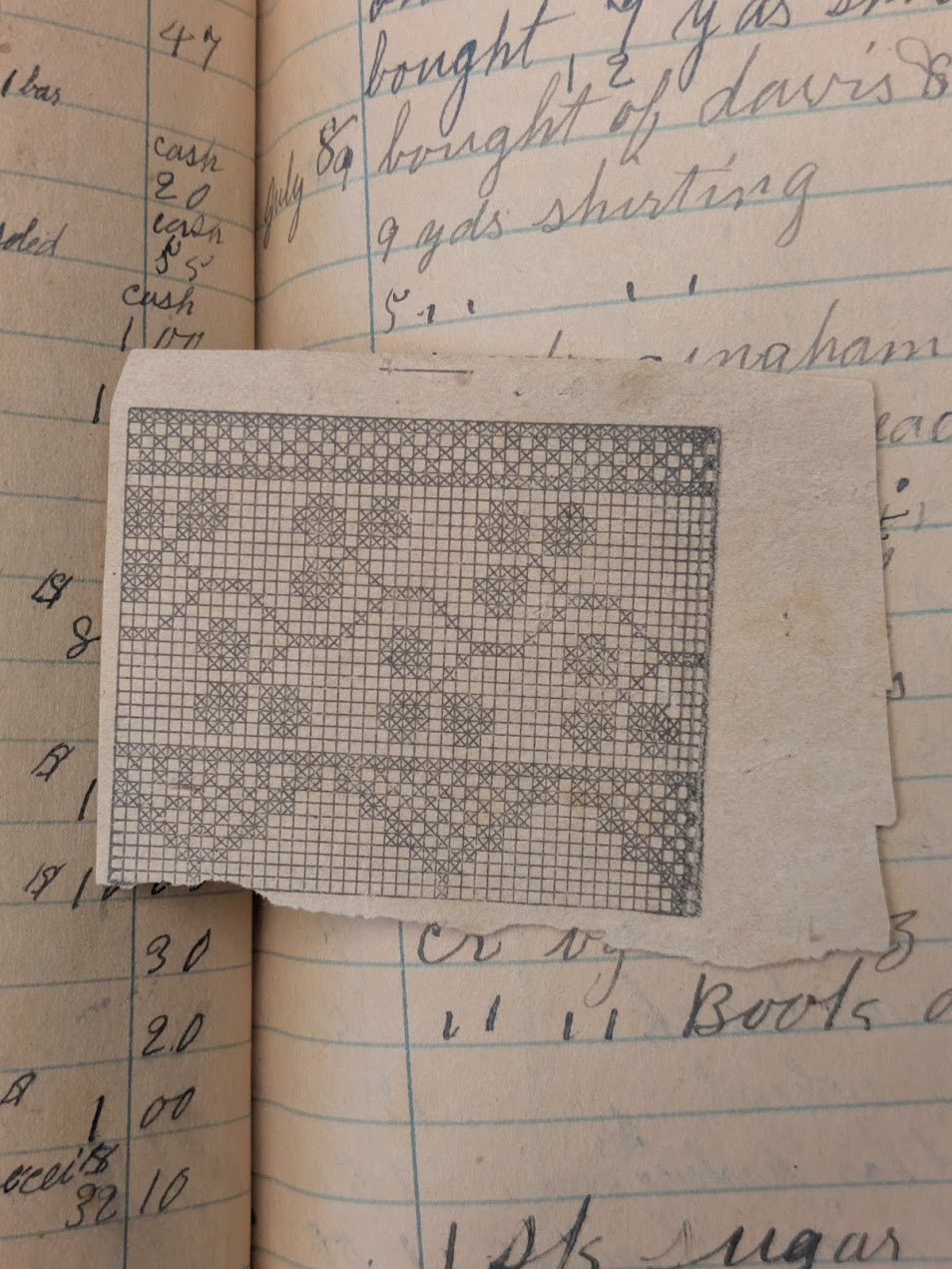
Morgan’s diaries provide a detailed glimpse into turn-of-the-century farm life. This embroidery pattern laid into one of them is suggestive of the kind of sewing she may have been doing while not tending to other farm duties.
Edith Luton notebook, 1912-1916
This 57-page notebook belonged to Edith Luton and contains notes, sewing exercises and samples, fabric swatches, sewing patterns, and diagrams. Entries range from November 13, 1912, to December 8, 1916. A linen cover embroidered with daisies and the author’s name (“E.L.U.T.O.N.”) is stitched around the notebook and has sewing needles tucked into it, one of which is still threaded.
Finding aid by graduate student intern Diana Baxter.
Prudence T. Morgan collection, 1883-1917
Prudence Thompson Morgan kept seventeen diaries and account books between 1883 and 1917, documenting her and her family’s lives and labors in Linn County, Oregon, and other nearby locations. She wrote about their farming and orchard operations, domestic labor, health, social activities, and the family’s expansion of their properties and technological advances. Written from when she was 41 until she was 76, the collection also documents the shift in her labor on the farm as she aged. Several letters, newspaper clippings, and two photographs are housed at the end of the collection.
Pennsylvania Oil record book, 1889-1892
This volume provides a record of barrels of oil extracted from different oil fields or by different rig owners/operators, apparently in Pennsylvania. Among the many names represented are James Stewart, James Harding, Aetna Oil Co., Jos. Kelly & Co., Crew-Levick & Co., and Miles Stit. Each entry includes dates, barrels demarcated as “sound” or “broke” crude oil, and barrels demarcated as “broke” or “sound” refined oil. The first pages have been repurposed and used to insert marriage and funeral announcements related to the Poulard family of Philadelphia.
Hannah Peters manuscript poems, 1778-1788
This collection consists of 12 pages of manuscript poems, at least 11 of which were composed by Hannah Peters (1706/7-1799) of Medfield, Massachusetts, on her birthdays between 1778 and 1788. She wrote rhyming verses on themes of marriage, old age, death, God and religion, and the afterlife (with references to Christian eschatological events). She also wrote about her children, mourning the death of two grandchildren, and her husband, William Peters. The final poem, “The Dark Day,” is unattributed, but appears to be another original poem by Hannah Peters given its opening lines of reflection over the previous year. The poem was written about New England’s “Dark Day” of May 19, 1780, when forest fires and cloud cover resulted in a day of near-complete darkness.
Queens County (N.Y.) Court documents, 1798-1843 (majority within 1816-1825)
This collection is made up of 59 documents produced or filed by Queens County, New York, Court of Common Pleas, Court of Oyer and Terminer, Court of Special Sessions, or Supreme Court, between 1798 and 1843 (majority falling between 1816 and 1825). The cases relate to a variety of legal subjects and procedures, including assault and battery, cepi corpus, debtor and creditor, ejectment, false imprisonment, insolvency, mortgages, larceny, praecipe, recognizance, replevin, slander trespass, venire, and others.
Real Cárcel de San Juan de Puerto-Rico prisoner records, 1896-1899
This collection is made up of four partially printed “Hoja Historico-Penal del Preso” for four men arrested, imprisoned at the San Juan Prison, then released. Three of the men were arrested on charges of rebellion against the Spanish government and the other for multiple arrests, including slander and kidnapping (for which he served a year in prison). The partially printed forms include blank spaces for the prisoner’s name, their parents’ names, nativity, court information, profession or occupation, religion, physical description, and other information.
Singer Manufacturing Company papers, 1861-1949 (majority within 1861-1879)
This collection is made up of correspondence, bills of sale, financial records, and other business papers of the Singer Manufacturing Company, one of the largest sewing machine producers internationally. The 2,398 items date largely from 1861 to 1879, during the company presidencies of company co-founders Isaac M. Singer and Edward C. Clark, and businessman Inslee Hopper. The majority of the collection regards orders for machines and machine parts, intellectual property disputes, and worker relations.
Finding aid by graduate student intern Theresa Azemar.
Davis H. Seamans cipher book, approximately 1800
This cipher book contains mathematics rules, examples, definitions, and exercises copied and completed by a student named Davis H. Seamans, possibly of Rhode Island, no earlier than 1800. The sections include the rule of three, tare and trett, conversions between currency, and trigonometry. The examples and questions incorporate Federal money and commerce, mentioning goods such as cloth, butter, rice, tobacco, and indigo. The final page includes list of names with tallies, [possibly an attendance sheet?]. The binding is contemporary sheepskin added as a cover by former owner, sewn with long stitches along spine; the inside of the cover is lined with newspaper, dated 1800 and featuring local news from Providence; the leather is very worn; length is 41 cm.
Finding aid by graduate student intern Naomi Yu.
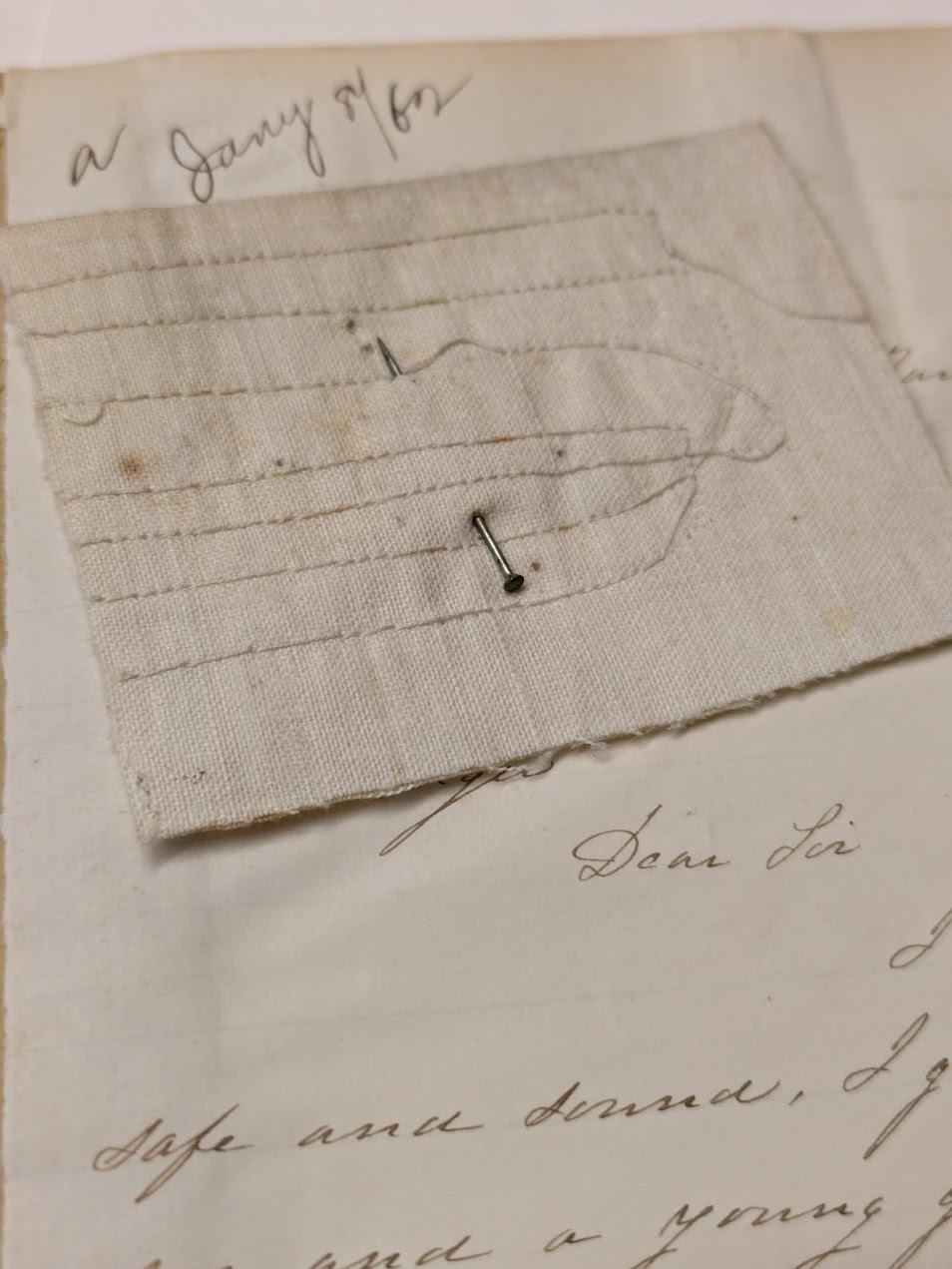
This letter from 1862 was written by a customer frustrated by their sewing machine “skipping,” and attached a sample to demonstrate the problem. Singer Manufacturing Company Papers.
Stanwood (Wash.) Logging and Pile Driving diary, 1896
This 1896 Excelsior pocket diary contains a daily account of the labor and life of a currently unidentified man who ran a logging and pile driving business along the Stillaguamish River in Snohomish County, around Stanwood, Washington. His brief but consistent entries are a record of changing prices charged, wages paid, names and locations of customers, locations where he worked and stayed, and types of work completed. The writer logged wood in forests around the river and, along with crews of two or three laborers, drove piles for waterfront docks and loading platforms. Some entries also include personal travels and social events.
Wayne County (Mich.) Superintendent of the Poor collection, 1899-1908 (majority within 1904-1905)
This collection contains correspondence and documents produced or filed by the office of the Wayne County (Mich.) Superintendent of the Poor between 1899 and 1908. The 232 items include correspondence, receipts, and financial reports pertaining to the Wayne County Asylum and the Wayne County House, institutions which evolved into the Eloise Psychiatric Hospital complex in Westland, Michigan. Much of the correspondence was written by or addressed to Stanislas M. Keenan and P. H. Dwyer, bookkeeper and secretary respectively, to the Wayne County Superintendent of the Poor during these years. Many letters discuss renovations and improvements made to the facilities at the county house and asylum, while others include inquiries about specific patients.
Finding aid by graduate student intern Diana Baxter.
Bert Wentworth journal, 1904-1911 (majority within 1904)
Bert Wentworth, Deputy Sheriff of the Dover, New Hampshire, Police, kept this journal from 1904 to 1911 to compile copies of court documents, notes about evidence, newspaper articles, correspondence, photographs, and other materials relating to the case State of New Hampshire vs. Deneigh Darisse. The case relates to an illegal abortion that led to the death of Regina Gamelin in 1904. The materials reflect on the practices surrounding terminations of pregnancy, working women’s social and labor conditions, and criminal investigations in the early 20th century.
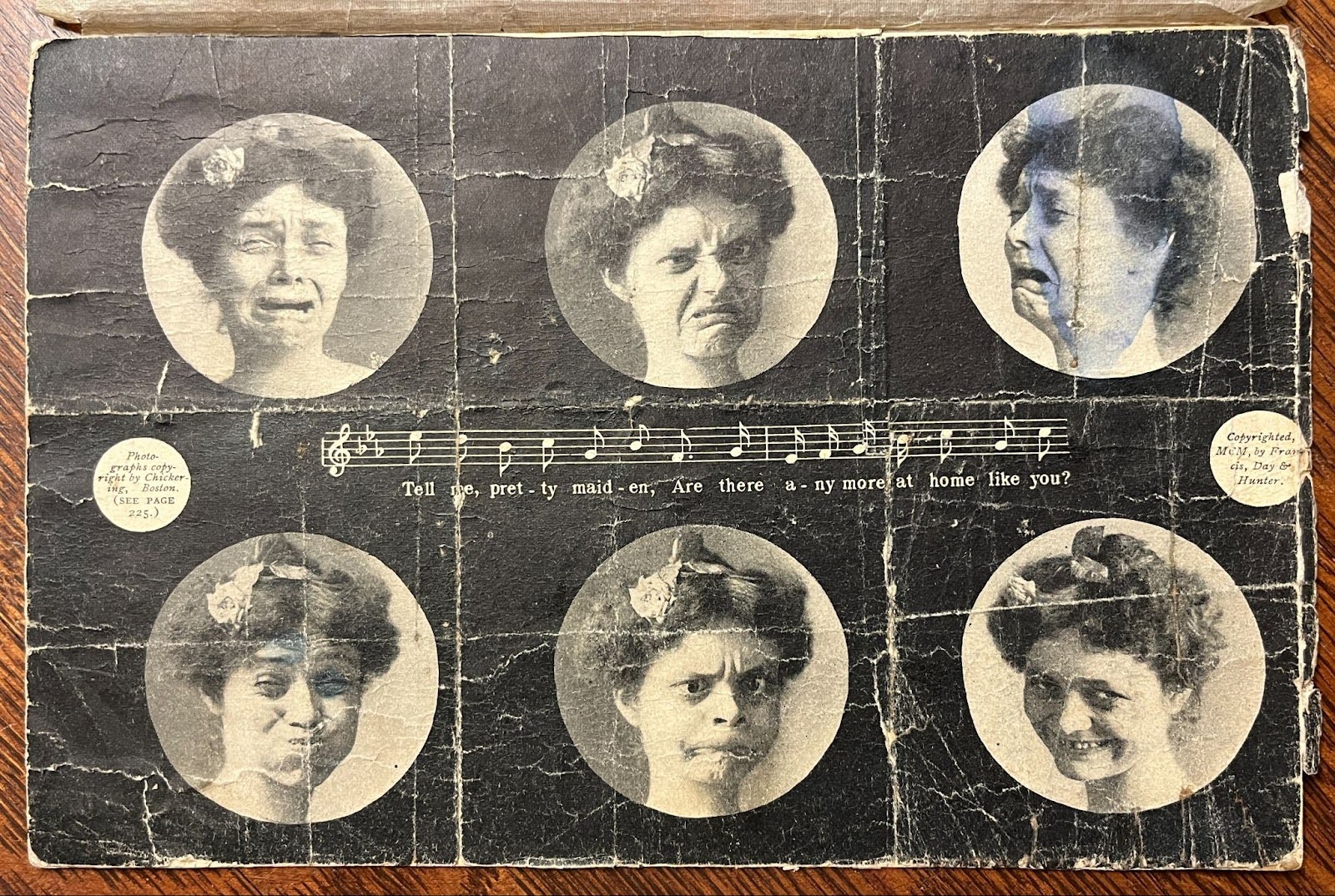
These six headshots of facial contortionist and vaudeville actress Elizabeth Lindley Whipps were likely made around the time of Whipps’ performances at a Chickering Hall venue in Boston in the first decades of the 20th century.
Elizabeth Lindley Whipps papers, 1898-1946 (majority within 1898-1920)
This collection of correspondence, documents, photographs, newspaper and magazine clippings, advertisements and ephemera, school notes, a scrapbook, and other materials belonged to vaudeville actress and facial contortionist Elizabeth Lindley Whipps (“Bessie Whipps”). The papers largely date from the late 1890s to the 1910s, beginning with her education at the New England Conservatory School of Oratory and following her early career managed by James Pond, then as understudy with Julie Marlowe’s Company.
Finding aid by graduate student intern Theresa Azemar.