
The Manuscripts Division has processed ten new collections of handwritten materials, including the 1898-99 diary of a currently unidentified soldier serving with the 31st Michigan Infantry. Everyone is welcome to conduct research at the Clements, what will you discover in our collections?
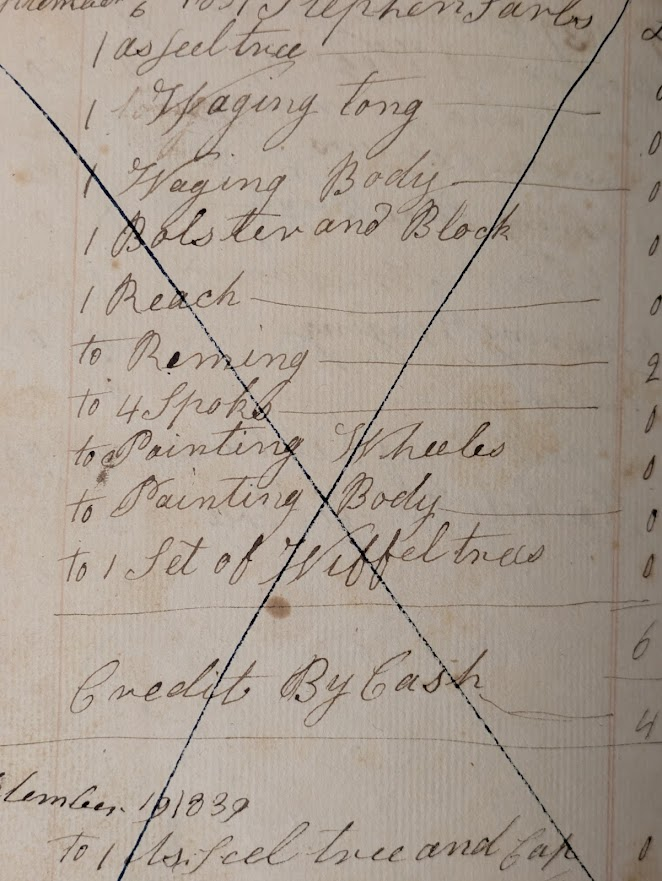
1839 entry in Robert Carpenter’s account book.
Robert Carpenter account book, 1819-1854
Robert Carpenter kept this account book between 1819 and 1851 to document the financial transactions relating to his work as a wheelwright and carpenter, likely around New Castle, New York. The final entries in 1854 relate to the settlement of his estate.
Frederick F. Coulter journal, 1847-1849
Frederick F. Coulter kept this journal while he was a ship’s boy learning to be a sailor aboard the American merchant vessel Matilda (Capt. Theodore Lewis), November 7, 1847-December 20, 1849. Coulter described everyday life aboard the Matilda during a voyage around the world that began in New York when he was 19 years old. The vessel traveled down the South American coast, around Cape Horn, with stops at Valparaiso, Monterey, Sandwich Islands, India, China, Singapore, the Philippines, St. Helena, Pernambuco, and back to New York. The merchants handled sugar, brown sugar, rock candy, alum, cotton, silk, linens, ivory, opium, tea, firecrackers, hides, hemp, Japan wood, sandalwood, cigars, indigo, wax, bricks, copper, pickles, and other products.
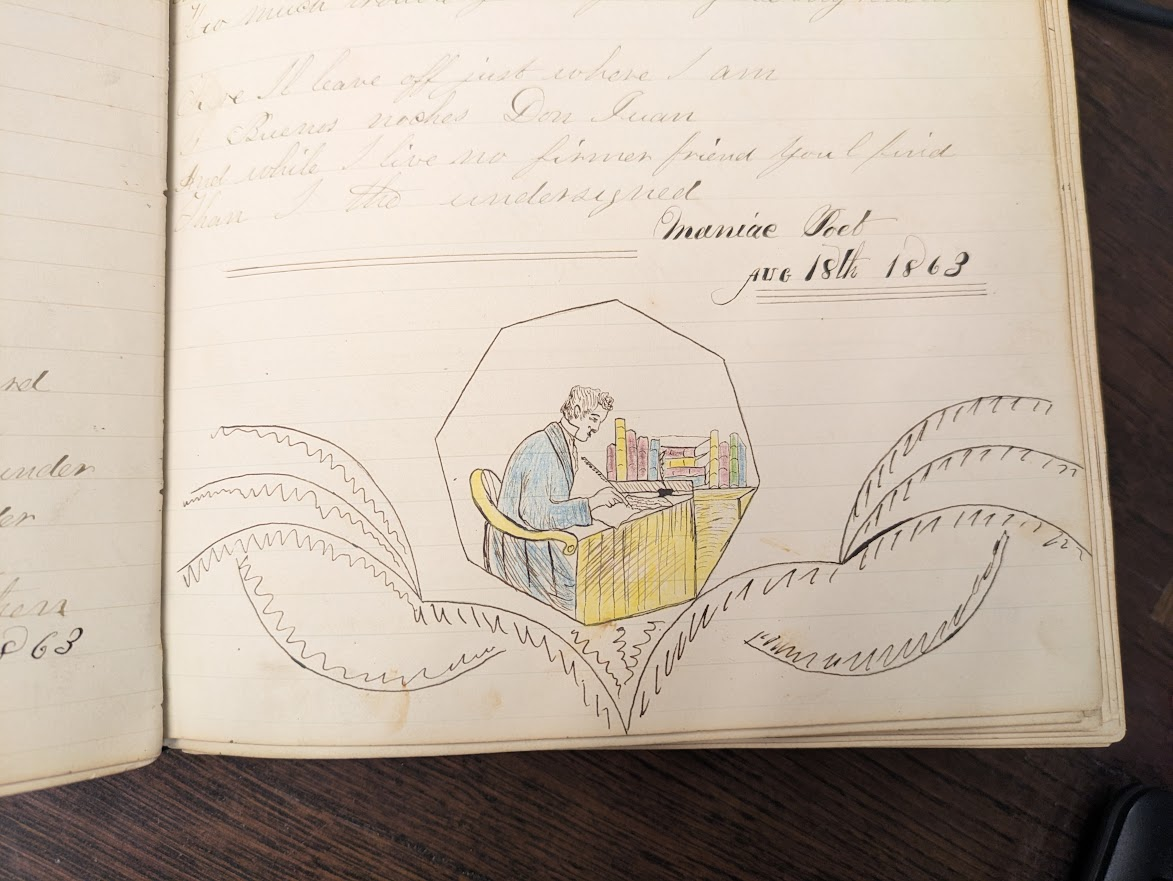
Watercolor and ink illustration in DeWitt Clinton Robinson’s notebook.
DeWitt Clinton Robinson illustrated notebook, 1862-1864
DeWitt Clinton Robinson kept this notebook between 1862 and 1864 to compile his humorous poetry and essays, watercolor and ink illustrations, as well as his autobiographical accounts of his travels to enlist in the United States Navy and his experience aboard the U.S. Rhode Island when it drove a Confederate blockade runner ashore. It includes reflections on gender and race, Civil War politics and events, and maritime culture.
Erastus Gile penmanship copybook, 1837-1840
Erastus Gile of Lee, New Hampshire, used this notebook as a penmanship copybook between 1837 and 1840. It includes repeated copies of sentences or phrases written in cursive, typically religious or moral maxims. Several pages were used to practice arithmetic, record Gile family genealogy, and copy various poems. The volume is bound with printer’s waste sheets from a sacred hymnal tune-book.
Osgood & Grey collection, 1882-1884
This collection includes letters and documents produced between 1882 and 1884 about the business operations of Osgood & Grey, a Chicago mercantile firm engaged in the meat industry and commission sales. The bulk of the letters were written by A. S. Osgood while operating out of New Orleans and various sites in Texas, seemingly involved in setting up a new firm named Fagan & Osgood and sharing details about the Texas Continental Meat Company. The collection includes content on the transportation of meat, meat markets, finances and disputes over debts, and conflict over stockholders and management.
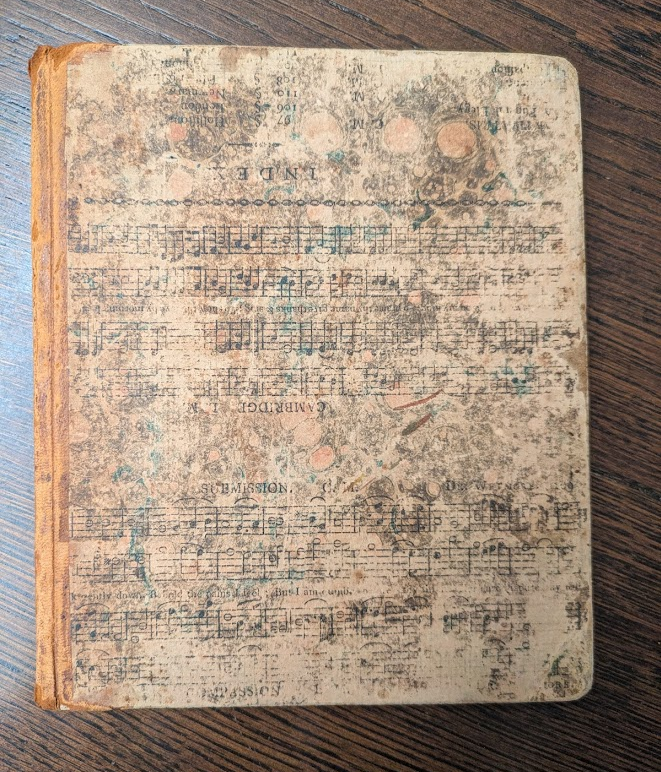
Printer’s waste sheets from a sacred hymnal tune-book used as the binding of Erastus Gile’s penmanship copybook.
Lucy Rice diary, 1856
Schoolgirl Lucy Rice kept this volume—”my first diary”—in the early months of 1856. She wrote brief daily entries January 1-February 19 about diary keeping; playing snowball and visiting the public library with her friend Mary Gage; sewing her own clothes; receiving presents; writing letters; “writing off some songs” (named “the Havel Dell” and “Jenny Dale”); having a party with seven other girls; and missing school because of measles, colds, injuries, and a “snow day!” school closure. She also wrote about her teachers, missing extra points for being spoken to in class, and school rules.
John J. Stoddart Philosophy and Psychology notebook, [circa 1874-1875]
University of Michigan student John J. Stoddart, Class of 1875, kept this notebook covering his course of studies in philosophy and psychology. He filled 132 pages (the even pages of 264 numbered pages) with carefully structured notes and diagrams, covering aspects of metaphysics, science vs. philosophy, methodology, physiological facts vs. phrenology, inductive methods, psychology (divided between the phenomenological and the dynamic), and reason. The volume includes a humanistic poem by P. Palmer rejecting born-again Christianity and embracing the accidental success of man.
Alexander H. Taylor letters, 1865-1867
This collection consists of nineteen letters written by Lieutenant Alexander H. Taylor of Blair County, Pennsylvania, between 1865 and 1867 to Maggie Junk. He began writing to Maggie shortly after he returned home from serving in the Civil War and continued corresponding upon moving westward to the Colorado Territory. He wrote of local news, his work farming, temperance, social outings with women, attending school, courtship and marriages, and living out west.
Thirty-First Michigan Infantryman’s diary, 1898-1899
A currently unidentified soldier serving with the 31st Michigan Infantry kept this diary between November 1898 and May 1899, documenting his service in the U.S. Army during the United States occupation of Cuba following the end of the Spanish-American War. It begins while the infantryman was stationed near Knoxville, Tennessee, describes the regiment’s travel to Savannah, Georgia, and their deployment to Cuba. The diarist described various locales where they were stationed in Cuba, as well as several trips taken while on leave, before returning to Savannah and disbanding.
Alonzo Tuttle journal, 1862-1863
Ship carpenter Alonzo Tuttle kept this journal while aboard the Wellfleet, a merchant ship carrying general merchandize from New York to San Francisco, taking on guano at the Chincha Islands, stopping at Callao, and then delivering the guano to Hamburg, Germany, between March 6, 1862, and September 1863. He returned to the United States on an “Express” ship to Boston. Tuttle recorded carpentry and blacksmith work that he had done, such as making beds and cabinets; repairing, modifying, and making boxes for the Captain; producing fittings, fastenings, ring bolts, screw eyes; and more. He also recorded daily goings-on aboard the ship, such as dances on deck, multiple stabbings and shootings, port stops, women at ports, and food and supply issues (such as the hungry crew short on rations stealing food).