

CONTAIN YOURSELF
No. 62 (Fall/Winter 2025)
Table of Contents
Outside the Box
Sierra Laddusaw
Curator of Maps and Graphics
Visually tantalizing packaging has always helped sell a product. As printing technology advanced, color became a key design element in helping make products appealing to potential customers. In the 1830s, the color printing process of chromolithography opened the door to the mass production of vibrantly colored printed works. Across all of the collecting divisions at the Clements Library, you will encounter countless examples of chromolithographed prints used in a multitude of ways: as book covers, letterheads and billheads, separately sold prints, and box labels. While games have existed in various forms for centuries, the emerging American game publishing industry made particularly extensive use of this new printing technology.
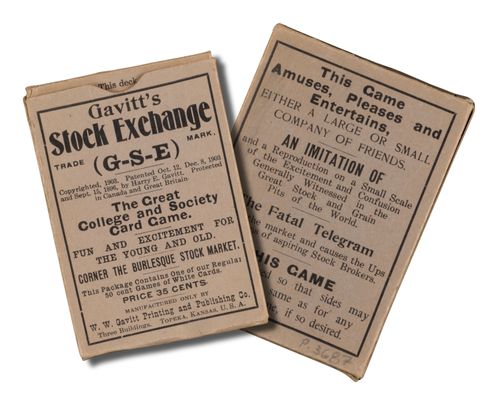
Gavitt’s Stock Exchange was issued in a classic tuck box.
Milton Bradley is often credited with creating the modern board game industry, and it should come as no surprise that he was a pioneer in producing games with appealing boxes, since his first commercial venture was as a lithographer.
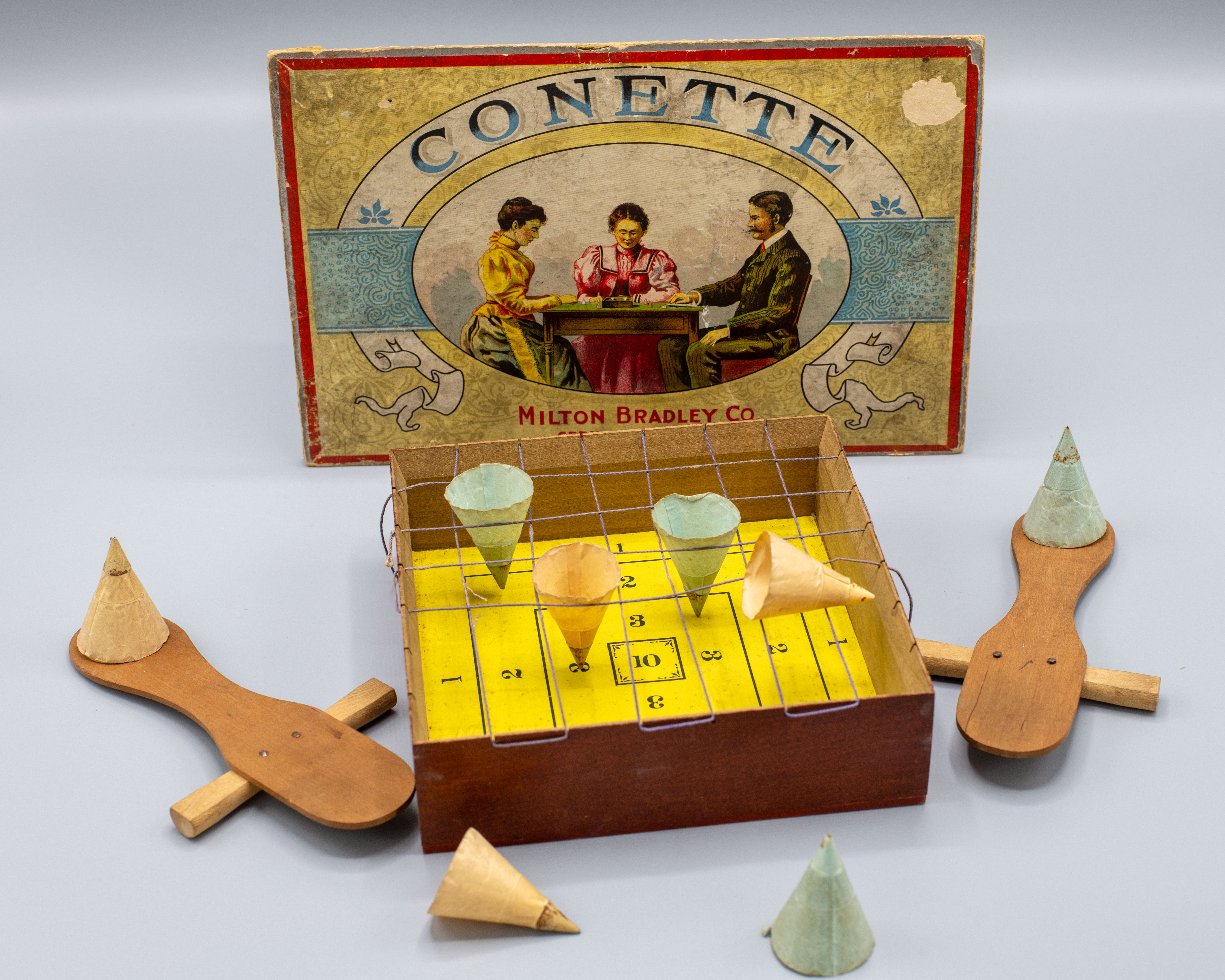
The two-piece box that holds Conette features a colorful illustration of three adults playing the game.
The humble game box hasn’t changed much since the 19th century. If you enter your local board game store today, you will find a variety of games housed in colorful tuck boxes and two-piece boxes. Tuck boxes are most often used for card games and are made by folding thick paper and tucking in the ends. Gavitt’s Stock Exchange (Gavitt Publishing & Printing, 1903), a card game where players trade “stock” in an attempt to corner the market, was issued in a tuck box printed on all sides in a variety of typefaces and sizes. Two-piece boxes, as the name implies, are two separate boxes that when put together form a lid and base. The lid box is slightly larger than the base box and slides over it when closing the box. Milton Bradley’s 1898 game Conette is a good example of a two-piece box, with the illustrated lid fitting tightly over the base. Bradley is often credited with creating the modern board game industry, and it should come as no surprise that he was a pioneer in producing games with appealing boxes, since his first commercial venture was as a
lithographer (he published a portrait of Abraham Lincoln that failed miserably as it depicted Lincoln just before he grew his famous beard). Bradley was acutely aware of the power of images to drive sales. Game publishers both past and present could simply decide to manufacture plain packaging and focus their attention on the design of the game inside. But in the American game publishing industry, that has never been the case.
Think about the container of your favorite game and what it looks like. It probably has a colorful box, designed to entice a shopper into picking it up, turning it over to see all its sides, and then purchasing it for play at home. The design on the box might depict people playing the game, like
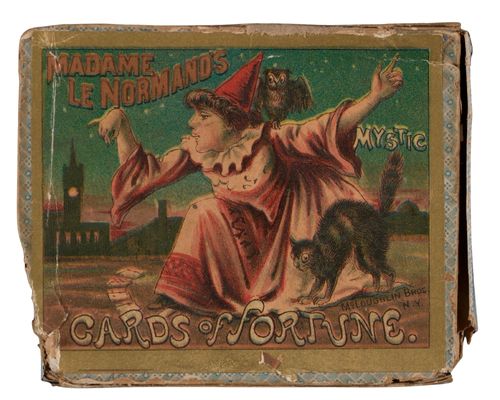
The box for Madame le Normand’s Mystic Cards of Fortune is illustrated with a fortune teller and her cat.
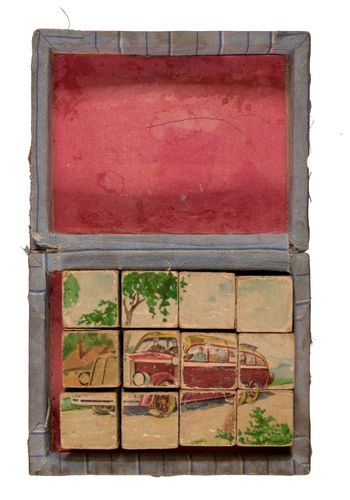
These picture puzzle blocks from Klee (circa 1940) are kept in a heavily home repaired box.
the box for Conette, which shows shoppers how the game is set up and a group of three adults playing. Other box designs were more fanciful, creating an entirely fictional scene. Madame le Normand’s Mystic Cards of Fortune (McLoughin Bros., 1887) is illustrated with a fortune teller decked out in medieval garb and accompanied by a black cat, reading someone’s fortune. In both cases, shelf appeal was the point.
While game boxes are designed to be durable, inevitably the boxes of frequently played games fall apart, as most boxes are made from paper or cardboard. The corners get dented in when dropped. The seam holding the box together separates. The entire box gets smashed, with the sides collapsing out. Today, you might use tape to repair a broken game box. The previous owner of one game at the Clements, a set of picture puzzle blocks (Klee, circa 1940), repaired the game’s box by wrapping and gluing cloth around the box. Other games in the collection are housed in boxes made at the library. Abbott’s Drawing Cards (Saxton & Miles, 1845) was originally issued in a tuck box. Over time, that box has fallen apart, and all that remains are two sides. To store and protect the cards and what remains of the original box, the Clements Library conservator built a custom tuck box for the game.
The next time you’re having a game night, take a moment to enjoy the container your game is stored in. While someone worked hard to create the game itself, another person put thought into the illustration, colors, and type of box the game is housed in.
To see more games from the William L. Clements Library collection, visit the online exhibit “For All Ages.”
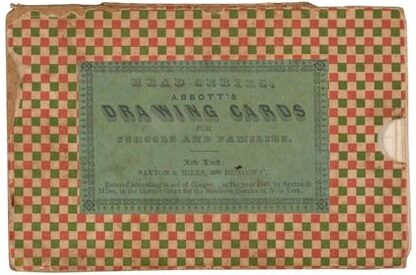
Abbott’s Drawing Cards lack their complete original box and are now stored in a custom-made tuck box made by the Clements Library’s conservator.