

CONTAIN YOURSELF
No. 62 (Fall/Winter 2025)
Table of Contents
Emotional Baggage
Cheney J. Schopieray
Curator of Manuscripts
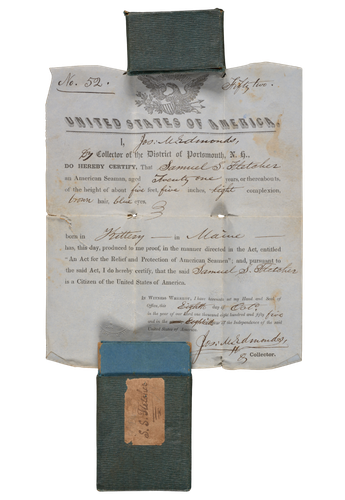
Samuel S. Fletcher followed his father’s footsteps into a career of sailing, beginning at least as early as his teens. He was in his 20s when he tucked his protection certificate into this sleeve. The paper and cardboard interior of this slipcase is protected by a semi-water resistant coating. Once inside, the document is not guaranteed safe but certainly has a better chance of surviving damp misadventures at sea. Papers of sailors and other maritime laborers are found alongside Fletcher’s identification document in the David P. Harris Collection.
The word “baggage” carries with it a sense of weight, bulk, and burden. Travelers’ trunks, barrels, and bags were filled with toiletries, changes of clothing for different social and practical needs, and much else. Moving them required careful packing, management, and manual labor. When Lena Smith planned a Nebraska-to-California trip in November 1904, she contemplated taking the Burlington railroad from Omaha, which had a local ticket opportunity to see friends southwest of Lincoln. This required that she send her luggage separately on a noon train through Lincoln, visit quickly, secure a carriage ride to Fairmont in time to catch the “Flyer,” which would then allow her to meet up with her luggage at McCook, Nebraska, before continuing west to California. After assessing a flurry of potential options sent by a friend, she abandoned her social calls at Lincoln, avoided the complexity of connecting modes of transport, and took the Union Pacific overland directly to Sacramento instead.
Many soldiers, immigrants, indentured and other laborers, itinerant educators and ministers, and homeless people traveled with much less. Their knapsacks, haversacks, parcels, and bags carried what they needed to get to the next town, next bed, next meal, next job. Without the privilege of carriage drivers, porters, or servants, the weight of even a few rudimentary necessities becomes heavy over time. When George Starbird went off to fight in the Civil War in July 1862, he kept it light, with few extras: only needles, thread, labels, pharmaceutical pills, and medical salve.
Though the language is new, the “emotional baggage” of broken hearts and lost loves draws its metaphor from experience well known to 19th-century America.
The word “baggage” also carries with it a sense of necessity or requirement, one that is often reflected in how official papers were conveyed. The security of nationality and citizenship documents was of paramount importance for seafarers and other travelers. Seamen’s Protection Certificates were paper documents issued by Customs Collectors in accordance with a 1796 act of Congress passed to protect sailors from being impressed into service on foreign vessels, particularly British ships. Since these documents connected names with ages, physical descriptions, and other vital information, they were often relied on to prove identity. A sailor without a certificate might start his voyage on an American merchant vessel and end it toiling aboard a British warship. Such a lifealtering (or life-ending) threat prompted sailors and officers to protect these certificates. The weather, the water, regular consultation, and theft were among the dangers that jeopardized these fragile, precious pieces of paper. Twenty-one-year-old sailor Samuel S. Fletcher of Kittery, Maine — 5-foot-5, brown hair, and blue eyes — had his certificate reinforced on one edge so that it could be inserted into a small slipcase and placed in a pocket or small chest for safekeeping at sea.
In the mid-1850s, at a time when passports were largely issued by the country of destination, not origin, American civil engineer Frederick Hubbard (1817-1895) embarked on a grand tour of Europe and the near East. As he passed through Greece, Messina, Naples, Rome, Paris, London, Tunis, Algiers, Tangiers, Gibraltar, Spain, and elsewhere, consulates added stamps, signatures, and partially printed pages to his passport by affixing them along the edges. As the document grew in length, it was folded, then rolled. It was kept in an oval tin tube to keep it from becoming too worn, tearing, or suffering other damage. Nevertheless, by the time it arrived at the Clements Library in the 1990s, it was in tatters.
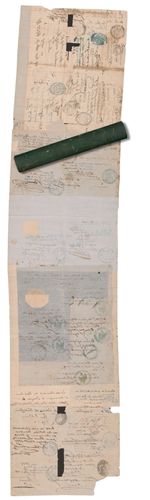
By the time the Clements Library staff first removed Frederick Hubbard’s x 24 cm (~9.5″) x 108 cm (~42.5″) passport from its tin tube, it suffered from split seams; tears bit into its edges, small sections were missing, and the different types of adhesives had in places lost their hold. In 2014 Clements Library Conservator Julie Fremuth carefully addressed its many issues, and now it is safely accessible (outside its container!) in the Thomas, Robert, and Frederick Hubbard Family Papers, 1803-1902.
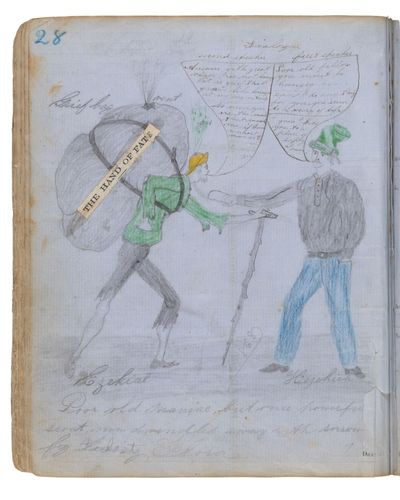
Visual metaphors such as scout Ezekial’s “grief bag” spewing out its gas of “hope” under the auspices of “The Hand of Fate” are found throughout the Illustrated Scrapbook, [1850s–1870s], acquired by the Clements Library in 2022.
Travel documents and clothing and other personal effects took material forms that dictated the shape of the items that carried them. Trunks, suitcases, barrels, slipcases — all were designed to hold and protect particular things, and all required different forms of labor to move them around.
But the things that travelers in the past packed into containers were not always transported by strong backs, seasoned arms, and muscled legs. “Emotional baggage” is a modern term — its earliest currently known use in print is from around the time of Lena Smith’s trip from Omaha to Sacramento. Terms such as “intellectual baggage” and “political baggage,” with similar figurative concepts, reach back to Shakespeare’s Hamlet. They express how a person’s past actions, experiences, knowledge, feelings, attitudes, and beliefs encumber them in internal, interpersonal, and community relationships in the present.
Sometime in the 1850s, a young man — perhaps James R. Reeves of Kennebec County, Maine, or a family member — took a partially printed volume of blank receipts and turned it into a combination scrapbook, drawing pad, and handwritten storybook. The narrative portion follows the adventures of Ezekial and Hezekiah, both young scouts, and focuses on Ezekial as he wends his way through life’s challenges. Our protagonist suffers from despair and heartbreak as he and Hezekiah court the same young woman, Flora. The illustrator visualizes loss of hope through a remarkable yellow hat that spews “gas of hope” from the head of the despairing. This page shows the “Poor old maniac,
but once powerful scout, now dwindled away with sorrow for the lost Flora.” His bent body and tattered clothes are weighted down by the “grief bag” he shoulders, also presumably leaking hope from a tear in its fabric. His rival Hezekiah reaches out to offer the beleaguered young man something to eat, attempting to offer some solace. “Poor old fellow you must be hungry. Can I do anything for you, you seem to be weary of life. I guess I take you to a place of safety at once.” Ezekial responds “with great vigor”: “I’m not hungry it is grief that gnaws like hunger at my very vitals. No never. You are the man that ruined me, if I was a smart man as I … I would kill you.”
Horace P. Bigelow, an in-law of the prominent Van Vechten and Huntington families of central New York state, beautifully rendered his and his sister’s feelings of “regret” into parcel form on April 8, 1865. The siblings wrapped their lamentations about not being able to visit in cloth and tied it with string, a tidy bundle of sadness.
The boxes, trunks, bags, and satchels people carried with them provided them with comfort in knowing they would have belongings at their destinations, while simultaneously creating stress over the weight and management of heavy trunks, and the dangers of damage or loss in transit. The tins, slipcases, suitcases, and chests that protected papers mitigated the risks of traveling with them but required forethought and preparation. Though the language is new, the “emotional baggage” of broken hearts and lost loves draws its metaphor from experience well known to 19th-century America. It was a life of carrying the heavy bag, assessing the risk, arranging the next stop, and ultimately making it beyond the regrets of the letter’s introduction to the present. Or not. In the case of Horace Bigelow’s April 8, 1865, letter, we find that he made it quickly past the regrets and on to news of their lame horse that had not recovered — “whence these tears.”
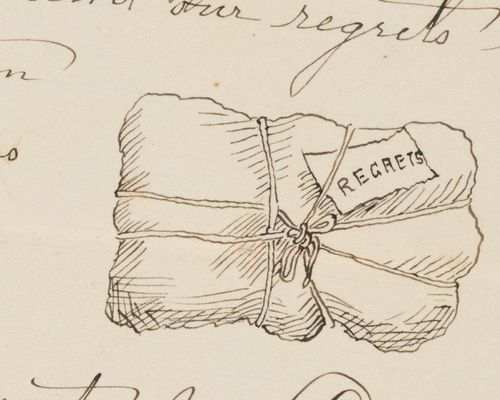
Horace P. Bigelow peppered his correspondence with illustrations, including this parcel of “regrets” offered to the recipient. His correspondence, along with a wealth of sources pertinent to the intermarried Bigelows, Huntingtons, Van Vechtens, Christies, and Danns are available for research thanks to gifts from family member and former Clements Library Director John C. Dann.