
CONTAIN YOURSELF
No. 62 (Fall/Winter 2025)
Table of Contents
Little Boxes
Paul J. Erickson
Randolph G. Adams Director
William L. Clements Library
People ask me all the time what my job is like. Directing a rare book library and archive of early American history is not something that a lot of people realize is a thing that someone might get to do. And I usually tell them the truth: my job is a huge amount of fun. It’s deeply satisfying to help students, researchers, and instructors find ways to answer questions by using one of the best collections of early Americana in the country.
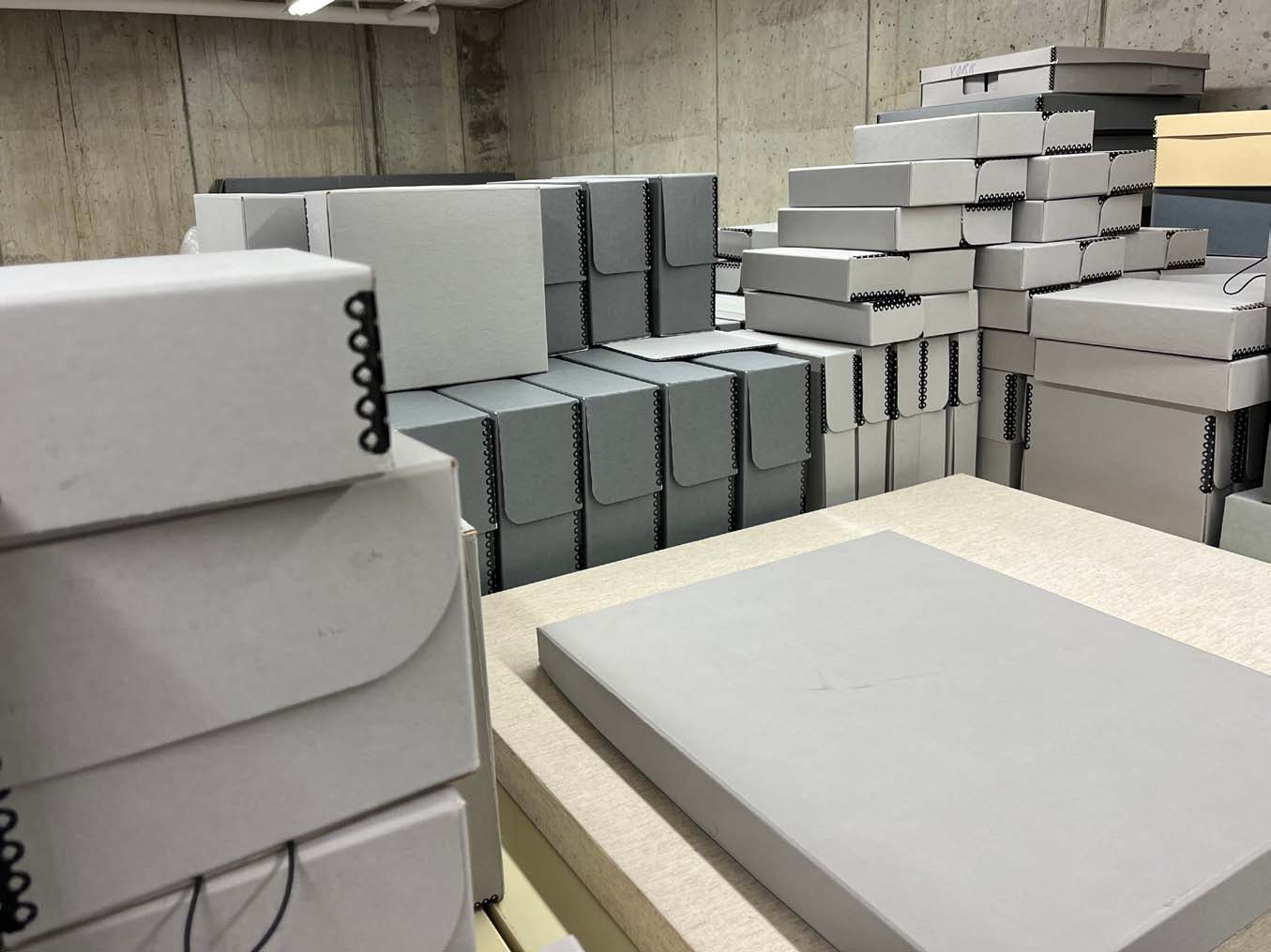
But I don’t usually tell them the complete truth. Because, if I were being honest, I would tell them that a lot of my job is about something that they might not find so exciting: Boxes. I spend a lot of time thinking about boxes. A good portion of every week is dedicated to opening boxes, which is exciting, since that usually means new additions to the collection. But it can also be a lot of boxes. This past year I bought my own personal box cutter — it’s bright purple, so I won’t lose track of it — and using a tool that is fit for purpose has made the box-opening work more pleasant.
In addition to the boxes that arrive holding the books and manuscripts and prints that we buy, we also buy a lot of other boxes (which arrive in boxes of their own). These boxes are acid-free library storage boxes that we use to safely house collection materials. What is a lot of boxes? Well, in the past twelve months we have spent over $25,000 on storage materials at the Clements Library, and the vast majority of that has been spent on boxes. And if we have something that is an irregular size that doesn’t fit well in a standard size storage box, Senior Conservator Julie Fremuth will create a custom box for it.
Ironically, many of the items that we are putting into those nice new library storage boxes are being removed from … you guessed it, other boxes. We are in the midst of rehousing the Henry Clinton Papers, which for the past eighty years have been stored in big hinged boxes that are designed to look like books. The Clinton Papers are one of our largest manuscript collections, over a hundred shelf feet. Which means that we have to figure out what to do with all of those boxes.
But nobody who asks me what my job is like wants to hear about how I’m really in the box business, so I don’t tell them. Then why am I telling
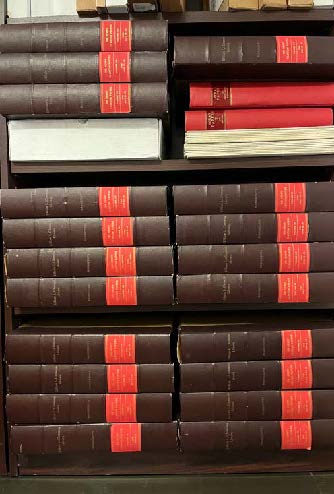
These boxes, now empty, used to hold the Henry Clinton Papers, one of the library’s most heavily-used manuscript collections. Preparing them for digitization involves removing them from these acidic boxes and moving them to acid-free boxes like those pictured above.
you? Because the theme of this issue of The Quarto is “Contain Yourself.” It’s about the things that hold (or held) the things in our collection that researchers come to use. The frame around the picture, the envelope that carries a letter safely to its destination, the printed box that holds a board game, homemade bindings on books.
Most of the time, these containers are, for us at the Clements, of secondary interest to the things they hold. It is true that when we’re buying things like 19th-century board games, we look for examples with intact boxes, not least because the game instructions are often printed on the box. But we don’t usually collect empty game boxes, just as we don’t collect empty daguerreotype cases or envelopes without letters (although there are many people who do).
Many of us probably have at least one box of letters or pictures on a shelf in a closet that we can’t bring ourselves to throw away, but that we also probably never open. By keeping them in a container, we keep ourselves safe.
Still, just because these containers are not our primary collecting interest does not mean that they don’t have a lot to tell us about how people in the American past lived with books and images. When people looked at the books on their shelves, they saw the bindings, not the contents. Visually, people experienced much of the world of words indirectly, through the containers that held and organized those words. The way that people in the past framed pictures of loved ones can tell us a lot about what those relationships meant, just as the way that people decorated envelopes they sent through the mail can tell us a great deal about how they felt about the person they were writing to.
“Contain” is a word that can mean a lot of different things. To take the example of the acid-free boxes that we buy at the Clements, we use those to contain manuscript collections, newspapers, prints — things that we want to keep organized, but even more so things that we want to protect. If old letters or newspapers were just kept in piles on the shelf, their edges would get snagged and torn every time someone walked past. We put those things in containers to protect them from harm.
But to contain something is also to keep it from harming us. We work to contain oil spills, or forest fires. We also put things in containers to protect us from what’s inside. Old letters and photographs can be painful. They can remind us of heartbreak, of the death of loved ones, of ways that we failed those we care about. Many of us probably have at least one box of letters or pictures on a shelf in a closet that we can’t bring ourselves to throw away, but that we also probably never open. By keeping them in a container, we keep ourselves safe.
One of the standard stops on any tour of the Clements Library is a visit to two big boxes, at the west end of the reading room. On the bottom shelf of a two-tiered wooden stand is Henry Clinton’s uniform trunk, an elaborately embellished leather-covered piece of luggage created for the commander in chief of Britain’s forces in North America. We talk more about the box on the shelf above it, a more prosaic square wooden trunk covered in heavy canvas. It is one of twelve document trunks that held the correspondence of General Thomas Gage during his stint as commander in chief, from 1763 to 1775 — one trunk per year. (We only have three left, which is a story for another Quarto.)
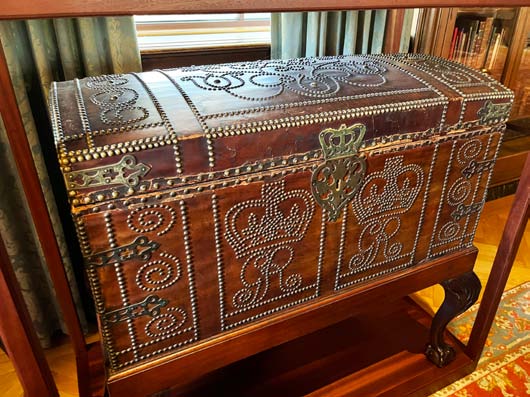
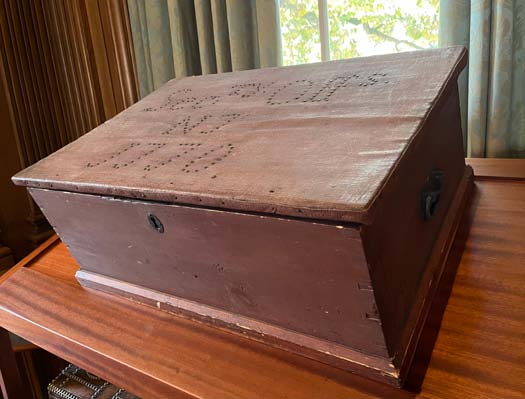
Two of the most-visited artifacts in the Avenir Foundation Reading Room are, well, boxes. At top left is General Henry Clinton’s uniform trunk, which came along with the purchase of the Clinton Papers. The other two images show General Thomas Gage’s documents trunk—one of twelve trunks that originally held the Gage Papers in the 18th century. Inside the trunk are two levels of cubbyholes (the top tray is removable). Each section represents a different location.
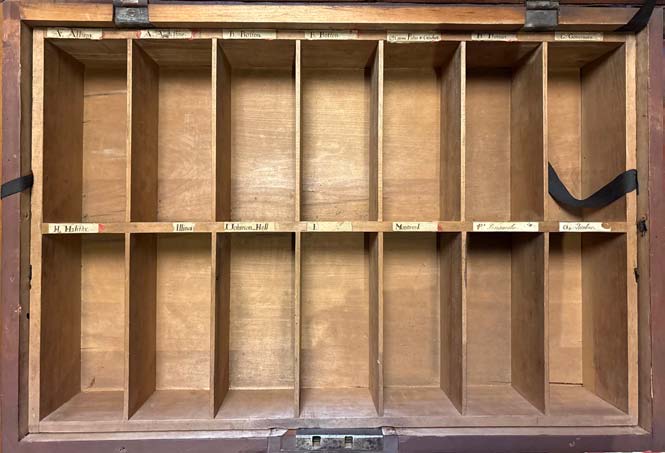
As many of you have seen, the Gage trunks are organized into two layers of cubbyholes, which are labeled according to geography. While the manuscripts in the Gage Papers are essential to understanding the coming of the American Revolution, I’d argue that the trunk is essential to understanding Thomas Gage. He was a man who was responsible for a continent — all of Britain’s colonial possessions in North America. How he physically contained his letters tells us a lot about how he organized his thoughts, and about how he approached his job. Maybe the box business isn’t so boring after all.