

CONTAIN YOURSELF
No. 62 (Fall/Winter 2025)
Table of Contents
Who Framed Joseph Keppler?
Naomi Yu
Clements Library-UMSI Intern
If you go into any family home in the United States where children live, the odds are very high that you will encounter portraits of those children in some form: framed and arranged on a table, attached to the refrigerator with magnets, populating the hallways, etc. The U.S. tradition of displaying portraits of one’s children is a long-standing one. These images often serve two purposes: first, to present children at their best, inviting admiration from visitors; and second, to complement the home’s decor, neatly filling empty spots on the wall. With these familiar motivations in mind, I will focus here on a truly unique example of child portraiture that recently arrived at the Clements Library.
This past July, the Clements was delighted to purchase from noted rare book and periodical dealer Richard West his personal collection of illustrated humor periodicals from the last three decades of the 19th century, a collection that he assembled over the course of over 40 years. The centerpiece of any collection of illustrated humor is Puck, a monthly magazine of satirical political cartoons published by an Austrian immigrant named Joseph Keppler in New York. The magazine was published in German at its inception in 1876, but was subsequently published in English from 1877 onwards. Keppler gained fame for the caustic wit of his political satires and for his pioneering use of chromolithography.
While the overall collection is a tremendously exciting addition to the Clements Library, what immediately captured the attention of the entire staff is a framed painted portrait of Keppler’s young son, Joseph Keppler Jr. (originally named Udo Keppler). The portrait of Keppler Jr. is not framed modestly. It is housed in a massive giltwood frame, carved to look like curving leaves and scrolls. The depth and intricacy of the frame make it extremely difficult to store — the only place to safely keep it is on a wall. Keppler Jr.’s sweet, innocent face is overshadowed by the magnificence of the frame, creating a dissonance that would leave most artists (and parents) cringing. What kind of living room would this portrait fit into? Why would a parent commission such a thing? To answer these questions, some digging was required.
The portrait itself is a watercolor, painted by a German-born artist named William Kurtz in 1879, putting the age of Keppler Jr. at around 7 years old. While we only know of this one portrait from the Keppler household, it is assumed that there were others, most likely depicting Keppler Jr.’s two sisters, Irma and Olga. Kurtz was trained as a lithographer in Germany, which meant that he had also studied painting and drawing. But he was unable to find work there, so he
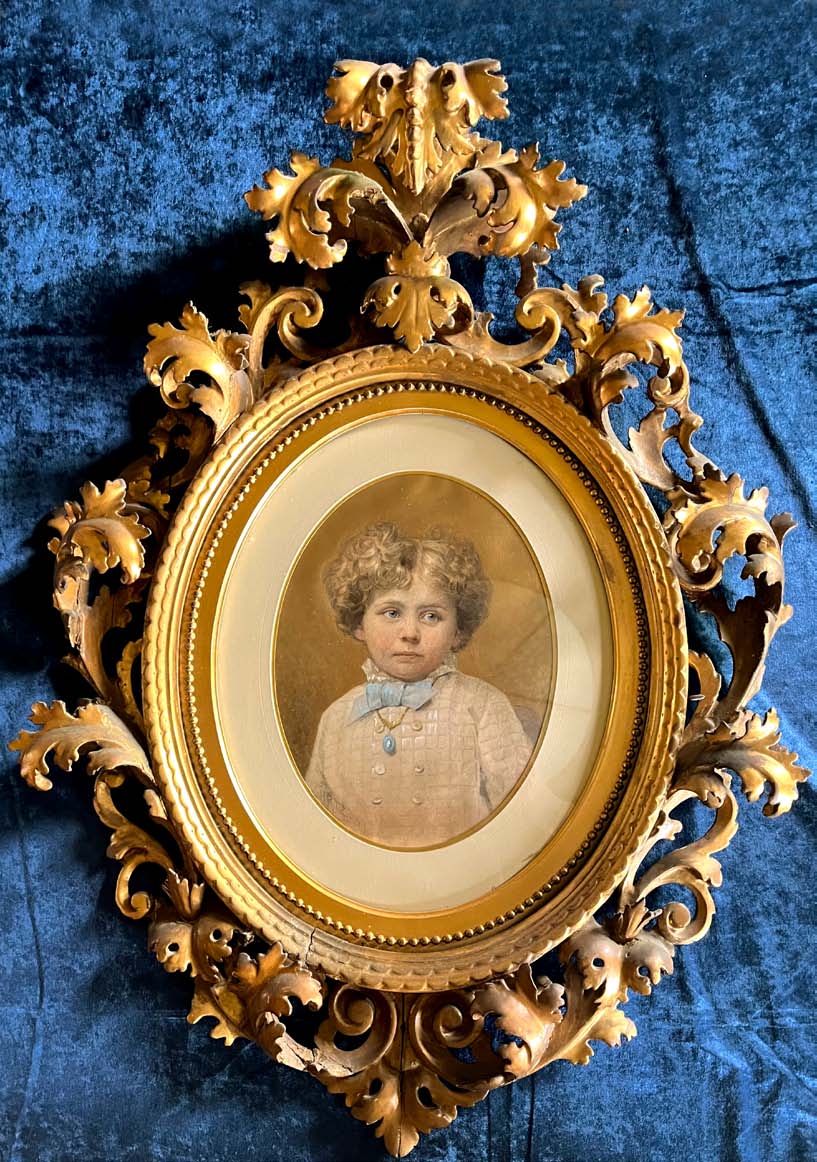
The painted portrait of Joseph Keppler, Jr. measures only 17 x 13 inches. Its incredibly ornate frame more than doubles the size of the portrait, at 37 inches long by 26 inches wide. The carved figure at the top of the frame is almost 6 inches deep.
became a sailor and made his way to the United States, serving in the Civil War before becoming a photographer. By the late 1870s Kurtz was quite well-known as a photographer, and was a pioneer in popularizing the halftone process in the United States, which permitted photographs to be reproduced in print. Both men were German-speaking immigrants and belonged to an affluent German-American singing group known as the Liederkranz that also functioned as a fraternal organization. Though Keppler Sr. was himself a talented artist and could have painted his son himself, commissioning Kurtz may have been a gesture of friendship or professional respect — an act of fraternity within their elite social circle.
Keppler Sr. had risen from modest Austrian immigrant to a man of substantial means, building a large house on top of a hill in Inwood, at the far northern tip of Manhattan. His home would have been richly decorated, filled with luxurious furnishings and objects meant to communicate his family’s status. In the late Victorian era, every item in the household was a statement of social standing. This portrait — likely hung in a formal space such as a parlor or drawing room — would have blended into the surrounding finery. This display of wealth would have been unusual at the time, as cartoonists historically did not make much money. Keppler Sr. was really the first cartoonist in the U.S. to achieve such monumental financial success. True to the spirit of the Gilded Age, even smaller and previously less profitable industries — like cartooning — suddenly found opportunities to expand and thrive on a much larger scale. The frame, as well as the origin of the painting, can be read as a symbol of Gilded Age prosperity and performance, all centered around one golden-haired child.
Keppler Jr.’s sweet, innocent face is overshadowed by the magnificence of the frame, creating a dissonance that would leave most artists (and parents) cringing.
The portrait is a well-executed likeness, showing the young boy’s cheeks glowing with health, a full head of fluffy, golden curls. He wears a white suit with a blue necktie, accessorized with a fine gold necklace. This child is obviously well cared for, raised in comfort. The 19th century is commonly known as the birth of childhood, the first period in which children were seen as innocent and set apart, deserving of care and special attention. Before this era, children were often seen as small adults, and children from the lower classes were put to work at a very young age and expected to shoulder the responsibility of financially contributing to the household. With this context in mind, we can observe that not only is the frame a display of wealth, but also a display of care. Practically, frames are meant to protect paintings from harm. They are also tools to contain the visual field, and enhance it. They have a remarkable ability to elevate or lower a visual moment, acting as a strong signal to the viewer. For instance, if this portrait had been put in a plain, cheap frame, our viewing experience would immediately change, and we would come to different conclusions about the painting. We would assume, for instance, that this was not a precious painting, and therefore perhaps the child was not especially valued. The frame provides an emotional, cultural, and socioeconomic context that fundamentally changes the viewing experience, and this portrait of young Keppler is an excellent example of these contexts and signals.
In the end, the portrait of young Joseph Keppler Jr. — lavishly framed and lovingly rendered — fits squarely into the social and cultural context of a Gilded Age Manhattan mansion. It is the product of a father who had risen swiftly from immigrant beginnings to the peak of professional and social success, eager to surround himself with symbols of both status and sentiment. What might seem garish by today’s standards was, in its time, a potent expression of pride: in wealth, in artistic networks, and, most poignantly, in one’s children. The ornate frame does more than simply house a likeness — it magnifies the message of care, identity, and arrival. Though we will never fully know the emotional dynamics between Joseph Keppler Sr. and his son, the legacy speaks for itself: the younger Keppler honored his father by not only adopting his name but also following his artistic path, continuing the family’s imprint on American satire. This portrait, then, is more than decorative — it is a statement of lineage, ambition, and perhaps an enduring familial bond.