

CONTAIN YOURSELF
No. 62 (Fall/Winter 2025)
Table of Contents
Threads (Not) to Pull On
Maggie Vanderford
Librarian for Instruction and Engagement
Imagine that you have two items on a table in front of you. One is an impressively formal manuscript wedding certificate, dated May 14, 1838, and signed by various witnesses — many of whom were leaders of the abolitionist movement in the antebellum United States. The other item is a small ivory moiré silk wedding purse, hand-painted with popular, sentimental engravings depicting the plight of enslaved women. Now take a moment to think: Which item tells you more about that wedding day? Which one would you use as “evidence” in a research paper about the wedding? Which gives you better insight into the bride? The groom? Their relationship?
These questions, developed with Associate Curator of Manuscripts Jayne Ptolemy, are ones we regularly pose to students in History 202 as part of their introduction-to-the-archives experience on their visits to the Clements Library. Of course, no “right” answer exists. Our only goal is to push them to make an argument — any argument — about the role of community in religious ceremonies, fashion as personal advocacy, the use of visual images in the abolitionist movement, or any number of other approaches depending on their interests and questions. As they learn in this class and in their future archival work, sources will not often explicitly tell you which historical arguments they can be used to support. It is often the work of the historian to, as our colleague Dr. Rebecca Scott describes it, “get the documents to speak.” More often than not, students leave their first archival visit with more questions than answers: When did women begin carrying wedding purses? When did they stop? Was it common to use fashion as a political statement in the 19th century? Why was William Lloyd Garrison at the wedding? This organic, genuine curiosity inspired by the in-person encounter with material artifacts from the past has always seemed to me an ideal way to initiate a relationship with the archive and its possibilities. Both the wedding certificate and the purse are indeed part of a cornerstone collection at the Clements Library, the Weld-Grimké Family Papers. These specific items relate to the marriage of the famous abolitionist-activist couple Theodore Dwight Weld and Angelina Emily Grimké Weld.
The wedding certificate indeed lists the names of dozens of prominent abolitionists attending what was as much a high-profile advocacy gala as it was a celebration of love.
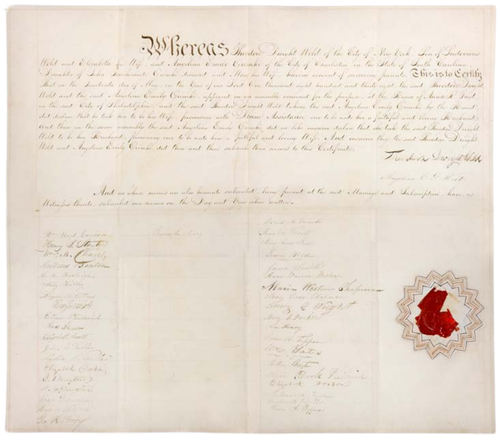
The Clements Library holds the wedding certificate documenting the marriage of Theodore Dwight Weld and Angelina Emily Grimké Weld, celebrated on May 14th, 1838. The certificate bears the signatures of many prominent abolitionist attendees from around the country, including William Lloyd Garrison.
At least, they might be? As I sat in my office after a recent class session (pleased as punch with our innovative approach to primary source instruction and patting myself on the back for a job well done), I took a closer look at the finding aid for the Weld-Grimké Family Papers. While the wedding certificate is undoubtedly the genuine article documenting their wedding day, the purse is described as “possibly Angelina’s wedding purse.” Suddenly, I found myself drawn into the same rabbit holes I regularly ask our students to climb down. Possibly? Had we been asking the wrong question all along? And had I been misleading our students about the origins of this purse
As it turns out, little evidence exists to definitively affirm or deny the possibility that Angelina walked down the aisle or attended the reception with this specific bag in hand. Newspaper articles about the wedding did describe her wardrobe — a brown dress, reminiscent of the Quaker imperative regarding “plain dress” — made with “free cotton,” sourced from producers that did not use enslaved labor. The wedding itself was an unprecedented abolitionist spectacle and was strategically designed to employ only vendors who supported the cause. The wedding confectioner was a baker of color who used “free sugar” in the cake itself, and the event invitation featured a letterhead with the famous “kneeling slave” motif designed by Josiah Wedgwood — the very icon painted on our silk purse. The wedding certificate indeed lists the names of dozens of prominent abolitionists attending what was as much a high-profile advocacy gala as it was a celebration of love.
Materially, the purse certainly makes a statement in line with the ethical goals of the wedding. On one side of the purse is a hand-painted version of an engraving by English designer Samuel Lines, depicting a female slave holding a child in her arms and seemingly in distress. On the reverse is the iconic kneeling slave symbol, modified from Wedgwood’s original medallion design to portray a female slave. The medallion was originally produced in 1787 for the Committee for Effecting the Abolition of the Slave Trade, but reproduced in 1828 to bring attention to the plight of female slaves. Both images were powerful, popular, and immediately recognizable images meant to evoke the intensity of feeling that drove the abolitionist movement. As such, they were printed and distributed on all sorts of materials, from pincushions to jewelry to prints and even bags. The silk purse in the Clements collections is nearly identical to other drawstring purses produced by the Female Society for Birmingham, which created and sold these fashionable accessories to wealthy abolitionist women in Britain. However, while other similar versions exist, no known version is actually identical to the Clements purse. Other purses held by the Victoria & Albert Museum, the Daughters of the American Revolution, and various historical societies all feature anti-slavery poetry printed on the back of the purse, rather
than a verso image. Moreover, the close eye of Clements Library Conservator Julie Fremuth detects that the Clements purse appears not to be printed, but hand-painted and embellished with an iron gall ink to add dimension and tone. If not completely unique, it is at the very least distinct.
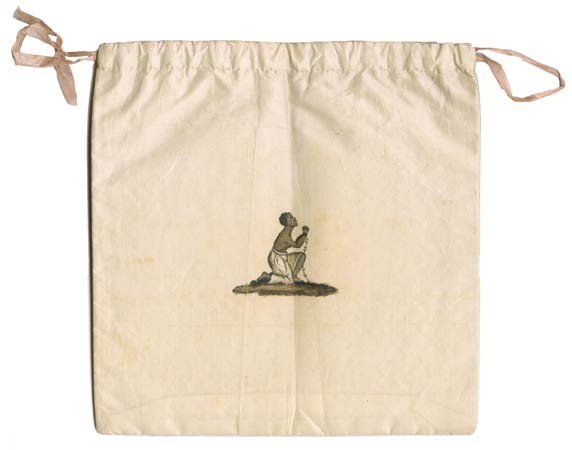
The handpainted silk purse held in the Weld-Grimké family papers is double-sided to feature two iconic images often utilized by the anti-slavery movement.
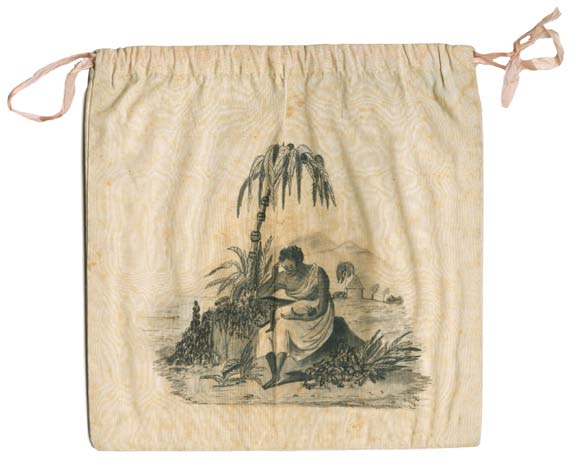
And thus, more questions arise. Did Angelina receive the purse as a special gift, or did she purchase it as a keepsake on one of her speaking circuits? Did she carry it at her wedding, or did it live in her armoire as a collectible item? What did owning a luxury item like this mean to a woman who lived her life in muted browns, blacks, patterns, and other “plain dress”? How did she understand the political implications of fashion? Even if she didn’t carry it at the wedding, how would she have used it or looked at it? If someone living 100 years from now plucked an item from your closet, could they learn something about you from studying it? Research questions, one and all.
Even as I am frustrated and humbled by the ways in which this particular document won’t speak to me as I wish it did, I realize how productive it is for archives to push back on our preconceived notions of the past, dispelling easy conclusions and adding complexity back into conversations. But this complexity can also sometimes be disappointing. I have questions about what Angelina carried in this purse — questions that I can’t answer. But I also have questions about what I’ve asked this purse to carry, both for me and my students. Thinking that Angelina carried the purse at her wedding gave me license to think about what it could tell me about her, about that day, and about her life. But not knowing whether it was used in this way sends those assumptions sideways. I had asked the purse to carry intellectual baggage that it can’t actually hold. This is a difficult lesson of teaching with archives, but also one of the most important.