

SCHEMERS, CONS, AND GRIFTERS
No. 59 (Spring/Summer 2024)
Table of Contents
Getting Away With It
Clayton Lewis
Curator of Graphic Materials, retired
Rowland Stephenson (1782– 1856), Member of Parliament for Leominster, was descended from generations of wealth and accomplishment and was well known to the social elite as a respected partner of the Lombard Street bank, Remington, Stephenson & Co. Although described as dapper, Stephenson was deeply in debt and had committed his bank to financing schemes that were hemorrhaging money, including the enormous, unfinished London Coliseum (an amazing story in itself) promoted by surveyor/artist Thomas Horner (1785–1844). In November of 1828, rumors spread of Remington, Stephenson & Co.’s insolvency.
It all caught up with Stephenson on December 26, 1828, when he was confronted by his banking partners. A hasty internal audit had revealed that Stephenson and his personal clerk, James Harman Lloyd, had secretly been using negotiable securities placed on deposit at his bank as collateral for personal loans. Remington, Stephenson & Co.’s liabilities now exceeded its assets by nearly £200,000, forcing a panicked closure, and triggering a run on London banks. The year ended with the financial ruin of many depositors. Senior partner Joseph Toulmine, age 64, suffered a stroke and died after having been declared completely bankrupt.
Before dawn the following morning, December 27, Stephenson ordered up his luxurious yellow coach and two gray mares and fled, accompanied by James Lloyd. By 6:00 that same morning, the remaining partners of Stephenson’s bank knocked at the door of his London residence to find it empty. Rewards were posted for both Stephenson and Lloyd. The hunt was wide-ranging. Dispatches went out to European seaports requesting cooperation in their apprehension, and reported sightings of the fugitives came in from every direction.
Stephenson’s hairsbreadth escape from London was followed by a dogged chase across the West Country, with Bow Street magistrate court officers on his heels. Two Bow Street officers were themselves arrested in St. Ives on suspicion that they were the notorious Stephenson and Lloyd.
Hiding for several nights of severe weather in the isolated seaside village of Clovelly on the Devon coast, Stephenson hired a small boat to cruise the Bristol channel to intercept a ship bound for America. On January 4, 1828, Stephenson and Lloyd boarded the heavily laden and slow sailing Kingston, bound for Savannah, Georgia, with a load of salt. Agents with arrest warrants representing London bankruptcy court just missed Stephenson and Lloyd at Clovelly but were quickly onboard a vessel for New York. The Royal Navy sent a cutter to the Azores in the hope of intercepting the Kingston as she replenished there, to no avail.
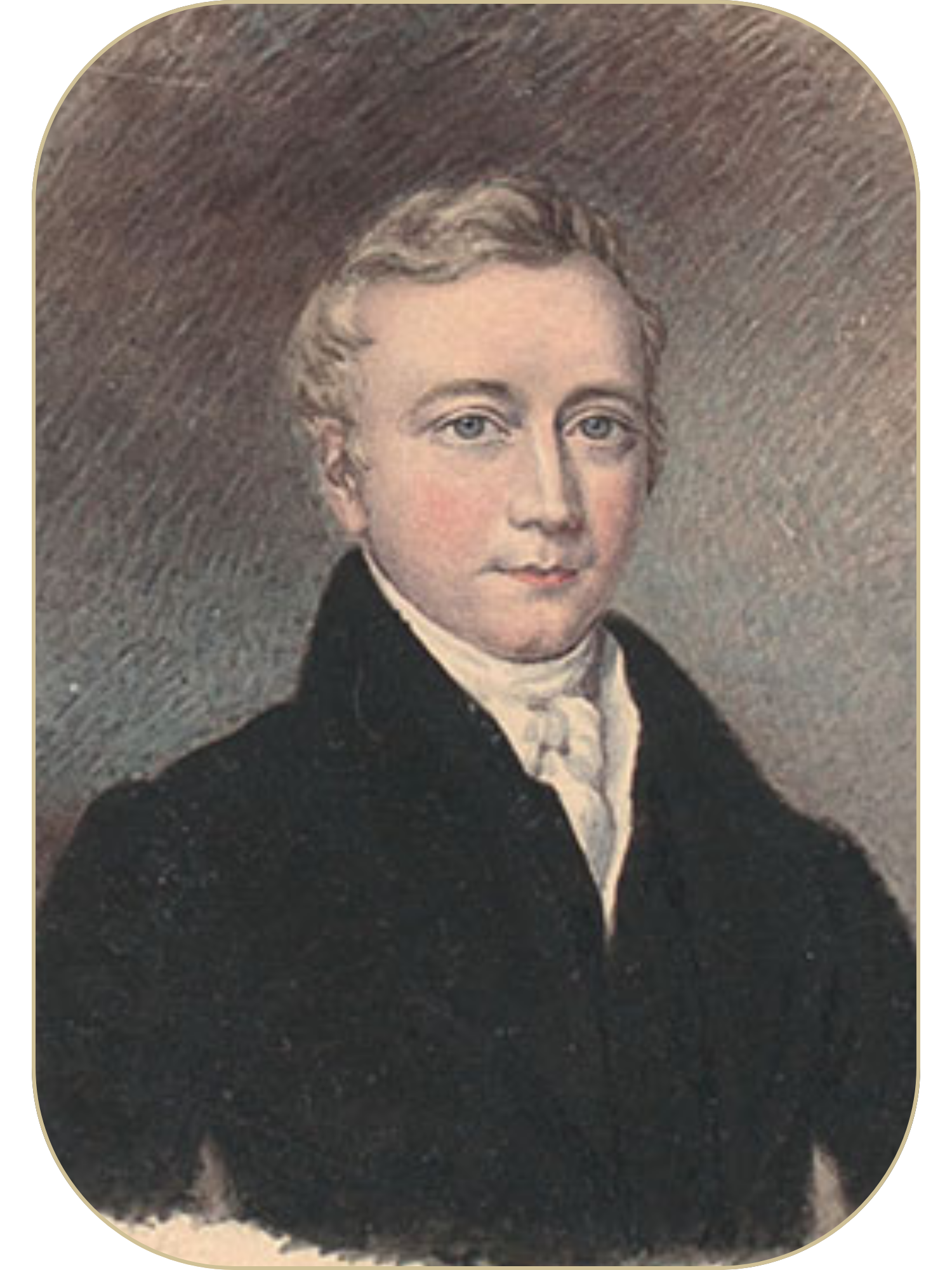
An anonymous miniature watercolor portrait of Rowland Stephenson, “a man who was accustomed to shuffle thousands before breakfast,” according to author and descendent Paul Bangay.
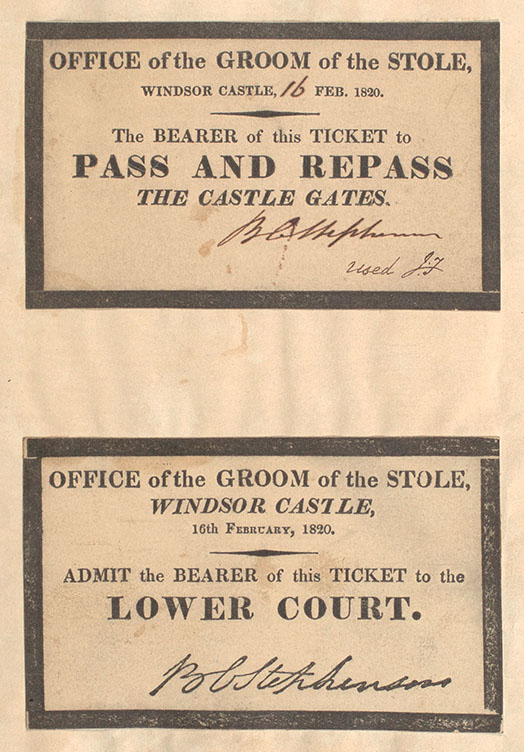
Stephenson’s passes for entry to Windsor Castle for the burial of the remains of King George III in the Royal Vault, February 16, 1820, signified his membership in the upper echelons of British society.
When Stephenson and Lloyd landed in Georgia on February 28, they were dismayed to find their story in the American papers, including their descriptions, details of their expected arrival in Savannah, and the posting of an additional reward by a retired sheriff of London turned bounty hunter, Joseph Parkins. Parkins, a notorious hothead, already had a history with Stephenson over past political confrontations. Parkins also was a significant depositor at the failed Remington, Stephenson & Co. He happened to be in the United States and was more than eager to pursue the case on behalf of the bank as well as for himself. It was personal.
Alerted to Stephenson’s presence by these same news reports, William Oates, Deputy Jailer of Savannah quickly apprehended Stephenson, bound him, locked him in the cabin of a fast pilot boat, and sailed up the coast to New York City, intending to hand him over to the British Consul and collect the rewards. Acting on word that Stephenson was being held against his will in New York Harbor, the chief constable of New York located and took charge of Stephenson. A battered but much relieved Stephenson stayed comfortably in a room in the constable’s house, even dining with British Consul James Buchanan. The news that the now notorious embezzler Rowland Stephenson was in New York spread like wildfire, along with public outrage that “foreign agents” were operating inside the country to apprehend him, in violation of the sovereignty of the United States.
A hearing in front of a New York judge went badly for the many parties interested in prosecuting Stephenson. The various warrants from Britain were ruled to be invalid, British Consul Buchanan refused to testify on William Oates’ behalf, and a writ was issued to apprehend Oates and his gang from Savannah for kidnapping. The judge was particularly unimpressed with the quarrelsome Parkins, who could not demonstrate any authority on American soil. The court recorder announced that Stephenson was at liberty and free to leave as cheers rang out.
Having fled New York, Parkins’ Savannah gang were arrested and prosecuted in Georgia. Strapped for cash, Parkins himself eventually landed in the same debtors’ prison that had previously held Stephenson. Deeply embittered, in 1938 he published a pamphlet, An Abridged Correspondence Between J. W. Parkins And His Late Bankers. Messrs. Remington, Stephenson & Co. London (S.l., [1829?]), complaining about the gross injustice of his situation and that “the reader … will be ready to acknowledge that Mr. Parkins is the most victimized man he ever read of.” James Lloyd is recorded as having married in 1833 in Georgia but disappeared after that.
With assistance from his eldest son, Stephenson acquired an estate in Bucks County, Pennsylvania. In 1848 he became a naturalized citizen. Rowland Stephenson passed away in Bristol, Pennsylvania, in 1856 at the age of 74. His last will reveals a life of comfort, short of extravagance. Scrapbooks were listed among his final possessions.
At the Clements Library in 2005, a worn and fragile scrapbook with pasteboard and leather binding landed on my desk. It was acquired on one of Director John C. Dann’s expeditions into the depths of John King Books in Detroit. I recall him telling me, “It’s British, not much American content. Seems to be a fine early example, worth having. Have a look and let me know what you think.” I have been thinking about it ever since.
In format, it is typical. In content, exceptional and mysterious. Spanning roughly 1820–1850, it includes carefully handwritten charts outlining the costs of a royal coronation, the debts of the Prince Regent George IV, tables of tax revenues, brief written histories of The Bank of England, and a willow sprig from the grave of Napoleon Bonaparte at St. Helena. With these are mixed popular prints from magazines, clippings regarding remarkable lives and deaths, lottery tickets, forged bank notes from the Bank of England (forgery being a capital crime at the time), humorous poems and sayings, over 100 clipped autographs of Members of Parliament and other British notables, and invitations to royal events at Windsor Castle and Buckingham Palace, including the funeral of George IV and the coronation of Victoria. Also tipped in are a few amusing manuscript letters, related to parliamentary affairs, and one fine miniature watercolor portrait of a gentleman.

The mysterious compiler of the Rowland Stephenson scrapbook was fascinated by all things financial, including the lottery. Sometimes decried as a form of government supported fraud and beset by forgeries and dodgy ticket-sellers, the lottery became the subject of review by a committee appointed by the British government. The committee reported that “under no system of regulations which can be devised will it be possible for Parliament to adopt it as an efficient source of Revenue, and at the same time divest it of all the evils and calamities of which it has hitherto proved so baneful a source.” The British lottery was suspended in 1826, and was reinstated in its current form in 1994.
Upon further study, a common thread began to emerge, having something to do with banking, personal debt, the costs of royalty, and financial crimes. A name, not known to me at the time, Rowland Stephenson, MP, appeared frequently as the addressee of the manuscript letters, the guest of royal event invitations, and the subject of the watercolor portrait. His name also appeared in a newspaper clipping announcing the reward for information leading to his arrest. A quick look into his entry in the Dictionary of National Biography found this: “Stephenson’s parliamentary career was distinguished solely by his manner of leaving it.” I was certainly intrigued and began to gather as much information as I could find on this absconder to America.
There is a distinctive handwriting throughout the scrapbook, however, it does not resemble Stephenson’s. Some of the material, of British origin, dates from after his 1828 escape to America, so it is very unlikely that this scrapbook was compiled by Stephenson. However, the personal nature of much of the contents—invitations, letters, etc.—are undoubtedly material that passed through his hands. Whose scrapbook was this and how did it get to America? Was it compiled by someone close to Stephenson (his sister-in-law, who lived at his estate?), or possibly a contemporary “true crime” memorabilia collector who attended the bankruptcy auctions of Stephenson’s personal property in England? In any case, the contents indicate it was probably assembled in Britain, well after Stephenson and Lloyd departed.

Forged Bank of England note, 1818. A chilling artifact given that forgery was a capital crime punishable by hanging. The severity of the punishment indicated both the era’s deep reliance on paper currency and credit, and the relative ease of producing credible looking fakes, such as this example. Rowland Stephenson was accused of other capital crimes, but not forgery.
In 2021 I was in touch with Dr. Paul Bangay, a descendant of the Stephenson family and the author of a carefully researched and detailed account of his relative in The Dapper Little Banker (Lancaster, England, 2011). Bangay was not aware of the scrapbook. I was excited to share images from it, and he enjoyed seeing them. He did not recognize the handwriting, nor offer a theory on how and why it could have landed in America. Much of the information in this article was drawn from Paul Bangay’s book, which is a captivating read.
Stephenson’s story is a complicated one which elicits a complicated response. Americans have a history of sympathizing with the fugitive and the outlaw. Nationalist pride and indignation also drove America’s defense of this financial scoundrel and protected him from prosecution. However, as we have re-learned of late, the collapse of financial institutions and the crime of embezzlement are not victimless. One wonders how a similar dramatic tale chronicling the experience of one of Stephenson’s victims would alter our perceptions.