

SCHEMERS, CONS, AND GRIFTERS
No. 59 (Spring/Summer 2024)
Table of Contents
Supreme Nonsense: The Ancient Band of the Anderson
Jakob Dopp
Graphics Division Cataloger
Whether or not people can truly interact with spirits of the deceased has long been a subject of controversy and fascination. Skeptics of 19th-century spiritualism often leveled accusations of financially-motivated fraud against the likes of William H. Mumler, Madame Diss Debar, and Tennessee Claflin, to name a few. Indeed, even the most enthusiastic proponents of spiritualist practices found themselves at times questioning the credibility and intentions of others within their ranks. The Clements Library holds a particularly wonderful example related to what this author considers to be an instance of fraudulent spiritualism, the Wella and Pet Anderson spirit drawings photograph album.
A total of 26 cabinet cards compiled by a Chicago-based spiritualist named John C. Bundy comprise the album, all of which photographically reproduce hand-drawn portraits of spirits created by married spiritualist duo Wella and Lizzie “Pet” Anderson. Originally from Maine, the Andersons became established in Brooklyn, New York, in the 1860s. Pet’s role was that of the trance medium who facilitated contact with the dead, while Wella served as a conduit through whom spirits could execute portraits of themselves. An Anderson spirit drawing could be completed in two to three hours, with Wella working in 10 to 12 minute bursts, often while in a darkened room and at times even blindfolded. Wella claimed to have had no previous artistic training or experience.
While the Andersons initially rendered spirit drawings on demand for people looking to connect with deceased relatives, they embarked on a different venture in the 1870s. Collaborating with fellow spiritualists Dr. James Cooper of Ohio and “General” Jonas Winchester (1810–1887) of California (a mining executive and first state printer of California), the Andersons relocated to San Francisco in November of 1870 in order to further explore a blossoming relationship with what can only be described as an allstar team of extraordinary spirits. This 28-member assemblage was dubbed The Ancient Band, and they supposedly had long been secretly guiding the progress of humanity from the spirit realm where they resided. Dr. Cooper claimed to have independently made first contact with The Ancient Band in 1857, while the Andersons only became aware of their existence during a séance with Winchester in 1869. The Ancient Band soon began to impress themselves so deeply upon the Andersons that even when they attempted to produce portraits of deceased relatives for customers, all they could conjure were portraits of members of the group. In 1874, the Andersons and Jonas Winchester put on an exhibition of portraits of Ancient Band members and published a descriptive catalog, The Biographical and Descriptive Catalogue of “The Ancient Band” (New York, 1874), that provided background details for each member of the group. Photographs of the exhibited portraits were copyrighted by the Pacific Art Union, a corporate entity controlled by Winchester.
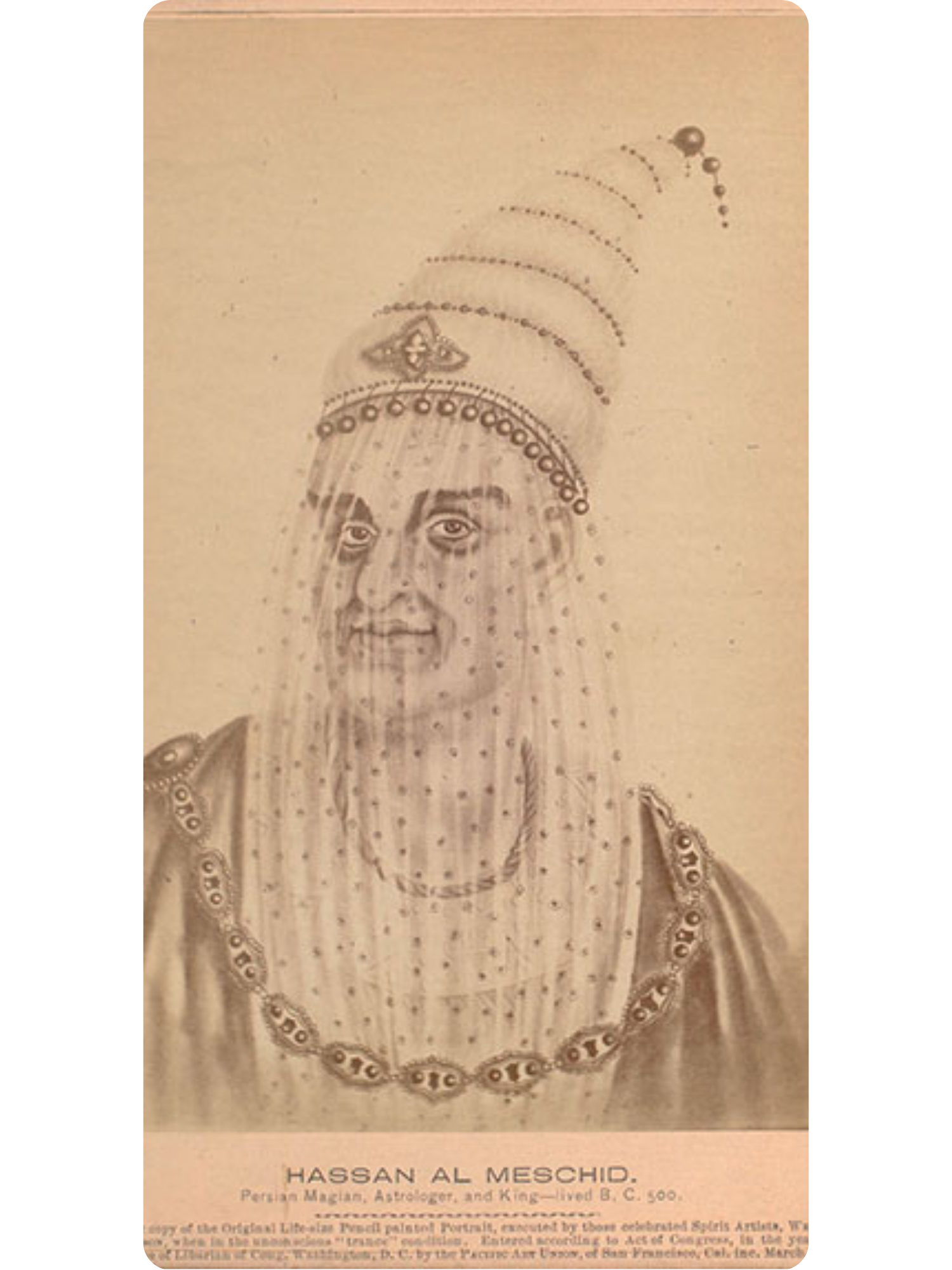
Hassan al Meschid was perhaps intended to inspire awe and mystery with the cryptic symbols on his headwear and his veil (“a most beautiful illusion which few painters can equal”). According to the Andersons, al Meschid was a wise philosopher and astrologer in Persia in the early 600s B.C., killed when he attempted to depose a cruel ruler.

The problematic portrait of “Confucius, The Great Chinese Reformer and Sage” that raised suspicions with San Francisco’s Chinese community and armed skeptics of the Andersons with ammunition to support claims of fraud.
Numerous members of The Ancient Band were in fact real historical figures including Anthony van Dyck, Omar ibn Al Kattab, Abelard and Heloise, Plutarch, Pindar, Alfred the Great, and Gautama Buddha. However, more than a few were complete fabrications cleverly constructed with a veneer of plausibility. For instance, there was “Henri de Brianville,” an English knight and alchemist who lived during the reign of Charles I; “Adehl,” an ancient necromancer from India who lived to the ripe old age of 180 after inventing an Elixir of Life; and “Dawn,” a young woman born in Massachusetts in the 1770s who perished just one hour into the dawning of her existence (hence the name).
Even aspects of some of the real historical figures don’t quite add up. In the descriptive catalog, the Andersons showcased their portrait of a ponytailed Confucius to the “learned and wealthy Chinese merchants” of San Francisco’s Chinatown. The response of the Chinese critics was to enlighten the Andersons that during the lifetime of Confucius (ca. 551–479 BCE) the queue (braided hairstyle) was not worn, the custom having been established only a few hundred years ago by edict, as a badge of loyalty to the present reigning [Manchurian] dynasty.” Apparently, this anachronism was used as proof that the Andersons’ spirit drawings were in fact fraudulent, “thereby discrediting the correctness of the Spirit Artist.” However, the Andersons attempted to explain away this gaffe by claiming that, much like Samson of the Old Testament, Confucius “believed in the idea that there was a power in the hair, which added to physical health and mentality” and that he “wore it braided, to keep it out of his way.” The fact that the Andersons felt compelled to defend themselves against the charges of fakery speaks volumes about the perceived threat to their reputations it must have posed at the time.
The most peculiar (and dubious) of all the Ancient Band depictions in this album are two portraits of individuals named Orondo and Atyarrah, both of whom were supposedly high-ranking members of a civilization occupying the lost continent of Atlantis. It was claimed in the descriptive catalog that they had both been alive during the time of their homeland’s sudden destruction. Atyarrah was said to be a military official leading an expedition in North America at the time of Atlantis’s fall, while Orondo (an eight foot tall engineer with a supreme talent for mining) was described as being intimately involved with salvaging the remnants of Atlantean civilization by brokering a network of strategic intermarriages with indigenous tribes of North America. For this reason, Orondo was billed as “Father of the Mound Builders.” The catalog claimed that integration of Atlantean genius was the reason certain Native American civilizations (such as the Mayans, Aztecs, Incas, Mound Builders, etc.) reached such astounding heights of sophistication and cultural complexity. The Atlanteans were even said to have undertaken “formidable invasions of Europe and Africa” while also populating the Indian subcontinent, where they introduced the caste system of social hierarchy. Such ideas are of course not only false, they are also offensive to the civilizations they misrepresented.
Ultimately, The Ancient Band project turned out to be a commercial flop, perhaps unsurprising given Jonas Winchester’s well-documented reputation as an incorrigible spendthrift. In the aftermath of the exhibition’s failure, Pet filed for divorce from her husband, and her petition was granted in 1877. While Wella appears to have returned to the East Coast and continued the practice of spirit drawing, Pet stayed out West for a time and even took out newspaper ads in San Francisco and Denver advertising services as a stock tip medium, trance medium, and psychic locator of undiscovered mines.
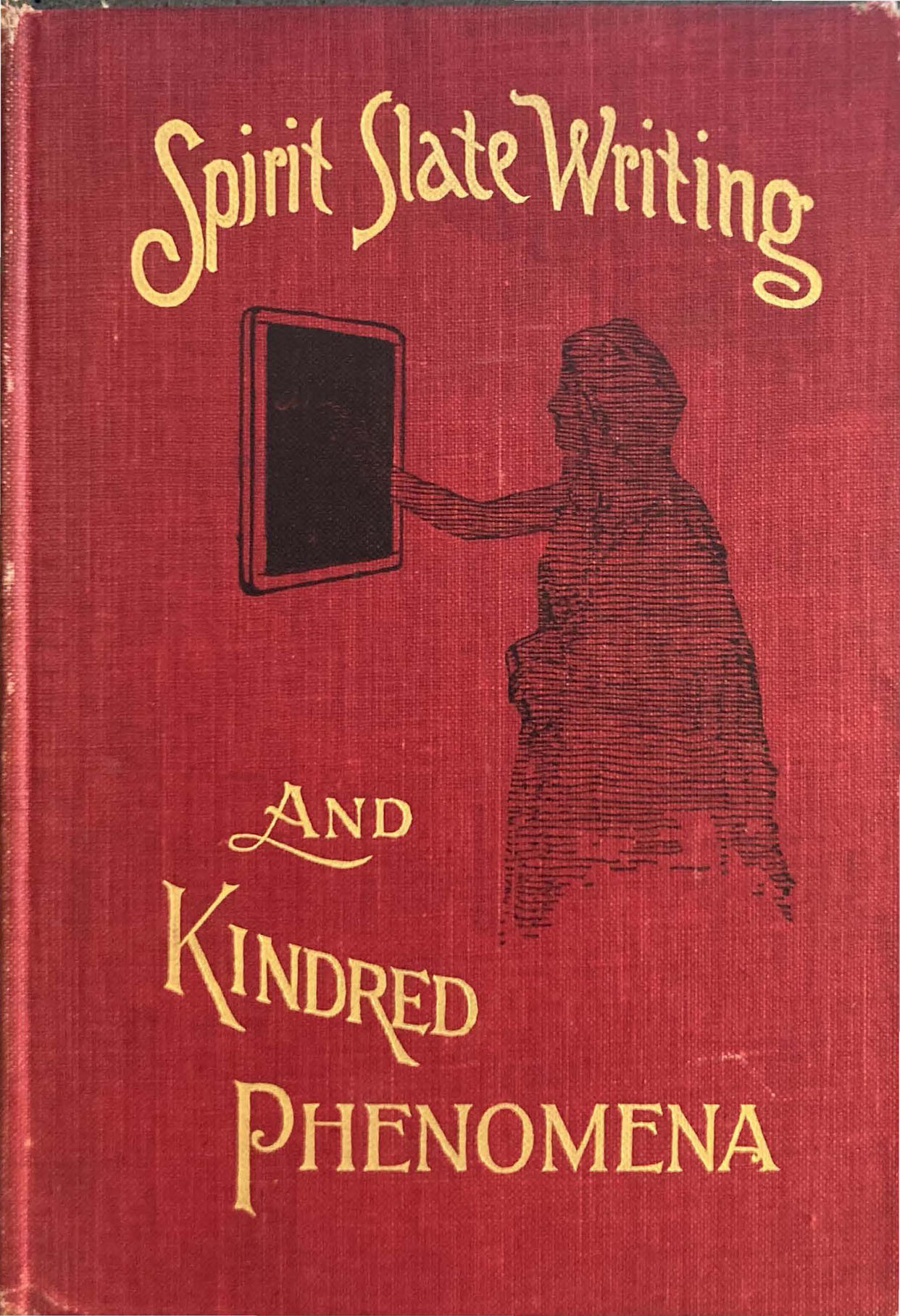
In the late 19th century when the Anderson’s were practicing their craft, others were attempting to warn spiritual seekers to be on the lookout for frauds. William Robinson (1861–1918), assistant to noted magician Alexander Herrmann (1844–1896) and author of Spirit Slate Writing and Kindred Phenomena (New York, 1898), walked a fine line. “The author of the present volume is not an opponent of spiritualism— on the contrary, he was brought up from childhood in this belief”; rather he attempted “to explain the methods of those who, under the mask of mediumship . . . victimize those seeking knowledge of their loved ones who have passed away.” Robinson’s book provided detailed descriptions and engravings to illustrate methods of deception used by charlatans in the field.

The deceased had many means of communicating with spiritual seekers. This stereograph, published by H. P. Moore in 1869, shows two women with their hands on a planchette, which would either be equipped with a pencil to convey a written message, or used on a Ouija board to select letters and numbers. The ghostly presence at rear no doubt directed the action.
Finally, Eunice White Beecher (1813–1897) (widow of clergyman Henry Ward Beecher and sister-in-law to author Harriet Beecher Stowe) had much to say about Pet Anderson and numerous other spiritualist mediums who began contacting her shortly after her husband’s death. In an interview included in the February 19, 1893, issue of the St. Louis Globe, Mrs. Beecher stated that shortly following the passing of her husband, “Spiritualists seemed to look upon me as their legitimate prey or object of conversion. . . . A clergyman in Chicago gave me a great deal of annoyance by sending letters in which he said Mr. Beecher had been heard from in the other world and that he said for twenty years he had been preaching error.” Another letter claimed that “Mr. Beecher had sent word from spirit land through ‘Pet’ Anderson, a female medium, that he had been in error for fifty-five years. Then the man wrote me begging me to let ‘Pet’ Anderson come here and stay with me for two or three days . . . Then he sent me what he called a sermon of Mr. Beecher’s, which he said had been communicated from spirit land.” When asked by the reporter if she thought the sermon was true to her husband’s style, Mrs. Beecher responded, “I hope none of his friends ever accused him of preaching anything like that. It was the most preposterous, childish nonsense that was ever penned. I could not imagine how such supreme nonsense could be conceived.” Nonsense or not, the human impulse to connect with the deceased and confirm the existence of an afterlife can be powerful. People like the Andersons skillfully manipulated these desires into opportunities for profit.