
SCHEMERS, CONS, AND GRIFTERS
No. 59 (Spring/Summer 2024)
Table of Contents
The Original Snake Oil Salesman
Emiko Hastings
Curator of Books
“Snake oil,” the notorious quack medical cure-all, has become a common metaphor for frauds and swindles of all kinds. It evokes an image of a late-19th-century traveling medicine show, complete with a fast-talking salesman peddling a dubious product said to heal everything from headaches to paralysis. Whatever the supposed “snake oil” contained, you could be sure no actual snakes were involved.
The origin of that myth is often traced back to a single historical figure. Clark Stanley, the self-proclaimed “Rattle Snake King,” developed his Snake Oil Liniment in the 1880s and continued to sell it for several decades until it was finally debunked. Much of the surviving information about Stanley comes from his self-published pamphlet, The Life and Adventures of the American Cow-Boy ([Providence], 1897), which is half a how-to guide for aspiring cowboys and half an advertisement for his snake oil liniment. Stanley claimed to have lived with the “Moki” or Hopi Indians for two years, during which time he learned their language and dances, including the famous Snake Dance. Supposedly, a medicine man he befriended gave him the secret of making their snake oil medicine, which they used for rheumatism and other ailments. Stanley maintained that he took this recipe and made an improvement on the original formula for his own Snake Oil Liniment, which he began selling in Texas.
![Cover of Clark Stanley's autobiography, "The Life and Adventures of the American Cow-Boy: Life in the Far West" ([Providence], 1897). Includes an image of Stanley.](https://clements.umich.edu/wp-content/uploads/2025/05/Q59-Images-1.png "Clark Stanley")
Clark Stanley’s fabulations possibly began with his own autobiography, when he claimed to be born in Abilene, Texas, in 1854. The town was founded in 1881. The Life and Adventures of the American Cow-boy: Life in the Far West ([Providence], 1897).
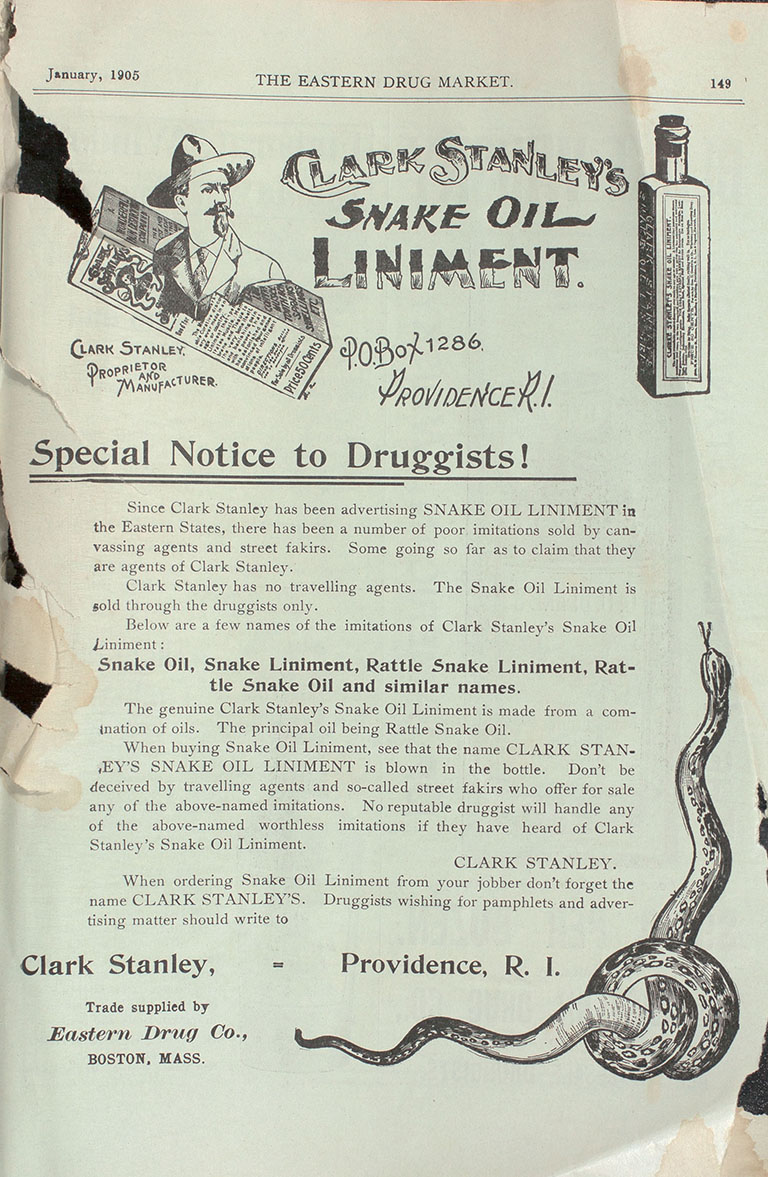
Given the eventual fate of Stanley’s product, this circular seems particularly audacious, warning users to be on the lookout for fakes and frauds, and to be wary of “poor imitations” peddled by those who would attempt to hoodwink the gullible buyer. Advertisement in The Eastern Drug Market, January 1905.
In 1893, Stanley said he attended the World’s Columbian Exposition in Chicago and made his snake oil liniment in a live demonstration, killing hundreds of snakes in front of his audience. If indeed this event took place as he described, it must have been an unofficial part of the fair, as Stanley does not appear among any official lists of exhibitors. After this publicity stunt, Stanley expanded his sales to the eastern United States and set up a factory in Providence, Rhode Island.
Stanley was apparently quite the showman, at least according to his own recounting. He was said to keep tame rattlesnakes as pets to be used in his shows, and claimed to have been bitten hundreds of times by venomous snakes, surviving only because he had the perfect cure for snake-bite. While several purported snake-bite antidotes were mentioned in his pamphlet, including a poultice of indigo and salt, applying a fresh-cut onion to the bite, and drinking generous amounts of whiskey, he did not specify which one he himself used. He raised thousands of rattlesnakes on his snake farms in Texas and Rhode Island in order to render their fat into oil for his liniment. The snake skins were tanned and made into slippers, belts, and neckties. Stanley’s Snake Oil Liniment claimed to cure rheumatism, gout, headache, toothache, sore throat, indigestion, frostbite, partial paralysis, lumbago, neuralgia, and insect and reptile bites. Ironically, Stanley also warned would-be customers against false imitations of his snake oil that were sold by traveling salespeople. He assured buyers that Clark Stanley’s Snake Oil Liniment was sold only by druggists.
The reputation of Stanley’s snake oil rested on its source as a traditional Indian remedy. However, his tale of living with the Hopi Indians and learning their secrets sounds like just the sort of false origin story that a scammer would invent. Other products of the time with similarly fictional backstories included Dr. Morse’s Indian Root Pills and Kickapoo Indian medicines. Both were created by white Americans but marketed as based upon Native American traditions. Stanley may indeed have witnessed a Hopi Snake Dance as he claimed, as white tourists were sometimes permitted to view this event. However, there does not appear to be any direct evidence tying Hopi traditions to the use of snake oil as medicine, and it seems unlikely that he alone would have learned this secret. Nevertheless, appropriating and commodifying Indigenous practices was a way for conmen like Stanley to give their fraudulent medicines an air of cultural authenticity.
Searching for the origin of snake oil, a popular alternate story has arisen that credits Chinese laborers on the transcontinental railroad with introducing it to the United States in the 1840s. According to this version, Chinese immigrants brought with them oil made from Chinese water snakes, a centuries-old remedy for muscle aches. Americans like Stanley saw its efficacy and marketing potential, but having no access to Chinese water snakes, began making oil with the locally-available American rattlesnake instead. It is true that Chinese water snakes are three times higher than rattlesnakes in omega-3 fatty acids, which can help to reduce inflammation when applied topically. American-made snake oil would be an inferior substitute.
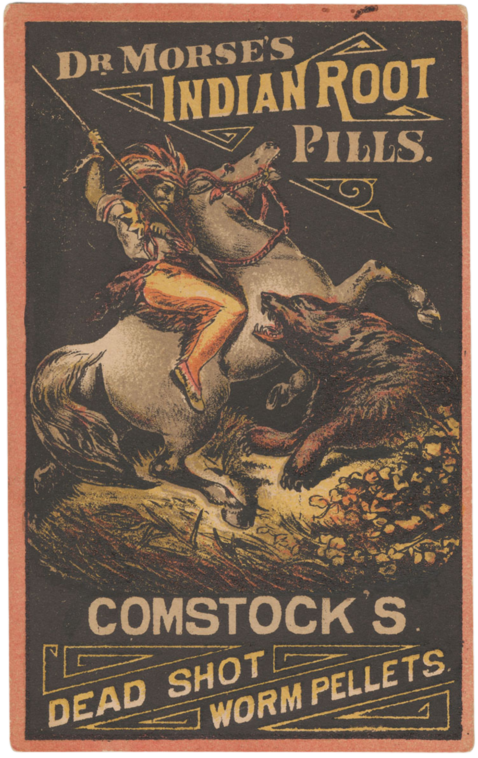
Dr. Morse’s Indian Root Pills traded on the romance of Native American traditions, and implied the ability to impart to its customers the strength and stamina of a bareback hunter. The pills were still being sold as late as the 1960s. Maxson Collection of Ephemera.

The Kickapoo Indian Remedies trade card at left borrows heavily from the image in George Catlin’s North American Indian Portfolio (London, 1844), capitalizing on the allure of the American West. At right is Buffalo Hunt, Chase No. 7.
While this theory has a charming simplicity to it, contrasting a real Chinese medicine with a shoddy American knock-off, there is little beyond circumstantial evidence to support it. Indeed, the use of rattlesnake oil in America long predates the arrival of Chinese immigrants. French captain Jean Bernard Bossu (1720– 1792), who explored the Mississippi River in the 1750s, reported that the Choctaw used snake oil for medicinal purposes. In the English translation of Bossu’s account (Travels Through That Part of North America, London, 1771), the Choctaw’s method is described: “The fat of the rattle-snake makes an excellent unguent for the rheumatic pains; this unguent penetrates into the body, to the very bones.” White American settlers appear to have copied the practice, listing snake oil among other household remedies in books such as Daniel J. Cobb’s The Family Adviser, Calculated to Teach the Principles of Botany (Rochester, N.Y., 1828). Cobb included rattlesnake oil among several oils made from animals, including bear, goose, hen, squirrel, mud-turtle, skunk, and wild-cat. He reported that “rattle-snake oil . . . will soften a callus, and will thereby many times limber a stiff joint.” In The Physician’s Assistant, Consisting of a Short and Comprehensive Materia Medica (S.l., 1833), Dr. Brooks recommends “rattle snake’s flesh, gall and grease” as a “great restorative.” A teaspoon of flesh could be powdered and mixed with wine, the gall preserved in chalk and given to treat fevers, and the grease taken internally or applied externally.
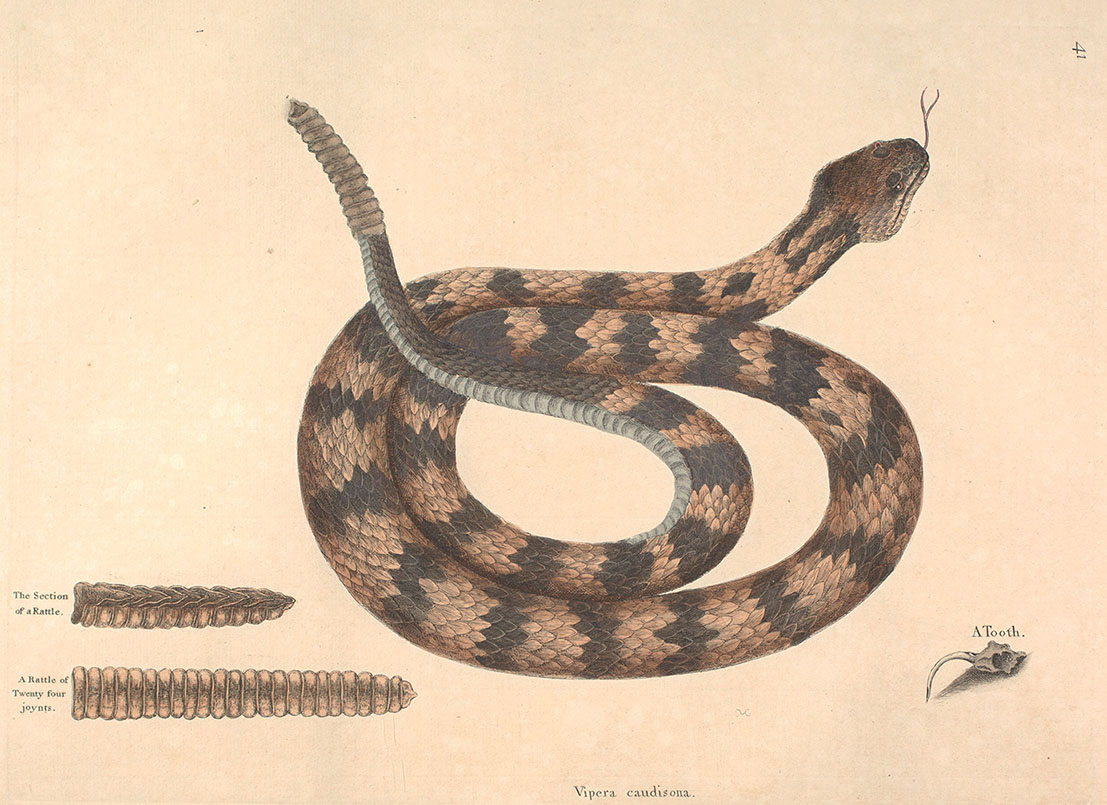
As opposed to the process of extracting venom, which requires ‘milking ‘ the fangs with no ill effects to the snake, rendering snake oil entails boiling down snake tissues, a process unavoidably fatal to the snake. This image of the American rattlesnake is a hand-colored copper plate engraving by Mark Catesby from The Natural History of Carolina, Florida and the Bahama Islands (London, 1731–43), vol. 2, plate 41.
Stanley wasn’t even the only person of his day to mass-produce snake oil as a medicine. Others across the country were manufacturing snake oil from rattlesnakes, crafting liniments containing the oil as an ingredient, or selling products called “snake oil” that did not actually contain any snake products. A number of these also traded on a supposed link to Native traditions, including Blackhawk’s Liniment, Rub-in-Oil sold by “Chief White Horse” of Madison, and White Eagle’s Indian Oil Liniment.
There does not seem to be a clear answer as to why snake oil had a surge in popularity while other animal oils remained in limited use. The reported ease and profitability of snake farming may have had something to do with it, compared to the difficulty of commercially producing bear or wildcat oil. As a venomous creature, the snake is naturally more dangerous and exciting than the common goose, squirrel, or skunk. Snake oil may also have caught the popular imagination because of its strong association with cowboys and the imagery of the American West.
By the time Clark Stanley’s Snake Oil Liniment was finally discredited, the term “snake oil” was already being used disparagingly to refer to any worthless cure-all medicine. Over a decade before Stanley claimed to have made his debut at the World’s Columbian Exposition, a May 15, 1882, issue of the Chicago Medical Review discussed snake oil as a fraud: “There are persons who still have great faith in the virtues of rattlesnake oil, and believe it a specific for rheumatism. A traveling quack who announced that his cure-all was compounded of rattlesnake oil, reaped a silver harvest from crowds on the square of a large city, not long ago.”
The final blow for Stanley came in 1916, when he was charged with violating the Food and Drugs Act. His snake oil liniment had been tested and found to contain nothing but “a light mineral oil (petroleum product) mixed with about 1 per cent of fatty oil (probably beef fat), capsicum, and possibly a trace of camphor and turpentine.” Having falsely represented his liniment as a remedy for numerous ailments, he was fined $20. The era of snake oil as medicine was finally over, but it continues to live on in the popular imagination as the quintessential American fraud.