

SCHEMERS, CONS, AND GRIFTERS
No. 59 (Spring/Summer 2024)
Table of Contents
The Mysterious Mrs. Ross
Cheney J. Schopieray
Curator of Manuscripts
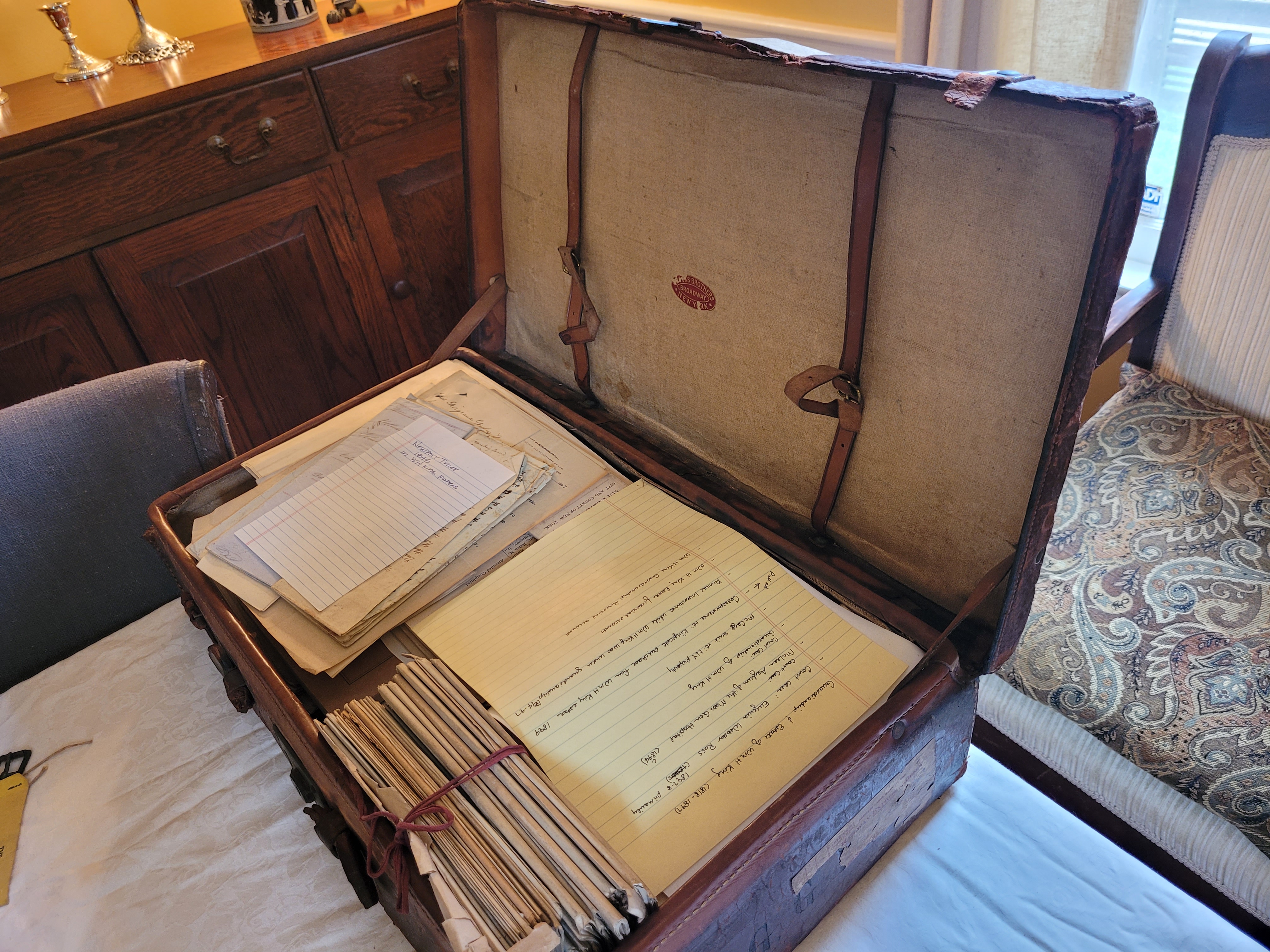
The William L. Clements Library acquired a group of King Family Papers in 1996. They focus heavily on the Kings’ mercantile activities at Macau and Canton, China, family property, and William H. King’s institutionalization. In 2020, the King Family Papers were digitized to support Fellow Lauren Davis’ research for “Beyond Institutions: Mental Disorders and the Family in New York, 1830–1900.” More recently, the library was contacted by Fran Wescott, a relative of a King family guardian, who thoughtfully and generously donated a large collection of 19th-century King family papers in the fall of 2023. This addition offers a wealth of new source material on a compelling family—and also Mrs. Ross.
“Mrs. Ross has always been a wandering character, her relatives don’t know where she lives or how. Her history, if written, might be as romantic as that of Rob Roy, Jesse James or Belle Star.”
Mrs. Ross is “a woman of uncommon intelligence and great will power, but as having obtuse moral perceptions, unscrupulousness as to the means, by which she attained her desires.”
(E. S. & J. T. Drake letters, October 16 and November 10, 1893; Port Gibson, Mississippi; King Family Papers).
In late 1888, a woman named Mrs. Ross arrived at the McLean Asylum for the Insane at Somerville, Massachusetts, to visit patient William H. King. Though she had never met him, she rejoiced in the belief that she had found her long lost uncle who had been presumed dead decades before. She was taken by his “patience, gentleness and beautiful humility” and began to work toward bettering his living conditions and comfort. She sent him papers and gifts. When Mr. King had a sore red spot on the bridge of his nose, she bought and sent him a pair of new gold spectacles with fine French crown lenses. Fearing for his discomfort she recommended elegant coverings for his leather armchair. Believing him in need of attention, she pleaded for increased social calls by herself and by prominent men and women who had known him. She encouraged frequent visits by asylum personnel to give him smiles and cheering words to lift his “poor broken spirit.” Nothing should be spared to provide for his comfort and happiness.
The institutionalized William H. King had been a prominent Newport, Rhode Island, merchant who made his fortune as a trader in China in the 1840s and 1850s. William King never married or had children, and by the early 1860s showed increasing signs of mental distress, characterized by heavy alcohol consumption, paranoia, hallucinations, and violent outbursts. His brother Edward King worked with Dr. Benjamin D. Silliman and others to assess William’s condition. On July 31, 1866, the King family had William involuntarily committed to the McLean Asylum under the care of superintendent Dr. Edward Cowles. There he remained for the 22 years before his unexpected visit from Mrs. Ross.
Dr. Cowles was suspicious of Mrs. Ross from their first interview. Between 1888 and 1893, Mrs. Ross sent a string of letters to the superintendent, making claims that she had inherited her uncle’s southern estate in the 1860s because he’d been thought dead—and could now impart it to her uncle. She believed that he was illegally imprisoned and was not insane. She besmirched William King’s brothers as men who had kidnapped him and confined him at the asylum for their own purposes. Though the brothers were now dead, their children—King’s nieces and nephews—were living off his wealth while keeping him from the luxuries he could afford. She praised Dr. Cowles for his care and protection of her uncle from the “evil” people living off the riches stolen by their fathers. As King’s niece, Mrs. Ross wrote, “No living mortal has any right to him but me—no living mortal has any right to his belongings but himself.”
Altercations with attendants and doctors resulted in the temporary banning of Mrs. Ross from asylum visits. During her exile, Mrs. Ross blew kisses from the street when William King was taken on his regular carriage rides. She continued to send papers and gifts, though some or all of them were intercepted and withheld. She eventually apologized to the asylum personnel, insisting that her behavior was on account of her desire to support Mr. King and noting that she would help build the finest sanitarium in the world with suitable accommodations for wealthy clientele and protection against the greed of “selfish and wicked” people.
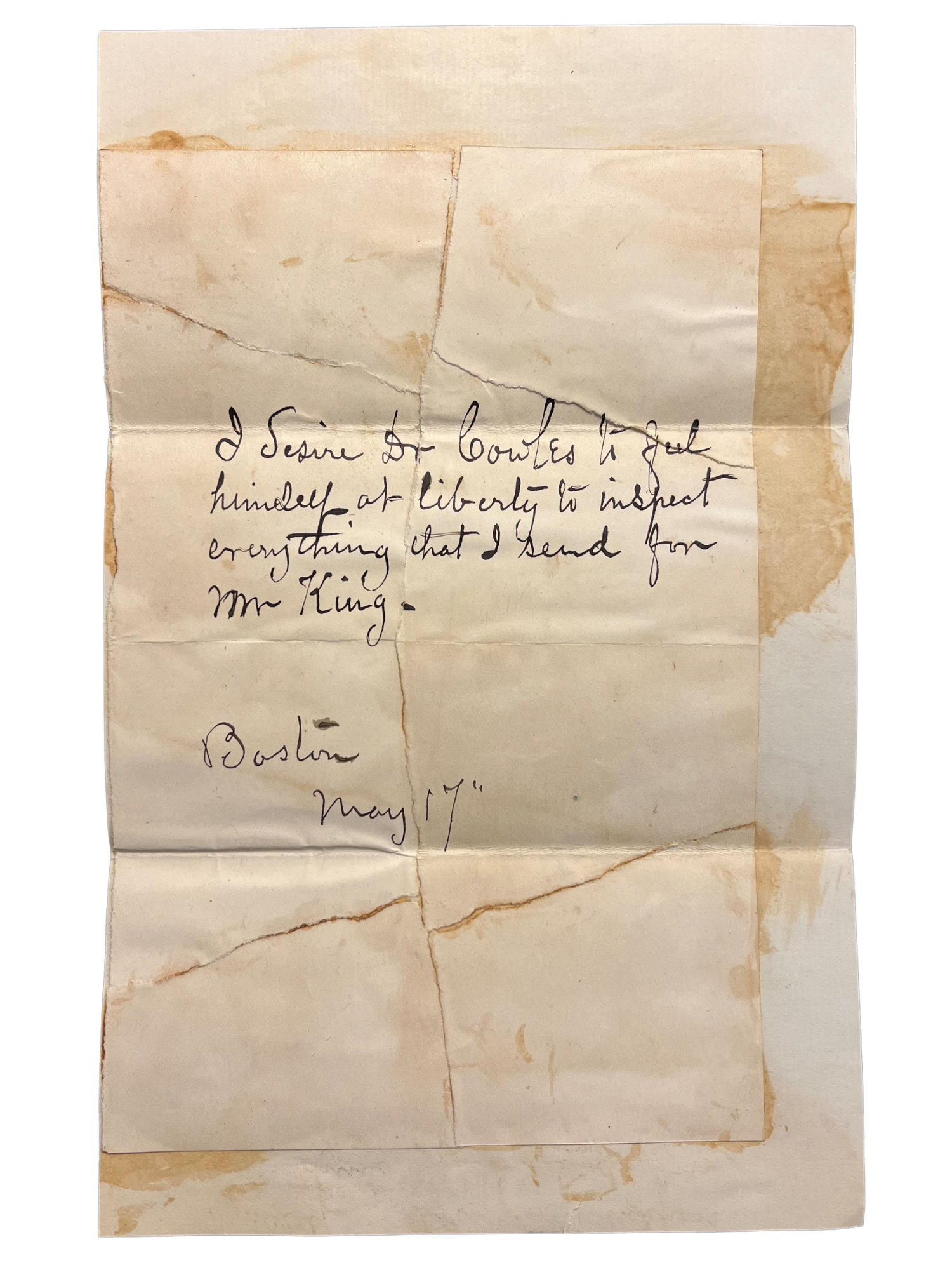
When Mrs. Ross believed her packages were not making it to William King, she presented this note encouraging Dr. Cowles to inspect them. It was torn in six, but then someone—probably the superintendent—had it pasted back together for retention.
“Who is Mrs. Ross,” read newspaper headlines in New York, Rhode Island, and Massachusetts in 1893. Mrs. Ross had filed a petition for habeas corpus with the Supreme Judicial Court in Suffolk County, Massachusetts, for the illegal institutionalization of William King and his unlawful detention at the asylum. She argued that he was sane and should gain his freedom. Immediately after the 1893 petition, W. H. King was removed from the asylum to a hotel, evaluated by a guardian ad litem, found to be insane and in need of medical care for seizures, and re-committed by the judge’s decree. Mrs. Ross appealed and asked for a jury trial to determine in/sanity. The appeal was rejected and dismissed on December 6, 1893. And thus began a string of lawsuits and appeals that would wend their way from Massachusetts to Rhode Island, to New York, and to the United States Supreme Court over the next six years.
Another legal battle between Mrs. Ross and the King family arose several months later upon the death of David King, Jr., William King’s nephew and guardian. The flurry of claims and counterclaims in the courts fed curiosity about Mrs. Ross, and newspapers scrambled for information about her. Who was this woman and how was she related to William H. King? The Providence Journal published regular updates and shared the common refrain, “No Explanation of the Identity of the Mysterious Mrs. Ross Who is Fighting the King Heirs.” Lawyers for Mrs. Ross refused to disclose her background so as not to prejudice the case.
Mrs. Ross’ opening affidavit of December 1894 carefully narrated the abduction of William King by his brothers at Troy, New York, in 1866, his forced institutionalization, the sketchy and missing paperwork surrounding it, and called into question the dismissal of her habeas corpus case the preceding year. She claimed that William H. King was not actually William H. King, but instead was her uncle Peletiah W. Gordon. Few other facts were provided and the bits and pieces about Mrs. Ross were only revealed through depositions of people who knew her through family. They shared that Eugenia A. Webster Ross was born at Port Gibson, Mississippi, to parents James and Christiana Calhoun. Her mother had died when she was young, and Eugenia was raised by her grandmother, Aletheia Gordon. According to an aunt-in-law, “Mrs. Alethea [sic] Gordon, the grandmother of Mrs. Ross, was very penurious and exceedingly eccentric. I believe that tendency thus inherited by Mrs. Ross had developed into insanity upon questions of property and the inheritance of great estates.” Eugenia Calhoun married Captain Isaac A. Ross. After her husband’s death in the 1870s, she did not inform the captain’s mother, who only learned of it months afterward from another source. Acquaintances claimed she had a “roving” disposition with no fixed address, unknown sources of money, and no estate through her deceased husband. She assumed different names in her travels and was boarding sporadically in Salem, Massachusetts between 1888 and 1891 as “Mrs. Black.”
At length, on July 1, 1895, a final decree from the Supreme Court Appellate Division at Providence, decided on William H. King’s relative, George Gordon King, as guardian.
The King family heard nothing more from Eugenia Ross until the death of William H. King on March 6, 1897, at the psychiatric Butler Hospital in Providence where he had been transferred. The King family deliberated on the most appropriate executors for William’s massive estate. George Gordon King and Sarah Birckhead, representing the two branches of family, were granted letters of administration. Eugenia A. Webster Ross filed an appeal to the Supreme Court of Rhode Island at Newport after the probate court upheld the appointment. She argued that George and Sarah were not next of kin, that Eugenia was next of kin, and that the Newport probate court granted the appointments before a legally required 30-day window passed. Over the spring and summer of 1897, Eugenia led her lawyers on an expedition to find evidence proving that the William H. King that traded in China was not the man who died in Butler Hospital and that Peletiah W. Gordon was the deceased. They called at the homes of King family members, demanding that they turn over or reproduce family photographs, private and business papers, family histories, and a sculpted bust. The goal was to secure depositions of persons who could visually identify which man was which.
On July 22, 1897, the Chief Justice ordered a deposition by Mrs. Ross, but she could not be found. The King’s lawyers hired the Pinkerton Agency to find her and deliver the summons. When the agent discovered her, he attempted to serve the document in the street. Mrs. Ross “caused a disturbance,” refused to accept the paper, and failed to appear before the judge. She was held in contempt. The case was decided in favor of the Kings for Mrs. Ross’ contempt and failure to submit the ordered bill of particulars in the Fall Term 1897. Mrs. Ross was terrifically frustrated and believed that she had been denied justice on account of a legal technicality. The case rose to the United States Supreme Court, which decided against her on November 7, 1898. And then as the Kings, the courts, creditors, and unpaid assistants began to press in on Mrs. Ross for financial obligations associated with the previous six years of litigation, she vanished.
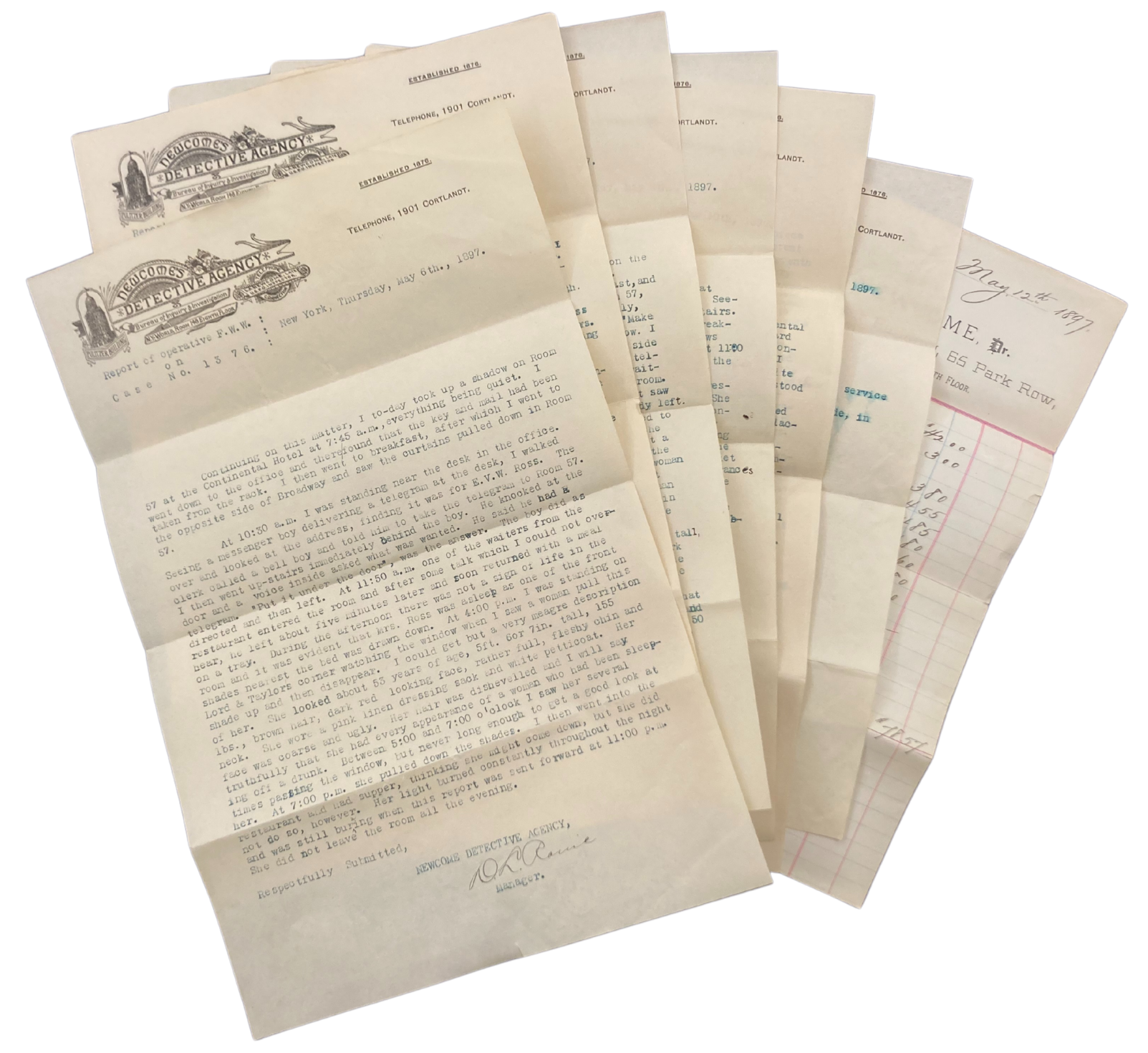
The 2023 addition to the King Family Papers included daily reports on the surveillance of Mrs. Ross. King family lawyers hired detectives on more than one occasion to find, identify, and serve papers to Mrs. Ross. In May 1897, Newcome’s Detective Agency operative F. W. Warde tracked her down at Room 57 of the Continental Hotel in New York. Questioning the bellboy about Room 57’s occupant elicited the response, “. . . she ain’t no Princess, but she’d like to be.” When finally confronting her in the hallway outside her room, she refused to take the papers, insulted his intelligence, and demanded information about who sent him. Stating that the papers only needed to touch her, he placed them on her shoulder and departed.
Eugenia Aletheia Calhoun Webster Ross was mysterious, but the lawyers, newspapers, in-laws, and detectives were simplistic in reducing her to an “adventuress” perpetually clamoring after wealthy men’s estates. Born in 1836, Eugenia was raised brought up by her father and grandmother in a tumultuous environment. Her father James was a manipulative and cruel man, who engaged in duplicitous real and personal property schemes. He relied on a combination of threats, genealogy and inheritance arguments, and questionable legal transactions to secure for himself the property of his in-laws, the Gordons. After the death of Eugenia’s mother in 1838, James installed himself on his mother-in-law’s cotton plantation at Port Gibson. He threatened that if she did not grant permission for him to live there, he would take Eugenia away to Texas where he would disallow any contact between them. Aletheia gave in and James, Eugenia, and Eugenia’s brother Adam settled on the plantation. An agreement was signed, stipulating that they could live on the plantation beginning June 28, 1837, so long as James kept the plantation profitable. James began calling the plantation “Calhoun Place.”
This arrangement lasted six years, until Aletheia’s husband died. His will stipulated that Aletheia would receive $1,000 annual allowance plus four enslaved domestic workers; considerable property would go to their children Christiana and Peletiah W. Gordon; and an investment was allotted to grandson Adam Calhoun for his education. To frustrate these terms, James refused to give Aletheia any accounting of plantation costs or profits. He also intervened and prevented her annual allowance, providing instead erratic small amounts of cash and groceries. Without regular funds, she was unable to pay debts, at least one of which went to court. She believed that James was intending to lead the courts into forcing her to sell the plantation property, which James would then buy for himself. Aletheia’s fears were justified. At an earlier date, she had sent James to Kanawha, Virginia, to pay taxes on 6,000 acres of Gordon lands. He instead sold the land to pay the taxes, and bought the property under his own name. To make matters worse, James’ barbarity prompted 10 of the 21 enslaved men, women, and children at “Calhoun Place” to flee to Aletheia’s home for protection. James gathered together several men and attacked her house, breaking into her kitchen, shouting, threatening, and pursuing the terrified enslaved laborers.
Eugenia Calhoun’s grandmother died in 1844, and she was left alone with her father. In a horrific irony, James became Aletheia’s executor. He took over the property, remarried, and parceled and sold parts of the land. Eugenia observed these actions. She saw court proceedings and women’s secondary legal status repeatedly favor her father’s unjust efforts to steal property and monies that rightly belonged to her mother and to her uncle—and to Eugenia as next of kin. What she didn’t witness herself, she learned through papers and court records later. Her father’s preoccupation with avarice revealed itself when Eugenia’s fiancée Isaac A. Ross asked James for permission to marry. Her father refused on grounds that Ross was only interested in Eugenia for her property. Nevertheless, Eugenia and Isaac married in 1858, and shortly thereafter “Isaac A. Ross & wife” sued James E. Calhoun for the inheritance he’d stolen from Aletheia, Christiana, and Eugenia. The Civil War caused delays, but on March 15, 1866, a portion of the claims were validated, and the courts awarded Eugenia Ross $17,641.86.
Eugenia Ross spent her 30s handling various aspects of her husband’s mercantile business, while simultaneously pursuing two avenues of legal inquiry. She attempted to track down her uncle Peletiah W. Gordon, who may or may not have been dead, and to secure her just inheritance from the Gordon property spuriously sold or re-arranged by her father. In the latter case, she engaged in multiple Mississippi lawsuits that finally concluded in 1895. In the former case, Eugenia’s path became murky. The Pinkertons later suggested that Eugenia became a Spiritualist during the Civil War period and that a medium working out of the Gayoso Hotel in Memphis, Tennessee, told her that her uncle Peletiah W. Gordon was still alive. Her investigations discovered that as a youth, Peletiah ran away multiple times, from home and from his school at Lawrenceville. After a final argument with his mother Aletheia, he left the family for good in his late teens. The last piece of information Eugenia learned was that her uncle was arrested in Boston for pickpocketing $27 and afterward absconded.
It is not clear how Eugenia came to the conclusion that her uncle changed his identity. In the 1870s, she came to believe Archibald W. Gordon (A.W.G.) of Mobile, Alabama, was in truth Peletiah W. Gordon (P.W.G.). She claimed that P.W.G. ran away and became director of the U.S. Bank at Mobile as A.W.G. Though the theory was far fetched, her strong advocacy, intelligence, and persuasiveness convinced lawyers to take it to court. They worked for her on promises of percentage returns, while she in turn borrowed money from individuals on similar assurances. Isaac B. Rich, Spiritualist editor of the newspaper Banner of Light (Boston, 1857–1907), offered to put up over $20,000 on loan and percentage returns for the effort. The Alabama cases were not decided in her favor. Eugenia Ross followed other genealogical trails, looking for P.W.G. and other ancestors’ estates, from Texas and New Hampshire to England, eventually leading to William H. King in the asylum at Somerville, Massachusetts, in 1888.
In the latter half of 1888, the same year Mrs. Ross arrived at the McLean Asylum in Massachusetts, she also arrived unannounced on the doorstep of septuagenarian schoolteacher Phoebe Dowdle at Stonewall, Mississippi. Mrs. Ross talked about the special place in her heart for Phoebe’s brother Edward, who had been so kind during Eugenia’s brother’s death. Mrs. Dowdle remembered Eugenia as a child and listened to stories of Mrs. Ross’ wealth, connections in Port Gibson, Philadelphia, Baltimore, and elsewhere. Two years later, Eugenia returned to convince Phoebe to join her in a month-long trip to New York. After pressure and convincing, the two women left Mississippi in October 1890. At Mrs. Ross’ insistence, Mrs. Dowdle brought only a trunk of her grandfather’s papers and his picture—no additional clothing or other baggage. One week later, Phoebe sent a note to her daughter Isabella with no return address, stating “If I had only known what I know now, I would never have been here.” And then silence.
The Dowdle children tried to speak with Mrs. Ross’ connections in Port Gibson—most were dead. Neither family, friends, nor detectives knew where Eugenia went with their mother. In the latter half of 1892, Salem, Massachusetts, mayor Robert Rantoul received a letter from Salem resident Mary F. Huse. Mary and her clairvoyant husband Asa had taken in a female boarder of unknown background two years earlier. She had been left there by a Mrs. Black, who offered to pay a large weekly sum for board because the woman was of “unsound mind,” confused, and needed additional care. Mrs. Black came and went, sometimes staying away for many months at a time, repeatedly insisting that the boarder needed to be ready at a moment’s notice for her return. The Huses could not convince their boarder to tell them anything about her family or where she came from. Over time, Mary Huse felt something was wrong.
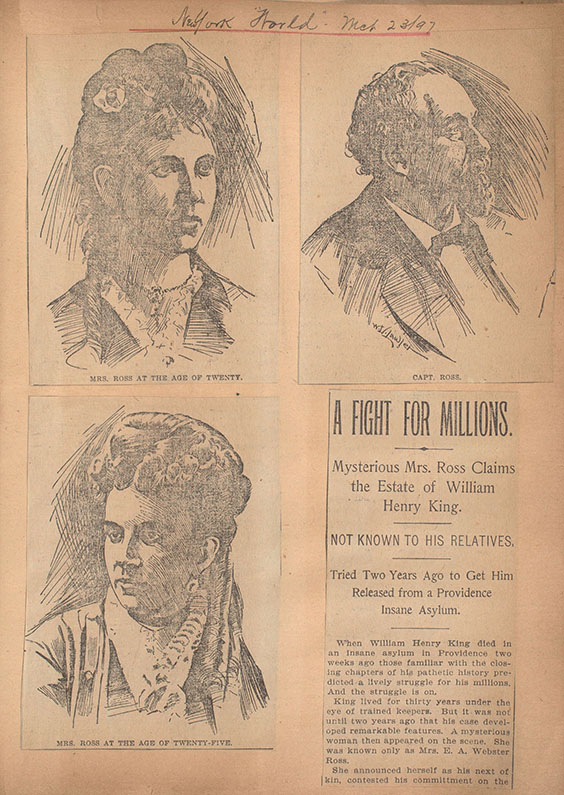
The King family compiled a newspaper scrapbook containing clippings related to the various cases by Mrs. Ross, including this page with reports of the March 1897 legal proceedings and a rare portrait of Eugenia Calhoun Ross. The volume of material kept by the family relating to the Ross cases speaks to its impact on the lives of those involved.
In February 1893, after mayor Rantoul began an investigation, Mrs. Dowdle revealed her identity. Mrs. Ross/ Black had convinced Phoebe Dowdle that she would be placed in an insane asylum if she shared even the tiniest detail about her identity with the Huses or anyone else. Mrs. Dowdle was so terrified that she remained in the Huses’ home, fearing they wouldn’t believe her true circumstances and that at any moment, Mrs. Black/Ross would show up and have her committed. Mayor Rantoul arranged for Mrs. Dowdle to travel home to Mississippi, met with Mrs. Ross and her lawyer to turn over unpaid board for the Huses, and the affair ended. Or, nearly so. Unbelievably, in December 1893, Mrs. Ross sent a letter to Phoebe Dowdle, stating that she was coming to visit in a few weeks.
The Clements Library’s collections are filled with complicated people, who seem to plead simultaneously for empathy and opprobrium. Mrs. Ross shrewdly built legal cases with a paucity of evidence, manipulated and deceived lawyers and people who loaned or gave her money, caused emotional pain to bereaved family members, inserted herself into the life of a mentally ill man on false pretenses, kidnapped and psychologically tortured an older woman for multiple years, crafted two or more identities for deceptive reasons, and much else. At the same time, she grew up watching her father ruthlessly manipulate her grandmother for advantage, experienced his threats and violence, and saw her own property stolen by him. She developed a strong character and a sense that she had to fight for her inheritance and her rights in the male-dominated spheres of the court system and daily life. The tale of Mrs. Ross has important ties to the history of mental health care, women and the law, property, slavery, Spiritualism, journalism, and more in the 19th century United States. Her full story has yet to be written, but when it is, it might just be as romantic as that of Rob Roy, Jesse James, or Belle Starr.