

SCHEMERS, CONS, AND GRIFTERS
No. 59 (Spring/Summer 2024)
Table of Contents
One Nation Under a Grift
Paul J. Erickson
Randolph G. Adams Director
William L. Clements Library
“It is good to be shifty in a new country” was the advice offered by Captain Simon Suggs. Created by the Southwestern humor writer Johnson Jones Hooper in the 1840s, the fictional Captain Suggs personified a type that would become familiar in antebellum American writing: a confidence man. Suggs traversed the Alabama frontier in pursuit of a wide variety of schemes designed to separate his neighbors from their money.
Suggs’ motto reflected what was a constant reality for people living in the early United States. It was a new country, characterized by a vast geographic scale and extremely high levels of mobility compared to most countries in Europe. People often found themselves dealing with individuals they had never met, with no social context to determine whether shopkeepers or ministers or teachers were on the up and up. They bought plots of land they had never seen. They relied on strangers to manage their business affairs and keep track of their money. This lack of certainty regarding identity could serve as a ladder for the ambitious and unscrupulous. The person we know today as the General Baron von Steuben—the Prussian military officer credited with introducing training methods that turned the Continental Army into a professional fighting force during the Revolutionary War—was not a general, nor was he really a baron. But he was introduced as such to Benjamin Franklin in Paris, who wrote “General Baron” von Steuben a letter of introduction to George Washington, and that was that.
The pages of early American writing—both in manuscript and print—are filled with widespread unease about frauds, swindles, grifts, counterfeits, and outright theft. This anxiety was fully justified in an era when, to take one example, anywhere between ten and fifty percent of the paper currency in circulation was counterfeit. The proliferation of state banks in the antebellum decades flooded the market with thousands of banknotes in endless designs and denominations. People tried to verify whether their notes were worth anything, often with the help of regularly published counterfeit detectors. But at some level it didn’t matter. In an economy where actual gold and silver were extremely scarce, people needed paper money to make daily economic activity possible, whether that currency was real or fake.
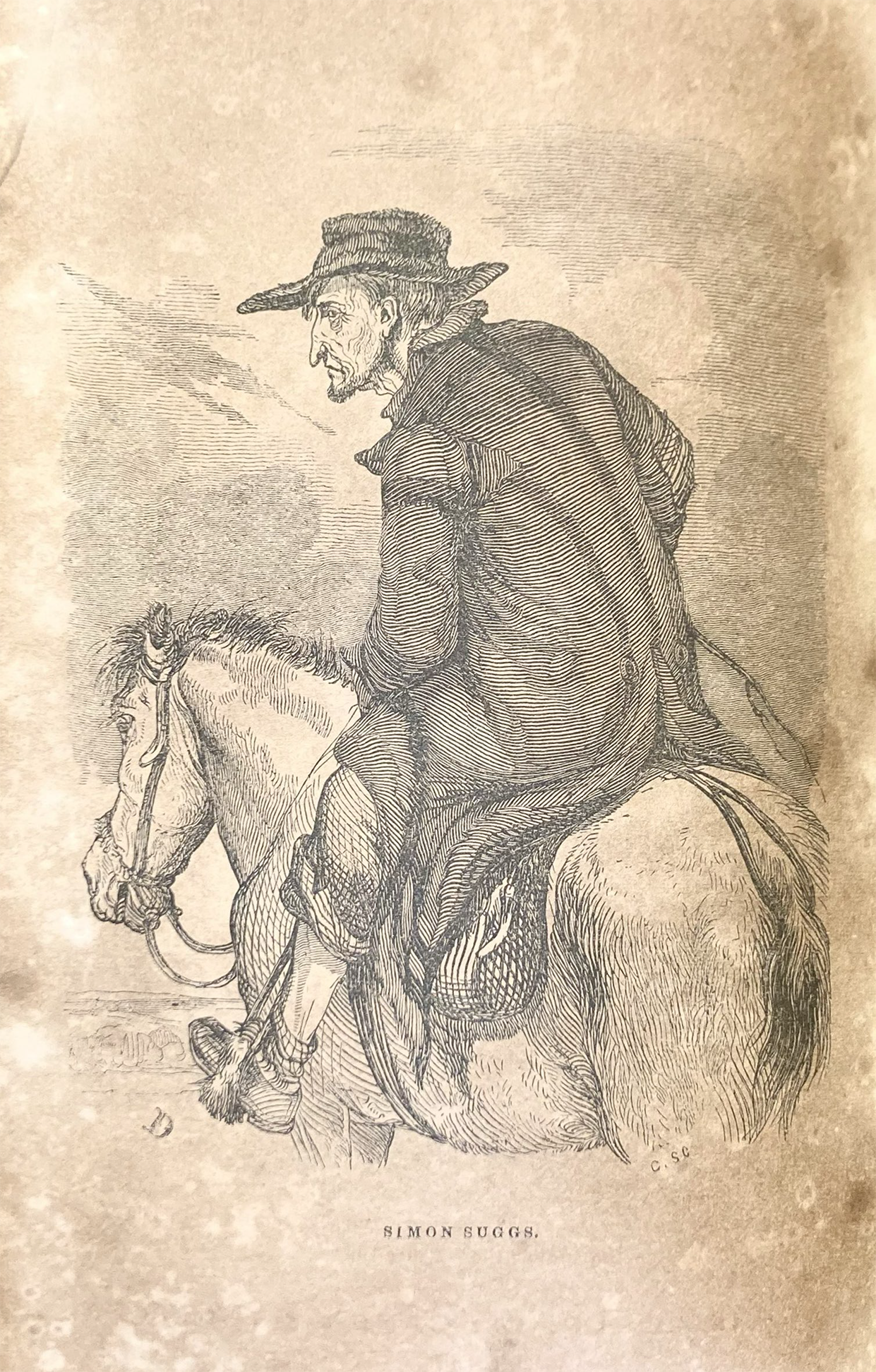
A teller of tall tales and an early exemplar of frontier humor, the shifty Captain Suggs was a lovable vagabond who cheated at cards, played (sometimes not so) harmless tricks on his circle of friends and acquaintances and was “a miracle of shrewdness.” His appeal was in “a quick, ready wit, which has extricated him from many an unpleasant predicament, and which makes him whenever he chooses to be so—and that is always—very companionable.” Major Jones’s Courtship and Travels; Some Adventures of Captain Simon Suggs, Late of the Tallapoosa Volunteers . . . (Philadelphia, 1846–7).
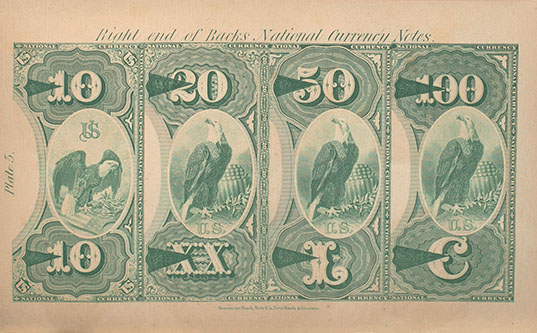
A sheet of bills from Heath’s Greatly Improved and Enlarged Infallible Government Counterfeit Detector by Laban Heath (Boston, [1866]) provided samples against which to compare one’s own bills for signs of illegitimacy.
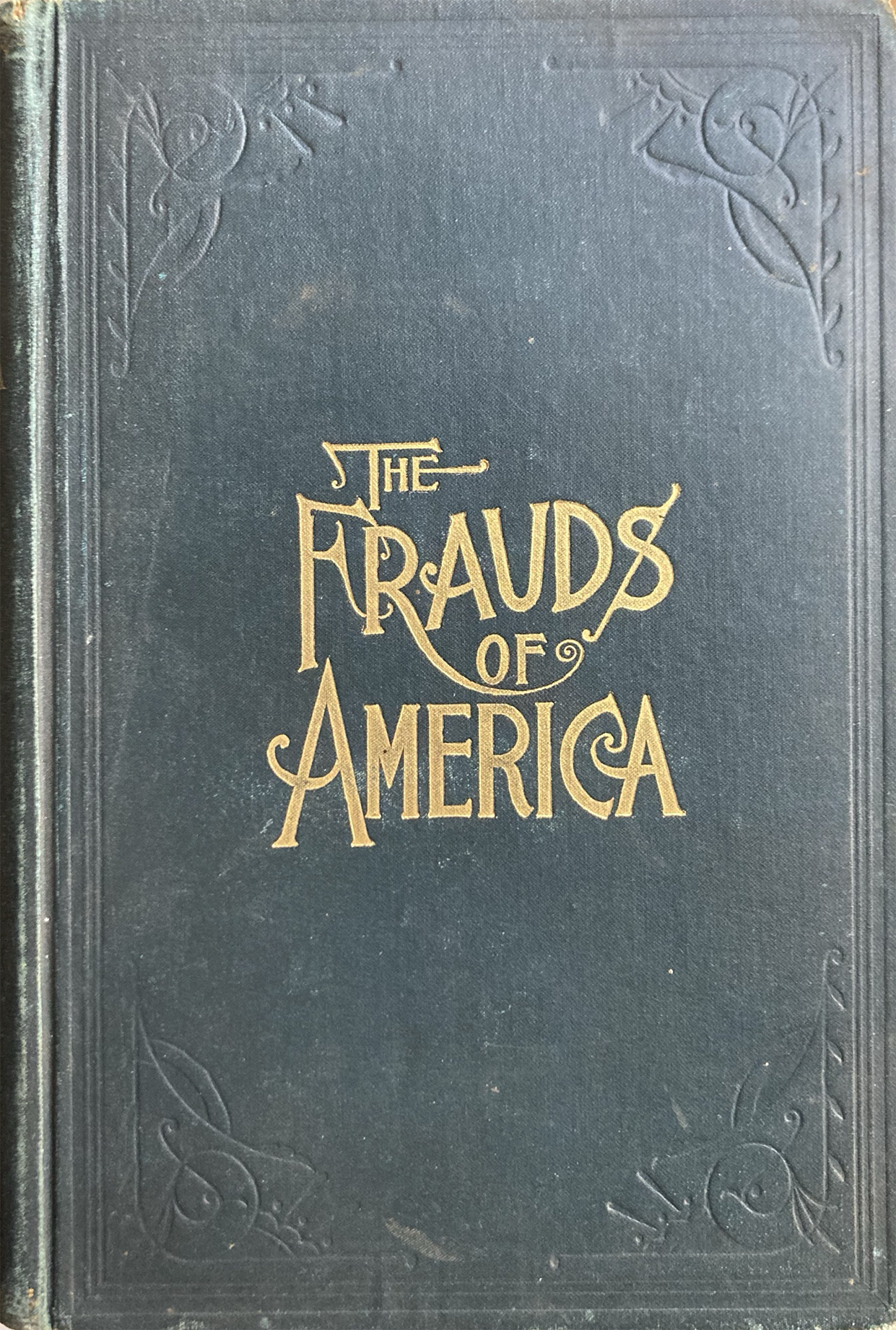
Frauds of America (Chicago, 1896) touted the uses of physiognomy as a helpful guide to determining moral character: “it is the sensualist whose vice is read in his lips, the knave whose propensity is revealed in the shape of his mouth, the man of violence is surrendered by his eyes. An experienced detective, policeman, or a trained jailer seldom needs to ask the crime of which the prisoner was guilty. He can tell it by his face.”
Many authors of advice manuals, city directories, and novels shared a concern with helping the guileless avoid being duped. These writers were particularly attuned to the dangers that confidence men posed to young people who were moving to American cities to find work. Away from the familiar environments of home and church, these transplants were targets of seducers, gamblers, prostitutes, and more. The table of contents of an 1896 book titled The Frauds of America: How They Work and How to Foil Them by E.G. Redmond (Chicago, 1896) is a list of urban swindles for which Americans needed to be on the lookout: forgers and counterfeiters, pickpockets and shoplifters, mail thieves, Ponzi schemes, genealogical humbugs, sellers of counterfeit goods, blackmailers, mock auctioneers, and thimble riggers (the thimblerig was a form of shell game). As Karen Halttunen so brilliantly outlined in her book Confidence Men and Painted Women (New Haven, 1982), all of these anxieties stemmed from the fact that increasing numbers of Americans in the antebellum U.S. were in regular contact with strangers.
In the nation’s growing cities, signs of respectability, such as good manners and decorous dress, served as codes for trustworthiness. But respectable clothes and comportment could be easily faked, particularly with the help of the aforementioned advice guides. The same books that told people how to identify spurious banknotes or untrustworthy salesmen could also serve as instruction manuals for how to more effectively trick the unsuspecting. Indeed, the shelves of the Clements Library are not only rife with anxiety about being cheated, they are also filled with advice on how to do the cheating. Narratives of mercantile life told shop clerks how to include their thumb in the measurement of fabric, so as to short customers a thumb’s width. They advised grocers on exactly how much sand they could get away with adding to their sugar barrel without having customers complain.
Some items in the Clements Library’s collection are remarkably forthright in providing guidance for how to put one over on an unsuspecting public. One such recent acquisition is The Bordeaux Wine and Liquor Dealer’s Guide: A Treatise on the Manufacture and Adulteration of Liquors, (New York, 1857). The anonymous author frames his work as being primarily concerned with consumers’ safety, explaining that all the countries of Europe combined do not produce enough pure brandy “to supply the natural trade of New York City alone.” Therefore, the author wishes to “introduce an entirely new system of manufacturing and adulterating liquors, by which the use of poisons and poisonous compounds are avoided . . . .” Readers were intended to be comforted by the fact that while all the liquor they bought was fake, at least it wouldn’t kill them.
Visitors to the United States often remarked on the widespread public acceptance of deception. Charles Dickens, in his 1842 American Notes for General Circulation, expressed astonishment at how people who would elsewhere have been imprisoned as swindlers were instead praised for their “smart dealing.” Dickens wrote: “The following dialogue I have held a hundred times: ‘Is it not a very disgraceful circumstance that such a man as So-and-so should be acquiring a large property by the most infamous and odious means, and notwithstanding all the crimes of which he has been guilty, should be tolerated and abetted by your Citizens? He is a public nuisance, is he not?’ ‘Yes, sir.’ ‘A convicted liar?’ ‘Yes, sir.’ ‘He has been kicked, and cuffed, and caned?’ ‘Yes, sir.’ ‘And he is utterly dishonourable, debased, and profligate?’ ‘Yes, sir.’ ‘In the name of wonder, then, what is his merit?’ ‘Well, sir, he is a smart man.’”
![Cover of "Trial of the Notorious Ann Carson, and Her Accomplices" ([Philadelphia?], 1823).](https://clements.umich.edu/wp-content/uploads/2025/05/Ann-Carson-bg-removed-e1748015047784.png "Ann Carson bg removed")
Ann Carson perhaps epitomized the type of person whose appearance was no guarantee of social status. With her outward veneer of education, manners, and dress, she operated in higher society, managing at one point to gain admittance to an audience with Dolly Madison. However, once her means proved unequal to maintaining her upper-middle-class lifestyle, Carson turned to kidnapping, robbery, and finally, forgery. She died from typhoid in prison after being convicted in the trial described in this pamphlet, Trial of the Notorious Ann Carson, and Her Accomplices ([Philadelphia?], 1823).
The frequency with which anxiety about fraud and deception turns up in the Clements Library’s collections raises questions about what living under such conditions does to a people. Can we trust our institutions? Our government? Can we trust one another? Herman Melville’s 1857 novella The Confidence-Man (New York, 1857) serves in many respects as the core text for all of these questions. Set on the Mississippi steamboat Fidèle on April Fools’ Day, the novella shows the title character turning up in a multitude of guises to ask all of the ship’s passengers for their confidence. In the book’s final scene, an old man struggles in the dark to compare two banknotes he had gotten in St. Louis to the images in a newly acquired counterfeit detector. Unable to decide if the notes are genuine or not, he spoke for many of his compatriots in the antebellum U.S.: “I don’t know, I don’t know . . . there’s so many marks of all sorts to go by, it makes it a kind of uncertain.” Understanding how people in the past dealt with uncertainty is one of the greatest challenges that contemporary historians face, and it’s why the Clements collections remain such a tremendous resource.