
The Maps Division has added three family atlases to the Clements Library holdings. In 19th century America, these atlases were popular with the general public and combined hand-colored maps with descriptive text about geography, history, and culture of the world.
A modern atlas, to accompany the system of geography and history combined: for the use of families and schools. Wethersfield: Deming & Francis. 1825.
This small atlas includes nine maps and multiple statistical tables. The map of North America shows United States claims on lands in the Pacific Northwest extending into Canada labeled New Caledonia and Canada labeled as Prince Rupert Land, referring to the control of the land by the Hudson’s Bay Company. The statistical tables are printed on the inside covers. The front cover focuses on data documenting the extent, population (including freed and enslaved people), military power, and commerce of the United States and its territories, while the back cover gives the heights of mountains and lengths of rivers.
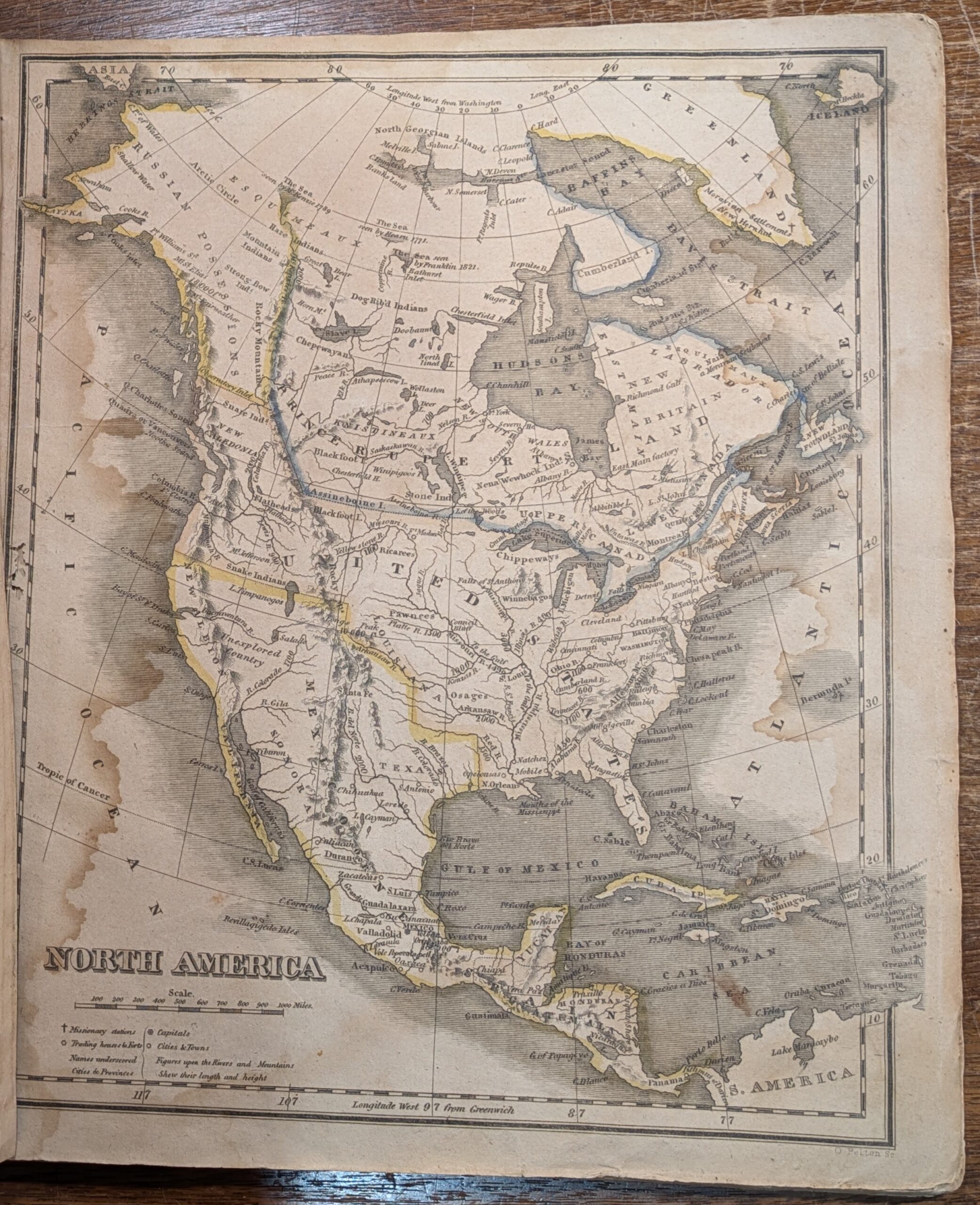
The Modern Atlas, 1825, depicts claims of North American land.
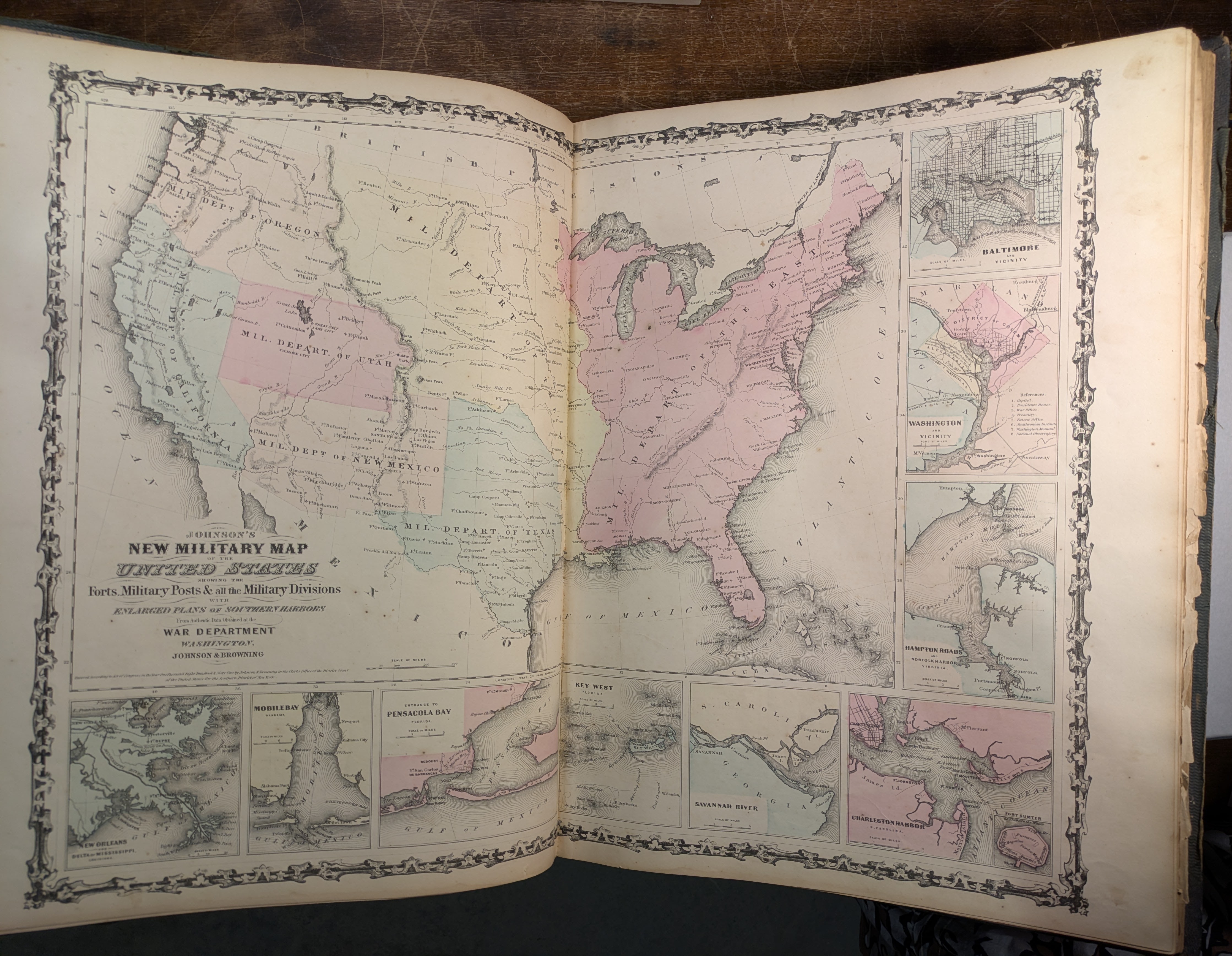
The Johnson map divides the continental U.S. by military department boundaries and locates military infrastructure.
Johnson’s new illustrated (steel plate) family atlas : with descriptions, geographical, statistical, and historical. New York: Johnson & Browning. 1861.
Gift of Daniel M. Rhodes, from the Estate of Bert S. and Ruth E. (West) Rhodes.
Published at the start of the United States Civil War, this atlas documents a country at growth and in conflict. In addition to maps of the territories and states, the atlas includes the first publication of “Johnson’s New Military Map of the United States showing the forts, military posts & all the military divisions.” This map lacks state boundaries, instead showing the boundaries of the country’s then seven military departments along with the location of forts and outposts. It also includes detailed inset maps of the nation’s key harbors.
The new encyclopedic atlas and gazetteer of the world: containing an entirely new series of colored maps executed upon an original plan, showing every country and all political or civil divisions, with their cities, mountains, islands, and bodies of water, and embodying an entirely new feature– that of indicating railroad lines in a separate color also an index gazetteer of the world giving precise and the most recent data regarding the principal cities of the world, with which are included numerous small sectional and full-page city maps, and many photographic illustrations and a complete physical, commercial, and historical analysis of the United States and each of its states, and of the domain of Canada and each of its Provinces, with a guide to the principal trunk railroads throughout North America. Second edition, revised. New York: P.F. Collier & Son. Copyright 1908.
Gift of Joel D. Marwil
Combining maps, a gazetteer, and illustrations, P.F. Collier’s New Encyclopedic Atlas and Gazetteer was a successful publication printed in several editions. The Clements Library copy was generously donated by Joel Marwil, who has pointed out several features of the atlas that would have been important to readers at the turn of the century and which still hold research value for today’s scholars.
“The maps indicate what the world looked like in that year. You will see what countries possessed what. Different countries possessed territory in Asia, Africa, Europe, and the Americas. In the gazetteer there are articles on the American Indian and on the cities of the world. There is an interesting article on the city of Detroit and the [extent of the city in 1908].”
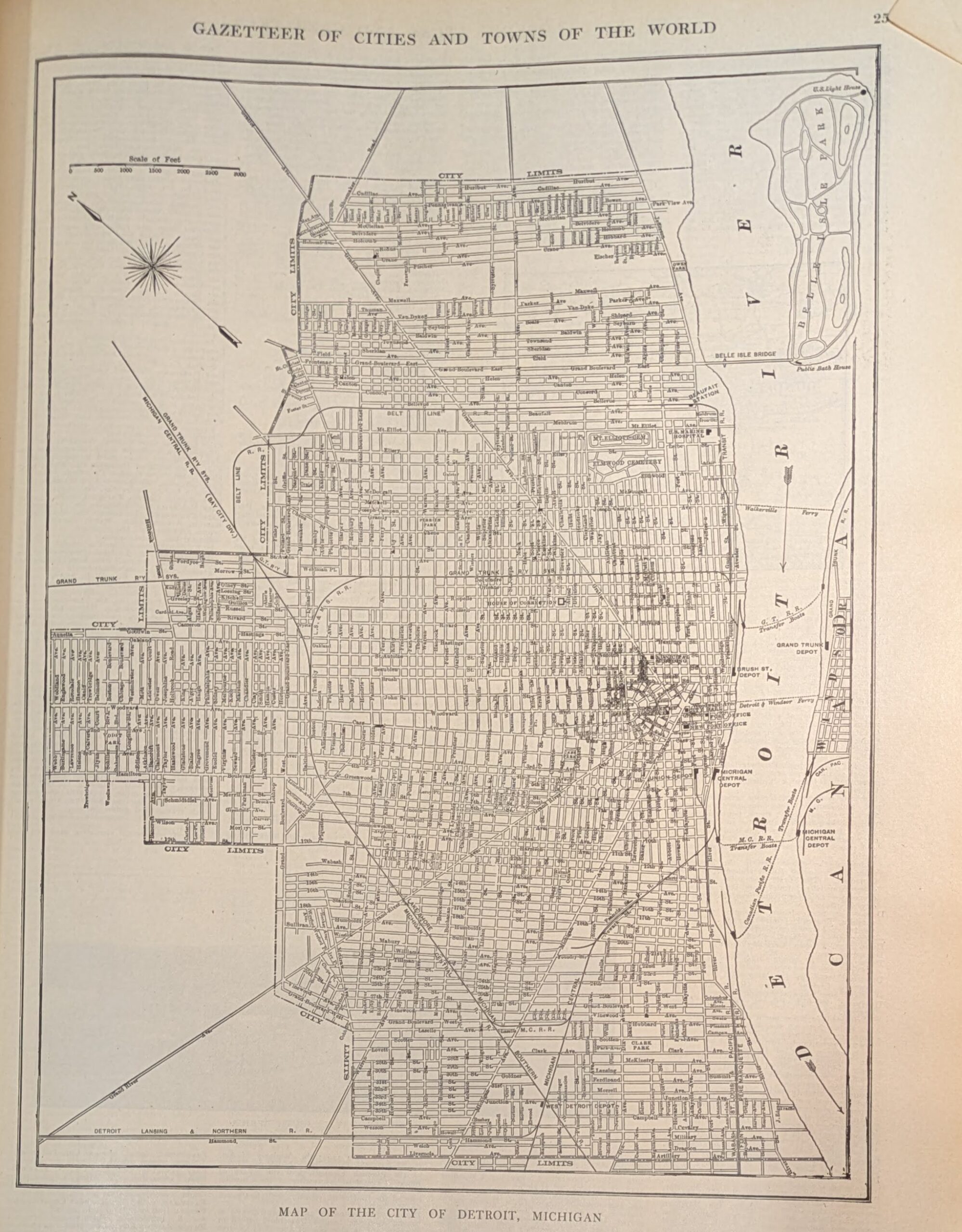
This New Encyclopedic Atlas and Gazetteer page is a gazetteer of Detroit.