
Welcome to the 6th edition of a Day in the Life at the Clements Library! Read on to spend a day with Diana Baxter, a recent graduate of the University of Michigan’s School of Information.
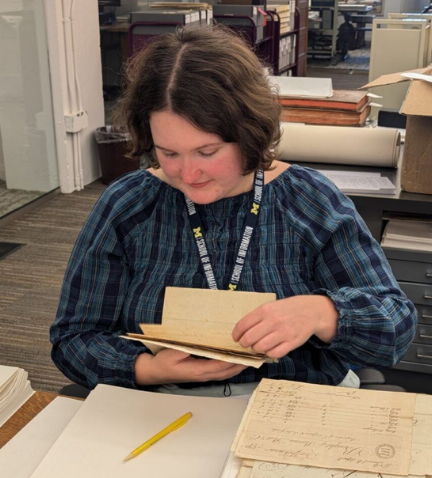
I am from Hoboken, New Jersey! I lived there for most of my life and moved to Northport, Michigan, once I graduated from high school. I attended Colgate University in New York and received my Bachelors Degree in History with minors in Geography and Japanese Language, and now I just recently graduated from the U-M School of Information (UMSI) with my Masters of Science in Information (MSI).
I have been with the Clements Library since September of 2024 and originally applied for a position in the Book Division! That position got taken, so I was referred to an opening in the Manuscripts Division instead where I got the job as a Library Assistant.
Fun Fact: I am the biggest dog lover that I know.
What is your favorite thing about working at the Clements Library?
I love never knowing what is going to come across my desk everyday. I get to work with a wide range of materials like letters, journals, and scrapbooks that give me a sense of an individual and their personality in some ways. It is a very personal thing!
What is your favorite time period to study?
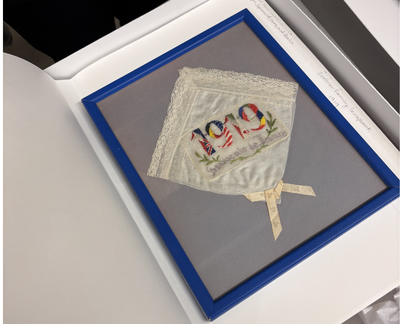
I am drawn towards people’s experiences of war and conflict, especially during the Civil War and World Wars I and II. It’s interesting to see how people understand and fit themselves within these periods of tumult, while often traveling and experiencing new places and people for the first time. The collection that has had the biggest impact on me since starting at the Clements was from World War I. It is called the Zoellner Family Scrapbook, and it contains letters from three brothers who all served in the war. Unfortunately, one brother died while stationed in France, and it was heartwrenching to watch the family’s tragedy play out across their letters.
What did your schedule look like balancing student life and student work? What about now that you have graduated?
I tried to schedule my classes so that I would have either mornings or afternoons free. Every week, I would have two 3-hour shifts, and then a full 8-hour day when I didn’t have class. It worked out nicely that I could maintain that sort of schedule for my entire time at UMSI. During my first year, my classes were on Central Campus, but they moved to North Campus for my second year. I was always happy that I could break up my day by spending half of it at the Clements. Now that I’ve graduated, I am working 30 hours per week.
What exactly is your job? What is your typical day?
I am essentially being trained as a processing archivist, and I have been working primarily with manuscript (handwritten) materials: family or individual collections that range from single letters to single volumes, all the way to multi-box collections. I am responsible for making these manuscript collections accessible to researchers by creating written descriptions, called finding aids, that are posted onto the Clements’ online catalog.
Recently, I began working with Maggie Vanderford, Beck Mallwitz, and some other Clements interns on the Research Guides Project. We meet regularly to create research guides, which are web pages that will be linked on the Clements website with an overview of specific topics that you can research here. So far, I have updated the Civil War research guide and created the Michigan History research guide from scratch. Next on my list is the Food History guide. This project has really broadened my knowledge of the collections that we have here.
What does a typical day look like for you?
Lately I’ve been creating accession records, which is one of the first steps in getting new acquisitions or donations into our collections management system. In practice, this means working through boxes of unaccessioned materials and noting administrative information like how much they cost, who we got them from, etc. I also take note of important high-level information about the collection, such as locations, dates, types of material, and names of people mentioned. Once the accession record is made, I can move onto other processing tasks like re-housing and arranging materials and writing finding aids. Creating the finding aid usually takes the most time.
Another student worker, Theresa Azemar, and I are currently implementing a workflow that we developed to streamline the creation of finding aids. The finding aids you can access on the Clements website are not just flat PDFs or text documents. They are written in a text format called XML, which allows you to do things like filter finding aids by date, creator, location, subject, etc. Theresa’s and my workflow, which involves a Python script of our own creation, helps us get to the desired XML quickly and requires minimal editing by hand.
What was the hardest and most beneficial part of being a student worker?
I was never super overwhelmed by working here and also balancing school. What I learn here complements and puts into perspective what I learned in class. Being at the Clements was always an enjoyable experience. However, class workloads during the first semester of my second year were heavy, so I did not have as much free time during those months. Having two years of experience under my belt after coming out of the MSI program has been really great. There is a record of my work here on the finding aids I created and collections I processed, which is very rewarding.
What skills are needed for this job?
Having a strong attention to detail, the ability to read cursive writing, and the writing skills necessary to create finding aids are all skills I needed for this work. In a finding aid, you’re not really making an argument or staking a claim, you’re just describing what’s there. I had never made a finding aid before starting here, so there was a learning curve to use the correct tone of voice, knowing what I should avoid vs. what I should include. It would be helpful if I had that prior experience, but I also was able to learn how the Clements does it.
Tell us about the award you won with Theresa!
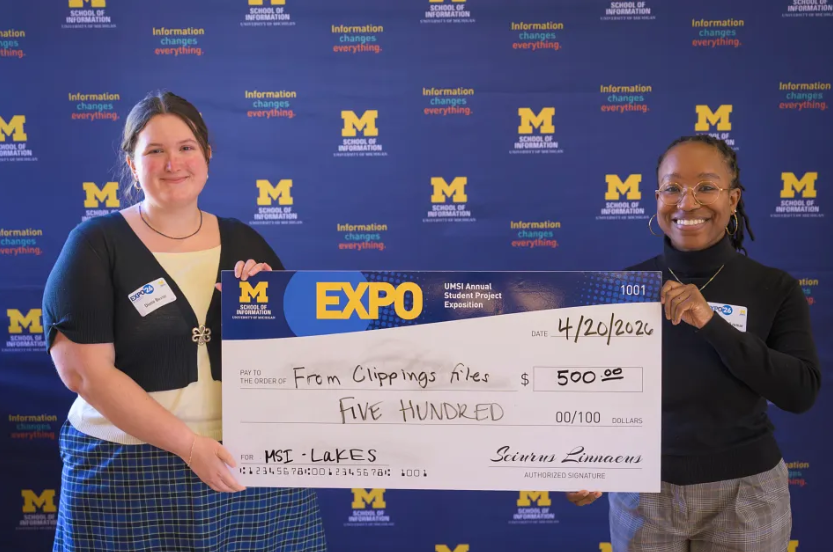
We worked together on our capstone project, the culmination of our MSI degree. Our clients were Mandy Rizki and Trillian Hosticka at the University of Virginia Library. In 2024, UVA Library led a 2-year crowdsourced indexing project to create item-level descriptions of a large clippings file collection. The collection was created by UVA librarians from the ‘30s to the ‘90s and documents UVA’s history as an institution. The recent indexing project ended up creating a very large spreadsheet which wasn’t ready to be shared with the public immediately. There were inconsistencies with the way things were recorded like names, dates, etc. Theresa and I worked to clean the dataset and standardize the way items were recorded. We used OpenRefine software and some Python coding to automate the cleaning, since 20k rows is far too much to do by hand! At the end, we also produced a data dictionary which will be shared alongside the data set in UVA’s repository to provide background information and describe the different data fields. Our project won best overall project in UMSI’s Libraries and Archives pathway at the 2026 UMSI Student Project Exhibition.
What are some of your favorite items you have processed at the Clements?
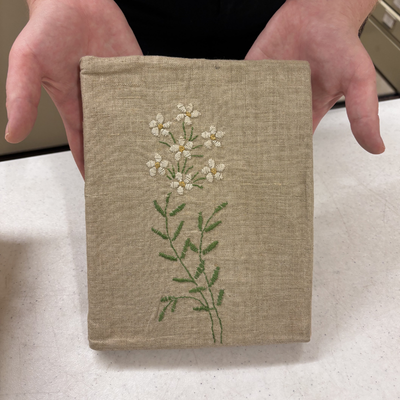
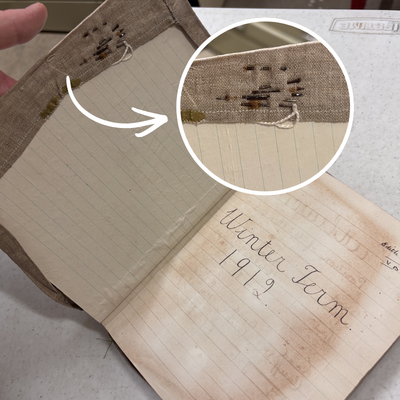
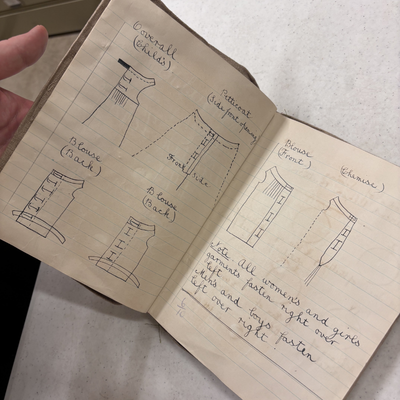
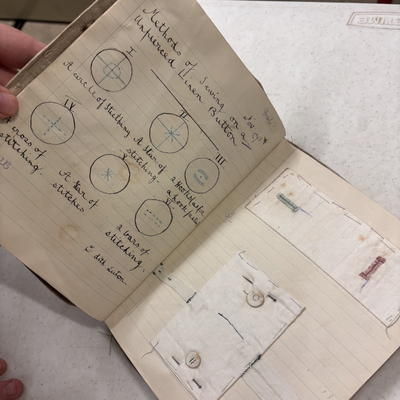
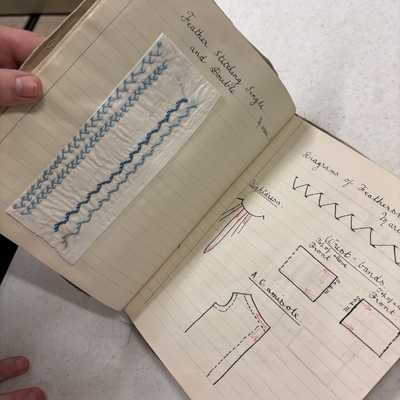
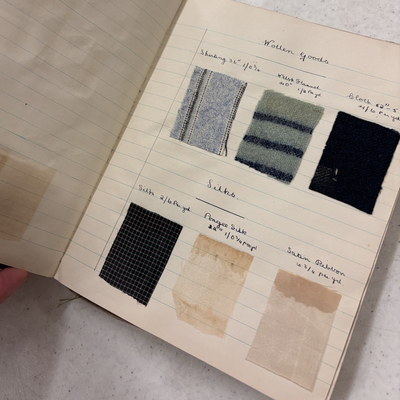
There is a notebook kept from1912 to 1916 by a woman taking a sewing class that I love the materiality of. Her name was Edith Luton, and she sewed her own cover for the notebook out of linen, and embroidered “E.L.U.T.O.N.” with daisies on the cover. It is part of the Garrett Scott Vernacular Bindings Collection, which highlights books that have been enhanced, repaired, or reinforced by their owners. There are fabric swatches and garment patterns that she pinned or sewed into the notebook, and there are even a few needles tucked into the cover, one of which is still threaded.
What was a surprise that came up for you while processing a collection?
Recently I was tasked with writing a finding aid for an item that did not come with much information from the seller. It was just called the “Louisiana-Missouri Diary.” The entries were dated but there was no indication as to who wrote it, except that he was a Sunday School teacher from Louisiana, Missouri. Months later, I was processing a second diary belonging to an unnamed Sunday School teacher. I didn’t make the connection immediately, but began to recognize the handwriting and tone. The way he wrote was very introspective and he was hard on himself a lot. He would write that he wasn’t doing enough in his work or life and wasn’t fulfilling his duties. The voice was very familiar, so I told my supervisor Cheney about it, and he suggested we pull out the first diary. It turned out that the dates matched up-one was from the first half of the year, the second was from the other half of the year, and they were created by the same person. If it hadn’t been me processing the second journal, the connection may not have been made between these two diaries.
What are your next steps?
I am currently applying for full time work. My lease in Ann Arbor ends soon, so I’ll be returning to Northport to continue the job search. I would love to find something back to the East Coast! A lot of my friends and family are still there. They are really hoping I find a job in New York, which I would also love.
What is some advice you would pass down to fellow students or aspiring archivists?
If you can, try to get any sort of experience outside of your classes in a library, museum, or archive. It is so helpful! But start looking early. I had my interview for the Book Division in the beginning of August. When the opportunity arose, I was ready. Look early at the school you’re going to or the city you’ll be living in. Don’t be afraid to apply! I didn’t get the first job I applied to here but I got referred to my current role. You’ll never know if you don’t try.