
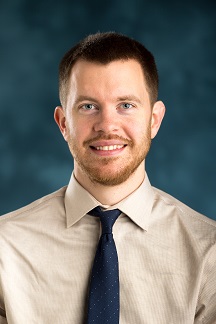
Welcome to the fifth edition of “A Day in the Life at the Clements Library!” Today we will meet with Jakob Dopp, our recently appointed Assistant Curator of Graphics.
I was born in Madison, Wisconsin, but my family moved to Ann Arbor when I was very young, therefore I consider myself a true dyed-in-the-wool Michigander. I attended Michigan State University for my undergraduate degree and majored in psychology (B.S. 2013), but ultimately fell in love with history after taking courses on Greek history and the Civil War. The human angle of wanting to better understand people’s minds, motivations, and behaviors appeals strongly to me, and I realized that there is no greater tool for exploring that than history.
After returning to Ann Arbor I ultimately decided I wanted to attend graduate school for library science and obtained an M.S.I. from the University of Michigan’s School of Information in 2016 specializing in archives and records management. While attending UMSI I also just so happened to meet my now wife Caitlin Moriarty, who works for our fellow archival neighbors the Bentley Historic Library
Walk us through the different roles you’ve had at the Clements.
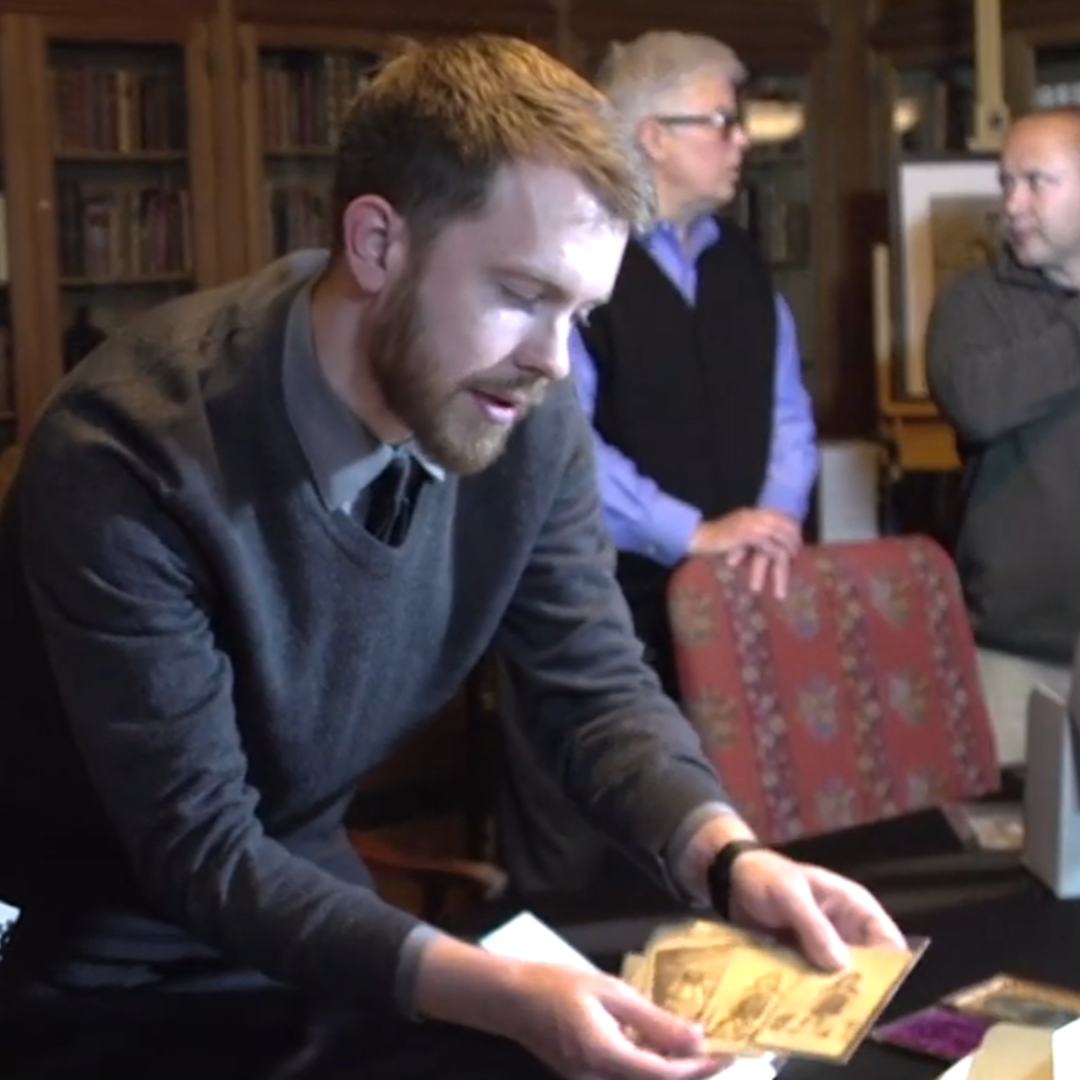
Like a number of my colleagues here, my first experience at the Clements was actually as a volunteer in the Manuscripts Division. My first staff position was as a part time reading room supervisor beginning in January 2017. I had recently finished graduate school and was simultaneously working two other temporary jobs while looking for something more permanent. Luckily, I knew someone who worked at the Clements and they encouraged me to apply and see what happens. After several months of working in the reading room a full time position opened up in the Graphics Division which I ended up taking on. This job mainly revolved around the processing of the Richard Pohrt, Jr. Collection of Native American Photography, but I was also tasked with cataloging a wide variety of visual materials. After a few years I ended up becoming the designated Graphics Division Cataloger in 2020.
Fast forward to the present, and I am thrilled to say that I have recently been made Assistant Curator of Graphics with special attention to photography collections!
What is your favorite thing about working at Clements?
I know it’s incredibly cliche, but when you work at the Clements you’re literally constantly learning amazing things about American history and fascinating human beings that you had no idea existed. Every single day you’re pretty much guaranteed to come across things that stop you in your tracks and leave your jaw on the floor. I have found this to be especially true of visual materials like photographs, as they possess an extra dimension of immediacy and intimacy that allows you to connect with them on a particularly deep level.
I also really love the “rabbit hole moments” that occur when you’re researching a collection and discover something that sets you off to the races. Perhaps it wasn’t known who took a certain group of photographs, who engraved this print, exactly when or where they were produced, who the people are who are represented in them, etc., but when you come across a small detail that causes a big paradigm shift in your understanding of a collection it is an incredible feeling.
That being said, the best feeling I get from working at the Clements is the sense of purpose I get from creating descriptive resources for awesome material that nobody on Earth previously knew we had. So much hard work goes into drafting catalog records and finding aids behind the scenes before they are released “into the wild,” and it is a tremendously special feeling when you see that someone has actually discovered (and wants to make use of) a collection that you had a hand in making accessible. For me, connecting people to resources is the main essence of the job.
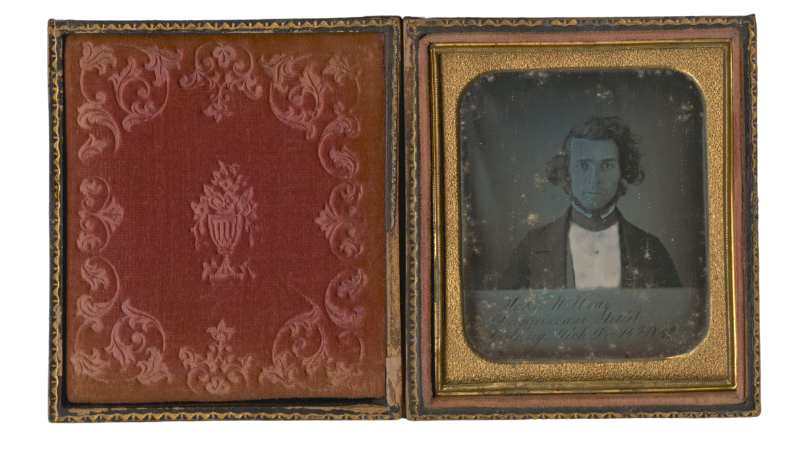
John W. Hoag self-portrait. / John W. Hoag Daguerrean Artist Lansing Mich Dec 14th 1849.
I do love me a daguerreotype! Being one of the two earliest historic formats of photography, they have this undeniable magic about them. You are essentially looking at a reflection in a mirror that has been chemically frozen in time. Not even the most advanced modern digital cameras can match the detailed resolution the daguerreotype offers, and perhaps nothing ever will. The fact that it is both the first as well as the highest quality photographic process in existence is mind blowing.
Generally speaking, I enjoy cataloging photographs more than anything else. More specifically, I enjoy working with historic Native American portraits and photos where something peculiar is occurring (such as photographic manipulations) and not everything is as it seems. I like the weird stuff!
For All Ages was the first Clements exhibit that I have played a role in co-curating, so it will always hold a special place in my heart. It also possessed a degree of generality and universal appeal that hasn’t always been present in some of our exhibits and it was interesting to see how relatable the materials were to people young and old across multiple generations.
No, Not Even a Picture also stands out as being the first Clements exhibition of materials from the Pohrt Collection, which I have spent considerable amounts of time working with and have special appreciation for. We had hired two interns, Veronica Cook Williamson and Lindsey Willow Smith (who recently returned to the Clements as a fellow!), to develop an exhibit in March 2020. The original plan was to create a physical installation, but thanks to the COVID-19 pandemic we obviously had to pivot into making a virtual exhibit that ended up being spectacular! The exhibit was so well received that in a true full circle moment the Saginaw Art Museum ended up hosting a physical installation of it from Oct 2021-March 2022! Overall, it was such a rewarding exhibit to help with because of my deep familiarity with the materials and for getting the chance to assist two brilliant students in Veronica and Lindsey.
Can you talk to us about some of the major photography collections we’ve acquired during your time here?
I’ve mentioned it a few times already, but the Richard Pohrt, Jr. Collection of Native American photography is a collection that continues to grow annually and is near and dear to me for many reasons. The Pohrt Collection consists of 19th/early 20th century historical images of Native Americans that visually illuminate many aspects of different traditional Native American cultures. However, these images are often laden with contextual complexities as they were produced during an exceptionally fraught period of relations between indigenous tribes and the United States of America. That we have such documentary evidence, and such a critical mass of it, is critically important.
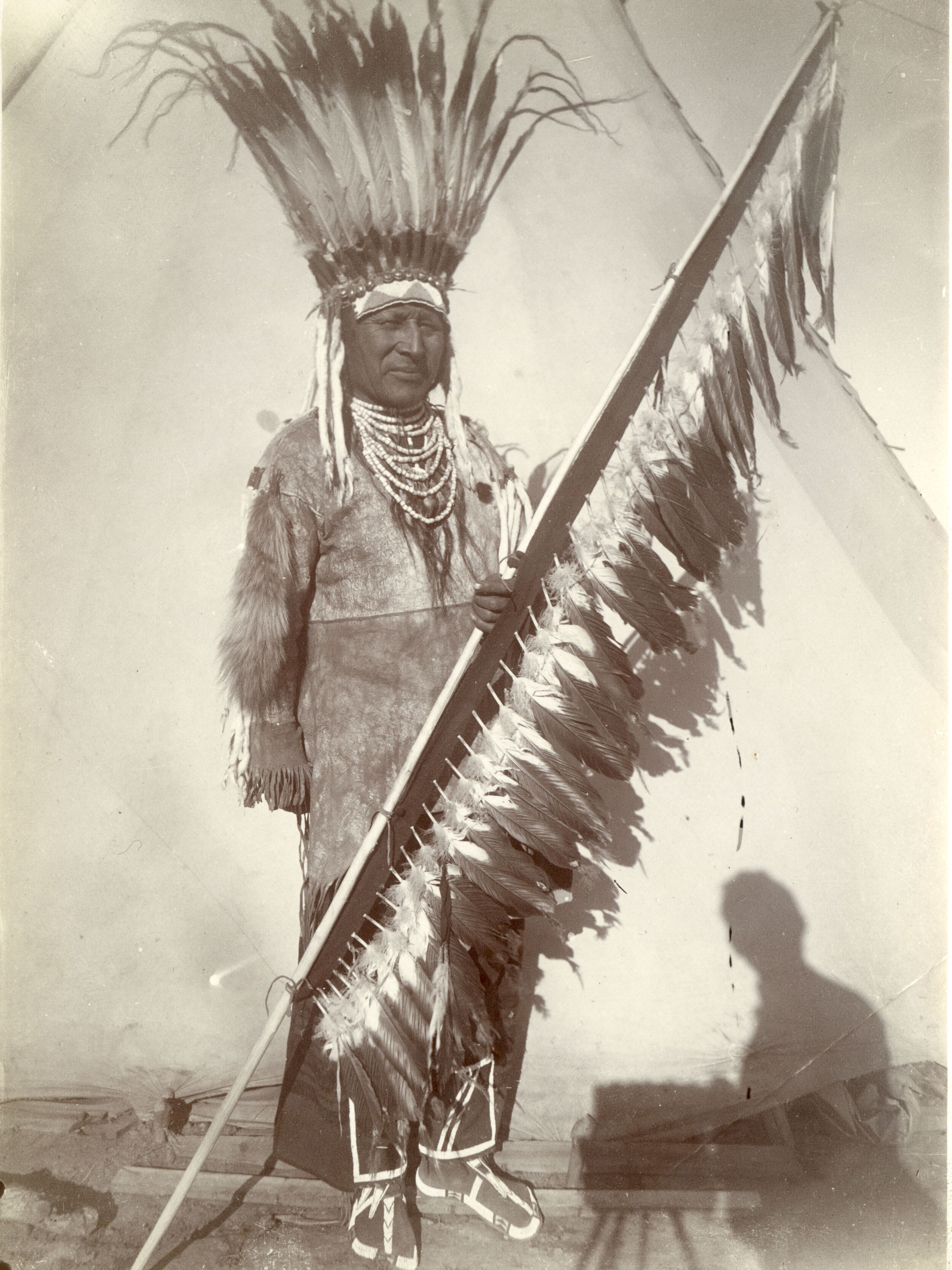
White Swan, one of six Crow scouts who served the United States under General Custer during the Battle of the Little Bighorn. Note the shadow of photographer Fred E. Miller and his camera in the foreground.
The Robert M. Vogel Collection of Historic Images of Engineering & Industry is another one that springs to mind as I quite literally helped acquire it. After driving out to Washington, D.C., in August 2022 with former Graphics Curator Clayton Lewis, we met up with Director of Development Angela Oonk at the Vogel residence and loaded up a University of Michigan rental van with hundreds of boxes. It is an incredible collection of thousands of photographs (mostly stereoviews) and other visual works related to a wide variety of topics relating to historic engineering, industry, and transportation.
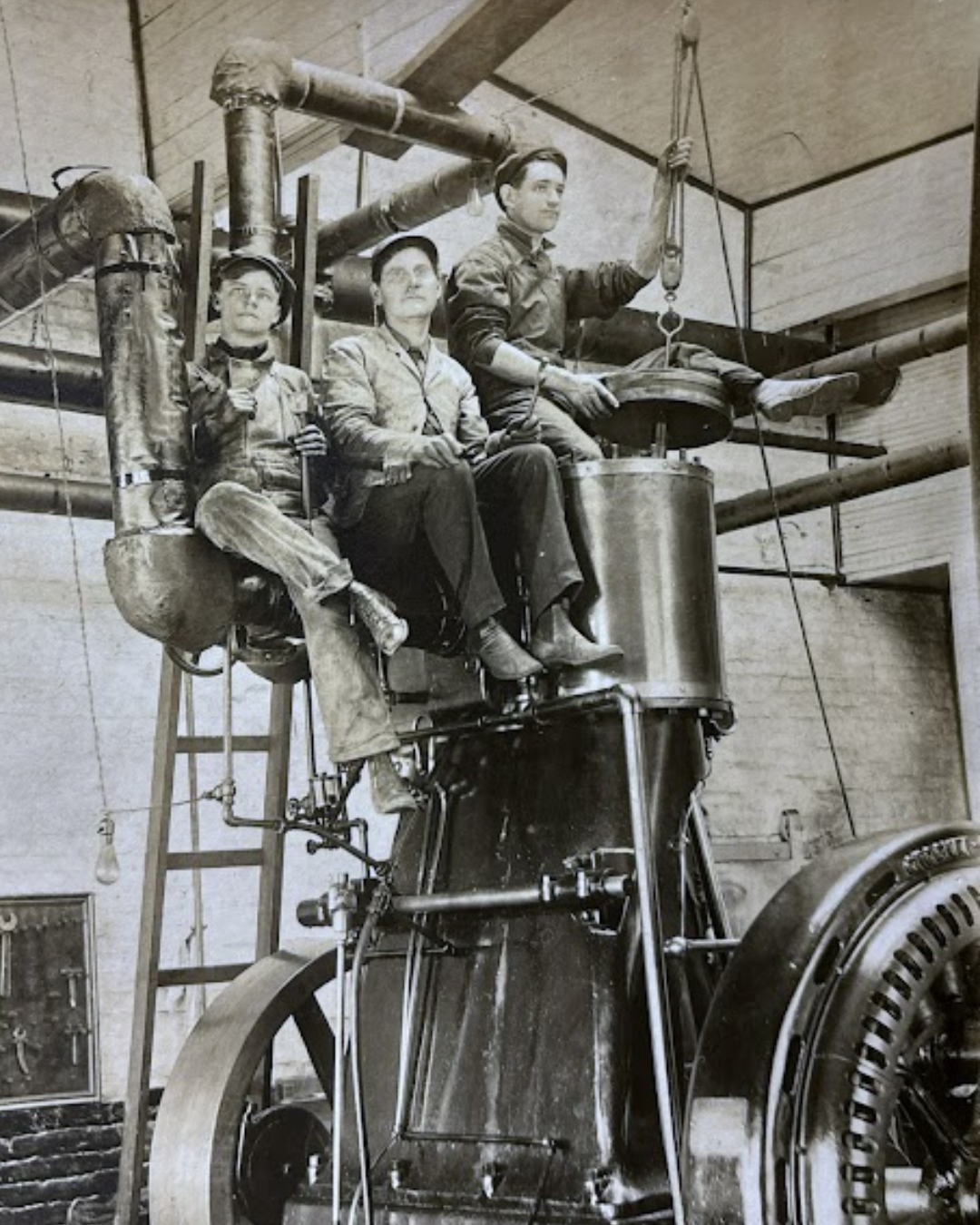
Robert M. Vogel Collection of Historic Images of Engineering & Industry, ca. 1850s-2004 (majority within ca. 1850s-1900)
Last but certainly not least, there is also the George C. Foreman Band History Collection which was acquired in . We are currently doing a lot of processing work at our off-site storage location for this collection. The Foreman Collection contains materials relating to the history of band music and performances, mostly in the United States but also in Europe. The collection includes lots and lots of sheet music (much of it illustrated) as well as programs for various performances and venues that are very useful for tracking performers and their bodies of work. However, some of the most interesting stuff is ephemeral material like billheads related to concert expenses and logistical arrangements. Working with these materials has quickly made me come to appreciate the sheer amount of time these musicians put in practicing, planning, traveling, and performing. When did they have time to sleep?!
What kind of education or training did you need for your job?
I had to get an MSI. For me, the most valuable education was on the job training. I didn’t know a single thing about historic photos until I started working here. There is no better resource, in some ways, than interacting directly with the resources in the collection. Someone telling you about something is different from picking something up, seeing a detail, and digging into why things are the way they are. There is a certain amount of self-teaching when you are spending hours in the vault. You have to make certain calls about things when initially you might not feel as comfortable to do that. There’s a lot of digging and research. It takes a lot of repeated exposure to these types of things.
What are your day-to-day responsibilities?
The main responsibilities I am tasked with are helping to manage the Graphics Division, managing the description of collection materials, and making them accessible to people. This entails creating catalog records and finding aids. Other responsibilities include helping review work by student employees and our long-serving volunteer Les High and finalizing it before it gets sent out. I still assist in the reading room and help supervise readers. I also contribute to the Clements Quarto, blog posts, etc. as well as fielding research inquiries that we get from offsite patrons regarding the graphics collections. Paul Erickson, our director, will occasionally send Curator of Graphics and Maps Sierra Laddusaw and I a list for an upcoming auction to review what we already have in our collections, and help to guide the new acquisitions and curation of the collections.
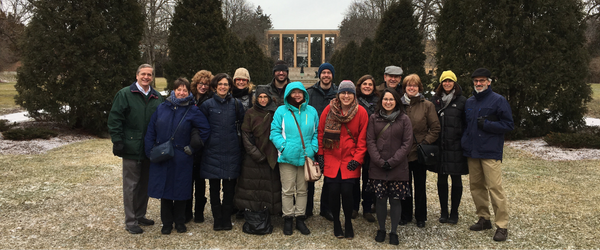
Group picture of the Clements Staff at Cranbrook
What does a typical day look like for you? What are some surprises that pop up during the week?
A typical day always involves surprises! I get in in the morning, chat with my colleagues. One great thing about working at the Clements is the comradery and closeness of the staff. We always touch base with one another. I check my email and make sure that there aren’t any outstanding reference inquiries. After that, it depends on the needs of that week! Are there classes to prepare for, do I need to request and pull materials, when are my reading room shifts? Depending on what project I’m working on, on any given week I could be knee deep in a project that is going to take months on end to finish. Maybe my morning is spent working on those for a few hours, maybe I’m reviewing the work of our interns and preparing them for working on a new collection. A day involves a little bit of this, a little bit of that, with hopefully a few chunks of uninterrupted time cataloging materials.
Why graphics and photography? What drew you to this particular aspect of history?
Naturally, I am a very visually oriented person. One of my parents was an artist. I was surrounded by art and encouraged to create art, draw, paint, take photos my whole life. I was taking pictures and creating home movies as a child with my brother. Visual arts were part of my home fabric. It wasn’t that big of a leap to be interested in historic imagery as well.
The previous Curator of Graphics, Clayton Lewis, taught me so much about the historical visual record, different types of materials, photography, prints. All of the different genres: satirical, sentimental, birds-eye-view, etc. Once I got a grasp of the lowdown from the curator’s point of view, that was a very formative experience.
A picture says a thousand words, so does a print. There’s so much you can glean from visual resources that I don’t think a lot of people understand that as the case. It’s some of the most fun stuff to work with! Literal windows into the past, bright colors galore. It’s hard not to get excited about it!
What do you wish you would have known about your job before starting?
With the benefit of hindsight, I’d remind myself that all the hard work is worth it! I wish I had taken a few more history classes tethered to American history and had a better bedrock understanding of the moments of American history that the Clements specializes in. If I could do it all over again, I would have majored in history.
If you could give one piece of career advice, what would it be?
Be flexible! Don’t pigeonhole yourself right off the bat. Be open to different types of institutions and roles. Sometimes you don’t know if you’d enjoy a position until you’re in it. Don’t get easily discouraged! Have the ability to be flexible in your geographic situation. Sometimes you have to leave to come back!