
Welcome to “A Day in the Life at The Clements Library!” On the third edition of this series, we will meet with Ella Brooks-Kamper, a student at the University of Michigan School of Information. Ella is the Historic Visual Culture Fellow. That’s right Wolverines, you can work here too!
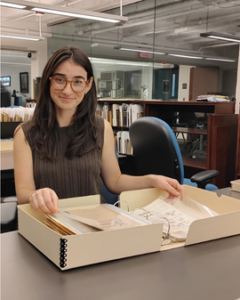 I am from San Diego, California, although I have moved around a bit for school. I received my Bachelors in English at a small Pennsylvania university called Haverford College, where I ended up focusing more on archives and not exclusively on literature. I am now a first year student at the University of Michigan School of Information on the Library and Archives track, studying to work at a place like this! I started at the Clements in August 2025 and am the Historic Visual Culture Fellow working under Sierra Laddusaw, the Curator of Maps and Graphics.
Fun Fact: I have a two year old Philly street cat who I rescued. A tuxedo cat with a black and pink nose whose name is Moby and still acts like he is on the streets of Philadelphia!
What do you love about working at the Clements?
I love being surrounded by the old materials, but also by the people here who are so enthusiastic and knowledgeable about them. Books and records can feel static, but the curators and employees here bring the materials to life.
Getting to work with graphic materials, there are so many beautiful things you didn’t even realize people in the past had the technology to create. Print and photograph technology has been really good for a really long time, which is crazy to think about. I’m very interested in different fonts and other details. I think of being able to trace different styles through the materials as an art. There are undated items that I can approximate their age because they are art nouveau, for example, so I can assume they are from the 1920s.
What does your schedule look like balancing student life and student work?
After settling in at work, I look over my notes from where I left off and find out what the next thing I need to process is. After that, I make sure everything is in the right place and I start processing. Sometimes, I might stick to my computer if I am drafting a finding aid or researching the biography of an individual within a collection I am working on. In the afternoon, I pack up and head to class on North Campus. Right now, I have a lot of technical courses including coding and the Ethics of Information. One of my favorite classes this semester is Preservation in a Digital Age. In this course, we consult on a project from a local organization and provide recommendations for preserving or digitizing their materials. For example, I’m working with St. Andrew’s Episcopal Church and we are going to help them rebuild their church archives following a flood. My team needs to help them make sure everything else is conserved and preserved in the right way, which means doing research on different techniques for different types of materials. I ask Clements Conservator Julie Fremuth and other staff here for questions that I might need to answer in my projects, which is a unique benefit to this position. In class discussions they will often ask if we can bring in any experience, and I am able to share what I do here, like issues I’ve run into or solutions I have found.
I get to stay in the library mindset all day. Everything I learn in class, I get to execute here. A lot of the interns who work here are also library students. We get to go through this together! We all help one another, especially when it comes to not being able to read early American handwriting. The time commitment is a lot, but worth it; you get to learn so much more and apply what you’re doing to your coursework.
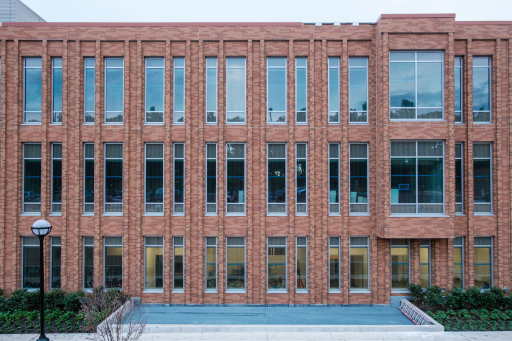
Leinweber Computer Science and Information Building
Photo: Jeffrey M Smith, School of Information, University of Michigan
What do you do as a student worker?
In the time since I’ve started, I have helped process large scale collections under the Graphics Division. I take a box of materials and ask myself questions about how it’s organized and what aspects should be mentioned in a finding aid or catalog record to make the collection findable. I then organize collections in a way that will make sense to researchers and create proper descriptions for it. I started with an ephemera collection called the City Directory Advertisement Collection. I am now working on a collection the George C. Foreman Band History Collection, which is centered on American marching band history.
What skills are required for your work?
I live my life in a giant spreadsheet, but I love that. Good proficiency with excel is a great skill to have. You also need to know how to handle the materials you’re given, which is something I have had to learn and develop. Understanding the standards of how we describe things, the procedures of the library, safely handling and storing the materials, all of that is crucial to my day-to-day work. Right now, I am working with sheet music. It’s not in one standard format, so the information can be anywhere on the material. Identifying things that I need to know to categorize and identify it correctly is important.
What are some of your favorite items you have processed at the Clements?
I added a new acquisition to an existing set of photographs and ephemera called the Black Bottom Collection. It’s a really cool, small ephemera collection relating to Detroit’s Black Bottom neighborhood and the people who frequented jazz clubs there. There are some incredible photographs, including one where this couple was dressed up fancy and on the back it said “First Date at the Zoo.” I think that’s why I’m drawn to graphics. You get the famous portraits along with the personal moments.
Ephemera in general is so cool to think about, the fact that a small piece of someone’s everyday life was kept. It’s interesting to think about the items that weren’t meant to be preserved, but were. One silly item I’ve come across was an advertisement from 1906 for an individual pickle-sorting machine!
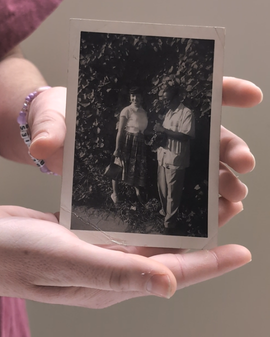
A couple enjoying their first date at the zoo, from the Black Bottom Collection, ca. 1941-1965
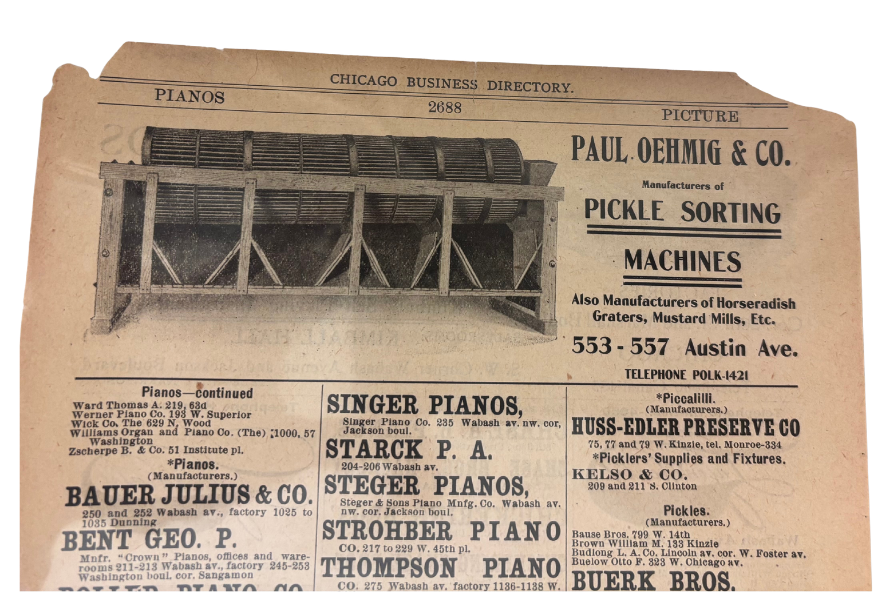
A 1906 Individual Pickle Sorting Machine advertisement from the City Directory Advertisement Collection, ca. 1870-1939
What is some advice you would pass down to fellow students or aspiring archivists?
Pay attention in your classes! Be open to different experiences! When they sent out the fellowship applications, I initially had a different fellowship in mind. But now, I am so happy to be where I am. You don’t have to work with what you think you will be most interested in. You’ll end up finding more things that catch your eye. I wasn’t sure what to expect with graphics, but I have found an appreciation for what to expect with graphics and for the work I do because I decided to be open to working with all different kinds of materials.