
By Jayne Ptolemy, Associate Curator of Manuscripts, and Julie Fremuth, Conservator
The joys and frustrations of studying early American women’s history are deeply entwined — letters and diaries allow you to glimpse life and labor and to revel in stories, but you’re also, always, deeply aware of all the things left unsaid. For example, what, exactly, did Philena Kendall mean when she briefly mentions in the deep winter of 1867 that “We have been verry buissy all fall and winter sewing & quilting Butchering and various other things which we find to occupy our time.” What does that look like, to spend your short, cold days with a needle in hand? What constituted “various other things,” and can we ever know?
There are some things the written word just will not tell us, which is why we’ve always been so drawn to the material objects that get saved alongside them. The exquisite, oversized quilt that came to the Clements Library as part of an addition to the Weld-Grimké Family Papers from donor descendant Charlotte Mason in 2007 demonstrates this particularly well. With over 18 boxes of letters, diaries, notebooks, and more, the collection documents the lives of sisters Sarah and Angelina Grimké, Angela’s husband Theodore Weld, their children and descendants, as well as the family’s life-long commitments to abolition and women’s rights. It’s no mystery why researchers are drawn to the papers. But pull out this colorful 98” x 87” quilt that used the “Grandmother’s Garden” pattern, and you’ll find the questions you’re asking shift.
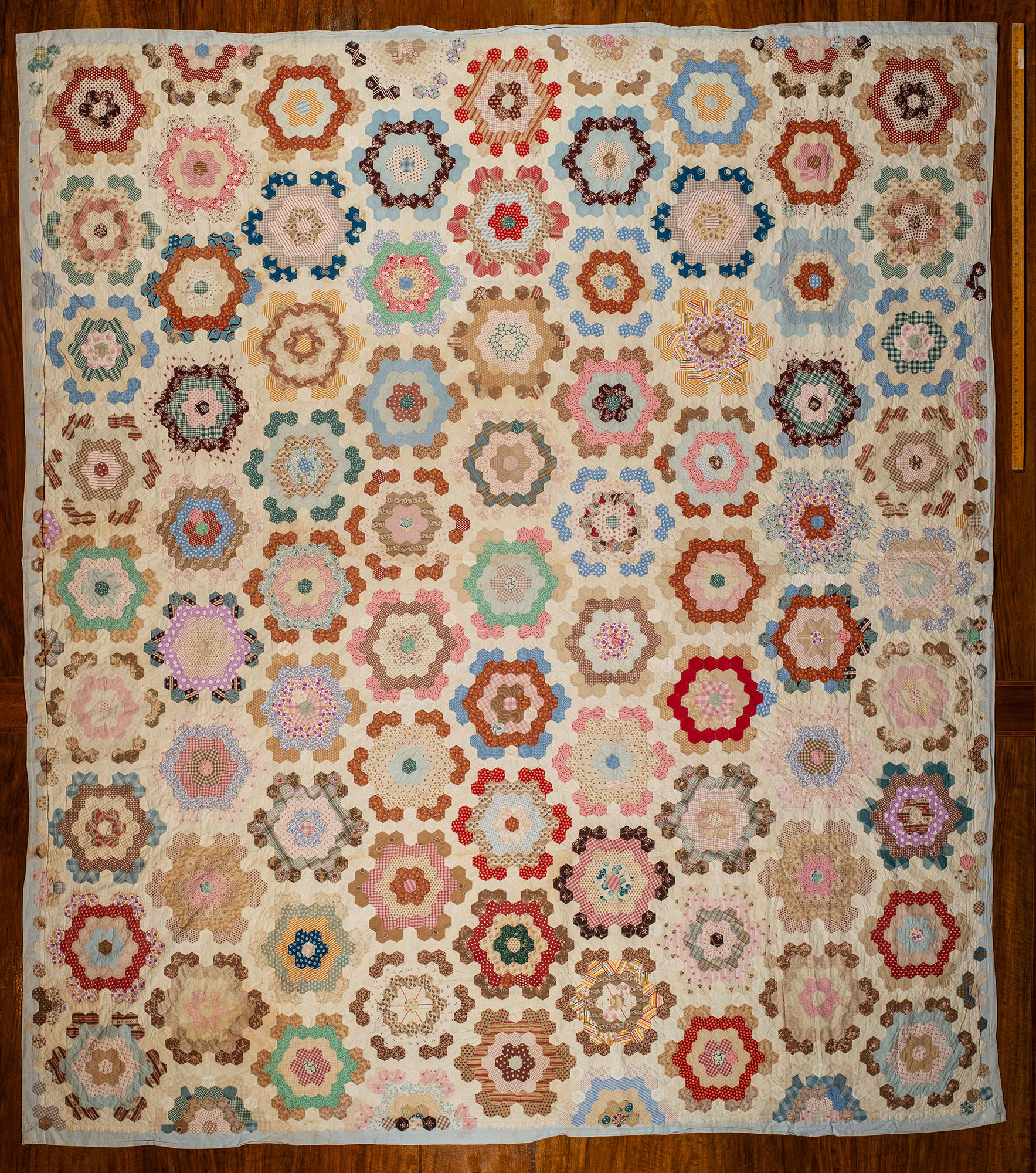
Our digitization team recently undertook the challenge of getting high quality photos of this oversized quilt in its entirety.
We know from a note that accompanied the quilt, that it was made in the 1860s using small hexagons cut from the cotton fabric of Sarah Grimké Weld’s school dresses and those of her classmates at the Eagleswood Academy, a school opened and operated by her parents Angelina Grimké and Theodore Weld. It was presented to the family as a gift. While we can read Theodore Weld’s letters to parents about unruly pupils and descriptions of the school, there’s something powerful about seeing the remnants of the clothing the children were wearing and feeling the emotional connection between teachers and students that would merit such a labor of love. The time, even, to cut these thousands of hexagons would have been enormous, and to spread it on your bed knowing the people and hours it reflected would have been deeply meaningful.
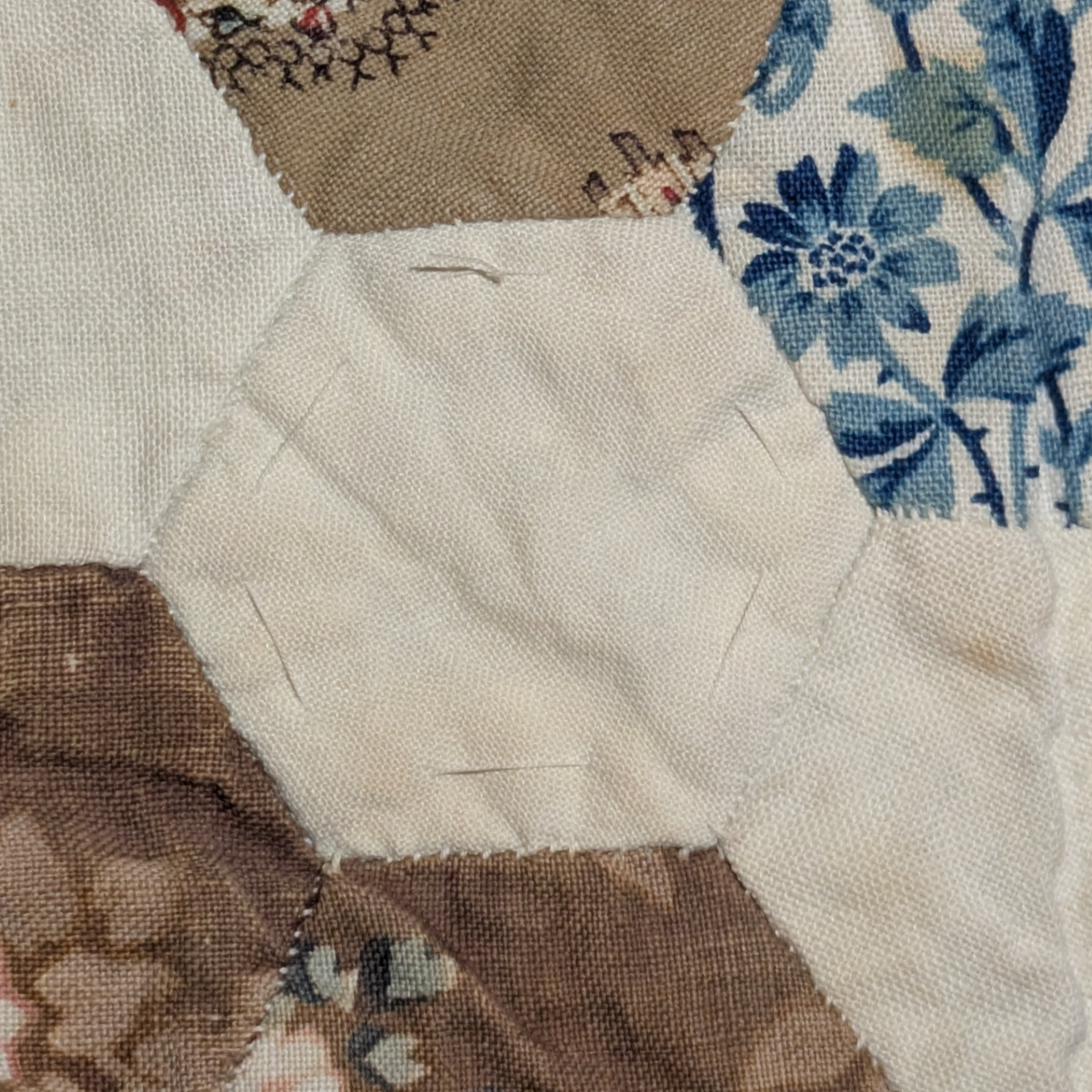
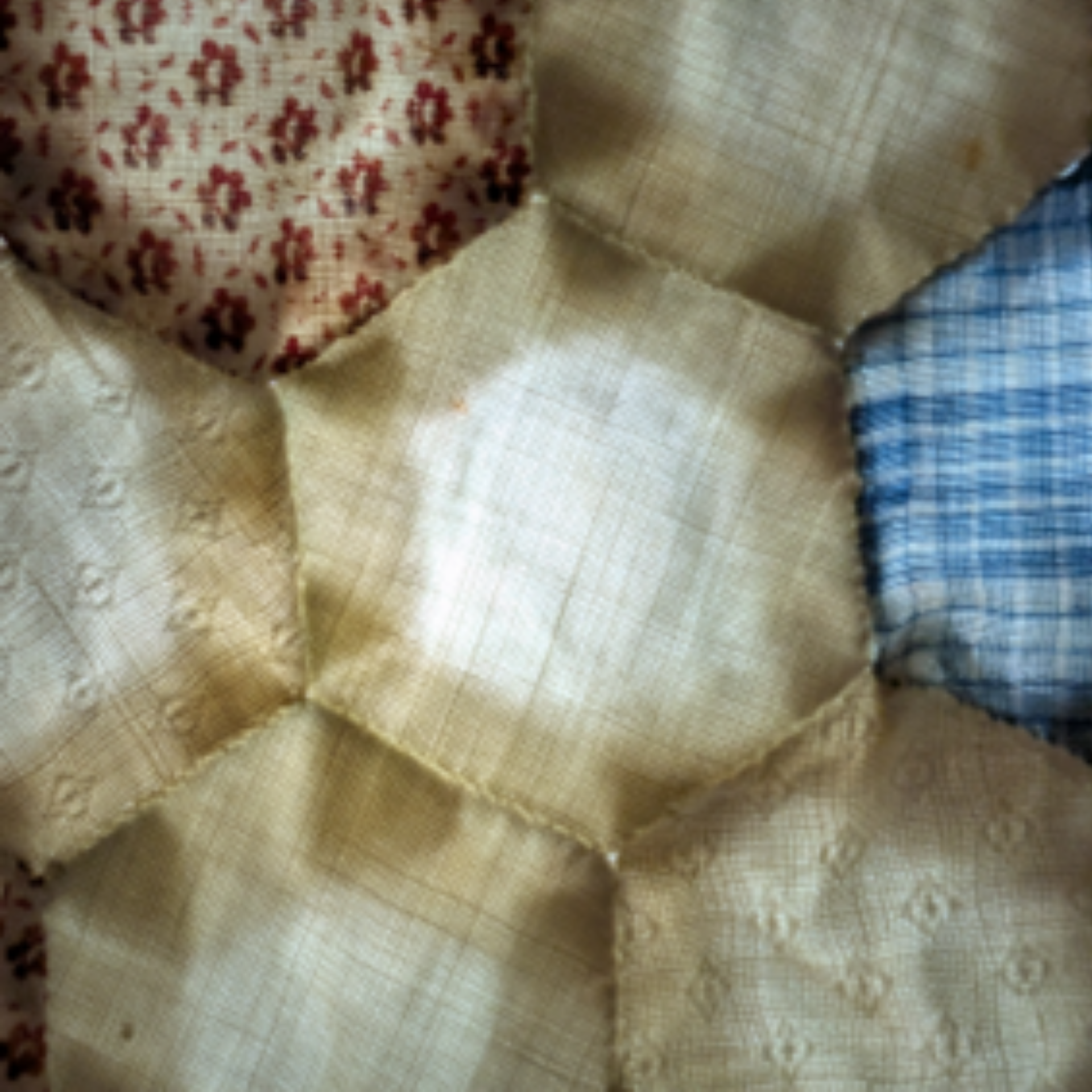
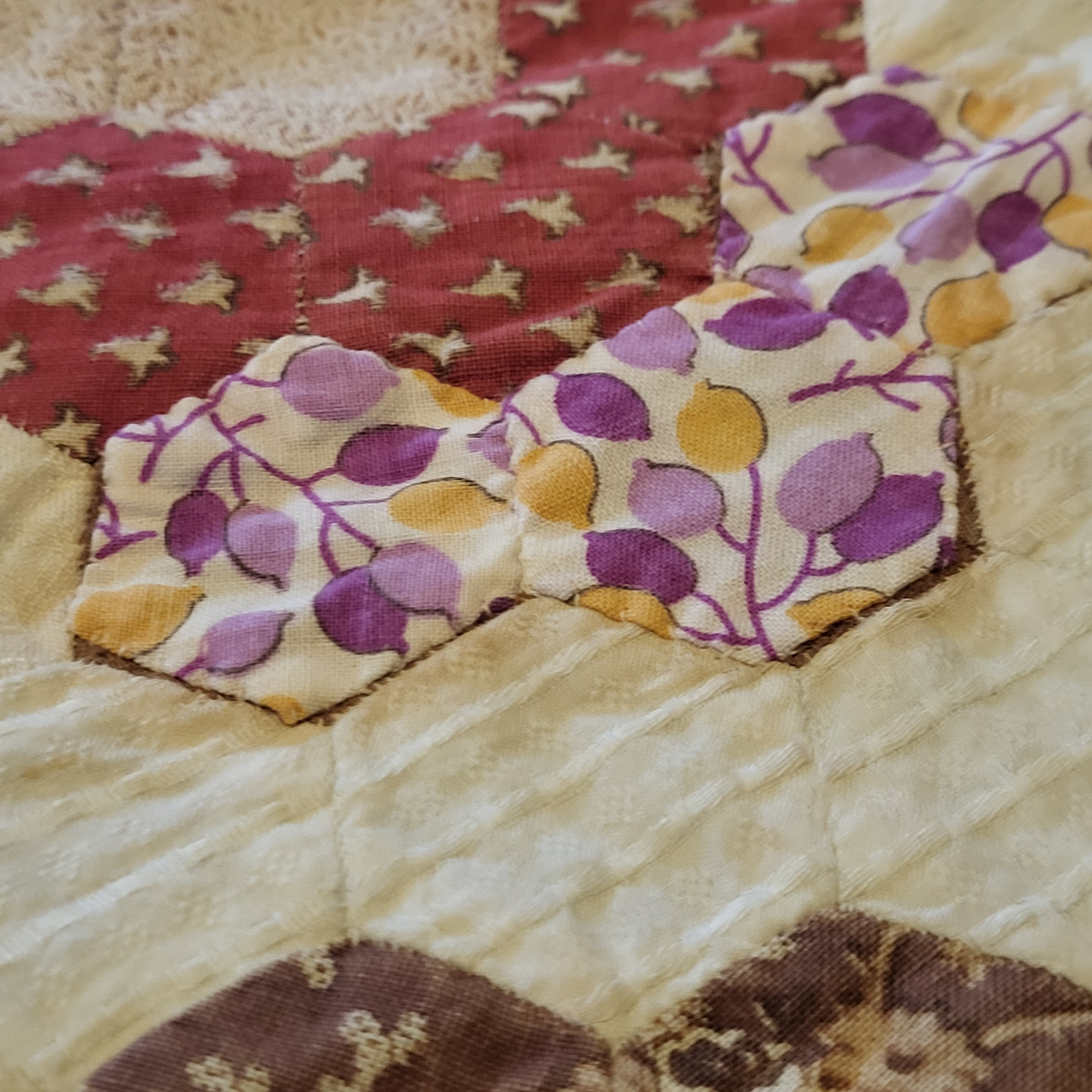
At left, you can see the basting stitch left on this hexagon, which would have held the paper template in place. At right, a portion of the quilt has been backlit, revealing how the fabric was carefully turned and pressed into its final shape.
But if you look closer at the quilt, noticing its construction and design, other parts of women’s histories begin to surface. We do not know the name of the quilter who did the bulk of this work, but we can still see her through the careful choices she made. The quilt was produced using the English paper piecing method, where each hexagon would have been carefully pressed and basted around a paper template to help it hold its angular shape. Making sharp corners meet neatly is no small feat, so the talent at play is extraordinary.
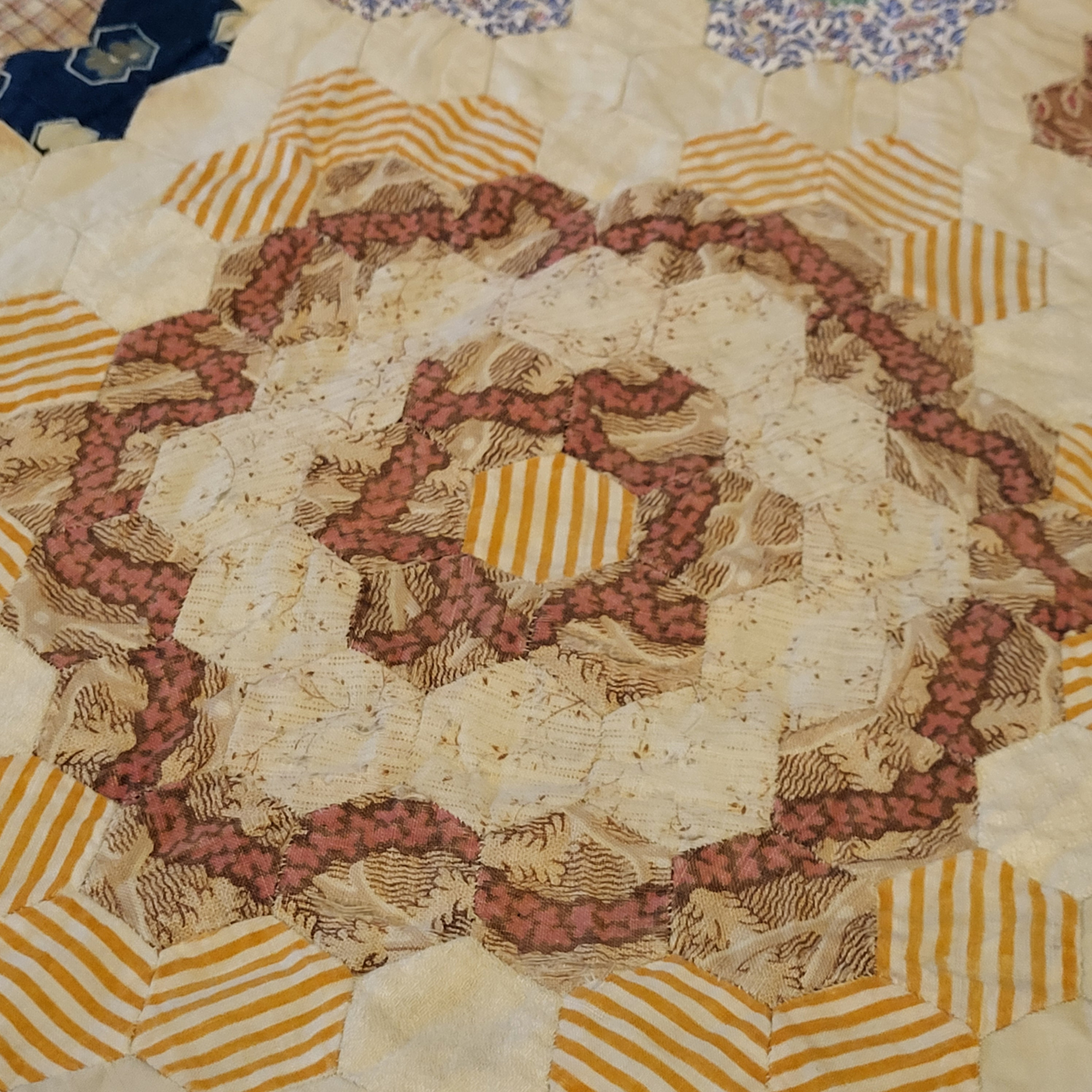
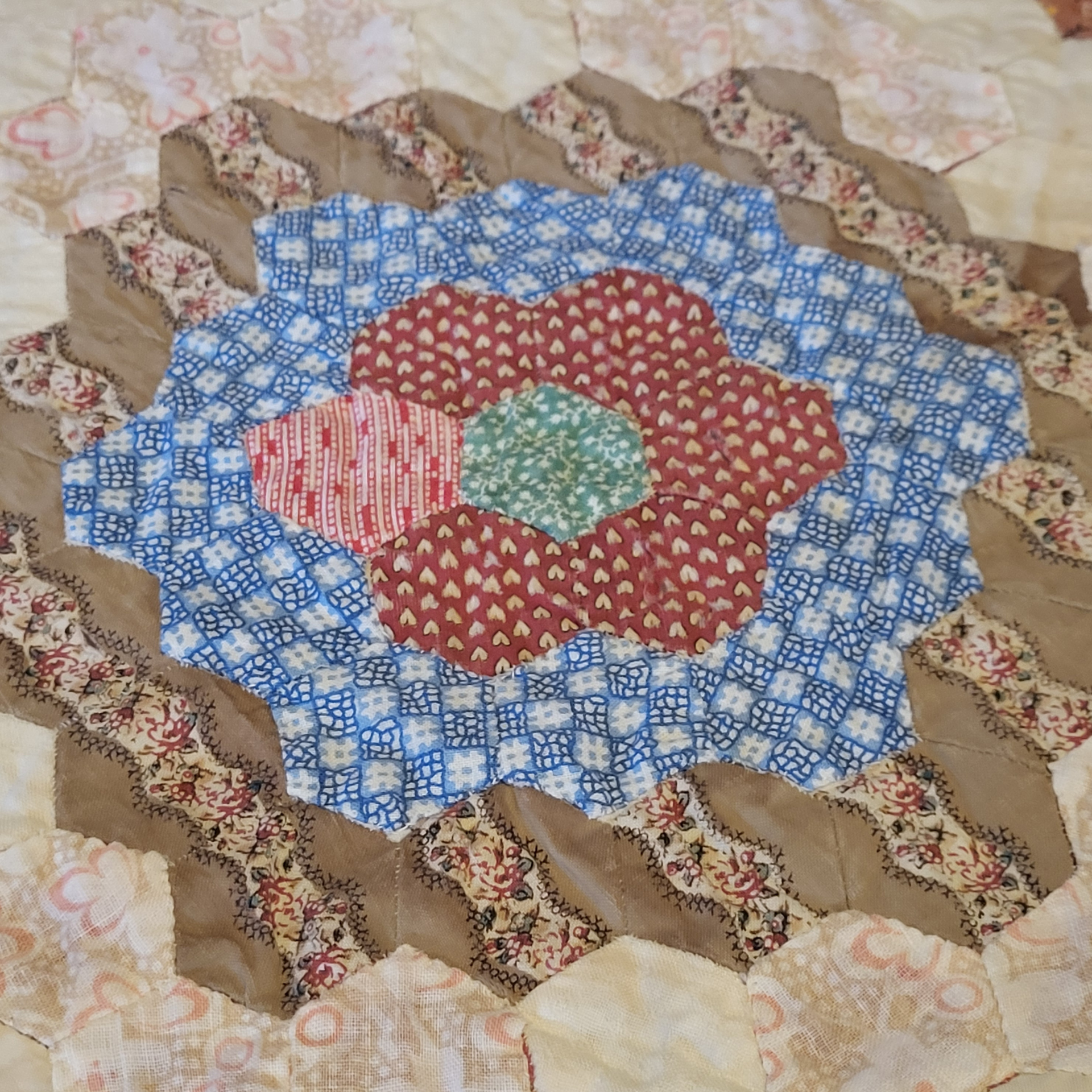
Looking closely at the fabric in these two blocks, you can see how the quilter deliberately cut and oriented the fabric so that the design carries across the hexagons.
You can also see how she mapped out the colors of the blocks, seeing deliberate mirroring across sides of the quilt to distribute them across the surface and create a sense of symmetry. But the skill used to carry the fabric’s patterns across multiple hexagons is perhaps the most stunning part of it all — carrying lines and waves and flowers from one piece to the other would have taken careful planning, cutting, alignment, and execution. We don’t have a letter telling us about this process or who dedicated the hours to seeing it done, but some 150 years later we still bear witness to its final result.
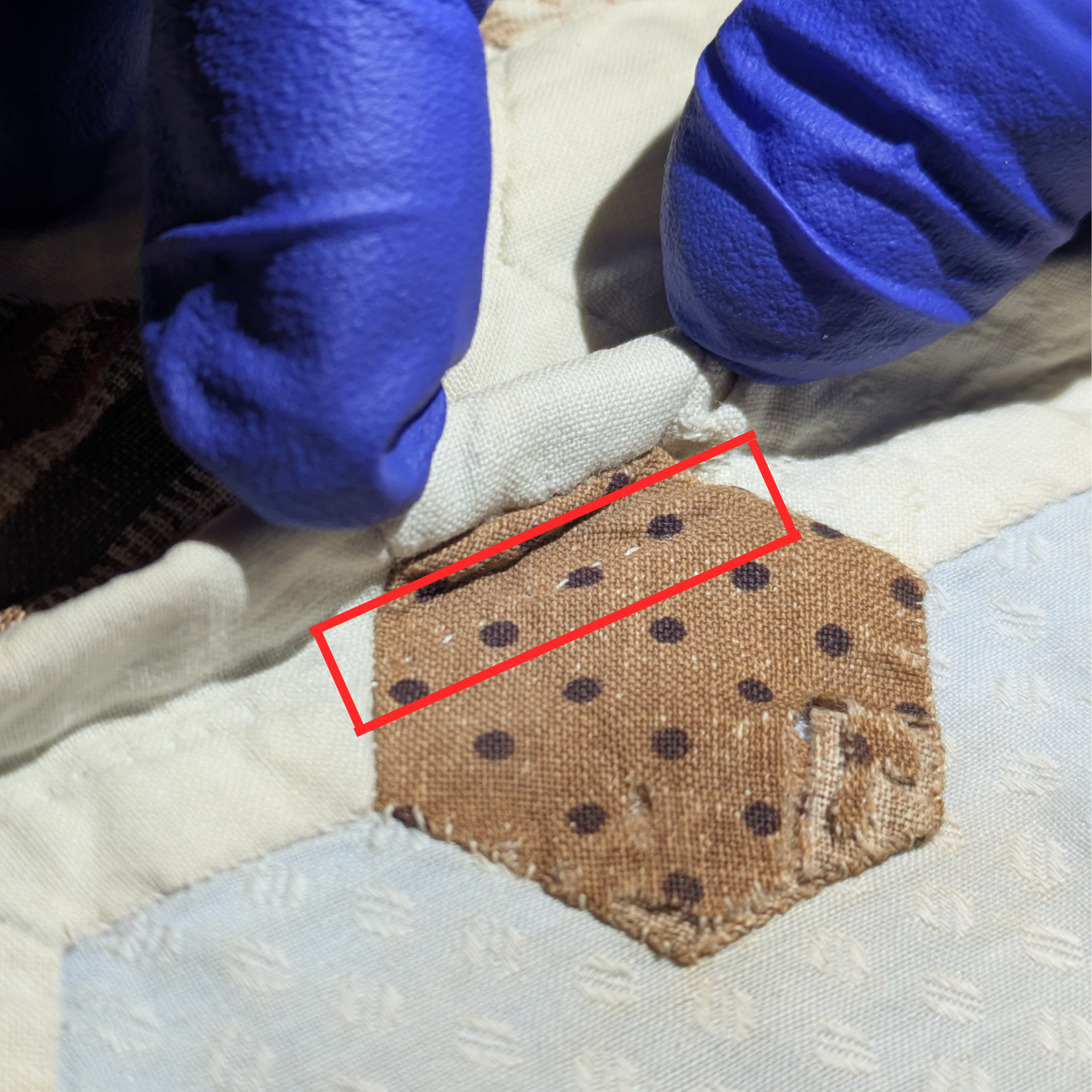
At left, you can see the addition of a 1930s fabric, with its pastel color scheme, appliqued atop the original deep brown fabric. At right, the highlighted section reveals the tidy running stitch that connects the top to the backing in order to hold it in place so the repair seamstress could maintain a consistent border while finishing the quilt.
The note that came with the quilt also acknowledges the care poured into the piece by later generations of women. Fabric thins and seams fray, so in the 1930s another set of hands came to bear, appliquing new hexagons atop the most threadbare sections. You can notice areas where fabrics have the coloring and pattern schemes of the 1930s, visually telling us where these repairs have been done. A new, pale blue border was also added at this time. Looking closely at the material evidence, it seems likely that this later seamstress first began by whip stitching the binding to the backing before turning to the front and putting a running stitch along the outside edge of the top to maintain a sharp, consistent 1” border. Finally, she whip stitched along the quilt top’s full outer perimeter to affix the top firmly in place.
Like most of women’s history, we’re left with a lot of silences — Who invested this time and skill in originally quilting this piece? What did they think about during the long hours? Did they sense the historical significance it would come to carry? But we’re also left with a lot of answers — we know the size and weight of the blanket, the labor that was poured into it, the decisions that were made that brought it to sit quietly and safely now in a secure library vault, nestled in an archival quality box, loved and cherished by a whole new generation of students. This beautiful, unwieldy quilt reminds us that women’s history is as much about the unknowns as the knowns, honoring the many hands that often labored without documentation, and to celebrate everything that has made its way down to us all the same.