
Welcome to the very first edition of “A Day in the Life at The Clements Library!” Today, we meet with Jayne Ptolemy, Associate Curator of Manuscripts.
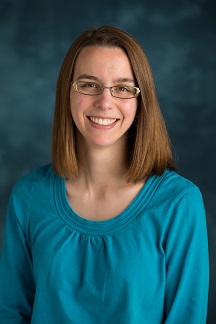
Tell me about your background and how you got to your current position.
I graduated from Albion College with a Bachelor’s degree in History and a concentration in Ethnic Studies. From there, I received my PhD in African American Studies and History from Yale and decided to move back to Michigan to be near my husband’s family. Progress is never linear, and I went on a winding road to get where I am today. In 2013, I applied for a Reading Room supervisor position that was posted at the Clements Library. When I didn’t hear back, I started volunteering for the library instead. Brian Leigh Dunnigan, former Associate Director and Curator of Maps, commented on my last name and showed me the library’s copies of Ptolemy atlases. He noted the supervisor role hadn’t been filled and asked if I wanted to interview for the role. I was fortunate enough to be hired, and I worked full time in reference where I was paging, reshelving, and staffing the reading room. My heart has always been with handwritten materials, and in my free time I was always working with manuscripts. When the opportunity arose, I was able to advance into my current role! So I joke that really, I owe it all to my last name, and I always say a word of thanks whenever I pass those Ptolemy atlases.
What draws you to manuscripts?
There is a real power to reading somebody’s unpolished words. It’s not a published book that an editor has gone through; it may even be something that the author didn’t expect or want someone else to read in the first place. You can read someone’s stories and thoughts in a really authentic way, and it demands extra care and empathy as a result.
I also love that by reading a certain person’s manuscripts enough, you get to know their handwriting. In processing the papers of Civil War surgeon George Stevens, I became very familiar with his handwriting, and I was struck when one of his letters was drastically different from what I had been used to. He described that his hands were shaking from exhaustion as he had performed so many amputations following a heavy battle. It was a humbling reminder that these handwritten documents are all telling deeply intimate histories.
What is your favorite period of history to study?
I previously was really drawn to studying the Early Republic, but recently I’ve been more pulled to the 1830s-50s. I’m finding that there is a lot of personality, choice, and options that are blooming during this time, as well as many social reform movements that are taking place. It gives texture to the archival life that I find intriguing. Even things that I didn’t find initially interesting, like an account book, have grown to capture my imagination as I continue to learn how to read them. It’s truly a matter of looking closely and following the trails they have left. There are stories in all of the items, it’s about learning how to find them and share them.
I have also been pulled toward women’s history, especially after becoming a mother. I began looking for myself in the archives in a different way, and I was able to see them differently based on my own experiences. I make no claim to direct parallels, but the personal resonances I was feeling helped me make connections and become more curious about these sources and the people creating them.
What is at the heart of your job?
Everyday at the Clements is different and comes with a fair share of surprises! At its heart, I collaborate with my colleagues to connect people with the materials in our collections. I work with Maggie Vanderford, the Librarian for Instruction and Engagement, to make manuscripts feel approachable to students attending class sessions. I also meet with students and fellows to talk about their work and provide recommendations to help guide their research. This always requires listening and trying to make connections between the materials and their interests. Behind the scenes, processing and describing items, writing finding aids, and making the collections searchable is another vital step to bring people and collections together.
What have been your favorite and most rewarding manuscripts to have at the Clements?
In my processing work, I got to describe a hand-sewn fish that two girls exchanged in a moment of levity and friendship. It was something that wasn’t intended to be saved, but the fact that it was shows how much it meant to the recipient. It felt so tender and unexpected. Recently, I’ve been enjoying handmade collaged dollhouses from the late nineteenth century. People repurposed bound volumes and pasted in clipped images of furniture and household goods to compose imaginary domestic scenes. They are so grounded in the material culture of that era, and it’s open-ended enough that you can glory in all the possibilities. We often don’t know who made these items, which makes it all the more interesting to wonder about who they were and how they played.
I was also fortunate enough to collaborate with a donor, Pat Martin, a vibrant woman in her 90s who was working with her children to make plans for how they wanted to handle their family’s papers. She had saved all of the letters her husband wrote to her during WWII. In one of the photograph albums she donated, she had carefully captioned the photos but simply marked all of the photos of herself with question marks. Being able to ask her why felt incredibly powerful, because I rarely get the chance to ask clarifying questions about the wonderful but puzzling things we encounter in the library. Connecting with the person who created the collection was such a special experience.
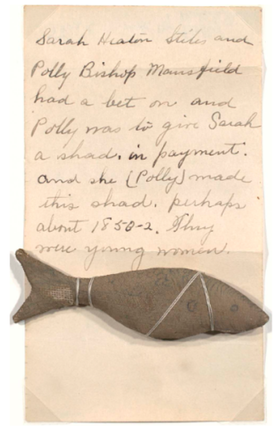
The note accompanying the shad, written at a later date, reads, “Sarah Heaton Stiles and Polly Bishop Mansfield had a bet on and Polly was to give Sarah a shad, in payment. And she (Polly) made this shad, perhaps about 1850–2. They were young women.” Polly C. Bishop Mansfield collection, [ca. 1850s].
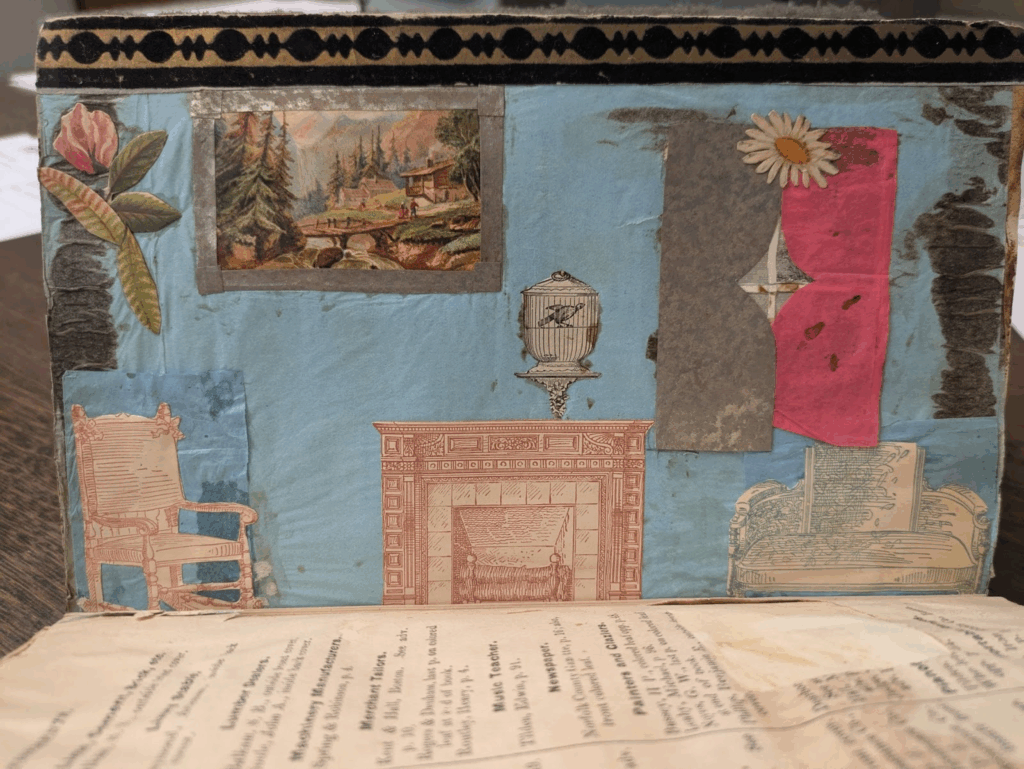
Using a copy of The Hyde Park Register and Business Directory of 1879 as a scrapbook, an unknown individual repurposed the images of furniture, appliances, and decorations to create scenes within ones own home.
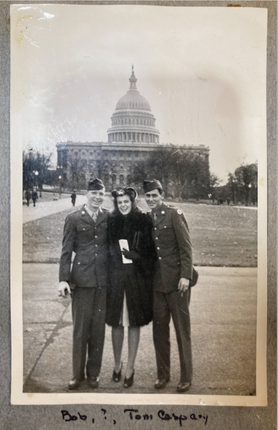
Image of Bob, Pat, and Tony Caspary, pictured in front of the Capitol Building where she indicates herself with a question mark. Robert S. Martin collection, 1923-2009.
Why is it important to humanize the people we have in our collections?
There are lots of reasons, but one of my main motivating reasons is to nudge people away from the feeling that history is boring or irrelevant to them. How does connecting to the story help you to not dismiss the past and instead be open to exploring and understanding it, as well as your own historical agency? If we can make the past come alive in a way that makes people want to care about and study it, we’re doing a service to ourselves in the present as well.
Final Thoughts:
If twenty years ago I had known how amazing this type of work was, I likely would have gone directly into graduate school for library science. But while I was in college it wasn’t on my radar, and my path took me in other directions. I’m grateful for those detours, because it all led me here… eventually. I’m especially grateful that my initial entry into the world of librarianship was through reference, because it has forever grounded me in the importance of connecting people with the materials, which has been a throughline for everything I have done since.